
(7% discount is applied at checkout)
Cart is empty
Your go-to destination for cutting-edge server products
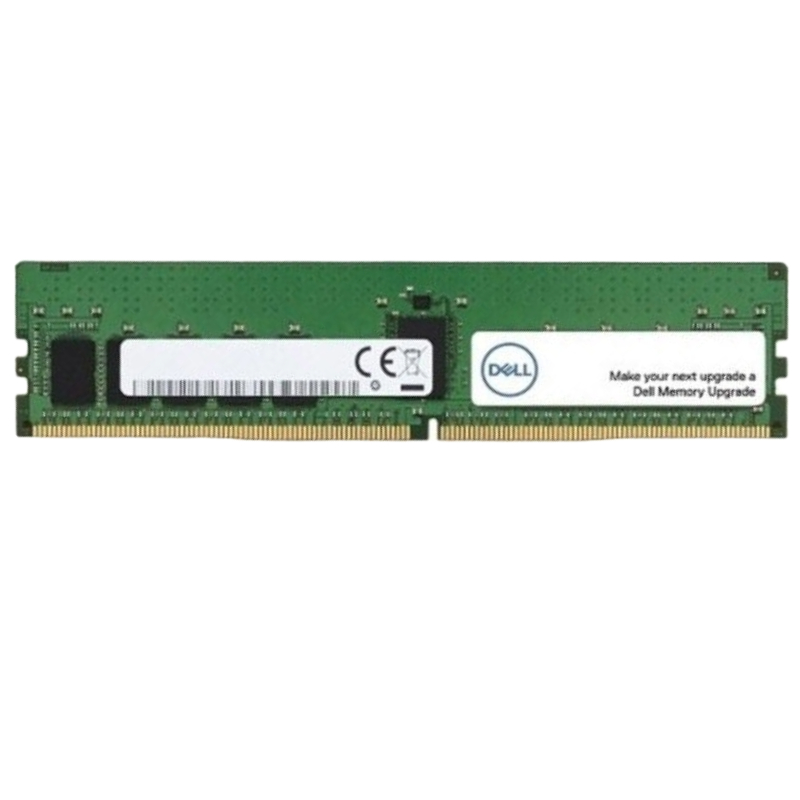
Dell 370-BBQS 16GB Memory DDR5 4800MHz Pc5-38400 ECC SDRAM 288-pin Rdimm for Server. New (System) Pull with 1 year replacement warranty - Samsung Version
| SKU/MPN | Warranty | Price | Condition | You save |
|---|---|---|---|---|
| 370-BBQS | 1 Year Warranty | $720.00 | New (System) Pull | You save: $252.00 (26%) |
| 370-BBQS | 1 Year Warranty | $1,056.00 | New Sealed in Box (NIB) | You save: $369.60 (26%) |
Server memory represents a critical component in data center infrastructure, demanding higher levels of reliability, performance, and stability compared to standard desktop memory. The Dell 370-BBQS is a specific memory module engineered explicitly for server environments where continuous operation and data integrity are paramount. This module belongs to the latest generation of memory technology, DDR5, which offers significant advancements over its DDR4 predecessor.
A memory module is a printed circuit board containing Dynamic Random-Access Memory (DRAM) integrated circuits. These modules are designed for installation into a computer's memory slots. In servers, these modules work in concert to provide the volatile memory that the central processing unit (CPU) uses to store actively running applications and data for quick access.
Server memory is distinct from consumer-grade memory in several key aspects. It typically incorporates features like Error Correcting Code (ECC) and Registered (Buffered) design to enhance data integrity and support higher memory capacities. These features are non-negotiable in environments where a single bit error could lead to system instability, data corruption, or application failure.
The Dell 370-BBQS is defined by a precise set of technical parameters that determine its compatibility and performance within a server system. Understanding these specifications is crucial for making an informed procurement and installation decision.
The module features a total capacity of 16 Gigabytes (GB). This capacity is achieved using a single 16GB DRAM component configuration. The "1x16GB" designation indicates that this is a single module, not a kit. For servers requiring higher total memory, multiple modules of this type would be installed across the available memory slots on the server motherboard.
The "1Rx8" or "1 Rank x8" specification describes the internal organization of the DRAM chips on the module. A "rank" is a set of DRAM chips that work together to respond to a memory access command from the memory controller. A single-rank module has one set of these chips. The "x8" refers to the physical bit width of each individual DRAM chip, indicating it has 8 data I/O pins. This organization impacts the memory controller's ability to access different ranks simultaneously and can influence overall system performance in multi-slot configurations.
DDR5 SDRAM (Double Data Rate 5 Synchronous Dynamic Random-Access Memory) is the fifth generation of DDR memory technology. It represents a substantial leap forward from DDR4, offering higher data rates, improved power efficiency, and greater memory densities.
The Dell 370-BBQS operates at a data rate of 4800 Megatransfers per second (MT/s). A "transfer" is equivalent to two data operations (one on the rising clock edge and one on the falling clock edge), which is the "double data rate" characteristic. This 4800MT/s speed is a base speed for DDR5, providing a significant bandwidth increase over standard DDR4 modules, which commonly top out at 3200MT/s. This higher speed allows for faster data movement between the CPU and memory, reducing bottlenecks in memory-intensive applications.
The "PC5-38400" is the module's classification under the JEDEC standard. The "PC5" denotes a DDR5 module. The number "38400" refers to the peak theoretical bandwidth in megabytes per second (MB/s) that the module can deliver. This is calculated as follows: 4800 MT/s * 8 bytes (64-bit data bus) = 38,400 MB/s. This bandwidth is a key indicator of the module's performance potential.
CAS Latency (CL), often just called latency, is the delay time between when the memory controller requests data and when that data is available. It is measured in clock cycles. A CAS Latency of CL40 means there is a 40-clock-cycle delay for this specific module at its 4800MT/s speed. While higher-speed memory often comes with higher latency numbers, the overall performance (latency in nanoseconds) can still be better due to the significantly faster clock speeds of DDR5.
This module is equipped with two critical features that define its role as a server-grade component: ECC and Registered design.
The Dell 370-BBQS is a Registered DIMM (RDIMM). Registered memory includes a register, or buffer, placed between the memory controller and the DRAM chips. This buffer handles the electrical load of the command and address signals, reducing the strain on the memory controller.
The primary benefit of using RDIMMs is stability and capacity. By buffering the signals, the memory controller can support a greater number of memory modules per channel and higher total memory capacities within a system. This makes RDIMMs the standard for servers that require large amounts of RAM. The trade-off is a slight increase in latency (typically one clock cycle) due to the buffering process, but this is considered an acceptable trade-off for the significant gains in system stability and maximum memory support.
This module uses a 288-pin layout, which is the standard physical interface for DDR5 memory modules. The pin count and keying are different from the 288-pin design of DDR4 modules, preventing accidental insertion into an incompatible motherboard slot.
DDR5 memory operates at a lower voltage than previous generations. The Dell 370-BBQS requires a nominal operating voltage of 1.1 volts. This reduction in voltage contributes to lower power consumption and reduced heat generation, which is a critical factor in dense server configurations where thermal management is a constant challenge.
Proper compatibility is the most critical aspect of selecting server memory. Using an incompatible module can lead to system failure, boot issues, or degraded performance.
The Dell 370-BBQS part number is an authentic Dell component, engineered, tested, and validated for use in specific generations of Dell PowerEdge servers. It is crucial to consult the official Dell documentation, such as the Owner's Manual or Technical Guide for the specific server model (e.g., certain PowerEdge 14th generation or newer systems designed for DDR5 memory), to confirm compatibility.
This memory module is suited for a wide range of server-based applications that benefit from high reliability and performance.
In virtualized infrastructures (e.g., using VMware vSphere, Microsoft Hyper-V, or Proxmox), physical memory is a shared resource among multiple virtual machines. The high capacity, reliability (ECC), and stability (Registered) of the Dell 370-BBQS make it an excellent choice for hosting numerous VMs, ensuring that memory errors do not cascade and affect multiple workloads.
Database management systems like Microsoft SQL Server, Oracle Database, and MySQL frequently cache large datasets in memory to accelerate query performance. The 16GB capacity contributes to a large total memory pool, while ECC is essential for protecting the integrity of the cached data and transaction logs.
Workloads involving scientific simulations, financial modeling, and big data analytics process massive datasets. The high bandwidth of DDR5-4800 memory helps to feed data to the CPU cores more quickly, reducing computation time. ECC is critical in these scenarios to ensure the accuracy of the final results.
The transition from DDR4 to DDR5 is a major architectural shift. Key differences include higher base data rates (4800MT/s for DDR5 vs. 2133/2400/3200MT/s for DDR4), lower operating voltage (1.1V vs. 1.2V), and a redesigned architecture that places the power management integrated circuit (PMIC) on the module itself rather than on the motherboard, allowing for more granular power control.
The primary advantage of DDR5 is increased bandwidth. The 4800MT/s speed of this module provides a 50% increase over a common DDR4-3200 RDIMM. This directly translates to faster data access for CPU-bound applications. The lower voltage also contributes to better power efficiency, a key metric for large-scale data center operations.


 Contact Us
 Information
 Catalog
 Solid State Drives (SSD)
 Network Switches
 Hard Disk Drives
 HBA & Controllers
 PC & Servers
 PC & Server Memory
 CPU & Processors
 Network Routers
 Power Supplies
 Tape Drives & Libraries
 Network Devices
 Computer & Network Cables