
(7% discount is applied at checkout)
Cart is empty
Your go-to destination for cutting-edge server products
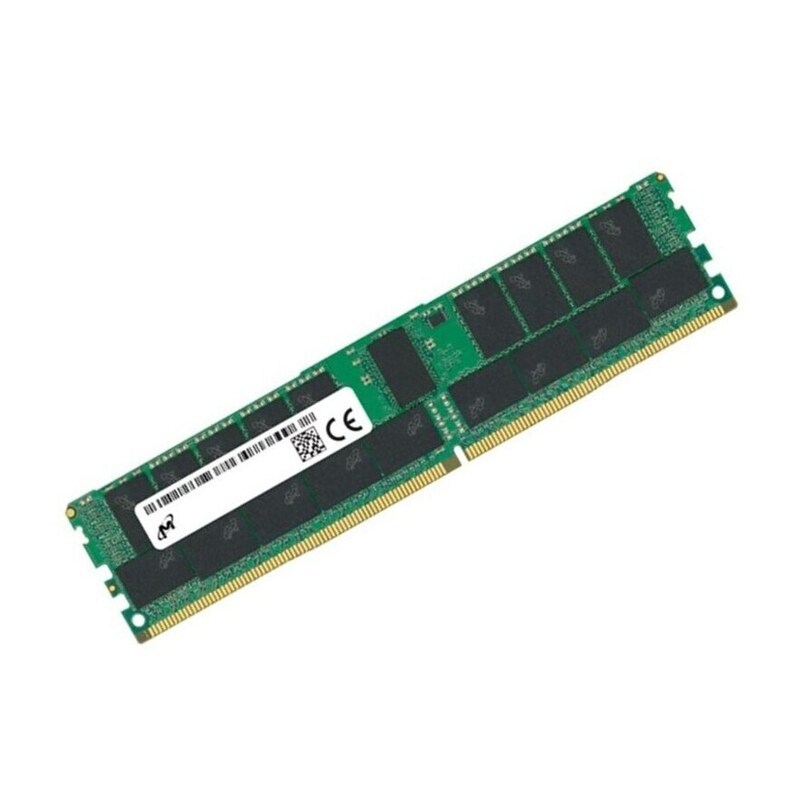
Micron MTA18ASF2G72PDZ-2G3B1 16GB PC4-19200 2400MHZ ECC Registered Dual Rank DDR4 SDRAM 288-Pin Dimm Memory Module. New (System) Pull with 1 year replacement warranty
| SKU/MPN | Warranty | Price | Condition | You save |
|---|---|---|---|---|
| MTA18ASF2G72PDZ-2G3B1 | 1 Year Warranty | $174.00 | New (System) Pull | You save: $60.90 (26%) |
| MTA18ASF2G72PDZ-2G3B1 | 1 Year Warranty | $450.00 | New Sealed in Box (NIB) | You save: $157.50 (26%) |
The Micron MTA18ASF2G72PDZ-2G3B1 represents a specific and crucial category of server memory: ECC Registered DDR4 SDRAM. Designed for enterprise-grade stability and data integrity, this 16GB module is engineered for single-slot population in servers and workstations, offering a balance of capacity, performance, and reliability. This memory category is defined by its adherence to strict JEDEC standards, its error-correcting architecture, and its compatibility with systems demanding unwavering operational consistency under continuous load.
The Micron MTA18ASF2G72PDZ-2G3B1 represents a pinnacle of server-grade memory engineering, designed to deliver uncompromising reliability and performance in enterprise environments. This module is a 16GB (1x16GB) DDR4 SDRAM component, operating at a speed of 2400MHz with a PC4-19200 data transfer rate. Its architecture is built to meet the rigorous demands of servers, workstations, and high-availability systems where data integrity and uptime are paramount.
At the heart of this module are Micron's own high-quality, vertically integrated DRAM chips. The "Dual Rank" designation indicates the module's internal organization, where the memory cells are split into two independent sets (ranks) that the memory controller can access alternately. This configuration increases potential performance by allowing for interleaving, which can reduce latency and improve data throughput compared to a single-rank module of the same capacity, especially in memory-intensive applications.
The two most critical features defining this module's server pedigree are ECC (Error-Correcting Code) and Registered design. ECC is a non-negotiable requirement for mission-critical systems. It goes beyond simple parity checking by adding extra bits to detect and, crucially, correct single-bit memory errors on the fly. This proactive correction prevents silent data corruption, system crashes, and computational errors that could lead to significant downtime or corrupted databases.
The "Registered" aspect, facilitated by a register (or RCD - Register Clock Driver) on the module, acts as an intermediary between the system's memory controller and the DRAM chips. It buffers the command and address signals, reducing the electrical load on the controller. This allows a server motherboard to support a much larger number of memory modules (and thus higher total capacity) without overburdening the controller, enhancing signal integrity and system stability at the cost of a minimal one-clock-cycle latency increase.
The module's timing is specified as CL17 (CAS Latency 17). CAS Latency is the number of clock cycles between the memory controller requesting data and the first piece of data being available. At 2400MHz, this CL17 timing offers a balanced performance profile for server workloads, which prioritize stability and bandwidth over ultra-tight latencies. The PC4-19200 designation confirms the peak theoretical bandwidth of 19,200 MB/s (19.2 GB/s) per module.
Correct compatibility is essential for server memory. The Micron MTA18ASF2G72PDZ-2G3B1 is not a consumer desktop module and will not function in standard PC motherboards. Its design is strictly for systems that require Registered (RDIMM) memory with ECC support.
This memory module is engineered for compatibility with a wide range of enterprise server platforms from major OEMs like Dell (PowerEdge), HPE (ProLiant), Lenovo (ThinkSystem), Cisco (UCS), and Supermicro. It is also fully compatible with Intel Xeon Scalable processors (e.g., Skylake, Cascade Lake, and compatible generations) and AMD EPYC platforms that support DDR4 RDIMMs. Always verify the specific memory QVL (Qualified Vendor List) of your server model to ensure validated operation.
In server environments, strict adherence to the manufacturer's population guidelines is required. For optimal performance, modules should be installed in matching pairs or sets per channel, following the server's manual for preferred slot population order. While mixing modules of different sizes, speeds, or ranks is often possible, it can force the system to run all memory at the speed and timings of the slowest module and may disable advanced multi-channel modes, impacting overall system bandwidth.
The reliability features of this Micron module make it ideal for applications where system failure is not an option. Primary deployment scenarios include virtualization hosts (VMware vSphere, Microsoft Hyper-V), database servers (SQL, Oracle), enterprise resource planning (ERP) systems, cloud infrastructure, and high-performance computing (HPC) clusters. In these environments, the combination of high capacity, ECC protection, and registered stability ensures data accuracy and sustained operation under heavy, continuous loads.
The MTA18ASF2G72PDZ-2G3B1 is constructed on a standard 288-pin DIMM (Dual In-line Memory Module) printed circuit board (PCB). The physical build quality reflects Micron's industrial manufacturing standards, with precision soldering, a robust PCB, and clearly labeled components.
The module utilizes a server-grade PCB with optimized trace routing to ensure clean signal transmission at high speeds. The DRAM chips and the essential Register Clock Driver (RCD) are symmetrically placed and securely attached. The use of a 1Rx4 or 2Rx4 chip organization (inherent to the dual-rank design) is a key factor in its compatibility and electrical characteristics.
While this specific module may ship as a standard DIMM without an attached heatsink, server environments typically rely on strong, directed airflow from system fans across the memory banks to dissipate heat. In high-ambient temperature or dense configurations, some servers may utilize vendor-specific heatsinks or air baffles to ensure modules operate within their specified thermal range (typically 0°C to 85°C TCASE). Maintaining proper cooling is vital for long-term reliability and preventing thermal throttling.
Micron's part number, MTA18ASF2G72PDZ-2G3B1, is a coded description of the module's attributes. Breaking it down: "MT" is Micron Technology; "A" is the product family; "18A" denotes the component; "SF" signifies a DDR4 Registered module with ECC; "2G72" indicates a 2Gbit die density and 72-bit width (64 data + 8 ECC); "P" is the revision; "DZ" is the package type; "2G3" confirms 2400MHz speed; "B1" refers to specific timing and engineering revisions. This precise labeling allows for accurate identification and sourcing.
Choosing a module from Micron, one of the world's largest DRAM producers, offers significant advantages over generic or white-label memory. Micron controls the entire production process from silicon wafer fabrication to module assembly, ensuring vertical integration and quality control at every step.
Micron stands behind its server memory with rigorous testing and validation. Modules undergo extensive stress testing under various thermal and electrical conditions before leaving the factory. This results in a lower FIT (Failures in Time) rate and a higher MTBF (Mean Time Between Failures). Furthermore, sourcing genuine Micron memory often provides access to technical support and clear warranty terms, which is crucial for enterprise procurement and maintenance cycles.
Using first-party Micron memory mitigates supply chain risks, guaranteeing that the DRAM chips and firmware on the SPD (Serial Presence Detect) chip are authentic and designed to work together. The SPD chip contains all the module's timing and configuration data, which the server's BIOS/UEFI reads automatically. Micron ensures this data is accurately programmed and compliant with JEDEC standards and often includes extra profiles for enhanced compatibility with major server platforms.
Within the broad spectrum of DDR4 memory, the MTA18ASF2G72PDZ-2G3B1 occupies a specific and crucial tier. Understanding its position helps in making an informed selection for a server upgrade or new build.
This module is a Registered DIMM (RDIMM). In contrast, Unbuffered DIMMs (UDIMMs) lack a register and are common in desktops; they offer lower latency but support far fewer modules per channel. Load Reduced DIMMs (LRDIMMs) use a more advanced buffer (iRCD) to further reduce electrical load, enabling the highest capacity modules (e.g., 64GB, 128GB) but at a higher cost and latency. The Micron 16GB RDIMM sits in the optimal middle ground, offering excellent capacity scaling for most mainstream two-socket and four-socket servers with a balance of cost, performance, and power.
At 2400MHz, this module operates at a foundational speed for DDR4 server platforms. Newer platforms support higher speeds like 2666MHz, 2933MHz, or 3200MHz. However, higher-speed modules often come with a price premium and may only achieve their rated speed in limited population configurations or with specific CPU generations. The 2400MHz speed provides broad compatibility across multiple generations of Intel Xeon and AMD EPYC processors, making it a versatile and often cost-effective choice for deployments where ultimate bandwidth is less critical than reliability and total capacity.
The dual-rank design of this 16GB module generally offers a performance advantage over a single-rank 16GB module in many server workloads. Because the memory controller can switch between the two ranks, it can hide latency and improve bus utilization. In many server benchmarks, a system populated with dual-rank modules will demonstrate higher memory bandwidth and better performance in memory-sensitive applications than the same system populated with single-rank modules of the same total capacity and speed.


 Contact Us
 Information
 Catalog
 Solid State Drives (SSD)
 Network Switches
 Hard Disk Drives
 HBA & Controllers
 PC & Servers
 PC & Server Memory
 CPU & Processors
 Network Routers
 Power Supplies
 Tape Drives & Libraries
 Network Devices
 Computer & Network Cables