
(7% discount is applied at checkout)
Cart is empty
Your go-to destination for cutting-edge server products
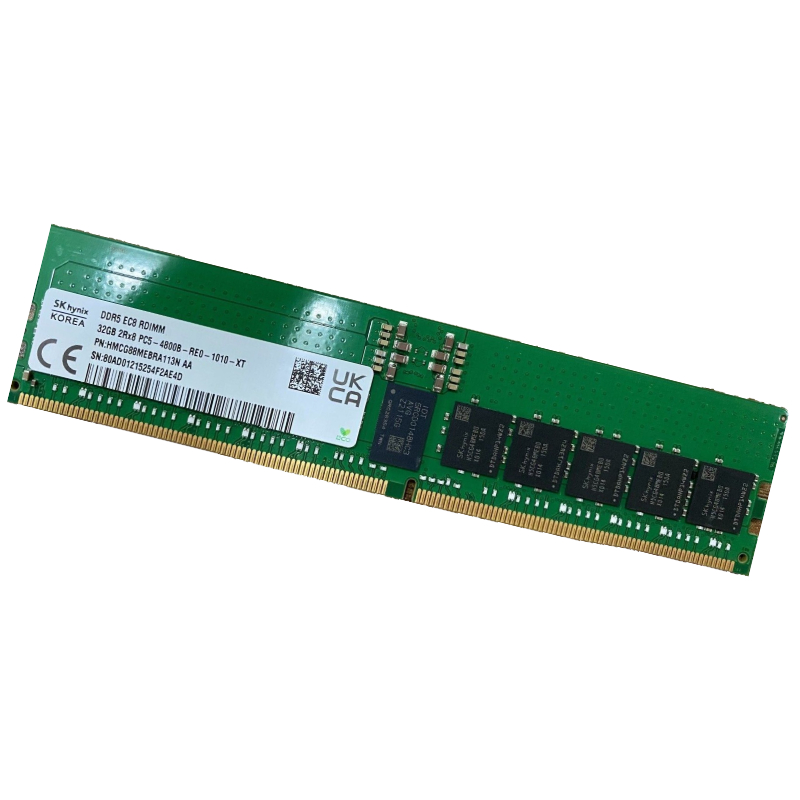
Hynix HMCG88AEBRA113N 32GB DDR5 Dual Rank Memory Module PC5-38400. New Sealed in Box (NIB) with 3 Year Warranty
The Hynix HMCG88AEBRA113N 32GB DDR5 dual-rank module delivers next-generation memory performance designed for enterprise-level workloads, advanced computing systems, and high-demand data processing tasks.
The Hynix HMCG88AEBRA113N represents a significant leap forward in memory technology, embodying the cutting-edge specifications of the DDR5 standard. This 32GB module, operating at a data rate of PC5-38400 (4800 MT/s), is engineered for next-generation computing platforms demanding high bandwidth, exceptional stability, and improved power efficiency. As servers, high-end workstations, and premium desktop systems evolve, this dual-rank module provides the foundational performance required for data-intensive applications, from complex scientific simulations and AI model training to massive virtualized environments and high-frequency trading.
Manufactured by SK hynix, a world leader in semiconductor innovation, this module leverages proprietary chip designs and rigorous validation processes. Its part number, HMCG88AEBRA113N, encodes key specifications: the 'HMC' prefix indicates a registered ECC module, 'G88' relates to the component density and organization, 'A' signifies a specific revision, 'EBRA' denotes the substrate and packaging, and '113N' confirms the timing parameters and speed bin. This meticulous coding reflects the precision engineering inherent in every module.
At its heart, the HMCG88AEBRA113N is built to the JEDEC standard for DDR5-4800, ensuring broad compatibility and reliable operation within its specified parameters. Its architecture incorporates fundamental shifts from the previous DDR4 generation, delivering not just higher speeds but a redesigned approach to data integrity and system management.
The module's PC5-38400 designation translates to a peak theoretical bandwidth of approximately 38.4 GB/s per module. This is calculated from the 4800 Megatransfers per second (MT/s) across a 64-bit data bus. However, DDR5's burst length is doubled to 16, enhancing efficiency in data transfer cycles. For the Hynix HMCG88AEBRA113N, typical first-word latency at 4800 MT/s is significantly reduced compared to DDR4-3200 equivalents, despite potentially higher CAS latency numbers, due to the faster base clock cycle time.
This module typically operates at JEDEC-standard timings such as CL40-39-39-76. The primary timing, CAS Latency (CL), is 40 clock cycles. However, because the DDR5 clock frequency is higher, the actual time in nanoseconds is calculated as (CL / Transfer Rate per second) * 2. For CL40 at 4800 MT/s, the real-world latency is roughly 16.67 nanoseconds. The other timings—tRCD (RAS to CAS Delay), tRP (RAS Precharge), and tRAS (Active to Precharge)—are equally optimized for the underlying silicon's capabilities, ensuring stable operation at the advertised speed.
Being a dual-rank (DR) module, the HMCG88AEBRA113N organizes its memory chips into two independent sets that share the same data path. This architecture allows the memory controller to interleave accesses between the two ranks, hiding precharge and activation delays and thereby increasing effective bandwidth and improving overall system responsiveness under multi-threaded workloads. Compared to single-rank modules, dual-rank configurations often provide a tangible performance uplift in server and workstation applications where continuous, saturated memory access is common, making this 32GB DR module a preferred choice for balancing capacity and performance.
This Hynix module is not merely a faster DDR4; it incorporates intrinsic DDR5 architectural changes that redefine memory subsystem operation.
A pivotal feature of DDR5 is the inclusion of On-Die ECC. Each DRAM chip on the HMCG88AEBRA113N contains its own simple error correction circuitry. This addresses bit errors that occur *within* the chip itself, correcting single-bit errors on the fly before data is sent to the system's main ECC (for ECC modules) or to the CPU. This enhances data reliability at the component level, reduces silent data corruption risks, and improves manufacturing yield for high-density chips, contributing to the module's overall stability and longevity.
The DDR5 standard splits the 64-bit data channel into two independent 32-bit sub-channels. The Hynix HMCG88AEBRA113N implements this, allowing the memory controller to address each sub-channel separately. This increases command efficiency and reduces access contention. Coupled with a Burst Length of 16 (BL16), which doubles the amount of data sent per column access command, the module achieves higher effective bandwidth for sequential data access patterns, benefiting large file operations and streaming data.
One of the most significant physical changes in DDR5 is the migration of voltage regulation from the motherboard to the module itself via an onboard PMIC. The HMCG88AEBRA113N includes this dedicated chip. It provides superior power delivery, cleaner voltage signals (VDD and VDDQ), improved power efficiency, and greater potential for fine-grained power management. This localized regulation reduces noise and signal integrity challenges, which is crucial for maintaining stability at high data rates like 4800 MT/s, especially in densely populated memory configurations.
The Hynix HMCG88AEBRA113N is engineered for professional and enterprise-grade environments where reliability, capacity, and consistent performance are non-negotiable.
In server platforms supporting DDR5 RDIMMs (Registered Dual In-Line Memory Modules), this 32GB module is a building block for high-capacity configurations. Its registered (buffered) design reduces electrical load on the memory controller, allowing the population of more modules per channel—critical for servers needing 512GB, 1TB, or more of total RAM. Applications include in-memory databases (e.g., SAP HANA), virtualization hosts running dozens of VMs, and big data analytics frameworks that cache massive datasets in RAM.
For hypervisors like VMware ESXi, Microsoft Hyper-V, or KVM, physical memory is a primary resource constraint. The high density (32GB) and reliability features (On-Die ECC plus standard ECC) of the HMCG88AEBRA113N allow data center operators to maximize virtual machine density per server chassis. The dual-rank design ensures predictable performance across consolidated workloads, from web servers and application hosts to GPU-passthrough workstations, all running concurrently on a single physical host.
Professional workstations for CAD/CAM, 3D animation, scientific computing, and 4K/8K video editing benefit immensely from large, fast memory pools. When used in a multi-channel configuration (e.g., quad-channel or octal-channel platforms), a set of Hynix HMCG88AEBRA113N modules provides the sustained bandwidth needed to feed high-core-count CPUs like Intel Xeon Scalable or AMD EPYC processors. This prevents bottlenecks when manipulating gigantic models, rendering complex scenes, or processing high-resolution time-series data.
To achieve optimal memory bandwidth, modules must be installed in correct populations per the system's memory channel architecture. For an 8-channel platform (like AMD EPYC), best performance is typically achieved by populating all channels evenly. For a dual-processor (2P) server, refer to the system manual for the exact DIMM slot population order (often starting with slots for Channel A on each CPU). Using identical modules (same part number, rank, and speed) across all populated slots is strongly recommended. The onboard PMIC aids in signal integrity, but proper population is key to achieving the full 4800 MT/s data rate.
The Hynix HMCG88AEBRA113N provides two layers of error correction: On-Die ECC (internal to each DRAM chip) and Standard ECC (handled by the system's memory controller using an extra 8-bit chip on the module per 64-bit data word). This combination corrects single-bit errors and detects multi-bit errors, providing robust protection for critical data. This is essential for financial computations, archival storage systems, and any application where data corruption is unacceptable. Note that ECC functionality requires support from both the CPU and the system BIOS.


 Contact Us
 Information
 Catalog
 Solid State Drives (SSD)
 Network Switches
 Hard Disk Drives
 HBA & Controllers
 PC & Servers
 PC & Server Memory
 CPU & Processors
 Network Routers
 Power Supplies
 Tape Drives & Libraries
 Network Devices
 Computer & Network Cables