
(7% discount is applied at checkout)
Cart is empty
Your go-to destination for cutting-edge server products
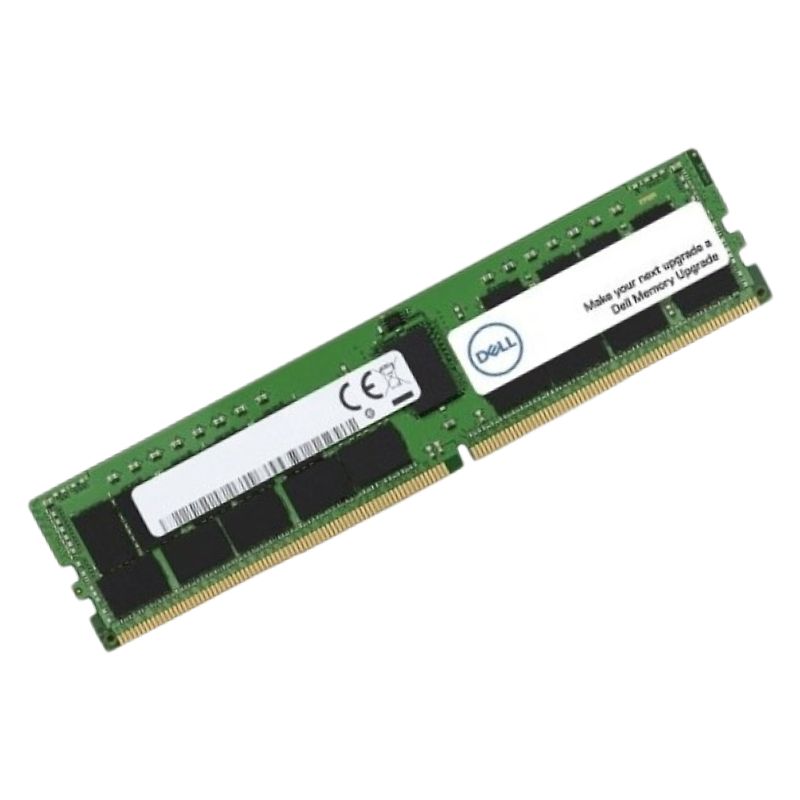
Dell 370-BCMJ 128GB DDR5 5600MHz PC5-44800 ECC Registered 1.1v Cl46 Memory Module. New Sealed in Box (NIB) - Samsung Version
The Dell 370-BCMJ 128GB DDR5 5600MHz PC5-44800 ECC Registered Memory Module is a high-performance RAM designed for enterprise-level servers. With advanced DDR5 SDRAM technology and exceptional data integrity, this module ensures efficient multitasking and smooth operation in demanding environments.
This Dell 128GB DDR5 5600MHz ECC Registered Memory Module is fully compatible with a wide range of Dell PowerEdge servers, ensuring optimal performance and reliability.
In the demanding landscape of modern data centers, cloud computing, and enterprise resource planning, memory is not just a component—it's the lifeblood of your server's performance. The Dell 370-BCMJ 128GB DDR5-5600MHz PC5-44800 ECC Registered memory module is engineered to meet these extreme demands. This specific module represents a significant leap forward in server memory technology, offering unparalleled capacity, blistering speed, and mission-critical reliability. Designed explicitly for compatibility with Dell PowerEdge servers and other select systems, this memory ensures that your infrastructure can handle intensive workloads like virtualization, in-memory databases, high-performance computing (HPC), and large-scale analytics without becoming a bottleneck. Investing in this memory means investing in the stability, scalability, and efficiency of your entire IT operation.
To fully appreciate the capabilities of the Dell 370-BCMJ module, it's essential to break down its key technical specifications. Each number and acronym tells a story of advanced engineering designed for enterprise-grade performance and data integrity.
The sheer 128GB capacity of this module is a game-changer for memory-intensive applications. In a multi-socket server platform, populating all channels with these modules allows for terabyte-scale memory configurations without sacrificing performance. This massive capacity directly translates to the ability to run more virtual machines concurrently, host larger databases in RAM for instant access, and process immense datasets without constant disk I/O, dramatically accelerating compute times and user responsiveness.
Operating at a raw clock speed of 5600 million transfers per second (MT/s), this module belongs to the cutting-edge DDR5 generation. The "PC5-44800" designation refers to the peak transfer rate of 44,800 MB/s (or approximately 44.8 GB/s) per module. This is a substantial increase over previous DDR4 standards. This high bandwidth is crucial for feeding data-hungry CPUs, ensuring that processors are kept busy with data instead of waiting for instructions, which maximizes the efficiency and throughput of your entire server.
When compared to a common DDR4-3200 (PC4-25600) module, the Dell 370-BCMJ offers a ~75% increase in theoretical bandwidth. This generational leap is achieved not only through higher clock speeds but also through architectural improvements within the DDR5 standard itself.
For any business-critical application, data integrity and system stability are non-negotiable. The Dell 370-BCMJ incorporates two essential technologies to ensure this:
ECC memory is a fundamental requirement for servers. It can detect and correct the most common types of internal data corruption, known as single-bit errors. In environments where a single bit-flip could corrupt a financial transaction, crash a critical database, or produce erroneous scientific calculations, ECC acts as an invisible guardian, preventing silent data corruption and ensuring the results you get are the results you expect.
This module is a Registered DIMM (RDIMM). It features a register, or buffer, that sits between the server's memory controller and the DRAM chips. This buffer reduces the electrical load on the memory controller, allowing a single system to support a much larger quantity of high-capacity memory modules stably and reliably. While adding a tiny amount of latency, this trade-off is essential for achieving the massive, multi-terabyte memory configurations that modern enterprises rely on.
The module operates at a low 1.1 volts and has a CAS Latency (CL) of 46. CAS Latency is the number of clock cycles it takes for the memory to deliver a requested column of data. While the raw number is higher than typical DDR4 latencies, it's important to consider it in the context of the much faster DDR5 clock speed. The combination of high speed and optimized timings, all while running at an efficient 1.1v, results in a module that delivers exceptional performance per watt, contributing to lower total power consumption and heat output in the data center.
The specific combination of high capacity, high speed, and ECC reliability makes the Dell 370-BCMJ memory module perfectly suited for a range of demanding enterprise and specialized workloads.
Server virtualization platforms like VMware vSphere, Microsoft Hyper-V, and Proxmox VE are notoriously memory-hungry. Each virtual machine (VM) requires a dedicated allocation of RAM. With 128GB per module, you can host dozens to hundreds of VMs on a single server, leading to higher consolidation ratios, reduced physical server footprint, and lower licensing and power costs. The high bandwidth also ensures that VMs experience minimal performance degradation, even under heavy load.
Applications such as SAP HANA, Oracle Database In-Memory, and Redis thrive when entire datasets reside in RAM. The 128GB capacity of this module is ideal for building these massive in-memory pools. By eliminating slow disk access, query times can be reduced from minutes to milliseconds, enabling real-time business intelligence, lightning-fast transaction processing, and instant data insights that provide a competitive edge.
In HPC clusters used for tasks like genomic sequencing, financial modeling, computational fluid dynamics, and weather simulation, enormous datasets must be loaded into memory for processing. The high bandwidth of DDR5-5600 is critical for quickly moving this data to the CPUs, while the ECC functionality is absolutely essential to ensure the accuracy of long-running, complex calculations that could be invalidated by a single memory error.
Training sophisticated machine learning models requires feeding vast amounts of training data to GPUs and CPUs. While GPUs have their own memory, the CPU and system memory are responsible for data preparation, management, and feeding the GPU pipelines. Ample, fast system RAM, like that provided by the 370-BCMJ, prevents the system memory from becoming a bottleneck, allowing AI workloads to run efficiently and complete faster.
Upgrading to DDR5 technology from DDR4 is not just an incremental improvement; it's a foundational shift that brings several key advantages to server architecture.
DDR5 introduces a new architecture that fundamentally changes how data is handled. Two of the most significant changes are:
Unlike DDR4's single 64-bit data channel, each DDR5 DIMM is split into two independent 32-bit addressable sub-channels. This allows for finer-grained memory access, improving efficiency and overall memory controller performance by handling two concurrent memory access commands more effectively.
DDR5 modules feature a Power Management Integrated Circuit (PMIC) on the DIMM itself. This decentralizes power delivery, moving it from the motherboard to the module. The PMIC provides more stable and cleaner power to the DRAM chips, which is crucial for achieving higher data rates reliably and improving signal integrity, especially in densely populated servers.
In addition to the standard ECC that corrects errors in data transmission, DDR5 DRAM chips often incorporate On-Die ECC. This is a separate, internal error-correction mechanism that handles bit errors within the DRAM chip itself before the data is even sent to the memory bus. This adds an extra layer of data integrity and improves the overall longevity and reliability of the memory chips.
The DDR5 standard is built from the ground up to support the high-density modules that modern servers require. Adopting DDR5 technology like the 370-BCMJ future-proofs your server investment, ensuring it can meet the escalating memory demands of new software and workloads for years to come.


 Contact Us
 Information
 Catalog
 Solid State Drives (SSD)
 Network Switches
 Hard Disk Drives
 HBA & Controllers
 PC & Servers
 PC & Server Memory
 CPU & Processors
 Network Routers
 Power Supplies
 Tape Drives & Libraries
 Network Devices
 Computer & Network Cables