
(7% discount is applied at checkout)
Cart is empty
Your go-to destination for cutting-edge server products
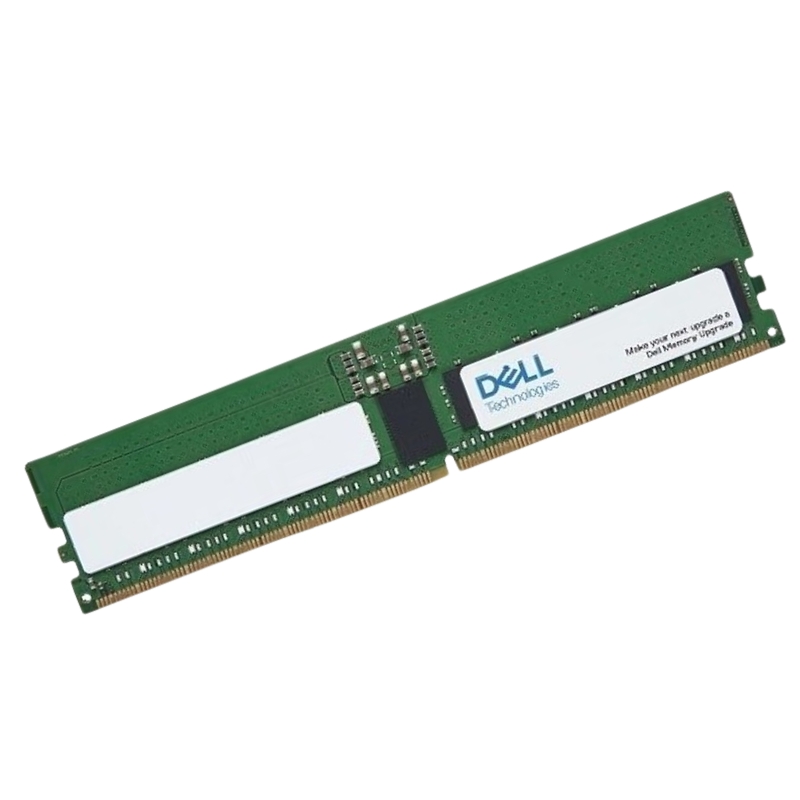
Dell 370-BCRB 64GB DDR5 4800mt/s Pc5-38400 Dual Rank Ecc Registered 1.1v Cl40 SDRAM 288-pin Rdimm Memory Module For Server. New (System) Pull with 1 year replacement warranty - Samsung Version
| SKU/MPN | Warranty | Price | Condition | You save |
|---|---|---|---|---|
| 370-BCRB | 1 Year Warranty | $776.00 | New Sealed in Box (NIB) | You save: $271.60 (26%) |
| 370-BCRB | 1 Year Warranty | $1,309.00 | New Sealed in Box (NIB) | You save: $458.15 (26%) |
Upgrade your server's performance with the Dell 370-BCRB 64GB DDR5 SDRAM memory module. This ECC, registered RDIMM delivers reliable error-correcting protection and enterprise-grade stability at a fast 4800 MT/s (PC5-38400) throughput — an excellent choice for data centers, virtualization hosts, and mission-critical systems.
The Dell 370-BCRB represents the cutting edge of server memory technology, specifically engineered for high-performance computing environments where reliability, capacity, and speed are non-negotiable. This 64GB DDR5 module operates at 4800MT/s (MegaTransfers per second), delivering significant performance improvements over previous DDR4 generations while maintaining the enterprise-grade features that mission-critical applications demand.
DDR5 memory architecture introduces fundamental changes that dramatically improve performance and efficiency compared to DDR4 technology. The Dell 370-BCRB leverages these advancements to provide superior performance in demanding server environments.
The 370-BCRB utilizes DDR5's enhanced bank structure, featuring 8 bank groups with 4 banks each (compared to DDR4's 4 bank groups with 4 banks each). This expanded parallelism allows for more simultaneous memory access operations, significantly reducing latency and improving overall system responsiveness during intensive workloads.
Unlike previous generations, DDR5 incorporates on-die ECC (Error Correcting Code) as a standard feature. This additional layer of error correction operates within the memory chip itself, detecting and correcting bit errors before they can affect system stability. When combined with the module-level ECC, this creates a comprehensive error protection system ideal for data-sensitive applications.
DDR5 doubles the burst length from 8 to 16, enabling the 370-BCRB to transfer more data with each column access. This architectural improvement, combined with the prefetch of 16n, allows for more efficient data movement and reduces the command overhead, resulting in better overall bandwidth utilization.
The Dell 370-BCRB incorporates carefully engineered specifications that define its performance characteristics and compatibility profile. Understanding these technical details is crucial for proper implementation in server environments.
Operating at 4800 MegaTransfers per second, the 370-BCRB delivers approximately 50% higher theoretical bandwidth compared to DDR4-3200 modules. This increased data rate translates to faster application loading, reduced processing bottlenecks, and improved handling of memory-intensive workloads such as virtualization, database operations, and scientific computing.
With a CAS Latency of CL40, this module balances speed with reliability. While higher numerically than DDR4 timings (due to the increased clock speeds), the actual latency in nanoseconds remains competitive. The CL40 timing ensures stable operation while maintaining the performance benefits of DDR5 technology.
The reduced 1.1V operating voltage represents a significant power efficiency improvement over DDR4's 1.2V standard. This lower voltage translates to reduced power consumption and heat generation, contributing to lower total cost of ownership and improved thermal management in densely populated server configurations.
Dell engineers the 370-BCRB with enterprise-specific features that distinguish it from consumer-grade memory. These capabilities ensure continuous operation and data integrity in business-critical environments.
Error Correcting Code (ECC) functionality represents a cornerstone feature of the 370-BCRB, providing essential protection against data corruption and system crashes.
The ECC implementation can automatically detect and correct single-bit errors in real-time without impacting system performance or requiring user intervention. This capability is crucial for maintaining data accuracy in financial transactions, database operations, and scientific calculations where even minor errors can have significant consequences.
Beyond single-bit correction, the module can detect multi-bit errors that exceed its correction capabilities. When such errors occur, the system can take appropriate action, such as logging the event, alerting administrators, or in severe cases, shutting down to prevent data corruption from propagating through the system.
The Registered (or Buffered) DIMM design incorporates a register between the memory controller and DRAM chips, providing several advantages for server environments.
By buffering the command and address signals, the register reduces the electrical load on the memory controller, enabling support for higher module densities and more DIMMs per channel. This architecture allows the 370-BCRB to maintain signal integrity even in configurations with multiple modules, ensuring stable operation at the rated 4800MT/s speed.
The RDIMM design facilitates larger memory configurations by reducing the electrical burden on the memory controller. This enables servers to populate all available memory slots while maintaining performance, a critical capability for memory-intensive applications that require terabytes of system RAM.
The dual rank design of the 370-BCRB provides performance and capacity advantages that make it particularly well-suited for server workloads.
Dual rank modules effectively double the number of memory banks available to the memory controller compared to single rank modules of the same capacity. This increased bank availability enables better interleaving and more efficient memory access patterns, resulting in improved performance for many server applications.
Dual rank modules typically offer a favorable balance of performance, capacity, and cost. While slightly slower than single rank modules in some access scenarios, they provide better overall performance than quad rank modules while offering higher capacity than single rank alternatives.
Maximizing the performance benefits of the 370-BCRB requires understanding of memory subsystem optimization techniques.
Modern server platforms typically feature multiple memory channels per processor. For optimal performance, populate an equal number of modules across all available channels rather than concentrating modules in fewer channels. This balanced approach maximizes available memory bandwidth and reduces potential bottlenecks.
Ensure that your operating system and applications are optimized for large memory configurations. Modern server operating systems include features such as memory compression, improved paging algorithms, and large page support that can enhance performance when using high-capacity modules like the 370-BCRB.
The Dell 370-BCRB is engineered to excel in specific server workloads that demand high memory capacity, bandwidth, and reliability.
Virtualized environments place unique demands on memory subsystems, making the 370-BCRB particularly well-suited for these applications.
Server virtualization platforms benefit from the high capacity and reliability features of the 370-BCRB. The 64GB module capacity allows for greater virtual machine density per host, while ECC protection ensures guest VM stability. The high bandwidth supports memory-intensive virtualization workloads and reduces contention in multi-tenant environments.
VDI deployments, particularly those using GPU virtualization and memory-intensive applications, benefit from the combination of high capacity and bandwidth offered by the 370-BCRB. The module's performance characteristics help maintain consistent user experience during peak usage periods.
Database servers represent another primary application for the 370-BCRB, where memory performance directly impacts application responsiveness and throughput.
Online transaction processing (OLTP) systems experience improved performance with the 370-BCRB due to reduced memory latency and higher bandwidth. The ECC functionality provides essential protection for financial and transactional data where accuracy is paramount.
Technical computing workloads often process massive datasets that benefit from the 370-BCRB's performance characteristics.
Computational fluid dynamics, finite element analysis, and other simulation workloads typically generate and process large datasets in memory. The 370-BCRB's high bandwidth enables faster computation, while ECC protection ensures the accuracy of complex calculations that may run for days or weeks.
Apache Spark, Hadoop, and other distributed computing frameworks utilize large memory pools for data processing. The 370-BCRB's capacity and performance characteristics enable faster data processing and reduced job completion times for analytical workloads.
Understanding how the Dell 370-BCRB compares to other memory technologies helps in making informed purchasing and configuration decisions.
The transition from DDR4 to DDR5 represents a significant technological advancement, with the 370-BCRB showcasing the benefits of this new standard.
The 370-BCRB operating at 4800MT/s delivers approximately 38.5GB/s of theoretical bandwidth per module, compared to approximately 25.6GB/s for DDR4-3200 modules. This bandwidth increase directly benefits memory-intensive applications and helps reduce processing bottlenecks in balanced systems.
The reduction from DDR4's 1.2V to DDR5's 1.1V operating voltage represents an 8.3% decrease in operating voltage. When combined with other architectural efficiencies, this results in significantly better performance per watt, an important consideration for large-scale deployments and energy-conscious data centers.
As a Dell-branded module, the 370-BCRB includes additional engineering and validation that distinguishes it from generic memory modules.
Dell subjects the 370-BCRB to rigorous testing beyond standard JEDEC requirements, including compatibility testing with Dell server platforms, thermal testing under various environmental conditions, and long-term reliability testing to ensure consistent performance throughout the module's operational lifespan.


 Contact Us
 Information
 Catalog
 Solid State Drives (SSD)
 Network Switches
 Hard Disk Drives
 HBA & Controllers
 PC & Servers
 PC & Server Memory
 CPU & Processors
 Network Routers
 Power Supplies
 Tape Drives & Libraries
 Network Devices
 Computer & Network Cables