
(7% discount is applied at checkout)
Cart is empty
Your go-to destination for cutting-edge server products
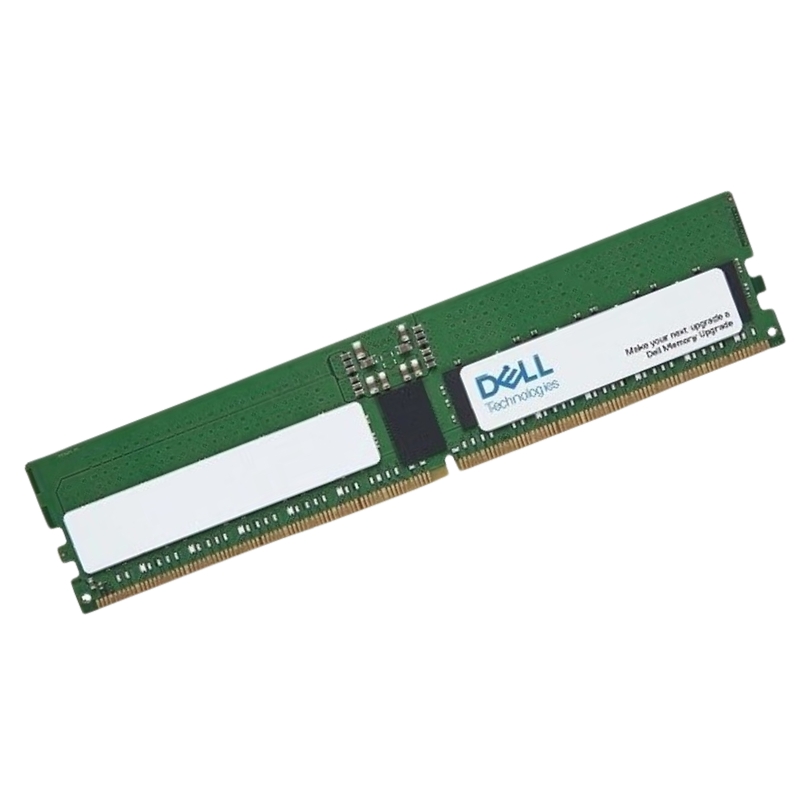
Dell 370-BCRB 64GB DDR5 4800mt/s Pc5-38400 Dual Rank Ecc Registered 1.1v Cl40 SDRAM 288-pin Rdimm Memory Module For Server. New Sealed in Box (NIB) - Samsung Version
| SKU/MPN | Warranty | Price | Condition | You save |
|---|---|---|---|---|
| 370-BCRB | 1 Year Warranty | $2,577.00 | New (System) Pull | You save: $901.95 (26%) |
| 370-BCRB | 1 Year Warranty | $3,681.00 | New Sealed in Box (NIB) | You save: $1,288.35 (26%) |
Discover the Dell 370-BCRB — a high-performance 64GB DDR5 SDRAM registered memory module engineered for servers and enterprise systems. Optimized for reliability and throughput, this PC5-38400 (4800MT/s) RDIMM supports ECC error correction and dual-rank architecture (2Rx4), making it ideal for mission-critical workloads and virtualization environments.
In the realm of enterprise computing, server memory serves as the critical backbone for data processing, virtualization, and application performance. The Dell 370-BCRB 64GB DDR5 RDIMM represents a significant leap forward in this technology, engineered specifically for modern data centers and high-demand server environments. Unlike standard consumer memory, server-grade modules are built with enhanced reliability, error correction, and signal integrity to ensure uninterrupted operation for business-critical applications.
While the CPU is often considered the brain of the server, the memory subsystem is its workspace. The speed, capacity, and latency of the installed RAM directly influence how many virtual machines can be run concurrently, how quickly databases can be queried, and how efficiently large datasets can be processed in-memory. Upgrading to a high-capacity, high-bandwidth module like the 64GB DDR5-4800 can alleviate I/O bottlenecks, leading to faster application response times and improved consolidation ratios.
The transition from DDR4 to DDR5 is one of the most significant advancements in memory technology in recent years. The Dell 370-BCRB is built on this new architecture, offering substantial improvements in performance, power efficiency, and scalability that are crucial for next-generation servers.
With a data rate of 4800 Megatransfers per second (MT/s), the Dell 370-BCRB operates at a significantly higher speed than mainstream DDR4 modules, which typically top out at 3200 MT/s. This boost in raw bandwidth allows the CPU to access data in memory much more quickly, feeding the processor cores and reducing wait states. This is particularly beneficial for memory-intensive applications like in-memory analytics, high-performance computing (HPC), and large-scale virtualization.
Operating at a low 1.1 Volt, DDR5 provides a better performance-per-watt profile than its predecessor. For large-scale data centers with thousands of servers, this marginal power saving per module aggregates into a substantial reduction in total energy consumption and cooling requirements, leading to a lower Total Cost of Ownership (TCO) and a smaller carbon footprint.
Understanding the part number and technical specs is key to ensuring compatibility and meeting performance expectations. Let's break down what "Dell 370-BCRB 64GB DDR5 4800mt/s Pc5-38400 Dual Rank Ecc Registered 1.1v Cl40" truly means.
The 64GB capacity of this module makes it ideal for memory-hungry workloads. This high density allows server administrators to maximize the total memory capacity of a system with fewer DIMM slots. For example, a dual-processor server with 16 memory slots could be populated with up to 1 Terabyte of RAM using these modules, providing ample resources for the most demanding enterprise applications, dense virtualization, and large in-memory databases.
This specifies the number of data transfers the module can perform per second on each data pin. 4800 MT/s is a common starting speed for DDR5 and offers a solid foundation for enterprise performance.
This is the industry-standard name for the module's theoretical peak bandwidth. It is calculated as (MT/s) x (Bus Width in bytes). For a 64-bit (8-byte) bus: 4800 MT/s * 8 bytes = 38400 MB/s (or 38.4 GB/s) of peak bandwidth. The "PC5" prefix denotes that it is a DDR5 module.
ECC is a non-negotiable feature for server stability. It allows the memory module to detect and correct single-bit memory errors on the fly, without any intervention from the operating system or applications. It can also detect, but not correct, multi-bit errors. This "self-healing" capability prevents corrupted data from causing application crashes, system reboots, or silent data corruption, which is paramount for data integrity in financial, medical, and scientific computing.
The "Registered" in the product title refers to the presence of a register, or buffer, on the module. This register sits between the server's memory controller and the DRAM chips. It buffers the command and address signals, reducing the electrical load on the memory controller. This allows a server to support a much larger number of memory modules and higher total capacities than would be possible with Unbuffered DIMMs (UDIMMs). The trade-off is a slight increase in latency (typically one clock cycle), but the benefits for system stability and capacity far outweigh this minor penalty in a server context.
A "rank" is a set of DRAM chips that work together to fill the data width of the memory bus (64 bits for ECC, 72 bits with ECC bits included). A Dual Rank (DR) module has two of these sets. This architecture allows the memory controller to access one rank while preparing the other for the next access, improving overall efficiency and interleaving. Compared to Single Rank (SR) modules, Dual Rank modules often offer better performance under heavy load and are a common configuration for high-capacity server memory.
CAS Latency (CL) is the number of clock cycles between the memory controller issuing a read command and the first piece of data being available. The Dell 370-BCRB has a CAS Latency of CL40. While this number is higher than typical DDR4 CL values (e.g., CL22), it is a proportional and expected figure for DDR5's higher clock speeds. It's more meaningful to calculate the absolute latency in nanoseconds: (CL / MT/s) * 2000. For this module: (40 / 4800) * 2000 = ~16.67 nanoseconds, which is competitive with and often better than high-speed DDR4 modules when considering the overall bandwidth advantage.
DDR5 memory modules use a 288-pin layout. This is a physical and electrical change from DDR4's 288-pin design, meaning DDR5 modules are not backward compatible with DDR4 slots. The key notch on the connector is in a different position to prevent accidental insertion into the wrong motherboard.
The Dell 370-BCRB is not a universal component; it is engineered for specific Dell PowerEdge server platforms that support the DDR5 memory architecture.
This module is designed for next-generation Dell PowerEdge servers, such as those based on the 4th Generation Intel Xeon Scalable processors (Sapphire Rapids) and newer. This includes server families like the Dell PowerEdge R760, R760xa, R760xd2, T560, and other similar models launched in the 2023-2024 timeframe and beyond. It is critical to consult the specific owner's manual and Dell's Memory Configuration Tool for the exact list of compatible systems for this part (370-BCRB).
The combination of high capacity, DDR5 bandwidth, and server-grade reliability makes this memory module ideal for a wide range of demanding applications:
Maximizing the number of Virtual Machines (VMs) per host is directly tied to available memory. 64GB RDIMMs allow for dense VM consolidation, improving hardware utilization and reducing physical server sprawl. This is essential for private clouds, VDI (Virtual Desktop Infrastructure), and large-scale application hosting.
Platforms like SAP HANA, Oracle Database In-Memory, and various big data frameworks keep entire datasets in RAM for instantaneous query responses. The high capacity and bandwidth of DDR5 dramatically accelerate data processing, real-time analytics, and business intelligence tasks.
Scientific simulations, financial modeling, and machine learning training jobs often work with massive datasets that must be readily accessible to the CPU. The increased bandwidth of DDR5 helps feed the insatiable data appetite of modern multi-core processors, reducing time-to-solution for complex calculations.
Large ERP systems (e.g., SAP, Oracle E-Business Suite), CRM platforms (e.g., Salesforce), and large-scale SQL databases require a stable, high-performance memory subsystem to handle concurrent user transactions and maintain service level agreements (SLAs). The ECC and Registered features of this module are indispensable in these environments.


 Contact Us
 Information
 Catalog
 Solid State Drives (SSD)
 Network Switches
 Hard Disk Drives
 HBA & Controllers
 PC & Servers
 PC & Server Memory
 CPU & Processors
 Network Routers
 Power Supplies
 Tape Drives & Libraries
 Network Devices
 Computer & Network Cables