
(7% discount is applied at checkout)
Cart is empty
Your go-to destination for cutting-edge server products
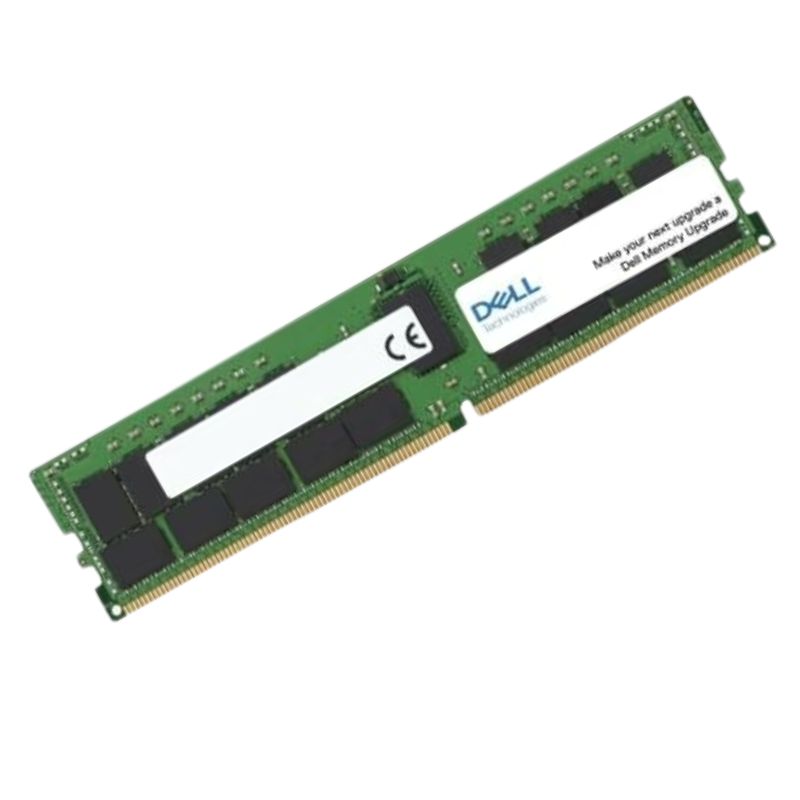
Dell 370-BCSQ 128GB DDR5 5600MHz Pc5-44800 2rx8 Ecc Registered 1.1v Cl46 SDRAM 288-pin RDIMM Memory Module. New Sealed in Box (NIB) - Samsung Version
The Dell 370-BCSQ 128GB DDR5 5600MHz PC5-44800 2Rx8 ECC Registered SDRAM Memory Module is a high-performance solution designed for advanced enterprise servers and data-intensive applications. Engineered with precision, it delivers exceptional speed, reliability, and stability for professional workloads.
This Dell 128GB DDR5 RDIMM is engineered to integrate seamlessly with select Dell PowerEdge systems, providing dependable performance and scalability for mission-critical environments.
DDR5 server memory represents a significant leap forward in computing technology, delivering substantial improvements in speed, capacity, efficiency, and reliability over its DDR4 predecessor. The Dell 370-BCSQ 128GB DDR5 module exemplifies this evolution, engineered specifically for demanding server environments where data integrity and consistent performance are non-negotiable. This technology is not merely an incremental update; it's a fundamental rearchitecture of memory subsystems designed to meet the needs of modern data centers, high-performance computing (HPC), artificial intelligence, and enterprise-level applications.
The transition to DDR5 introduces several key architectural changes. Most notably, DDR5 divides the memory module into two independent, 32-bit data channels (with ECC, this becomes 40-bit per channel), a departure from DDR4's single 64-bit channel. This effectively doubles the burst length and allows for more efficient data handling by the memory controller. Furthermore, the power management integrated circuit (PMIC) is now located on the memory module itself, a shift from the motherboard-based power delivery of DDR4. This on-DIMM PMIC enables more precise voltage regulation, improving signal integrity and power efficiency, which is critical for the stability of large-scale server deployments.
The Dell 370-BCSQ is a specific configuration of DDR5 memory meticulously validated and qualified for optimal performance and compatibility within Dell PowerEdge servers and other compatible systems. Understanding its detailed specifications is crucial for making an informed procurement decision and ensuring seamless integration into your existing infrastructure.
This single module boasts a substantial 128GB capacity. In a typical multi-channel server configuration, such as an 8-channel platform, populating all slots with these modules can yield a terabyte-scale memory configuration (e.g., 16 slots x 128GB = 2TB) within a single server. This massive capacity is essential for memory-hungry applications like in-memory analytics databases (e.g., SAP HANA), large-scale virtualization hosts, and high-performance computing simulations that require entire datasets to be loaded into RAM for rapid processing.
Often marketed as 5600MHz, the correct terminology is 5600 Mega Transfers per second. This signifies the speed at which the memory module can read and write data. Compared to common DDR4 speeds of 2933MT/s or 3200MT/s, the 5600MT/s data rate of this DDR5 module offers a significant bandwidth increase. This higher speed reduces latency and ensures that the CPU cores are fed with data more quickly, preventing them from sitting idle and thereby maximizing overall system throughput.
The "PC5-44800" designation is the module's classification under the JEDEC standard. The number "44800" refers to the peak theoretical bandwidth in megabytes per second (MB/s) for the module. This is calculated as (5600 MT/s * 8 bytes per transfer) = 44,800 MB/s. This metric provides a standardized way to compare the potential bandwidth of different memory modules.
ECC is a critical feature for any server or workstation where data integrity is paramount. It works by adding extra bits (in this case, 8 ECC bits for every 64 data bits) to form a special code. As data is written to memory, this code is calculated and stored. When the data is read, the code is recalculated and compared to the stored code. If a single-bit error is detected, the ECC circuitry can automatically correct it on the fly without any interruption to the system. This prevents silent data corruption, system crashes, and computational errors that could be catastrophic in financial, scientific, or database applications.
Standard ECC, as found in this module, is primarily designed to correct single-bit errors and detect two-bit errors. A single-bit flip, often caused by cosmic rays or electrical interference, is the most common type of memory error. When a multi-bit error is detected that cannot be corrected, the system will typically halt to prevent corrupted data from propagating, ensuring data integrity is maintained even at the cost of a system stoppage.
The "Registered" in RDIMM indicates the presence of a register, or buffer, placed between the server's memory controller and the DRAM chips on the module. This register buffers the command and address signals, reducing the electrical load on the memory controller.
The key component that enables RDIMM functionality is the Registering Clock Driver (RCD). The RCD takes the command/address signals from the memory controller, re-drives them with improved signal integrity, and then sends them to the DRAM chips. This process allows a server to support a much higher number of memory modules and greater total memory capacity without overburdening the memory controller, which is essential for multi-socket servers and high-density memory configurations.
Operating at a lower voltage of 1.1V (compared to DDR4's 1.2V) is a key factor in DDR5's improved power efficiency. This reduction lowers power consumption and heat generation, which is crucial for dense server racks. The CAS Latency (CL46) is a measure of the delay, in clock cycles, between the memory controller requesting data and the data being available. While the raw CL number is higher than in DDR4 (e.g., CL22), it is measured relative to the much faster clock speed of DDR5. When calculating actual latency in nanoseconds, DDR5's faster cycle time often results in similar or even lower real-world latency despite the higher CL value.
DDR5 modules utilize a 288-pin edge connector, which is physically different from DDR4's 288-pin design (the key notch is in a different location to prevent accidental insertion into an incompatible slot). The RDIMM form factor is specifically keyed for servers and will not fit into desktop (UDIMM) or laptop (SODIMM) motherboards.
DDR5 memory requires a supporting platform. This includes a CPU with a integrated DDR5 memory controller and a motherboard with a DDR5-compatible memory slot.
This module is designed for servers utilizing Intel Xeon Scalable Processors (4th Gen Sapphire Rapids and newer) or AMD EPYC processors (Genoa and newer) that natively support DDR5 memory. The server's chipset and BIOS must also provide support for the specific memory type (DDR5), speed (5600MT/s), and features (ECC, RDIMM).
Servers have strict rules for how memory slots must be populated to achieve optimal performance, especially in multi-CPU configurations.
Modern server CPUs have multiple memory channels (e.g., 8 or 12). For best performance, memory modules should be installed in a balanced fashion across all channels. It is generally recommended to populate the same number and type of modules per channel and across all CPUs in a multi-socket system. Consulting the specific owner's manual for your Dell PowerEdge server model is essential to determine the correct population sequence for your desired configuration.
While it is sometimes possible to mix memory modules of different speeds or capacities, the entire memory system will typically operate at the speed of the slowest installed module. Mixing different capacities within a channel can also lead to sub-optimal performance. For a homogeneous and predictable system, it is highly recommended to use identical memory modules (same part number, capacity, speed, and rank) across all slots.
The Dell 370-BCSQ is not a general-purpose memory module; it is a specialized component engineered for specific, high-stakes computing environments where its advanced features provide maximum value.
In modern data centers, server consolidation through virtualization is a key strategy. Platforms like VMware vSphere, Microsoft Hyper-V, and Proxmox VE rely on massive amounts of RAM to host dozens or even hundreds of virtual machines (VMs) on a single physical host.
Each VM requires a dedicated portion of the host's physical memory. A server equipped with multiple 128GB DDR5 RDIMMs can support an extremely high density of VMs, improving hardware utilization and reducing the physical footprint, power, and cooling requirements of the data center. The ECC functionality is critical here to ensure the stability of the entire virtualized environment, preventing a memory error in one VM from crashing the host server.
Applications like SAP HANA, Oracle TimesTen, and various Redis configurations operate by storing the entire database in main memory (RAM) instead of reading from slower traditional storage (SSDs, HDDs).
This "in-memory" approach eliminates I/O bottlenecks, allowing for lightning-fast transaction processing, real-time analytics, and complex queries on massive datasets. The high bandwidth of DDR5 5600MT/s memory is a perfect match for these workloads, ensuring that data can be moved between the CPU and RAM as quickly as possible. The large 128GB capacity of each module is essential for accommodating these massive datasets.
HPC clusters used for scientific research, engineering simulation (CAE), weather modeling, and genomic sequencing perform complex calculations that often require working with enormous matrices and vectors stored in memory.
The combination of high capacity and high bandwidth provided by modules like the 370-BCSQ allows researchers and engineers to build more detailed and accurate models that can be solved in a reasonable time. ECC memory is practically mandatory in this field, as a single undetected bit-flip could invalidate days or weeks of computation, leading to erroneous scientific conclusions or flawed engineering designs.
AI and ML workloads, particularly during the training phase, involve processing vast amounts of training data and performing countless mathematical operations on multi-layered neural networks.
While GPUs handle the core computational load, the CPU and system memory are responsible for feeding data to the GPUs and managing the overall workflow. Insufficient or slow system RAM can become a bottleneck, leaving expensive GPUs idle. High-capacity, high-bandwidth DDR5 RDIMMs ensure that the CPU can prepare and stream training data to the GPUs without delay, maximizing the utilization of the entire AI server infrastructure.


 Contact Us
 Information
 Catalog
 Solid State Drives (SSD)
 Network Switches
 Hard Disk Drives
 HBA & Controllers
 PC & Servers
 PC & Server Memory
 CPU & Processors
 Network Routers
 Power Supplies
 Tape Drives & Libraries
 Network Devices
 Computer & Network Cables