
(7% discount is applied at checkout)
Cart is empty
Your go-to destination for cutting-edge server products
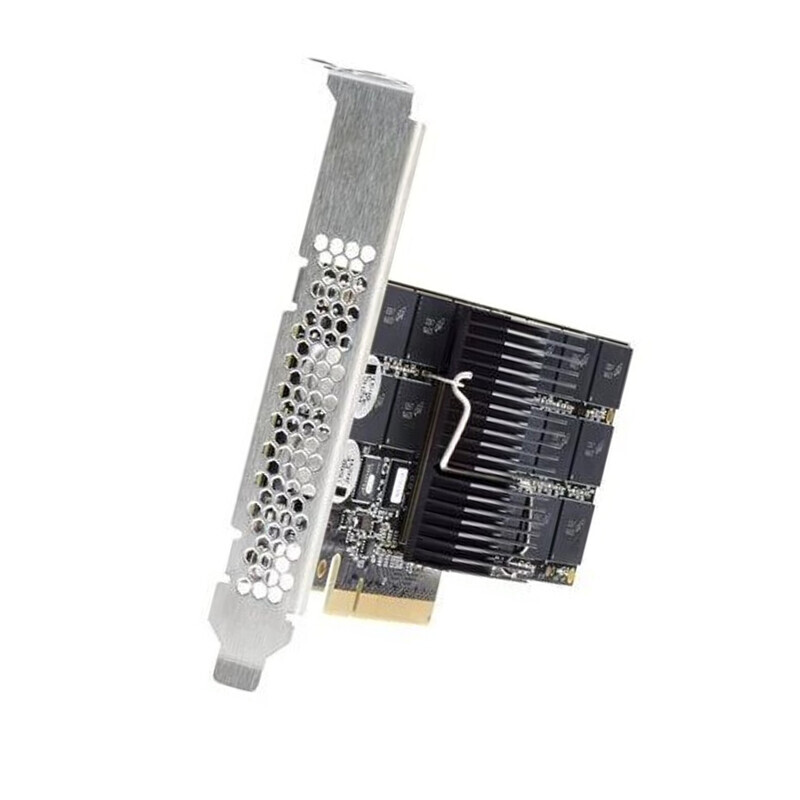
HPE 804566-001 800GB PCI-E NVMe Write Intensive Workload Accelerator HHHL Add-in Card SSD. Excellent Refurbished with 1 year replacement warranty
Engineered for demanding write-intensive environments, the HPE 804566-001 SSD delivers exceptional throughput and reliability for enterprise-grade applications.
The HPE 804566-001 is positioned as a purpose-built, server-grade solid state add-in card engineered to accelerate write-heavy application workloads in data center and enterprise server environments. It pairs an 800GB usable capacity with an NVMe protocol over PCI-Express to deliver predictable throughput for logging, caching, telemetry ingestion, database commit logs, and any workload where sustained write performance and endurance are more important than raw sequential capacity. The unit’s Half-Height, Half-Length (HHHL) add-in card form factor gives system architects the flexibility to install high-end NVMe performance without changing drive bays or common U.2/U.3 mechanical constraints, enabling upgrades in servers that expose PCIe lanes to the chassis backplane or expansion slots.
At 800GB usable capacity, this drive is balanced to deliver substantial on-device storage while optimizing endurance characteristics for write-intensive classifications. Unlike consumer or mainstream SATA/SAS drives that prioritize capacity per dollar, the 804566-001 is tuned to deliver a sustained write lifecycle suitable for enterprise logging, streaming write caches, and high-churn datasets where drive endurance (measured in drive writes per day and total terabytes written over warranty life) is a primary consideration. Vendors and resellers list this product specifically under “write intensive” workload accelerators, and the product details consistently highlight endurance as a defining trait alongside the NVMe interface and PCIe add-in implementation.
Functionally, the HPE 804566-001 implements the NVMe protocol over a PCI-Express interface designed to expose multiple I/O queues and exploit parallelism across modern CPU cores. NVMe’s architectural advantages—reduced command overhead, deeper command queues, and direct PCIe lane access—translate into much lower command latency and better small-I/O performance compared with legacy SAS and SATA drives. Practical results for the 804566-001 as reported in commercial listings indicate high random write responsiveness and sequential throughput figures oriented toward real-world server workflows. These technology choices are why operators choose this SKU as an accelerator card rather than a general purpose SATA SSD.
Mechanically delivered as a Half-Height, Half-Length (HHHL) add-in card, the 804566-001 installs into a standard PCIe expansion slot and is commonly recommended for ProLiant servers and comparable enterprise-class platforms that provide direct PCIe access for storage accelerators. HHHL cards often require fewer chassis modifications than drive sled replacements and can be a preferred route in dense rackmount servers where the system I/O topology exposes NVMe lanes to expansion slots. Resellers and legacy product pages identify compatibility with a range of HPE ProLiant configurations and public sector purchasing channels, making the part a common inventory item for refreshes and repairs. System integrators should verify PCIe lane allocation, power draw, and airflow in target chassis models before deployment.
Published vendor descriptions and reseller spec summaries list conservative but meaningful performance figures for the 804566-001. Typical sequential read throughput is reported in the multi-GB/s range while sequential write throughput is scaled to match the drive’s write-intensive class. Random small-block I/O response times—especially with low queue depths typical of metadata and logging patterns—are called out as a competitive advantage relative to older drive classes. Values such as sequential read speeds near 2600 MB/s and sequential write speeds around 1700 MB/s appear in product listings, which aligns with the expectations for an NVMe device optimized for PCIe Gen3/Gen4 backplanes in enterprise servers. These figures provide a useful baseline for capacity planning, but architects should measure application-level throughput under representative load profiles to capture true end-to-end performance.
Applications that write frequently and demand low latency commit times are the primary beneficiaries of write-intensive NVMe accelerators. Real-time logging systems, time-series telemetry ingestion, high-transaction database commit logs, tiered cache layers in web platforms, and write-back caching for storage controllers all gain from a device optimized for high sustained writes and consistent low latency. In these contexts the card’s ability to accept high sustained write traffic without dramatic performance cliffs or premature wear is more valuable than purely maximizing raw sequential read throughput. For companies that process high volumes of short writes and append operations, a purpose-tuned write-intensive NVMe device simplifies application architecture by removing write throughput as a bottleneck.
Compared to mainstream mixed-use NVMe drives, write-intensive models typically trade a bit of read density or peak sequential read speed for much higher program/erase cycle budgets and flash management profiles tuned to sustained writes. Mixed-use SSDs are often recommended for a blend of random read and write tasks where read latency cannot be traded off, while write-intensive variants focus on endurance and predictable write throughput under sustained pressure. When selecting between these categories, evaluate the dominant I/O type and map that to the vendor’s endurance rating and workload class. For data centers running heavy ingestion pipelines, the write-intensive card can reduce operational risk by minimizing degraded performance windows during heavy commit phases.


 Contact Us
 Information
 Catalog
 Solid State Drives (SSD)
 Network Switches
 Hard Disk Drives
 HBA & Controllers
 PC & Servers
 PC & Server Memory
 CPU & Processors
 Network Routers
 Power Supplies
 Tape Drives & Libraries
 Network Devices
 Computer & Network Cables