
(7% discount is applied at checkout)
Cart is empty
Your go-to destination for cutting-edge server products
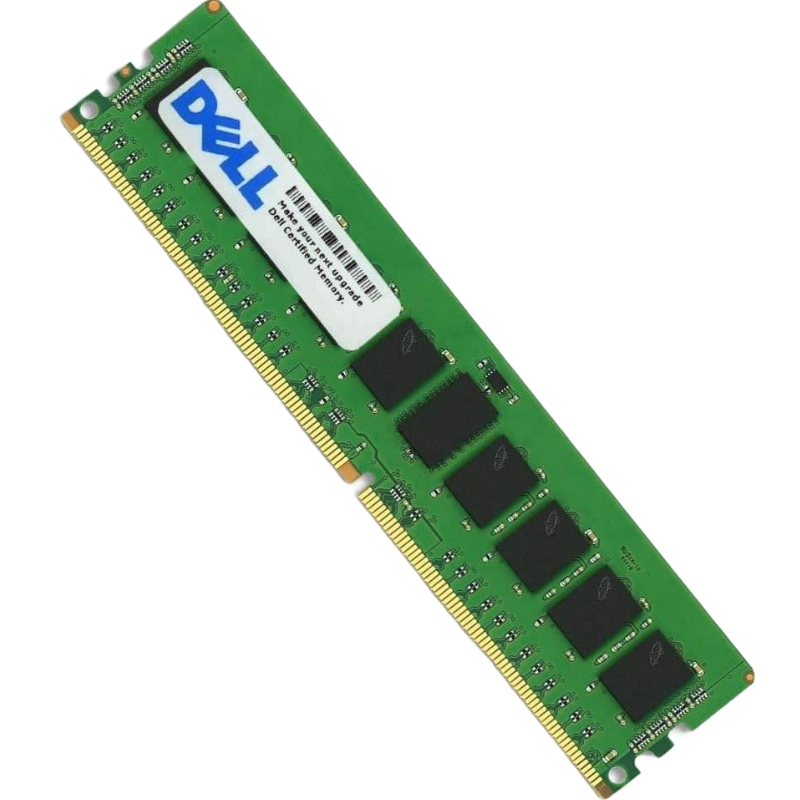
Dell A9365698 16GB 2400MHz PC4-19200 CAS-17 ECC Registered Dual Rank 2rx8 DDR4 SDRAM 288-Pin RDIMM for Poweredge Server Memory Module. New (System) Pull with 1 year replacement warranty - Hynix Version
| SKU/MPN | Warranty | Price | Condition | You save |
|---|---|---|---|---|
| A9365698 | 1 Year Warranty | $320.00 | New Sealed in Box (NIB) | You save: $112.00 (26%) |
| A9365698 | 1 Year Warranty | $203.00 | New (System) Pull | You save: $71.05 (26%) |
Explore the Dell A9365698, a high-performance 16GB DDR4 SDRAM Memory Module designed for PowerEdge servers. This module provides reliable, efficient memory solutions for demanding server environments, delivering speed and stability with its advanced features. It is specifically engineered to meet the needs of businesses looking to enhance the performance and reliability of their IT infrastructure.
This memory module integrates smoothly with a wide range of Dell PowerEdge servers and Precision workstations, ensuring maximum flexibility.
The Dell A9365698 16GB 2400MHz PC4-19200 CAS-17 ECC Registered Dual Rank 2Rx8 DDR4 SDRAM 288-Pin RDIMM is a purpose-built server memory module engineered to deliver consistent performance, robust error correction, and enterprise-grade reliability for PowerEdge servers and compatible enterprise systems. Designed for data centers, virtualization hosts, database servers, and compute nodes where uptime and data integrity are non-negotiable, this module combines the stability of ECC Registered (RDIMM) architecture with the performance characteristics of DDR4 at 2400MT/s. The category encompasses memory modules that match or exceed OEM specifications for Dell PowerEdge families and provides IT procurement teams, system administrators, and resellers with a reliable selection of compatible RDIMM components that maintain system stability under sustained heavy workloads. The category prioritizes compatibility with server chipsets and BIOS profiles used in modern Dell platforms while addressing the needs of mixed memory configurations, capacity scaling, and multi-socket systems.
The defining technical attributes of this category include the 16GB capacity, dual-rank 2Rx8 organisation, PC4-19200 bandwidth rating, CAS latency 17 timing, and ECC Registered functionality in a 288-pin DIMM form factor. Each of these characteristics plays a role in determining how memory behaves in a server environment. The 16GB density offers an ideal balance between capacity and cost for many enterprise workloads, enabling greater virtual machine density and improved in-memory database performance without moving to higher-cost large-capacity modules. The dual-rank configuration effectively increases memory parallelism and can improve throughput in certain memory controller implementations, while the 2Rx8 architecture refers to the way DRAM chips are organised across ranks and data lines, influencing compatibility and performance characteristics in multi-channel memory subsystems.
Operating at 2400MHz (often expressed as DDR4-2400), the module provides PC4-19200 peak theoretical bandwidth per module. In server deployments this frequency balances thermal, power, and latency characteristics; 2400MT/s remains widely supported across many PowerEdge generations and Intel or AMD server platforms that accept DDR4. Bandwidth improvements directly translate to better memory throughput for I/O-heavy workloads and parallel processing tasks. For database workloads and virtualization clusters, the sustained memory bandwidth helps reduce stalls and improve overall application responsiveness. IT architects often select 2400MHz RDIMMs when stability and compatibility are prioritized across mixed-generation server fleets.
CAS latency 17 (CL17) indicates memory access timing characteristics that, when considered with frequency, determine effective memory latency. While raw MHz figures capture transfer rates, CAS latency contributes to effective memory access time—an important metric for latency-sensitive applications. In server contexts where large datasets are accessed frequently, lower latency may reduce transaction response times. However, CAS-17 at 2400MT/s represents a stable, commonly deployed timing that balances cost and performance for enterprise memory modules.
ECC Registered functionality is central to the product category’s value proposition. Error-Correcting Code (ECC) memory detects and corrects single-bit errors in real time, protecting against data corruption that can arise from electrical noise, alpha-particle strikes, or other rare fault conditions. The Registered (or buffered) DIMM design adds a register between the DRAM chips and the memory controller, reducing electrical load on the memory bus and enabling higher module counts per channel — a crucial feature for multi-socket, high-capacity server systems. For enterprise administrators, ECC RDIMM modules like the Dell A9365698 ensure that mission-critical services, such as transactional databases and virtualization platforms, continue to operate with predictable behavior and minimized risk of silent data errors.
This category focuses on memory modules validated for Dell PowerEdge servers and systems that share the same memory architecture and BIOS support. Common PowerEdge families that accept similar 288-pin RDIMM DDR4 modules include rack and tower models across multiple generations. While exact BIOS and firmware compatibility may vary by specific server model and service tag, the modules in this category are intended to match Dell’s original equipment manufacturer (OEM) part specifications for DDR4 RDIMMs, ensuring plug-and-play operation when installed into supported PowerEdge configurations. The category also addresses cross-compatibility with other server brands that implement the same DDR4 RDIMM standards, though purchasers are advised to verify firmware compatibility and refer to vendor compatibility matrices before large-scale deployment.
The 288-pin RDIMM form factor is standard for DDR4 server memory, ensuring physical and electrical compatibility with server motherboards designed for DDR4 RDIMM modules. The pin count and notch placement are designed to prevent improper insertion and to comply with JEDEC mechanical standards. For systems with multiple memory channels and banks, correct installation order and population rules must be followed to maximize performance and to ensure the memory controller recognises all installed DIMMs. The category’s product descriptions typically include installation guidelines, recommended population schemes, and notes about mixing ranks and speeds.
Performance for server memory modules in this category is influenced by module population, memory channel configuration, BIOS memory settings, and interaction with CPU memory controllers. For optimal throughput, administrators should populate DIMM slots following the server vendor’s channel population recommendations, enabling balanced multi-channel operation across all CPU sockets. When mixing modules of different densities or speeds, the memory subsystem will usually operate at the lower-performing module’s speed and timing, so homogeneous deployments are commonly recommended for predictable behavior. The Dell A9365698 16GB 2400MHz RDIMM is often used in matched sets across server arrays to ensure consistent timing and capacity for virtualization hosts or scale-out clusters.
Memory capacity and density are critical scaling levers for virtualization infrastructures, container orchestration nodes, and in-memory computing platforms. The 16GB density of this module maps to many virtualization sizing models, allowing administrators to allocate adequate RAM per virtual machine while maintaining a balance between total system capacity and cost per gigabyte. Because RDIMMs support higher overall system capacity through improved electrical loading characteristics, containers and virtual machines can scale more predictably across nodes without encountering stability limitations that may arise with unregistered memory. The category therefore supports both incremental scaling — adding modules to existing servers — and larger fleet upgrades where capacity per node needs to be increased to host more demanding workloads.
This category supports a range of server workloads where reliability, data integrity, and sustained throughput are required. Typical use cases include virtualization hosts running multiple virtual machines or containers, database servers performing OLTP or in-memory caching, web and application servers supporting large user bases, and HPC nodes executing parallel jobs. Because the Dell A9365698 module is optimized for server operation, it fits particularly well into enterprise stacks that require certified parts for regulatory compliance or auditability. It is also commonly used in maintenance and repair operations to restore servers to factory-spec configurations or to replace failed modules with OEM-equivalent components to preserve vendor support.
Enterprises with large-scale deployments often adopt standardized memory configurations across racks and chassis to simplify procurement, spare part inventory, and support processes. Small and medium businesses (SMBs) benefit from the same reliability characteristics when migrating to consolidated servers or adopting virtualization to reduce physical footprint. The 16GB module occupies a practical middle ground for SMBs that require more than baseline capacity but are not yet ready to invest in higher-density modules. For both segments, the category helps buyers choose modules that align with performance needs and budget constraints while ensuring compatibility with Dell PowerEdge systems.
Within the broader category of server memory, buyers may compare RDIMMs with LRDIMMs (load-reduced DIMMs) or UDIMMs depending on their capacity and scaling needs. RDIMMs such as the Dell A9365698 strike a balance between cost, compatibility, and capacity, whereas LRDIMMs permit higher per-module capacity at a higher cost and with different performance trade-offs. When evaluating alternatives, administrators should weigh system requirements, maximum supported memory per socket, and the impact of different DIMM types on memory channel population rules. The category content can guide readers to consider when to prefer 16GB RDIMMs over larger-capacity modules, or when migrating to LRDIMM architectures becomes a strategic requirement for very large in-memory datasets.


 Contact Us
 Information
 Catalog
 Solid State Drives (SSD)
 Network Switches
 Hard Disk Drives
 HBA & Controllers
 PC & Servers
 PC & Server Memory
 CPU & Processors
 Network Routers
 Power Supplies
 Tape Drives & Libraries
 Network Devices
 Computer & Network Cables