(7% discount is applied at checkout)
Cart is empty
Your go-to destination for cutting-edge server products
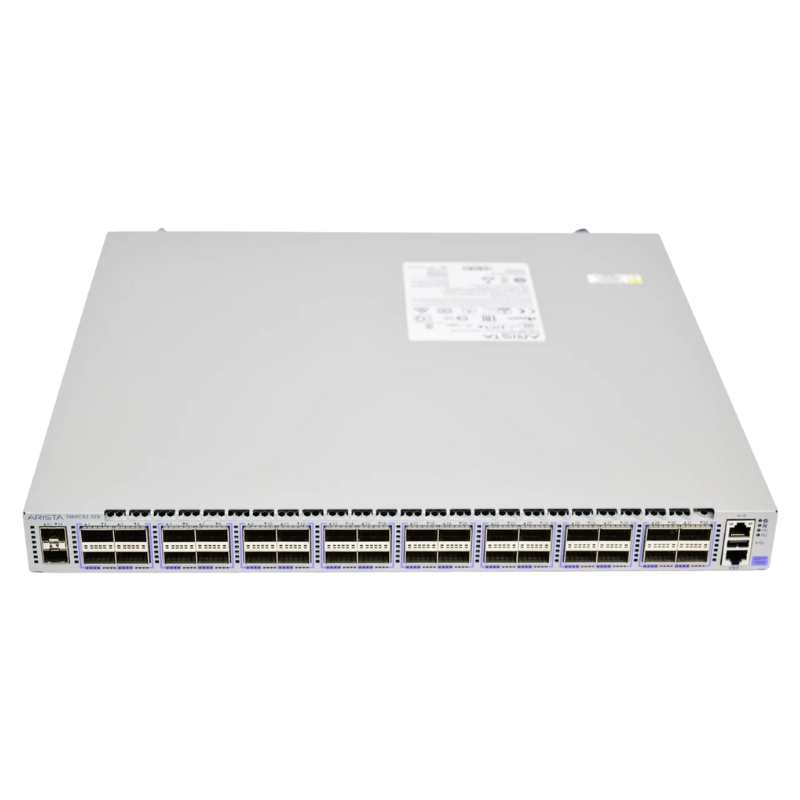


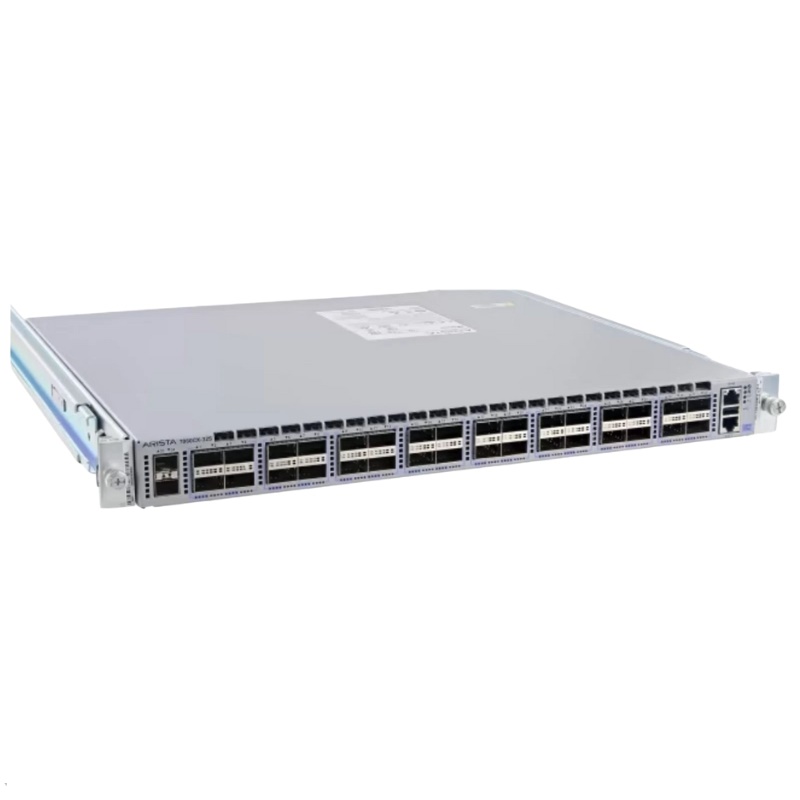
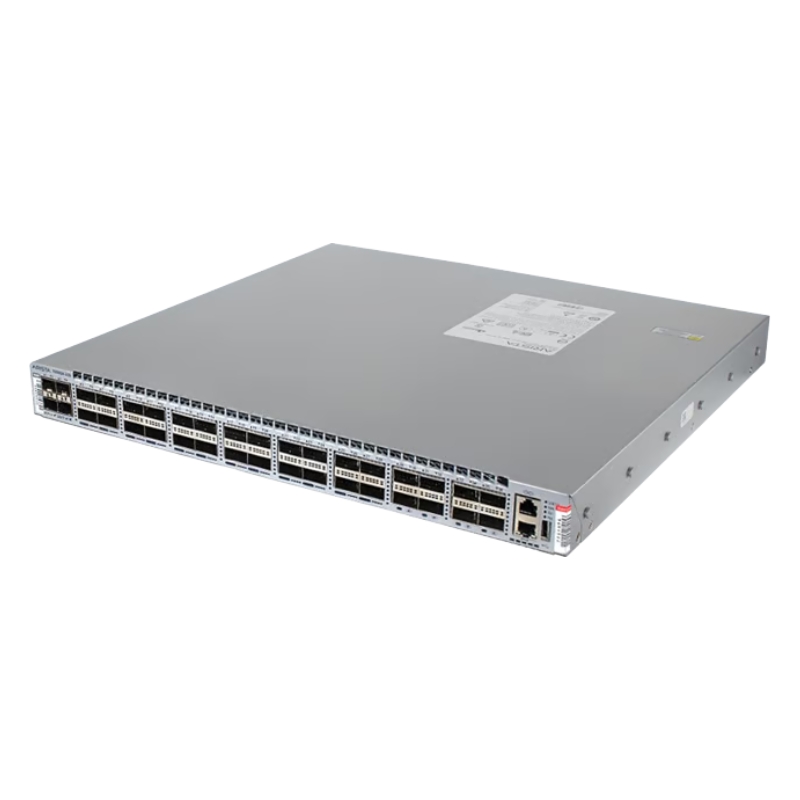
Arista DCS-7060PX4-32-F 7060X4 32 Ports 400GbE OSFP Front-to-Back Airflow Rack Mountable 1U Ethernet Switch. Excellent Refurbished with 1 Year Replacement Warranty
The Arista 7060X4 series represents a transformative leap in data center network architecture, engineered to meet the explosive demand for bandwidth driven by artificial intelligence, machine learning, high-performance computing, and data-intensive cloud applications. As a flagship within this series, the Arista DCS-7060PX4-32-F is a purpose-built, 1U fixed-configuration switch designed to deliver unprecedented port density and performance in a remarkably compact form factor.
The Arista 7060X4 series represents a transformative leap in data center switching, engineered to meet the escalating demands of artificial intelligence, machine learning, high-performance computing, and modern cloud infrastructures. At the core of this series is the Arista DCS-7060PX4-32-F, a switch designed to deliver unprecedented port density and bandwidth in a remarkably compact 1U form factor. This platform is built for spine, super-spine, and high-performance leaf deployments where low latency, high throughput, and scalability are non-negotiable. Leveraging Arista's Extensible Operating System (EOS) and deep integration with modern network automation tools, the 7060X4 series provides a robust, programmable, and resilient foundation for the next-generation data center and high-capacity enterprise core.
The DCS-7060PX4-32-F is a purpose-built, fixed-configuration switch that consolidates immense networking power into a single rack unit. Its architecture is optimized for environments requiring massive east-west traffic flows and minimal oversubscription. The switch is powered by a cutting-edge, merchant silicon-based pipeline, providing deterministic performance and deep buffer capacity to handle demanding, bursty workloads typical in AI/ML clusters. Every aspect of its design, from the thermal profile to the power distribution, is engineered for continuous operation in high-stakes data center environments.
Encased in a rugged, standard 1U (1.75-inch) rack-mountable chassis, the switch is built for high-density deployments. The front-to-back airflow (designated by the "F" in the model number) is a critical specification for data center planning, ensuring compatibility with hot aisle/cold aisle containment strategies where cooling air is drawn from the front (cold aisle) and exhausted to the rear (hot aisle). The chassis features a robust steel construction with port designations clearly labeled for easy identification and cable management.
The switch leverages a deep packet buffer architecture, which is essential for handling bursty traffic patterns common in big data and storage applications. This prevents packet loss during momentary congestion, maintaining application performance. The forwarding rate is measured in billions of packets per second (Bpps), capable of handling massive amounts of network flows with ease.
At the heart of the DCS-7060PX4-32-F lies a cutting-edge Broadcom Tomahawk 4 switching ASIC. This silicon delivers the full non-blocking throughput of 32 ports of 400GbE, offering an aggregate switching capacity of 12.8 Terabits per second (Tbps). The ASIC's deep buffers and advanced packet processing capabilities are essential for handling the bursty, high-volume traffic patterns characteristic of AI/ML workloads and large-scale data analytics, preventing packet loss and ensuring predictable application performance.
The switch is equipped with substantial DDR4 memory to manage the switching tables, routing information bases (RIBs), and forwarding information bases (FIBs) required for large-scale network topologies. It includes high-reliability, solid-state storage for the Arista EOS image, startup-configurations, and logs, ensuring fast boot times and resilient operation.
While QSFP-DD (Quad Small Form Factor Pluggable Double Density) is another popular 400G form factor, OSFP was selected for this platform due to its superior thermal and electrical characteristics. The OSFP's slightly larger size allows for better heat dissipation from high-power optical modules, which is crucial for maintaining signal integrity over longer distances or when using cutting-edge optics. It also provides a clearer electrical pathway for 400G signals, supporting both today's and tomorrow's optical requirements.
The 1U rack-mountable chassis of the DCS-7060PX4-32-F is a marvel of thermal and spatial efficiency. The "Front-to-Back Airflow" designation (indicated by the "-F" in the model number) is critical for integration into data centers with aligned hot aisle/cold aisle containment systems. This design draws cool air from the port side (front) and exhausts heated air out the power supply side (rear), ensuring optimal cooling efficiency. The chassis construction is of robust, heavy-gauge steel, providing electromagnetic interference (EMI) shielding and structural integrity for dense, fully loaded rack deployments.
The front panel of the DCS-7060PX4-32-F is dominated by its 32 x OSFP ports. These high-density interfaces are the cornerstone of the platform, each capable of supporting 400 Gigabit Ethernet. The OSFP form factor is selected for its superior signal integrity at ultra-high speeds and its forward-looking design that supports future higher-speed modules. The ports are arranged in a clean, logical grouping for easy cable management. The front panel also houses critical status LEDs for system health, port activity/link status, and fan/power supply conditions, providing immediate visual operational feedback.
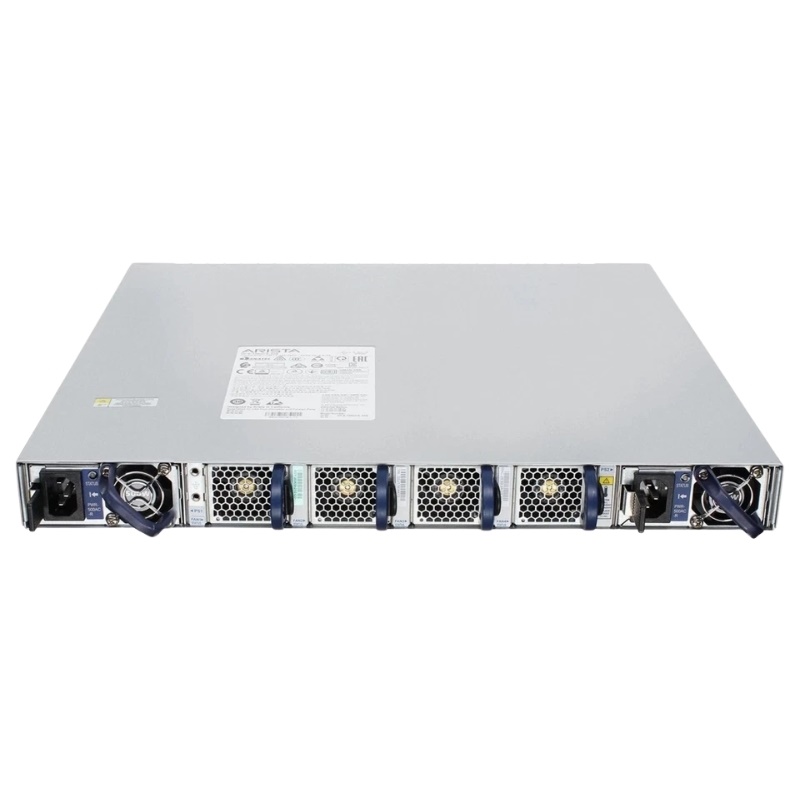
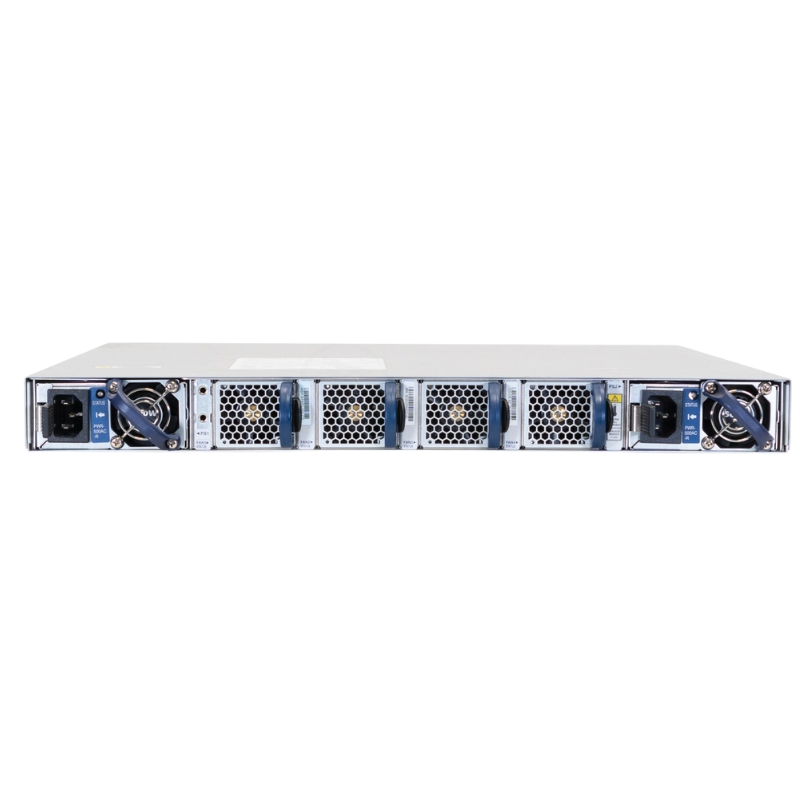
The rear of the switch houses the hot-swappable, redundant power supply units (PSUs) and fan trays. The PSUs are typically available in various wattages (e.g., 2000W AC or 2400W High Voltage DC) to support the full power load of all 32 ports running at 400GbE with optics installed. The power supplies are 1+1 redundant with load sharing, ensuring no single point of failure. The fan tray assembly is also hot-swappable and N+1 redundant, with individual fans capable of variable speed control based on real-time thermal sensors to balance cooling and acoustics efficiently.
With 32 ports of 400GbE, the DCS-7060PX4-32-F delivers an aggregate switching capacity of 12.8 Terabits per second (Tbps). This raw bandwidth enables it to act as a powerful spine in Clos (leaf-spine) architectures, connecting a vast number of 100GbE or 25GbE leaf switches, or to directly interconnect high-performance servers and storage arrays equipped with 400GbE network interface cards. The switch fabric is fully non-blocking, ensuring line-rate throughput on all ports simultaneously under any traffic pattern—a critical requirement for lossless RoCEv2 (RDMA over Converged Ethernet) traffic in AI/ML workloads.
The DCS-7060PX4-32-F is engineered for ultra-low latency, typically in the sub-microsecond range for cut-through switching. This deterministic latency profile is vital for financial trading, real-time analytics, and tightly-coupled parallel computing tasks. Jitter, or latency variation, is minimized through the advanced silicon and EOS scheduler design, providing a stable and predictable network plane for time-sensitive applications.
The DCS-7060PX4-32-F generates rich, real-time telemetry data. EOS supports streaming telemetry, pushing granular data on switch performance, counters, and network analysis to collectors at scale, far surpassing the pull-model limitations of SNMP. This capability is magnified when managed by Arista CloudVision, a network-wide management platform.
The immense bandwidth and density of the DCS-7060PX4-32-F make it ideal for several critical roles in modern data centers and research facilities.
In AI/ML training clusters, where thousands of GPUs need to communicate with low latency and high bandwidth, this switch forms an ideal spine or top-of-rack fabric. It supports RDMA protocols natively, allowing for efficient GPU-to-GPU communication. The non-blocking architecture ensures that all-to-all traffic patterns, common during training phases, do not create bottlenecks, drastically reducing job completion times.
As a spine switch, the DCS-7060PX4-32-F can connect to dozens of 100GbE leaf switches, creating a massively scalable, multi-stage Clos fabric. Its 400GbE ports can be used as high-speed uplinks or can be broken out via breakout cables into 4 x 100GbE connections, offering deployment flexibility. As a super-spine in very large-scale data centers, multiple units can interconnect pods or data center modules with high-capacity links.
The switch can be deployed at the edge of the data center for high-capacity DCI. Using appropriate long-reach optics, the 400GbE ports can connect geographically dispersed data centers over dark fiber or dedicated wavelengths, enabling active-active data centers and workload mobility across campuses or metropolitan areas.
For large-scale storage environments (SAN/NAS) and data lakes, the switch can aggregate traffic from hundreds of storage nodes, providing a high-speed pipeline for data analytics and backup workloads. Support for features like Data Center Bridging (DCB) enables a unified fabric for storage and data traffic.
Internet Exchanges (IXs) and cloud providers can utilize this switch as a dense peering router or core fabric interconnect, where handling enormous internet tables and traffic volumes is required. The extensive routing table capacity and advanced BGP features of EOS are fully leveraged in these scenarios.


 Contact Us
 Information
 Catalog
 Solid State Drives (SSD)
 Network Switches
 Hard Disk Drives
 HBA & Controllers
 PC & Servers
 PC & Server Memory
 CPU & Processors
 Network Routers
 Power Supplies
 Tape Drives & Libraries
 Network Devices
 Computer & Network Cables