(7% discount is applied at checkout)
Cart is empty
Your go-to destination for cutting-edge server products


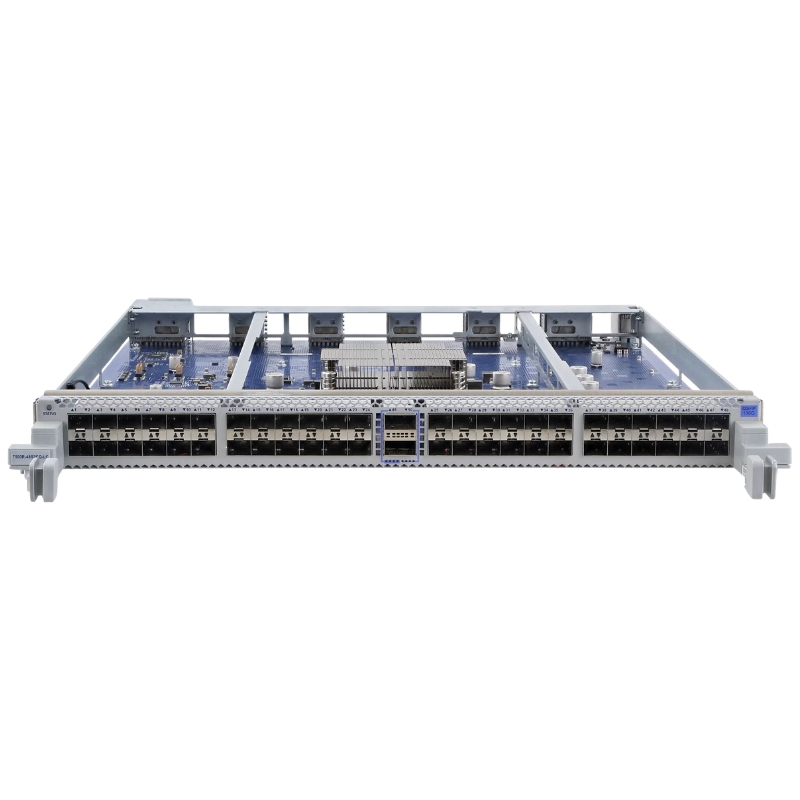
Arista DCS-7500E-72S-LC SR10 10G SFP+ Mod 2X 48X Port 100G MXP Expansion Module. Excellent Refurbished with 1-Year Replacement Warranty
| SKU/MPN | Warranty | Price | Condition | You save |
|---|---|---|---|---|
| DCS-7500E-72S-LC | 1 Year Warranty | $294.00 | Excellent Refurbished | You save: $102.90 (26%) |
| DCS-7500E-72S-LC | 1 Year Warranty | $960.00 | New Sealed in Box (NIB) | You save: $336.00 (26%) |
The Arista DCS-7500E-72S-LC SR10 10G SFP+ Module with 2X 48X Port 100G MXP Expansion capability is designed to deliver exceptional speed, scalability, and reliability for modern data centers. This advanced module enhances connectivity and supports demanding enterprise networking requirements.
The Arista DCS-7500E-72S-LC SR10 10G SFP+ Mod 2X 48X Port 100G MXP Expansion Module belongs to a specialized category of high-performance line cards engineered for modular data center switching platforms. This category is designed to extend the port density, bandwidth capacity, and deployment flexibility of enterprise-grade switching chassis, particularly within hyperscale, cloud, and large enterprise environments. Expansion modules such as this are purpose-built to integrate seamlessly into the Arista 7500E Series architecture, delivering scalable 10GbE and 100GbE connectivity options to support evolving network demands.
Within modern leaf-spine and core network designs, modular line cards play a pivotal role in enabling non-blocking throughput and ultra-low latency communication. The SR10 10G SFP+ module category focuses on maximizing interface density while preserving the switching fabric’s performance envelope. As data center traffic patterns become increasingly east-west oriented, expansion modules that offer flexible combinations of 10G SFP+ and 100G MXP ports are critical to maintaining predictable performance and operational efficiency.
Switching chassis platforms differ significantly from fixed-configuration switches in their ability to scale port density and performance through interchangeable modules. The expansion module category represented by the Arista DCS-7500E-72S-LC is designed to function within a centralized switching fabric, leveraging distributed forwarding and high-speed backplane interconnects. This architecture ensures that each line card operates as an integral component of the broader system, contributing to a unified control and data plane.
The modular design supports incremental growth strategies, allowing data center operators to add capacity without replacing the entire switching infrastructure. By deploying SR10 10G SFP+ and 100G MXP modules as demand increases, organizations can align capital expenditure with actual traffic growth, preserving investment value while avoiding overprovisioning.
Expansion modules in this category operate under the control of :contentReference[oaicite:1]{index=1}, a programmable and resilient network operating system that provides consistent management across the switching platform. EOS leverages a state-sharing architecture, enabling seamless module recognition, configuration propagation, and fault isolation. This integration ensures that newly installed modules are automatically provisioned and incorporated into the existing network topology with minimal operational disruption.
The combination of high-density hardware and a programmable software layer empowers network engineers to automate provisioning workflows, deploy advanced routing protocols, and maintain network segmentation policies with precision.
The SR10 10G SFP+ module category emphasizes high-density 10 Gigabit Ethernet connectivity for server access, storage networking, and aggregation tasks. The inclusion of SFP+ interfaces allows flexible deployment using short-range, long-range, and direct-attach copper transceivers depending on cabling requirements. This flexibility supports diverse data center environments, including top-of-rack aggregation, blade server enclosures, and hyperconverged infrastructure clusters.
10GbE connectivity remains a widely adopted standard for enterprise workloads, offering a balanced combination of throughput and cost efficiency. Expansion modules that concentrate dozens of 10G ports on a single line card simplify cabling strategies and reduce rack-level complexity. The high port density also supports virtualization clusters where multiple physical hosts require redundant uplinks to the core switching layer.
Virtualized data centers depend heavily on consistent network performance and scalable port availability. The 10G SFP+ expansion module category is optimized for supporting large numbers of hypervisors, each requiring multiple network interfaces for management, storage, and production traffic. By providing dense 10GbE connectivity within a modular chassis, organizations can centralize switching resources while maintaining granular traffic control.
In private and hybrid cloud deployments, reliable 10G connectivity ensures that east-west traffic between virtual machines remains predictable and low latency. The high-speed backplane of the switching chassis ensures that traffic between modules does not become a bottleneck, preserving application performance even during peak load conditions.
Line cards within this category are engineered to maintain ultra-low latency forwarding across all active ports. Deterministic performance is essential in financial trading platforms, distributed databases, and real-time analytics systems where microseconds matter. The hardware design minimizes buffering delays while maintaining deep packet inspection capabilities for advanced routing and policy enforcement.
Deterministic forwarding also contributes to consistent quality of service, ensuring that high-priority traffic receives the bandwidth and responsiveness it requires without interference from lower-priority data streams.
Beyond 10GbE aggregation, this category integrates high-speed 100G MXP expansion capabilities to support spine connectivity, core aggregation, and inter-data-center links. The MXP form factor enables high-bandwidth uplinks within a compact footprint, facilitating efficient utilization of chassis slot space. 100GbE connectivity is essential for environments experiencing rapid data growth, including big data clusters and distributed storage systems.
High-capacity uplinks ensure that aggregated 10G traffic from servers and edge devices can be transmitted to the core without oversubscription. This architecture aligns with modern spine-leaf designs where predictable throughput and minimal congestion are central design principles.
Spine-leaf network designs emphasize uniform latency and equal-cost multipath routing. Expansion modules with integrated 100G MXP ports enable seamless connectivity to spine switches, ensuring that aggregated workloads maintain consistent bandwidth availability. This scalability is particularly valuable in large data centers where thousands of endpoints must communicate simultaneously.
The category supports high radix configurations, enabling network architects to expand horizontally while preserving performance metrics. By combining dense 10G access ports with 100G uplinks, the module facilitates efficient traffic distribution across multiple spine nodes.
Modules in this category adhere to IEEE Ethernet standards, ensuring compatibility with a wide range of optical transceivers and cabling infrastructures. Standards compliance simplifies integration into multi-vendor environments, supporting interoperability across diverse network ecosystems. This flexibility reduces vendor lock-in and provides organizations with greater procurement agility.
Compliance with established Ethernet protocols also enables advanced features such as VLAN tagging, link aggregation, and dynamic routing protocols, ensuring seamless participation in complex enterprise networks.
High-density expansion modules are not merely port multipliers; they incorporate advanced routing silicon capable of handling large forwarding tables and complex traffic policies. The category represented by the Arista DCS-7500E-72S-LC supports Layer 2 and Layer 3 functionality, enabling deployment in core, aggregation, or data center interconnect roles.
Support for dynamic routing protocols enhances network resilience and adaptability. Traffic engineering, route redistribution, and policy-based routing can be implemented directly on the module, ensuring localized processing and reducing reliance on centralized control mechanisms.
Enterprise networks require granular traffic management to prioritize mission-critical applications. Expansion modules in this category implement sophisticated quality of service mechanisms, allowing administrators to define bandwidth allocation, enforce traffic shaping, and maintain service-level agreements. These capabilities are essential in multi-tenant data centers where traffic from diverse workloads must coexist without interference.
Traffic segmentation features enable the creation of isolated broadcast domains and secure routing instances, supporting compliance and data protection requirements. By integrating segmentation at the hardware level, the module ensures consistent enforcement with minimal performance overhead.
Security features are embedded into the switching silicon, providing access control lists, port security, and traffic mirroring for monitoring purposes. These capabilities enhance visibility across the data center fabric, enabling proactive threat detection and incident response. Hardware-accelerated filtering ensures that security policies do not compromise throughput or latency.
Comprehensive telemetry and streaming analytics capabilities allow network operators to monitor performance metrics in real time, facilitating rapid troubleshooting and capacity planning.


 Contact Us
 Information
 Catalog
 Solid State Drives (SSD)
 Network Switches
 Hard Disk Drives
 HBA & Controllers
 PC & Servers
 PC & Server Memory
 CPU & Processors
 Network Routers
 Power Supplies
 Tape Drives & Libraries
 Network Devices
 Computer & Network Cables