(7% discount is applied at checkout)
Cart is empty
Your go-to destination for cutting-edge server products


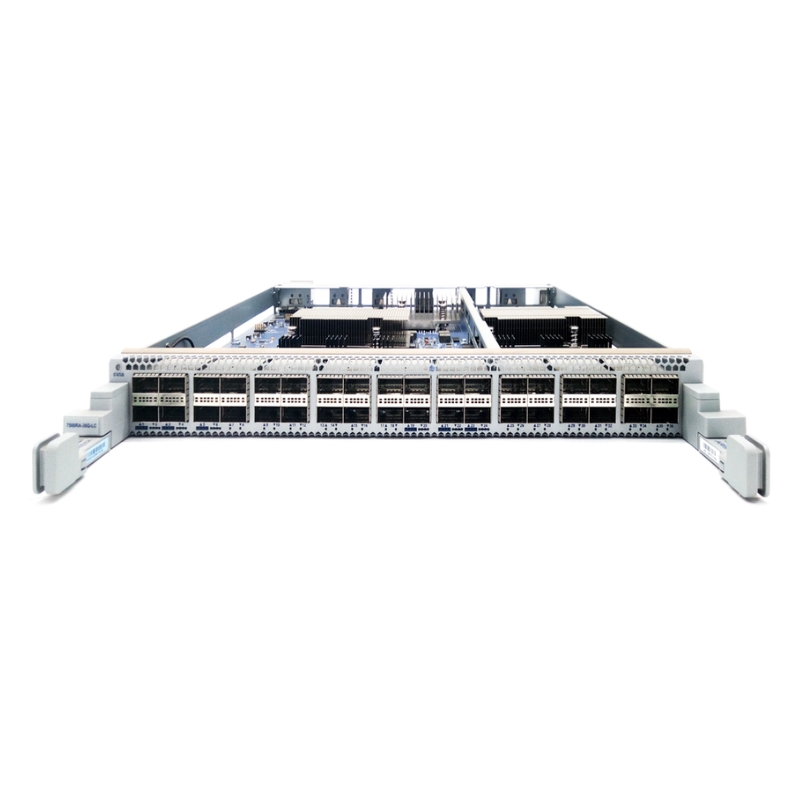
Arista DCS-7500RA-36Q-LC 7500R Series 36 Ports 40GBE QSFP+ Switch Line Card. Excellent Refurbished with 1-Year Replacement Warranty
The Arista DCS-7500RA-36Q-LC is a high-performance line card engineered for the 7500R Series, offering 36 ports of 40 Gigabit Ethernet QSFP+. Built to deliver exceptional scalability and speed, this switch line card ensures seamless integration into demanding enterprise and data center environments. Its robust design supports advanced networking needs, making it a reliable solution for organizations requiring efficient traffic handling and superior connectivity.
The Arista DCS-7500RA-36Q-LC 7500R Series 36 Ports 40GBE QSFP+ Switch Line Card represents a specialized switching infrastructure component engineered to address hyperscale data center demands where predictable performance, deep buffering, and high-capacity forwarding must operate continuously under intensive workloads. Designed for deployment within modular chassis environments, this line card delivers a powerful balance between throughput scalability and deterministic latency behavior required in large-scale enterprise, cloud, and service provider networks. The architecture focuses on maintaining consistent packet delivery even during congestion-heavy east-west traffic flows, ensuring uninterrupted data exchange across compute clusters, storage fabrics, and virtualization platforms. High-performance switching environments increasingly rely on modular expansion capabilities, allowing organizations to grow network capacity without disruptive infrastructure replacement. This line card functions as an integral forwarding element within the 7500R switching ecosystem, enabling seamless integration into spine aggregation layers and core routing domains.
Modern data centers depend heavily on predictable packet delivery to maintain application performance consistency. The switching silicon embedded within this line card supports high-scale forwarding tables combined with hardware-based packet inspection mechanisms capable of maintaining line-rate performance across all ports simultaneously. Traffic forwarding is optimized through distributed processing, minimizing bottlenecks commonly associated with centralized switching architectures. The forwarding pipeline enables deep visibility into packet flows without introducing performance degradation, supporting real-time routing decisions even under burst-heavy workloads such as storage replication, virtualization migration, and distributed computing traffic. High-performance buffering mechanisms allow the system to absorb microbursts and congestion events while preventing packet loss, a requirement especially important in financial platforms, scientific computing, and high-frequency transaction systems.
Network congestion remains one of the most significant challenges within high-throughput environments. The deep buffer architecture incorporated into this switch line card enhances traffic fairness across applications by intelligently allocating memory resources during peak demand periods. This capability ensures latency-sensitive workloads such as voice, video streaming, or real-time analytics remain unaffected by sudden traffic spikes generated elsewhere in the network.Dynamic queue allocation and adaptive congestion handling mechanisms enable networks to maintain stability without requiring extensive manual tuning. Packet prioritization policies operate directly within hardware, ensuring that mission-critical traffic maintains guaranteed delivery performance even when overall link utilization approaches maximum capacity.
The availability of thirty-six QSFP+ ports provides extensive connectivity flexibility suitable for aggregation layers and spine switching roles. Each interface supports high-speed Ethernet connectivity designed to interconnect servers, storage arrays, and additional switching platforms with minimal latency overhead. The density achieved through this configuration allows network architects to consolidate infrastructure while reducing rack space consumption and cabling complexity.
QSFP+ interfaces support a wide variety of optical transceivers and direct attach cable solutions, enabling administrators to tailor connectivity according to distance requirements and performance objectives. Short-range copper connectivity provides cost-efficient intra-rack communication, while long-range optical modules facilitate cross-building or metro-scale data transport.
This switch line card supports integrated Layer 2 switching and advanced Layer 3 routing functionality, allowing organizations to deploy unified network architectures capable of handling massive route tables and complex segmentation requirements. Hardware-based routing acceleration ensures that forwarding performance remains unaffected even when routing scale expands dramatically across multiple tenants or services. Support for large routing domains allows seamless operation within enterprise WAN aggregation points and carrier-grade backbone environments. High-scale route processing enables efficient interconnection between internal network segments and external connectivity providers without introducing additional latency.
Virtualized workloads require network abstraction mechanisms capable of isolating tenant traffic while maintaining efficient transport across shared infrastructure. VXLAN-based overlays enable scalable network segmentation without the limitations of traditional VLAN boundaries. Hardware-assisted encapsulation and decapsulation processes ensure overlay networking operates at full line rate, eliminating performance penalties commonly associated with software-based tunneling implementations.
Within leaf-spine architectures, the line card functions effectively as a high-capacity spine or core switching element responsible for aggregating massive east-west traffic volumes. Its throughput capabilities allow thousands of servers to communicate simultaneously without oversubscription constraints. The predictable latency profile ensures application synchronization remains stable even during high-volume workload orchestration events.
Data replication and disaster recovery strategies frequently require high-speed connectivity between geographically separated facilities. The line card’s forwarding performance and routing scale make it suitable for data center interconnect deployments where large datasets must traverse extended networks reliably. Low packet loss characteristics enhance storage synchronization efficiency and reduce retransmission overhead.
High-performance switching equipment must balance processing capability with energy efficiency to reduce operational expenditure. Intelligent power management within the line card dynamically adjusts consumption according to traffic demand, minimizing unnecessary energy usage during lower utilization periods. Efficient airflow design contributes to stable operating temperatures, enabling deployment within dense data center racks without excessive cooling requirements.
Energy-conscious hardware design aligns with organizational sustainability initiatives aimed at reducing carbon footprint and improving resource utilization. Extended hardware lifespan and upgradeable modular components reduce electronic waste while supporting evolving network requirements.


 Contact Us
 Information
 Catalog
 Solid State Drives (SSD)
 Network Switches
 Hard Disk Drives
 HBA & Controllers
 PC & Servers
 PC & Server Memory
 CPU & Processors
 Network Routers
 Power Supplies
 Tape Drives & Libraries
 Network Devices
 Computer & Network Cables