(7% discount is applied at checkout)
Cart is empty
Your go-to destination for cutting-edge server products
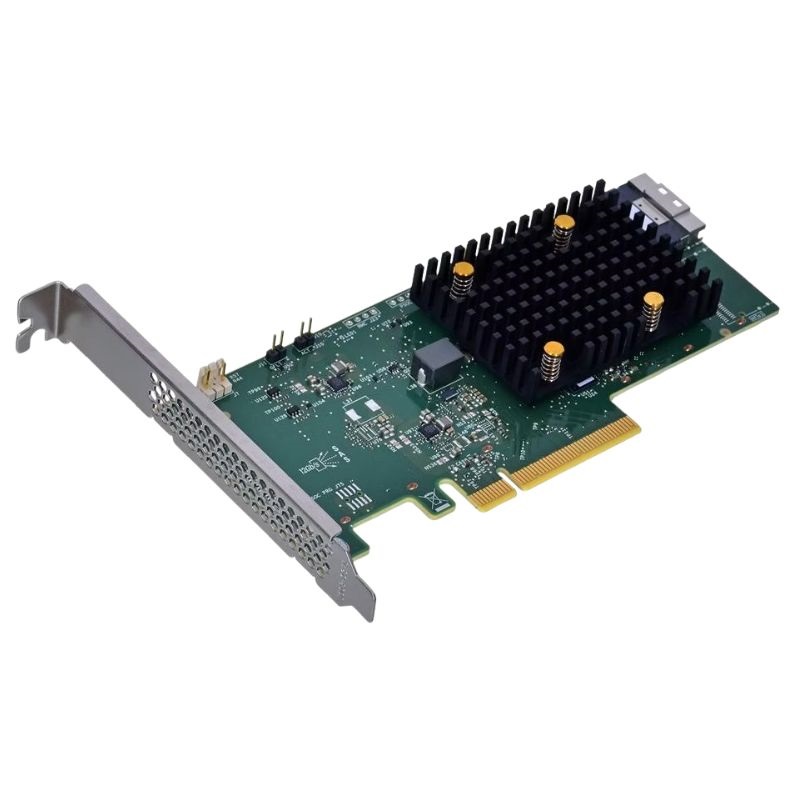


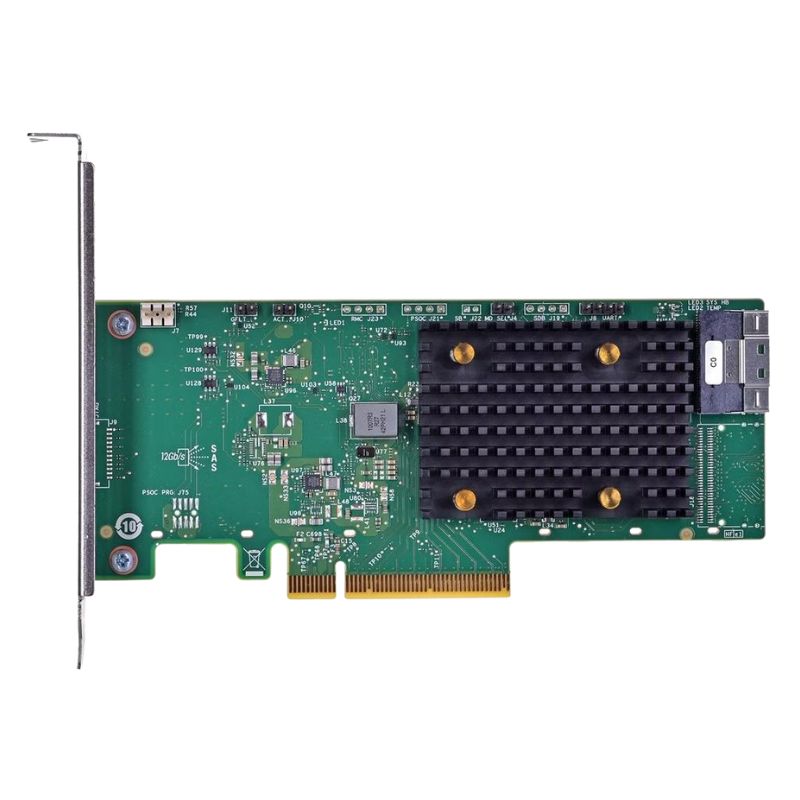
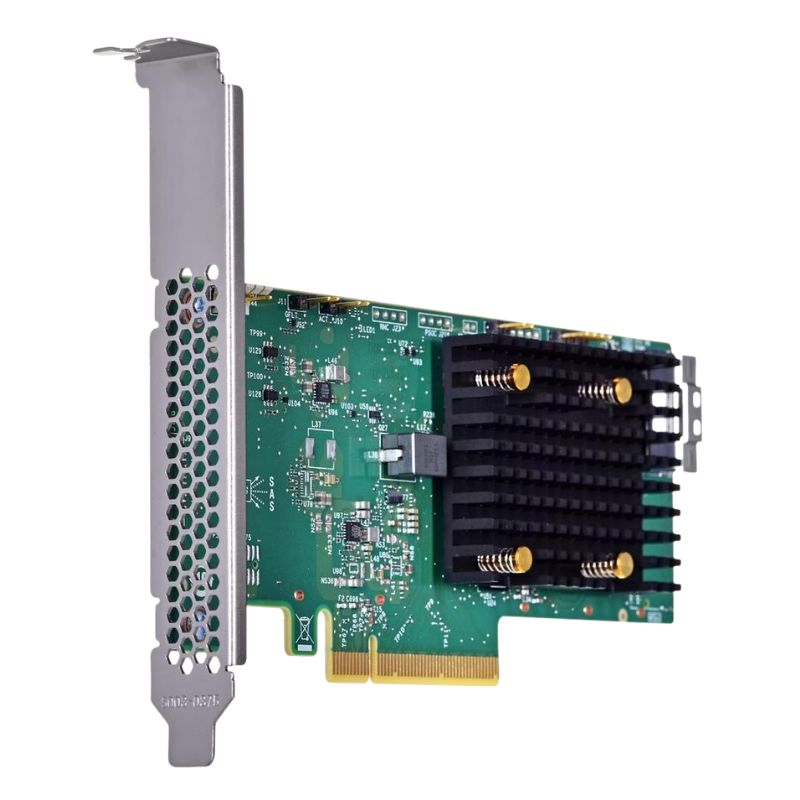
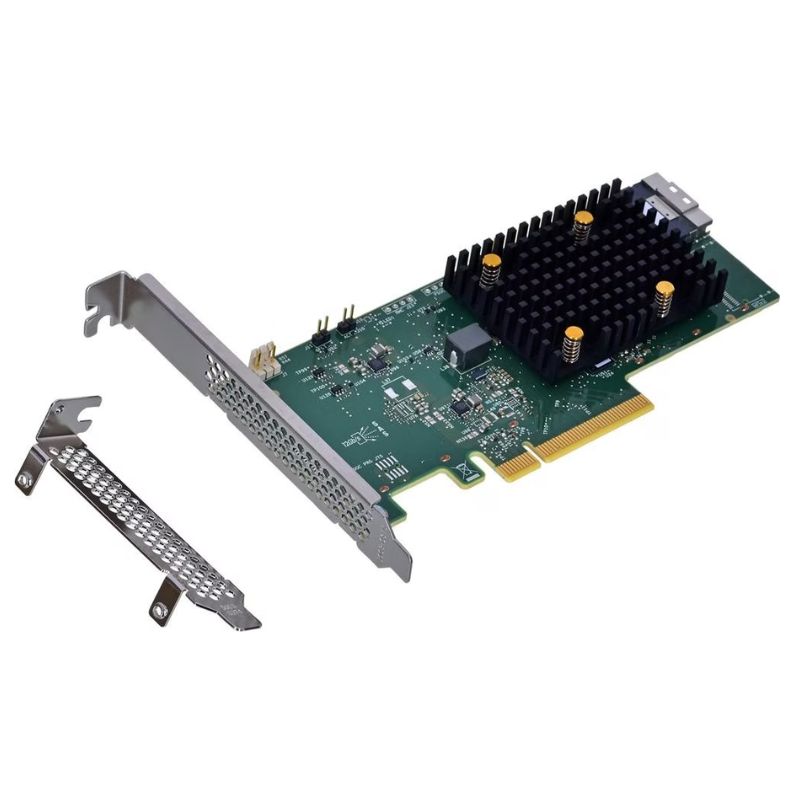
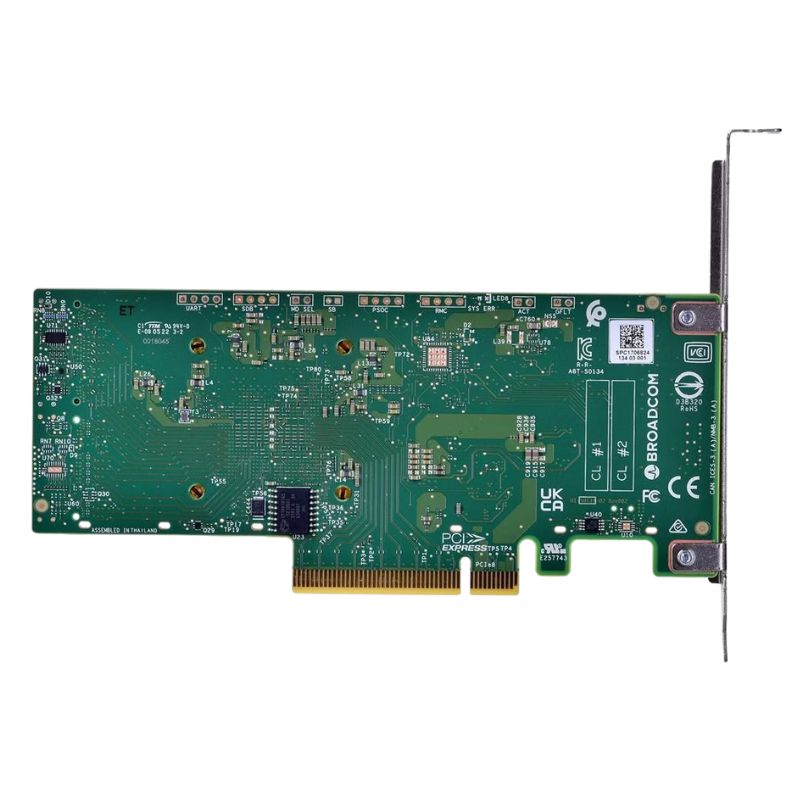
Broadcom 9520-8I Megaraid PCI-E 4.0 Raid Controller 8 Port SATA/SAS/NVMe – SAS 12GBPS, SATA 6GBPS, NVMe PCI-E Gen4 Sff-8654. New Sealed in Box (NIB) with 3 Years Warranty
Optimize storage throughput and resilience with the Broadcom 9520-8I MegaRAID controller — a high-performance, enterprise-grade RAID adapter supporting SATA, SAS and NVMe devices over PCI-Express Gen4. Engineered for demanding data-center workloads, this low-profile PCIe 4.0 x8 card combines multi-protocol connectivity, advanced data-protection features and robust management utilities to deliver reliable, low-latency storage acceleration.
This controller is widely compatible with major server and hypervisor ecosystems, making it suitable for heterogeneous deployments and mixed operating-system environments.
The Broadcom 9520-8I MegaRAID PCIe 4.0 RAID controller category represents a high-performance family of server-class storage controllers engineered to unify, accelerate, and secure mixed storage environments. This category centers on controllers designed for enterprise and prosumer deployments where throughput, low latency, and robust data protection are required. The Broadcom 9520-8I particularly addresses the needs of modern data centers, virtualization platforms, high-performance computing clusters, and content-delivery storage arrays by supporting simultaneous connectivity for SATA, SAS, and NVMe devices. By integrating PCIe Gen4 bandwidth, SAS 12Gb/s signaling, SATA 6Gb/s compatibility, and NVMe passthrough capabilities through the SFF-8654 interface, this product category delivers a blend of legacy compatibility and next-generation performance that keeps storage infrastructures future-ready.
Controllers in this category are built on PCI Express 4.0 architectures that double the per-lane bandwidth compared with the previous generation, enabling aggregate I/O throughput that suits high-density NVMe arrays and mixed-drive configurations. The Broadcom 9520-8I family typically supports eight internal ports via the SFF-8654 mini-SAS HD connector, allowing administrators to attach a variety of drive types: 12Gb/s SAS HDDs and SSDs for high reliability and capacity, 6Gb/s SATA drives for cost-efficient storage, and NVMe devices for ultra-low latency and extreme IOPS. The controller implements advanced RAID levels, hardware offload engines for parity calculations, and enterprise-grade features like persistent cache protection, power-loss data integrity, and end-to-end data path protection to reduce the risk of corruption during failure events.
Compatibility is a central theme in this category. The Broadcom 9520-8I is engineered to be compatible with a broad spectrum of server platforms, chassis backplanes, and storage arrays. Using the SFF-8654 interface enables easy connection to modern backplanes and breakout cables for direct-drive arrays. The controller's support for SAS, SATA, and NVMe means migration paths are smoother when replacing spinning media with flash, or when mixing HDDs and SSDs to create tiered storage solutions. Firmware ecosystems and management tools typically accompany these controllers, offering cross-platform drivers for major operating systems and hypervisors to ensure stability and predictable behavior in heterogeneous server farms.
Performance in this category is characterized by three primary metrics: aggregate throughput, random IOPS, and latency. PCIe Gen4 connectivity unlocks higher bandwidth headroom, which is vital when several high-speed NVMe drives are attached. For mixed workloads with heavy random reads and writes, the controller’s hardware RAID processing and caching mechanisms improve sustained performance and reduce write amplification on SSDs. The SAS 12Gb/s channels support high sustained throughput for enterprise SSDs and HDDs, while the SATA 6Gb/s lanes ensure compatibility with legacy drives without introducing bottlenecks. Low-latency NVMe devices can be deployed in passthrough or in RAID configurations where supported; this enables ultra-responsive database workloads and latency-sensitive applications such as real-time analytics and virtualization.
One of the defining advantages of the Broadcom 9520-8I class is the onboard hardware acceleration for RAID parity calculation and data protection tasks. By offloading parity and rebuild computations to dedicated ASIC engines, the controller minimizes CPU utilization on the host, allowing application processors to focus on core workloads. This offload capability dramatically shortens rebuild times following a drive failure, reducing the exposure window to additional failures. In flash-heavy deployments, the controller’s features are tuned to protect SSD endurance and maintain consistent performance through garbage collection-friendly write patterns and optimized I/O scheduling.
Reliability features are paramount in this category. The Broadcom 9520-8I controllers commonly include mechanisms for battery-free persistent cache (BBU-less NV cache or supercapacitor-based solutions) which ensure that in-flight writes are committed to non-volatile storage in the event of power loss. Error detection and correction protocols, end-to-end data integrity checks, and support for T10 DIF/DIX (when applicable) help protect data across the entire data path. RAID levels supported typically include 0, 1, 5, 6, 10, 50, and 60, providing flexible trade-offs between capacity, performance, and redundancy. Advanced management features such as snapshot-aware rebuilds, dedicated hot-spare management, and predictive drive failure alerts further elevate the category’s suitability for mission-critical deployments.
Available options within this category enable architects to craft resilient storage subsystems. Controllers often operate as part of a high-availability design, integrating with host operating system clustering, virtualization failover, and remote replication software. Hardware-level support for multiple hot spares, background consistency checks, and controlled rebuild throttling ensures that cluster performance remains steady while degraded arrays are restored. Many Broadcom-based controllers also support online firmware updates and hot firmware activation, reducing maintenance windows and enabling non-disruptive upgrades in production environments.
The Broadcom 9520-8I category serves a variety of use cases. In virtualization and cloud infrastructure, it provides consistent storage performance to VMs and containers while offering the resilience required by multi-tenant platforms. For database workloads, the mix of NVMe and SAS devices allows architects to place log and index files on NVMe for low-latency access while keeping bulk data on high-capacity SAS drives. Content delivery networks and media streaming infrastructures leverage the high sequential throughput for large file reads, while analytics platforms benefit from the controller’s random IOPS capabilities. Backup appliances, archival servers, and cold-storage gateway appliances also find value in the combination of SATA compatibility and SAS enterprise features when cost-efficiency and scale are priorities.
Although often associated with larger data centers, this category is also appropriate for small business and edge computing environments that need enterprise-level features. Edge servers that run analytics, video surveillance, or localized caching can benefit from the controller’s compact eight-port design which offers a balance between connectivity and cost. For remote offices or branch locations, the controller simplifies the deployment of mixed-media arrays that can be centrally managed through integrated tools, reducing the need for specialized local IT staff.
Tiered storage strategies are common within this product family. Organizations can create high-performance tiers using NVMe devices attached directly through the controller while assigning colder, capacity-oriented tiers to SAS or SATA drives. Automated tiering software or manual policy-driven allocation can thus place frequently accessed data on the fastest media while relegating seldom-accessed objects to economical drives. This hybrid approach provides a cost-effective way to accelerate key workloads without the expense of equipping all storage with the fastest media.
Management and integration capabilities are essential elements that differentiate controllers in this category. Broadcom MegaRAID solutions ship with comprehensive tools for provisioning, monitoring, and firmware management. These tools provide administrators with a granular view into array health, drive statistics, throughput metrics, and event logs. Integration into existing monitoring frameworks and automation stacks is typically accomplished through standard interfaces such as SNMP, RESTful APIs, and command-line utilities. Vendor-certified drivers and firmware updates ensure compatibility with major server vendors and hypervisor platforms, simplifying procurement and deployment.
Firmware is the control plane of a RAID controller, and the category emphasizes regular updates to address performance enhancements, security patches, and compatibility improvements. Secure firmware update mechanisms and cryptographic signing are often used to guard against tampering. Administrators should adopt a disciplined maintenance cadence for firmware where updates are tested in staging environments before rolling into production. Additionally, role-based access controls for management interfaces and secure communication channels (such as HTTPS and secure SNMP) are recommended practices to protect the storage plane from unauthorized changes.
Proactive monitoring is a significant differentiator. The Broadcom 9520-8I family supports telemetry that drives predictive analytics to flag early signs of drive degradation or thermal anomalies. By analyzing SMART attributes, read/write error rates, and latency trends, administrators can replace components on their own terms rather than waiting for catastrophic failure. This predictive maintenance approach improves uptime and reduces the total cost of ownership by avoiding emergency replacements and unplanned downtime.
Capacity planning within this category requires a thoughtful examination of drive mix, RAID level overhead, and future growth trajectories. The eight internal ports of the 9520-8I provide a compact footprint suitable for dense servers or chassis that support multiple controllers. For larger arrays, controllers can be cascaded via expanders or used in conjunction with external JBODs to scale beyond the native port count. Effective capacity planning must account for RAID overhead, hot-spare allocation, and expected rebuild times; selecting higher RAID protection levels, though improving redundancy, requires additional capacity and increases rebuild workload during recovery scenarios. Hybrid topologies that combine high-capacity spinning media with flash caches or NVMe tiers offer a predictable path to scale while maintaining performance for critical workloads.
Thermal design and power consumption are practical concerns when deploying multiple controllers and high-density storage media. NVMe drives, while offering superior performance, generate more heat than SATA drives under sustained I/O. The category therefore benefit from chassis designs with proactive airflow and thermal monitoring. Power provisioning must accommodate the startup current and steady-state power of attached devices as well as the controller’s own power needs. Manufacturers will often publish thermal and electrical specifications which should be consulted to ensure reliable operation, especially in blade server or compact form factor deployments.


 Contact Us
 Information
 Catalog
 Solid State Drives (SSD)
 Network Switches
 Hard Disk Drives
 HBA & Controllers
 PC & Servers
 PC & Server Memory
 CPU & Processors
 Network Routers
 Power Supplies
 Tape Drives & Libraries
 Network Devices
 Computer & Network Cables