
(7% discount is applied at checkout)
Cart is empty
Your go-to destination for cutting-edge server products
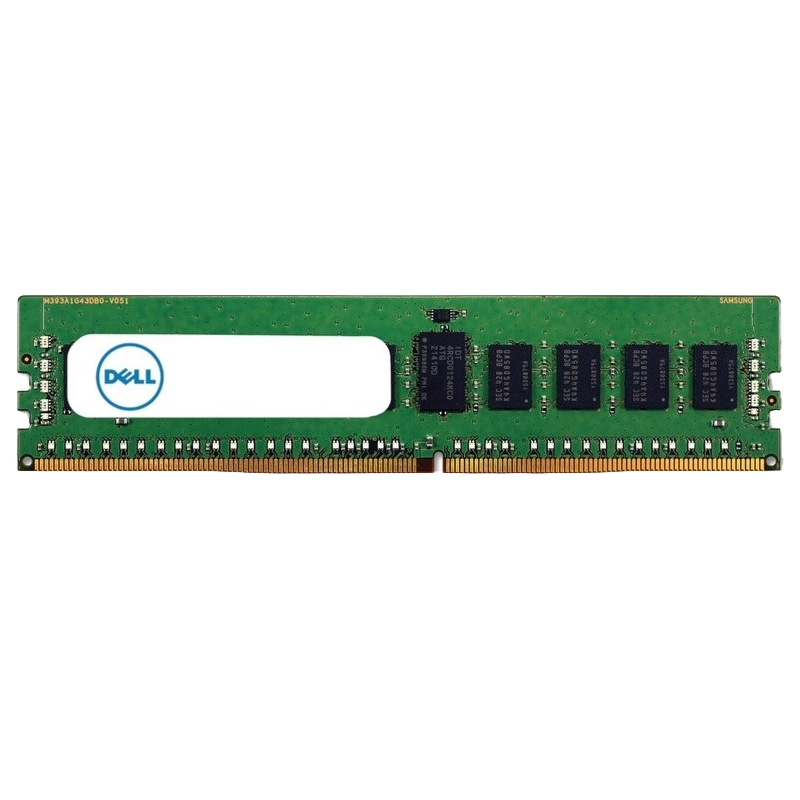
Dell 370-BBQN 32GB Memory 3200Mhz Pc4-25600 Ecc Ddr4 Sdram 288-pin Rdimm for Servers. New (System) Pull with 1 year replacement warranty
DDR4 SDRAM (Double Data Rate 4 Synchronous Dynamic Random-Access Memory) represents the fourth generation of DDR memory technology, offering significant improvements over previous DDR3 modules. Operating at lower voltages while delivering higher speeds and increased efficiency, DDR4 has become the standard for modern server environments, workstations, and high-performance computing systems. The Dell 370-BBQN utilizes this advanced memory technology to provide reliable performance for demanding server applications.
The architectural design of DDR4 memory incorporates several key innovations that differentiate it from earlier generations. These include bank group architecture that allows for improved efficiency in memory access patterns, higher prefetch lengths that enable greater data transfer rates per clock cycle, and enhanced command buses that reduce overall latency. The 288-pin physical interface of DDR4 modules represents a fundamental change from DDR3's 240-pin design, making the modules physically incompatible with previous generation memory controllers and motherboards.
Operating at just 1.2 volts compared to DDR3's 1.5V standard, DDR4 memory delivers substantial power savings, which is critically important in data center environments where energy consumption directly impacts operational costs. The reduced voltage also contributes to lower heat generation, allowing for more stable operation and reduced cooling requirements. The Dell 370-BBQN maintains this 1.2V operating voltage while delivering consistent performance across various server workloads.
Error Correcting Code (ECC) memory represents a critical technology for server environments where data integrity is paramount. The Dell 370-BBQN incorporates ECC technology that can detect and correct single-bit memory errors in real-time, preventing data corruption and system crashes that could result from memory faults. This capability is essential for applications involving financial transactions, database management, scientific computing, and any scenario where data accuracy cannot be compromised.
ECC memory modules include additional memory chips that store special codes used to verify the accuracy of data being written to or read from memory. For every 64 bits of data, ECC memory typically stores an additional 8 bits of error correction code, creating what is known as 72-bit memory architecture. When data is read from memory, the ECC circuitry checks the integrity of the data using these codes and automatically corrects any single-bit errors it detects. The system can typically detect, though not correct, multi-bit errors, alerting administrators to potential memory hardware issues before they cause system failures.
The Dell 370-BBQN is classified as a Registered DIMM (RDIMM), which incorporates memory registers between the memory controller and the DRAM chips. These registers buffer command, address, and control signals, reducing the electrical load on the memory controller and enabling support for higher memory capacities per channel. This architecture is particularly beneficial in server environments where large memory configurations are necessary for virtualization, database applications, and other memory-intensive workloads.
Registered memory provides several distinct advantages in server configurations. By reducing the electrical load on the memory controller, RDIMMs allow systems to support more memory modules per channel while maintaining signal integrity and system stability. This capability enables servers to achieve much higher total memory capacities compared to systems using unbuffered memory. Additionally, the registered design typically allows for higher clock speeds in large memory configurations, making RDIMMs the preferred choice for performance-oriented server applications.
Server memory comes in three primary types: Registered DIMMs (RDIMMs), Unbuffered DIMMs (UDIMMs), and Load Reduced DIMMs (LRDIMMs). UDIMMs lack the registering buffers found in RDIMMs, making them less expensive but limited in capacity and speed for large configurations. LRDIMMs take the concept further by using isolation memory buffers that reduce the electrical load even more than RDIMMs, enabling the highest possible memory capacities. The Dell 370-BBQN's RDIMM design strikes an optimal balance between performance, capacity, and cost for most enterprise server applications.
The Dell 370-BBQN provides a substantial 32GB memory capacity using a single 32GB module. This single-module configuration offers flexibility for memory upgrades, allowing system administrators to incrementally increase total system memory without requiring complete memory replacement. The module's design as a dual-rank DIMM provides performance benefits over single-rank modules of equivalent capacity while maintaining compatibility with a wide range of server platforms.
Dual rank memory modules contain two sets of memory chips that are accessed separately, though they share the same memory channel. This architecture allows the memory controller to access one rank while preparing the other for the next operation, effectively hiding some of the latency associated with memory access. The Dell 370-BBQN's dual rank design provides better performance compared to single-rank modules in most server workloads, particularly those involving random access patterns and multiple simultaneous memory operations.
Operating at 3200MHz (PC4-25600), the Dell 370-BBQN delivers high-speed data transfer capabilities essential for modern server applications. The 3200MHz speed refers to the module's data rate, indicating it can perform 3.2 billion transfers per second. The PC4-25600 designation specifies the peak transfer rate of 25,600 MB/s, calculated by multiplying the bus speed (3200MT/s) by the data width (64 bits) and converting to megabytes per second.
The Dell 370-BBQN features a CAS Latency (CL) of 22, which indicates the number of clock cycles between when a read command is issued and when the data becomes available. While higher CAS latency numbers might suggest slower performance, they must be considered in the context of the memory's clock speed. At 3200MHz, the actual time delay for CL22 is comparable to lower latency values at slower speeds. The module operates with standard DDR4 timing parameters optimized for server reliability and compatibility rather than extreme performance.
In server environments, memory performance is influenced by multiple factors beyond raw speed specifications. The combination of 3200MHz operating frequency, ECC functionality, registered architecture, and dual-rank design in the Dell 370-BBQN creates a balanced profile suitable for diverse server workloads. Applications benefiting from this configuration include database management systems, virtualization platforms, content delivery networks, and enterprise resource planning systems where consistent, reliable performance is more critical than peak theoretical bandwidth.
The Dell 370-BBQN is exceptionally well-suited for virtualization environments where memory capacity and reliability directly impact the number of virtual machines that can be hosted on a single physical server. Virtualization platforms like VMware vSphere, Microsoft Hyper-V, and Citrix Hypervisor benefit from the module's ECC protection, which helps prevent guest VM corruption, and its registered design, which supports the large memory configurations necessary for consolidation. The 32GB capacity per module provides flexibility in allocating memory to virtual machines while maintaining adequate resources for the hypervisor.
In technical computing environments, including scientific research, engineering simulation, financial modeling, and media rendering, the Dell 370-BBQN provides the reliable high-capacity memory necessary for processing large datasets. Applications such as finite element analysis, computational fluid dynamics, genomic sequencing, and climate modeling often require substantial memory resources to hold complex models and datasets in memory during computation. The module's ECC functionality is particularly valuable in these scenarios where computational accuracy cannot be compromised.
Modern enterprise resource planning (ERP), customer relationship management (CRM), and supply chain management systems typically operate most efficiently with ample memory resources. The Dell 370-BBQN supports these memory-intensive business applications by enabling large memory configurations that keep frequently accessed data readily available, reducing dependency on slower storage systems. The reliability features of ECC memory help ensure business continuity by preventing memory-related system crashes that could disrupt critical business operations.
To maximize performance when using the Dell 370-BBQN, follow the memory population guidelines specific to your server model. Most Dell servers implement multi-channel memory architectures that require specific slot population sequences to achieve optimal memory bandwidth. Proper configuration ensures that memory channels are balanced and operating in the intended multi-channel mode. Additionally, ensure that the server firmware is updated to the latest version, as updates often include memory compatibility improvements and performance optimizations.
When planning memory upgrades with the Dell 370-BBQN, consider both current requirements and anticipated future needs. The 32GB capacity per module provides significant expansion capability, but total system memory limits depend on the server model and processor configuration. Also consider the memory requirements of specific applications and operating systems, as some software licenses are tied to memory capacity. Proper capacity planning helps avoid premature hardware refresh cycles while ensuring adequate performance for projected workloads.


 Contact Us
 Information
 Catalog
 Solid State Drives (SSD)
 Network Switches
 Hard Disk Drives
 HBA & Controllers
 PC & Servers
 PC & Server Memory
 CPU & Processors
 Network Routers
 Power Supplies
 Tape Drives & Libraries
 Network Devices
 Computer & Network Cables