
(7% discount is applied at checkout)
Cart is empty
Your go-to destination for cutting-edge server products
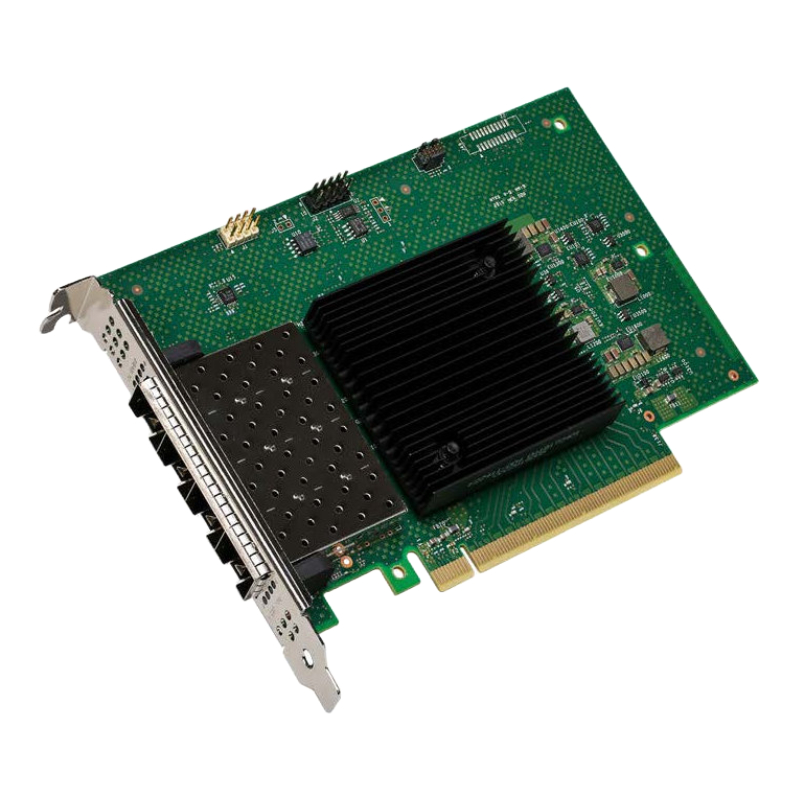
Dell Y1DY8 Intel E810 Quad Port Adapter 10/25GPBS SFP28 PCI-Express. New Sealed in Box (NIB)
The Dell Y1DY8 Intel E810 Quad-Port Adapter is a powerful enterprise-class networking card engineered for high-performance data centers and cloud-scale infrastructures. Built on Intel’s advanced E810 architecture, it delivers ultra-fast connectivity, intelligent hardware offloads, and scalable multi-port bandwidth optimization for modern virtualized environments.
The Dell Y1DY8 Intel E810 Quad Port Adapter 10/25Gbps SFP28 PCI-Express belongs to a highly specialized category of enterprise-grade network interface cards designed for high-density data center environments, cloud-scale computing, and mission-critical virtualization infrastructures. This category is defined by advanced multi-port Ethernet connectivity, hardware-accelerated packet processing, and flexible bandwidth scaling across 10GbE and 25GbE network fabrics. It is engineered to meet the evolving requirements of modern IT architectures where network throughput, latency reduction, and deterministic performance are essential.
At the core of this category lies the Intel Ethernet E810 controller, which is engineered to support multi-lane high-speed Ethernet connectivity with advanced hardware offloading capabilities. The controller is optimized for handling multiple simultaneous data streams across four independent ports, each capable of operating at 10Gbps or 25Gbps using SFP28 optical transceivers. This architecture significantly reduces CPU overhead by offloading packet processing tasks such as checksum calculations, segmentation, and routing directly to the hardware.
The E810 controller also introduces advanced telemetry and adaptive load balancing capabilities, which dynamically distribute network traffic across available ports. This ensures consistent performance even under unpredictable workload conditions commonly found in cloud computing environments and virtualized data centers.
The quad port design of the Dell Y1DY8 adapter enables four independent network channels to operate simultaneously. Each port is physically isolated yet logically integrated, allowing for parallel data processing that enhances throughput and redundancy. This design is particularly beneficial in environments requiring high availability and fault tolerance, as traffic can be rerouted instantly in case of port failure without service disruption.
The architecture supports both link aggregation and independent channel operation, providing flexibility for different deployment scenarios such as storage networks, compute clusters, and hybrid cloud architectures.
The use of SFP28 transceiver interfaces defines this category as part of next-generation high-speed networking solutions. SFP28 modules provide enhanced signal integrity and support both copper and fiber-based transmission media. This allows organizations to customize their networking infrastructure based on distance, bandwidth, and environmental requirements.
In dense data center deployments, SFP28-based connectivity ensures reduced latency and improved power efficiency compared to older SFP+ architectures, making it a preferred choice for modern enterprise networks.
One of the defining features of the Dell Y1DY8 Intel E810 Quad Port Adapter category is its ability to support both 10Gbps and 25Gbps Ethernet speeds. This dual-speed capability enables seamless integration into heterogeneous network environments where legacy systems coexist with modern high-speed infrastructure. Administrators can configure each port independently, allowing gradual migration to higher bandwidth without requiring complete infrastructure replacement.
This flexibility is particularly valuable in enterprise data centers undergoing phased upgrades, where cost efficiency and operational continuity are critical considerations.
Latency optimization is a fundamental design principle in this category of network adapters. By leveraging hardware acceleration engines embedded within the Intel E810 controller, packet processing delays are significantly reduced. Tasks such as packet segmentation, checksum validation, and routing decisions are executed at the hardware level, minimizing reliance on CPU resources.
This results in highly predictable network behavior, which is essential for applications such as high-frequency trading, real-time analytics, and distributed database synchronization.
The adapter employs intelligent interrupt moderation techniques that reduce the frequency of CPU interrupts generated by network events. This optimization ensures that system resources are not overwhelmed during high traffic bursts. Instead, the adapter aggregates network events and processes them in optimized batches, improving overall system efficiency and throughput consistency.
Adaptive load distribution ensures that traffic is dynamically balanced across all four ports based on real-time network conditions. This prevents congestion and ensures that no single port becomes a bottleneck. The system continuously evaluates traffic patterns and adjusts routing decisions accordingly, maintaining optimal performance across all network paths.
Single Root I/O Virtualization (SR-IOV) is a key technology integrated into this category of adapters. It enables a single physical network interface to be partitioned into multiple virtual interfaces, each of which can be assigned directly to virtual machines. This eliminates hypervisor overhead and provides near-native network performance for virtualized workloads.
In large-scale cloud environments, SR-IOV significantly improves network efficiency by reducing context switching and CPU utilization, thereby increasing the density of virtual machines that can be supported per server.
The Data Plane Development Kit (DPDK) compatibility of this adapter category allows applications to bypass traditional kernel networking stacks and process packets directly in user space. This architecture dramatically increases packet throughput and reduces latency, making it ideal for network function virtualization (NFV) and software-defined networking (SDN) deployments.
DPDK-enabled environments benefit from deterministic performance characteristics, which are essential for telecom infrastructure and high-performance computing workloads.
Modern cloud-native applications rely heavily on microservices architectures, container orchestration platforms, and distributed processing frameworks. This adapter category is optimized for such environments by providing consistent network performance across dynamically scaling workloads. It ensures that containerized applications can communicate efficiently without network bottlenecks.
In modern data centers, rack density is a critical factor influencing infrastructure design. Quad port adapters like the Dell Y1DY8 are specifically engineered to maximize port density per server, reducing the need for additional physical NICs and minimizing cabling complexity. This contributes to more efficient airflow management and improved thermal performance within server racks.
Redundancy is a core requirement in enterprise networking environments. The quad port design enables multiple failover paths, ensuring uninterrupted connectivity even in the event of hardware or link failure. This is essential for mission-critical applications where downtime is unacceptable.
This adapter category is widely used in storage networking environments that rely on protocols such as iSCSI and NVMe-over-Fabrics. Its high throughput and low latency characteristics ensure efficient data transfer between compute nodes and storage arrays, reducing bottlenecks in distributed storage systems.
By leveraging hardware acceleration, the adapter minimizes overhead in storage communication protocols, improving overall input/output performance for database systems and virtualization platforms.
In environments using distributed file systems, the quad port architecture ensures parallel data transfer across multiple nodes. This significantly improves read and write performance for large-scale datasets commonly used in analytics, machine learning, and scientific computing workloads.
Security is a fundamental requirement in enterprise networking. This adapter category supports hardware-based encryption acceleration, allowing secure data transmission without placing additional load on the CPU. This is particularly important for environments handling sensitive financial, healthcare, or governmental data.
Encryption processes are executed directly within the network controller, ensuring minimal latency impact while maintaining high security standards.
Quad port SFP28 adapters generate significant heat due to their high-speed operation. To maintain stable performance, this category incorporates advanced thermal management systems that optimize heat distribution across the adapter surface. This ensures reliable operation even under sustained high-load conditions.
Dynamic power management algorithms adjust energy consumption based on real-time network load. This reduces power usage during low traffic periods while ensuring full performance availability during peak demand. This balance between efficiency and performance is critical for large-scale data center operations.
Administrators can monitor traffic flow across all four ports in real time, gaining insights into bandwidth utilization, error rates, and packet distribution. This visibility is essential for maintaining optimal network health and identifying potential performance issues before they impact operations.
Remote management capabilities allow administrators to configure adapter settings without physical access to servers. This is particularly beneficial in distributed data center environments where hardware may be located across multiple geographic regions.
The Dell Y1DY8 Intel E810 Quad Port Adapter category is designed for scalability, allowing organizations to expand their network infrastructure without significant redesign. Its support for multiple speed configurations ensures compatibility with both existing and future network standards.
This future-proof design approach makes it suitable for long-term enterprise IT strategies focused on incremental scalability and cost optimization.
In high-density computing environments, where thousands of virtual machines or containers operate simultaneously, this adapter category ensures consistent network performance by distributing traffic efficiently across all available ports.
Workload isolation ensures that network performance for one application does not negatively impact others. This is achieved through hardware-level segmentation and traffic prioritization mechanisms that maintain consistent service levels across all workloads.


 Contact Us
 Information
 Catalog
 Solid State Drives (SSD)
 Network Switches
 Hard Disk Drives
 HBA & Controllers
 PC & Servers
 PC & Server Memory
 CPU & Processors
 Network Routers
 Power Supplies
 Tape Drives & Libraries
 Network Devices
 Computer & Network Cables