(7% discount is applied at checkout)
Cart is empty
Your go-to destination for cutting-edge server products


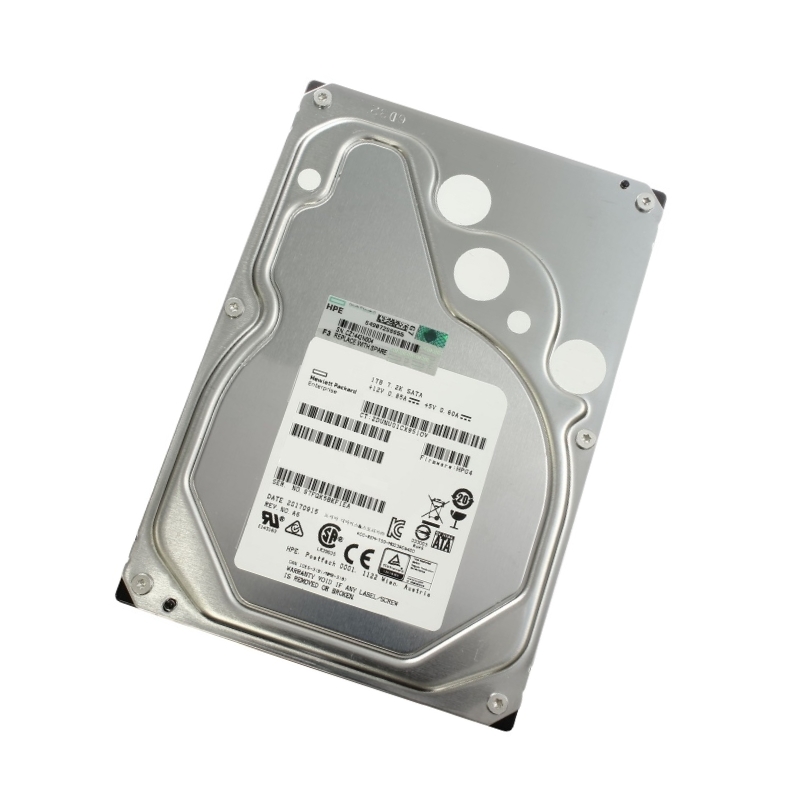
1TB 7.2K RPM HDD SATA 6GBPS Lff Non-Hot Plug HPE 843266-B21. Factory-Sealed New in Original Box (FSB) with 3 Years Warranty
The HPE 843266-B21 is a dependable enterprise-class internal hard disk drive designed for HPE ProLiant servers. With 1TB of storage, SATA 6Gbps connectivity, and 7,200 RPM spindle speed, this 3.5-inch LFF drive ensures reliable performance, efficient data handling, and seamless integration for business workloads.
The HPE 843266-B21 1TB 7200RPM SATA 6G LFF 3.5-Inch Non Hot Plug Entry 512e Hard Drive represents a highly reliable and cost-efficient enterprise storage solution engineered for data-intensive server environments. Designed for compatibility with Hewlett Packard Enterprise server ecosystems, this storage device is built to deliver stable performance, predictable latency, and long-term operational durability for entry-level enterprise workloads. The drive integrates a traditional spinning disk architecture with modern SATA 6Gbps interface technology, ensuring a balanced combination of capacity, reliability, and affordability suitable for business-critical infrastructures that require dependable storage without the premium cost of solid-state solutions.
This category of enterprise hard drives is widely used in data centers, small to mid-range server deployments, archival systems, and general-purpose storage arrays where consistent data access and sustained throughput are more important than extreme IOPS performance. The 1TB capacity provides a practical balance for organizations managing structured data, application logs, virtualized environments, and backup repositories.
The mechanical architecture of the HPE 843266-B21 drive is based on a precision-engineered spindle motor operating at 7200 revolutions per minute, enabling consistent rotational performance under continuous workloads. This rotational speed is optimized to deliver a balance between energy efficiency and data access speed, making it suitable for enterprise applications where predictable performance is more valuable than burst-level acceleration. The internal platters are designed with high-density magnetic recording technology, allowing efficient storage of large datasets while maintaining data integrity across long operational cycles.
The drive’s mechanical design is reinforced with vibration resistance mechanisms that reduce performance degradation in multi-drive server chassis environments. This ensures that when deployed in dense storage arrays, the drive maintains consistent read and write behavior even under thermal and mechanical stress conditions.
The SATA 6Gbps interface used in this hard drive provides a modernized communication channel between the storage device and the host server system. This interface supports theoretical maximum transfer rates of up to 6 gigabits per second, significantly improving data throughput compared to earlier SATA generations. In enterprise environments, this ensures smoother data streaming for applications such as backup processing, file sharing systems, and database storage layers.
The integration of SATA 6G technology also improves command queuing efficiency, allowing the drive to handle multiple simultaneous read and write requests with improved scheduling. This is particularly beneficial in multi-user environments where concurrent data access is frequent and system responsiveness is critical.
The HPE 843266-B21 is specifically validated for use within HPE ProLiant server infrastructures and storage arrays. This ensures firmware-level compatibility, optimized performance tuning, and reduced risk of system incompatibility issues. The validation process ensures that the drive operates seamlessly within HPE’s ecosystem, delivering predictable behavior in both standalone and RAID configurations.
The 512e (512-byte emulation) format allows the drive to present itself as a traditional 512-byte sector disk while internally utilizing advanced 4K physical sector structures. This design enables backward compatibility with legacy operating systems and applications while still benefiting from modern storage density improvements. It reduces overhead in data processing and ensures smoother integration into mixed-generation server environments.
The 7200RPM spindle speed is a critical performance factor that defines the responsiveness of the drive. At this rotational speed, the drive achieves a balanced approach between latency reduction and power consumption optimization. This makes it ideal for enterprise workloads that require continuous operation without excessive thermal output or energy usage.
Rotational latency is a key performance metric in mechanical drives, and the 7200RPM configuration ensures that data sectors become available for read or write operations within a predictable timeframe. This consistency is essential in enterprise environments where data predictability directly impacts application performance and user experience.
The sustained throughput of the HPE 843266-B21 drive is optimized for sequential read and write operations, making it suitable for large file transfers, backup operations, and archival storage systems. The SATA 6Gbps interface complements this capability by minimizing bottlenecks between the drive and the server controller, ensuring efficient data movement across the system.
The 3.5-inch Large Form Factor (LFF) design allows the drive to accommodate larger platters, which directly contributes to higher storage density and improved cost-per-gigabyte efficiency. This makes it a preferred choice for enterprise storage arrays where maximizing capacity within limited rack space is a key requirement. The larger form factor also supports better heat dissipation compared to smaller drive formats, contributing to extended operational lifespan.
Thermal management plays a critical role in enterprise storage reliability. The 3.5-inch structure provides improved airflow pathways within server chassis, enabling more effective heat dissipation during sustained workloads. This reduces the likelihood of thermal throttling and ensures stable performance even in high-density server configurations.
The drive is designed to fit seamlessly into HPE-supported server bays, ensuring secure mechanical alignment and stable connectivity. The LFF format supports standardized mounting mechanisms, reducing installation complexity and enabling easier maintenance in large-scale deployments.
The non hot plug configuration indicates that the drive is intended for systems where drive replacement is performed during system downtime rather than active operation. This design is particularly suited for entry-level enterprise servers, archival systems, and environments where continuous hot-swapping is not a primary requirement.
By eliminating hot-swap complexity, the drive architecture prioritizes mechanical stability and cost efficiency. This makes it highly suitable for controlled IT environments where maintenance windows are scheduled and system downtime is acceptable for hardware servicing.
The HPE 843266-B21 is widely deployed in entry-level enterprise systems where organizations require reliable storage without investing in advanced hot-plug infrastructure. It serves well in file storage servers, small business databases, application hosting systems, and backup repositories.
This hard drive category is particularly effective in file storage systems where large volumes of structured and unstructured data need to be retained over long periods. Its stable read and write performance ensures reliable access to archived data, making it suitable for compliance storage and long-term record retention systems.
In virtualized environments, the drive can support virtual machine storage layers that do not require high IOPS but demand consistent throughput. It is particularly effective in hosting secondary virtual machines, backup snapshots, and non-performance-critical workloads within a virtual infrastructure.
For small-scale databases and internal enterprise applications, the drive offers sufficient performance to handle query processing and transaction logging. While not designed for high-frequency transactional systems, it performs reliably in moderate database environments where stability is prioritized over speed.
Backup systems require large storage capacity combined with consistent write performance, and this drive meets those requirements effectively. It is commonly used in backup servers, disaster recovery storage pools, and replication systems where large data volumes are written sequentially over time.
Enterprise-grade error correction systems are integrated into the drive to ensure data integrity during long-term storage operations. These mechanisms reduce the risk of silent data corruption and ensure that stored information remains reliable over extended periods of inactivity.
The drive is fully compatible with RAID configurations commonly used in enterprise systems. It can be deployed in RAID 1, RAID 5, RAID 10, and other redundancy architectures to enhance data protection and system resilience. This ensures that even in the event of drive failure, data integrity is maintained through redundancy mechanisms.
When used with HPE storage controllers, the drive benefits from optimized firmware synchronization that enhances performance consistency and reduces latency variations. This integration ensures smooth communication between hardware layers within the storage ecosystem.
The drive supports scalable deployment strategies, allowing organizations to expand storage capacity incrementally without disrupting existing infrastructure. This makes it ideal for growing enterprises that require flexible storage expansion capabilities.


 Contact Us
 Information
 Catalog
 Solid State Drives (SSD)
 Network Switches
 Hard Disk Drives
 HBA & Controllers
 PC & Servers
 PC & Server Memory
 CPU & Processors
 Network Routers
 Power Supplies
 Tape Drives & Libraries
 Network Devices
 Computer & Network Cables