
(7% discount is applied at checkout)
Cart is empty
Your go-to destination for cutting-edge server products
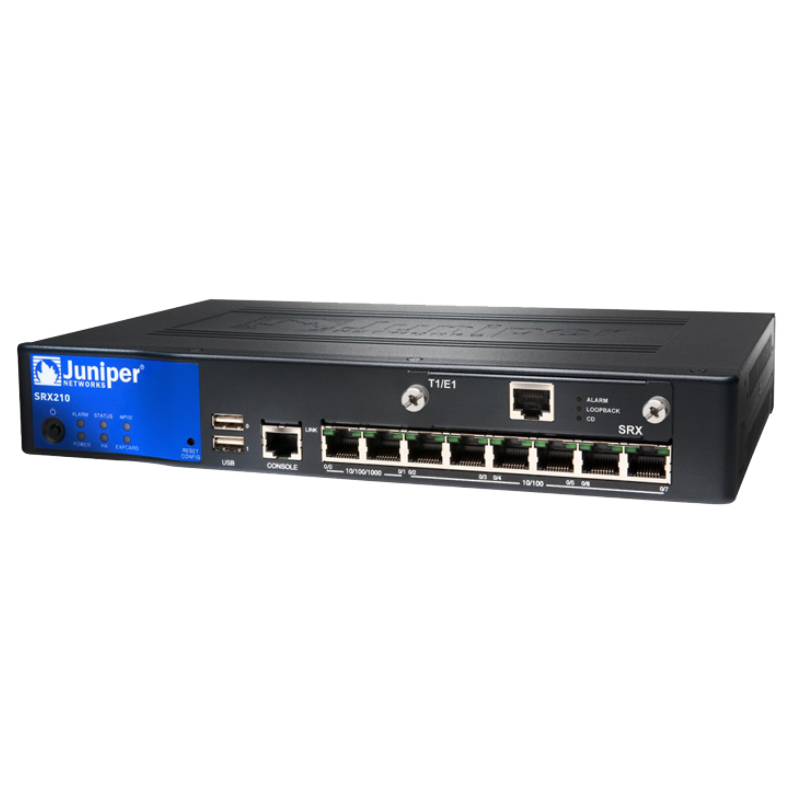
Juniper SRX210HE2 SRX210 Services Gateway High Memory Enhanced Security Appliance. New Sealed with 1 year replacement warranty
The Juniper SRX210HE2 SRX210 Services Gateway is a high-memory-enhanced security appliance engineered to deliver reliable network protection and efficient routing performance for branch and small enterprise environments. Built with advanced firewall capabilities and integrated networking intelligence, this model ensures secure data transmission while maintaining optimized throughput across multiple connected devices. Designed by Juniper Networks, it combines robust hardware architecture with scalable security features, making it suitable for modern business infrastructure that demands both performance and protection in a single unified platform.
The Juniper SRX210HE2 SRX210 Services Gateway High Memory Enhanced Security Appliance belongs to a class of integrated security devices designed to consolidate multiple network security and routing functions into a single compact platform. This category of services gateway is engineered to support secure connectivity for distributed enterprise environments, branch office deployments, and edge network infrastructures where space efficiency and unified control are essential.
Within the broader security appliance ecosystem, this model represents a high-memory enhanced variant of the SRX210 series, offering expanded resource capacity for handling more concurrent sessions, deeper inspection workloads, and more complex policy sets. The increased memory configuration plays a critical role in enabling stable performance under heavier traffic conditions and advanced security feature usage, making it suitable for organizations requiring consistent uptime and predictable throughput under dynamic network loads.
The enhanced memory design in the SRX210HE2 variant is a defining characteristic that differentiates it from baseline models in the same family. This additional memory allocation allows the system to maintain larger session tables, support extended firewall rule sets, and process more simultaneous VPN tunnels without degradation in performance. In environments where network traffic diversity is high, such as mixed application traffic and cloud-bound workloads, memory capacity directly impacts responsiveness and security processing efficiency.
The high memory architecture also improves the ability of the device to handle logging, buffering, and real-time analytics functions. These capabilities are especially important in security environments where rapid inspection of packets and consistent enforcement of policies must occur without introducing latency that could impact business applications.
The SRX210HE2 is designed with a compact integrated hardware structure that combines routing, switching, and security functions into a single unified appliance. This architecture reduces the need for multiple standalone devices and simplifies network topology at the edge. The internal design is optimized to distribute processing loads efficiently between control plane and data plane operations, ensuring that traffic inspection and routing decisions occur with minimal bottlenecks.
The hardware system is engineered for reliability and long operational life in branch and distributed environments. Its modular internal structure allows the device to manage multiple simultaneous services, including firewall policies, VPN encryption, NAT translation, and intrusion prevention functions.
The processing subsystem in this category is optimized for concurrent packet handling and security enforcement tasks. It is designed to support multiple threads of network traffic processing while maintaining consistent latency characteristics. The high memory enhancement in the HE2 variant strengthens the ability of the processor to maintain session tracking tables and security policy databases in active memory.
The expanded memory capacity significantly improves the scalability of session management. In real-world deployment scenarios, each active connection requires system resources for tracking state information, applying security policies, and maintaining NAT mappings. With enhanced memory, the system can support a larger number of simultaneous connections, making it more suitable for modern branch environments where cloud applications, remote access VPNs, and SaaS platforms are heavily utilized.
The memory subsystem also contributes to faster failover handling in dynamic routing environments. When network conditions change or policies are updated, the system can recalculate and reapply configurations without experiencing memory bottlenecks.
The packet processing pipeline is structured to ensure that incoming traffic is evaluated through multiple security layers without unnecessary delay. Packets are processed through classification, inspection, policy evaluation, and forwarding stages. The architecture ensures that each stage operates in a streamlined manner, reducing overhead and improving throughput consistency.
The SRX210HE2 category typically includes multiple Ethernet interfaces designed to support both LAN and WAN segmentation. These interfaces allow administrators to define secure boundaries between internal corporate networks and external internet-facing connections. The physical ports are integrated into the chassis to support flexible deployment scenarios where different network zones must be logically separated.
Each interface is designed to support configurable roles, enabling administrators to assign ports dynamically as WAN uplinks, internal LAN segments, or dedicated security zones. This flexibility is essential in environments where network architecture evolves over time.
The segmentation model in this device category supports strict separation of traffic flows between trusted and untrusted zones. WAN interfaces typically handle encrypted traffic from external networks, while LAN interfaces manage internal communication flows. This separation enables precise policy enforcement and reduces the risk of unauthorized lateral movement within the network.
The SRX210HE2 supports IPSec VPN functionality, enabling secure encrypted tunnels between distributed network sites. This capability is essential for connecting branch offices to central data centers or cloud environments. IPSec encryption ensures that data transmitted over untrusted networks remains confidential and protected from interception.
The VPN subsystem is designed to handle multiple concurrent tunnels, with session management optimized through the high-memory architecture. This allows organizations to scale secure connectivity without compromising performance.
In addition to site-to-site VPN capabilities, the platform supports secure remote access configurations. SSL-based VPN mechanisms allow remote users to connect securely using standard web protocols. This is particularly useful for mobile workforces and remote employees who require secure access to internal resources.
The integration of VPN functionality within the same appliance as firewall and routing services simplifies network management and reduces infrastructure complexity.
The SRX210HE2 category supports both static routing configurations and dynamic routing protocols. Static routing is typically used in smaller or more predictable network environments, while dynamic routing enables automatic adaptation to network topology changes.
Dynamic routing support allows the device to exchange routing information with other network devices, ensuring efficient path selection and redundancy in complex environments. This contributes to improved network resilience and optimized traffic distribution.
The device operates on the Junos operating system, which is known for its structured and hierarchical configuration model. This model allows administrators to define network policies in a clear and organized manner, reducing configuration complexity and minimizing the risk of errors.
The configuration system is designed to separate logical components such as interfaces, security policies, and routing protocols, enabling modular management of network behavior.
The SRX210HE2 category is engineered to balance security processing with network throughput efficiency. Performance optimization is achieved through hardware acceleration, memory optimization, and efficient packet scheduling mechanisms. These systems ensure that even under heavy traffic loads, the device maintains stable latency and predictable performance.
The enhanced memory configuration plays a critical role in maintaining performance consistency when handling large numbers of concurrent sessions, encrypted tunnels, and active security policies.
In enterprise environments, the SRX210HE2 is commonly deployed at branch office locations where centralized security management is required. It enables organizations to extend consistent security policies across geographically distributed sites while maintaining centralized control.
The appliance supports integration with larger security infrastructures, allowing it to function as an edge enforcement point within a multi-layer security architecture.
Branch office environments benefit significantly from the compact and integrated nature of the SRX210HE2. It reduces the need for multiple separate devices by combining firewall, routing, and VPN functionality into a single platform. This simplifies deployment and reduces operational complexity.
The device is particularly effective in environments where reliable connectivity to headquarters or cloud services is essential for daily operations.
The SRX210HE2 is designed for continuous operation in demanding network environments. Its architecture emphasizes stability and resilience, ensuring that critical network services remain available even under heavy load conditions.
The system is engineered to recover gracefully from unexpected events and maintain consistent policy enforcement across all active connections.
Compared to standard SRX210 models, the HE2 high memory enhanced variant provides significantly improved capacity for session handling, VPN scalability, and policy complexity. The increased memory allocation enables better performance under simultaneous workloads and supports more demanding enterprise configurations.
This distinction makes the HE2 model more suitable for environments where network traffic growth is expected or where advanced security features are heavily utilized. The enhanced capabilities ensure that the device remains effective even as network demands increase over time.


 Contact Us
 Information
 Catalog
 Solid State Drives (SSD)
 Network Switches
 Hard Disk Drives
 HBA & Controllers
 PC & Servers
 PC & Server Memory
 CPU & Processors
 Network Routers
 Power Supplies
 Tape Drives & Libraries
 Network Devices
 Computer & Network Cables