
(7% discount is applied at checkout)
Cart is empty
Your go-to destination for cutting-edge server products
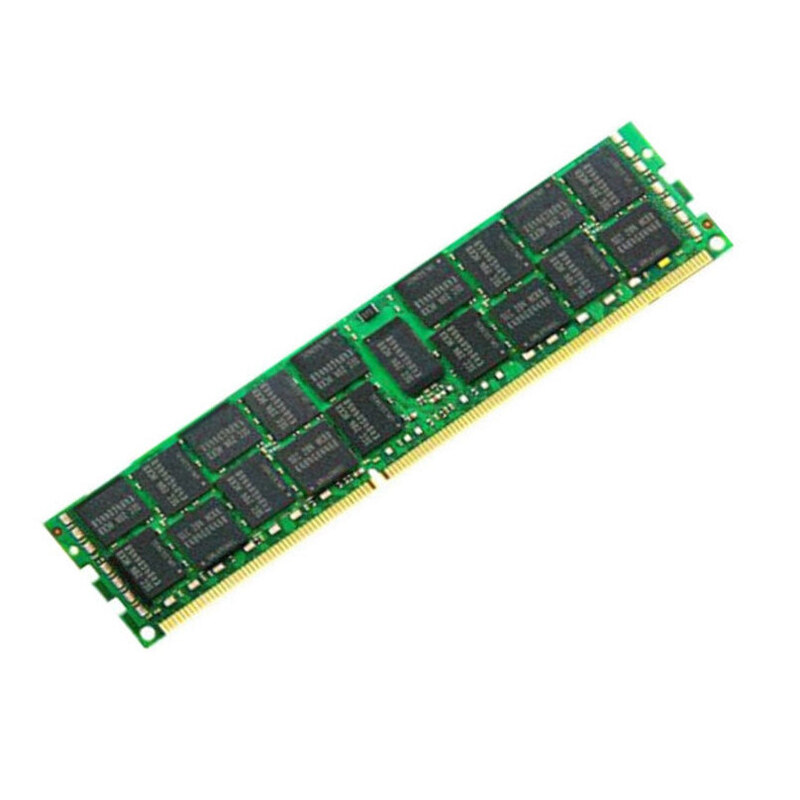
Micron MTA18ADF2G72PZ-3G2 16GB RAM Pc4-25600 DDR4 3200MHZ Rank Cl22 288-pin Ecc Registered Rdimm Module. New (System) Pull with 1 year replacement warranty
The Micron MTA18ADF2G72PZ-3G2 represents a critical class of memory engineered for stability, reliability, and performance in demanding computing environments. As a 16GB DDR4 ECC Registered RDIMM, this module is specifically designed for servers, high-end workstations, and data center applications where data integrity and system uptime are paramount. Unlike standard unbuffered DIMMs (UDIMMs) used in consumer PCs, RDIMMs incorporate a register (or buffer) on the module to reduce the electrical load on the memory controller.
The Micron MTA18ADF2G72PZ-3G2 DDR4 module has a capacity of 16GB, making it an excellent choice for users who require high-performance memory for their systems. With this capacity, users can enjoy seamless multitasking, faster data processing, and improved overall system performance.
This section details the core technical identifiers of the module. The part number MTA18ADF2G72PZ-3G2 follows Micron's naming convention, which encodes key attributes. It is a 16GB (Gigabyte) module, operating at a data rate of PC4-25600, which equates to a 3200 Megatransfers per second (MT/s) speed. The module's latency timing is CL22 (CAS Latency 22). It is a Dual Rank (2R) module, using a 288-pin DDR4 form factor. The voltage specification is the standard DDR4 1.2V. These specifications collectively define the module's performance envelope and compatibility profile.
Micron's part numbers are informative. Breaking down MTA18ADF2G72PZ-3G2 reveals: MT = Micron Technology; A = Commercial/Industrial temperature; 18 = 1.2V DDR4 voltage; A = Revision; DF = 16GB density and specific technology (RDIMM); 2G72 = Organization (2Gx72); PZ = 288-pin RDIMM; 3G2 = 3200 MT/s speed bin (PC4-25600) at CL22 timings. Understanding this nomenclature is crucial for ensuring precise compatibility and identifying the module's exact characteristics.
The "Registered" aspect is a fundamental differentiator. The register acts as a signal repeater and buffer between the memory controller and the DRAM chips. This buffering reduces the electrical load, allowing the system memory controller to drive more memory modules stably. Consequently, servers and platforms designed for RDIMMs can populate more DIMMs per channel (e.g., 2 or 3 DPCRDIMMs per channel) compared to just 1 or 2 for unbuffered modules, enabling total system memory capacities that can reach into the terabytes. This comes with a slight, typically one-clock-cycle, latency penalty, which is an acceptable trade-off for the immense gains in capacity and signal integrity.
ECC is a non-negotiable feature for mission-critical systems. The "x72" organization in the part number (2Gx72) indicates 72 bits per transaction. Of these, 64 bits are for data, and the extra 8 bits are for the ECC code. This allows the module to detect and automatically correct single-bit errors (SEC, Single Error Correction) and detect (but not correct) multi-bit errors (DED, Double Error Detection). This hardware-level protection prevents soft errors from cosmic rays or electrical noise from causing system instability or data corruption, a feature absent in non-ECC consumer memory.
The performance of server memory is measured not just by speed, but by the combination of bandwidth, latency, rank structure, and reliability. The Micron MTA18ADF2G72PZ-3G2 is engineered to deliver optimal performance within its targeted ecosystem.
The designation PC4-25600 refers to the peak theoretical bandwidth of the module. Calculated as 25600 Megabytes per second (MB/s), this is derived from the 3200 million transfers per second (MT/s) across an 8-byte (64-bit) wide interface. In a dual-channel or multi-channel server platform, this bandwidth aggregates, providing massive data throughput essential for CPU-intensive tasks like in-memory databases (e.g., SAP HANA), scientific computing, and high-frequency trading applications. The 3200 MT/s speed represents a high-performance tier within the DDR4 ECC RDIMM spectrum, balancing speed with compatibility across a range of Intel Xeon Scalable (e.g., 2nd/3rd Gen Cascade Lake, Ice Lake) and AMD EPYC (e.g., 2nd/3rd Gen Rome, Milan) platforms.
CAS Latency (CL) is the number of clock cycles between a read command and the moment data is available. A CL22 rating at 3200 MT/s indicates the latency in nanoseconds. The actual latency in nanoseconds is calculated as (CL / Speed in MHz) * 2000. For this module: (22 / 3200) * 2000 = 13.75 nanoseconds. While higher CL numbers may seem slower compared to consumer DDR4, they are optimized for the server memory controller's architecture and the registered design. The overall system performance in a server is more dependent on bandwidth, capacity, and stability than on ultra-tight latencies.
The module is configured as a Dual Rank (2R) RDIMM. A "rank" is an independent set of DRAM chips that is accessed simultaneously by the memory controller. A dual-rank module has two such sets. This architecture improves performance efficiency by allowing the memory controller to interleave access between the two ranks, hiding precharge and activation delays and effectively improving memory bandwidth utilization. For server workloads, dual-rank modules often provide the best balance of performance, capacity, and loading for the memory controller compared to single-rank (1R) or quad-rank (4R) modules.
This module is not compatible with consumer desktop motherboards. It requires a server or workstation platform explicitly designed to support DDR4, ECC, and Registered (RDIMM) memory. This includes motherboard chipsets such as Intel C621, C622, C624, C625, C627 (and similar) for Xeon Scalable processors, and AMD SP3 sockets for EPYC processors. Crucially, the platform's memory QVL (Qualified Vendor List) should be consulted to ensure this specific module (or its speed/timing/rank profile) is validated for the target server system. Mixing RDIMMs with other types like UDIMMs or LRDIMMs is not supported.
The Micron 16GB DDR4-3200 RDIMM is a versatile component deployed across numerous enterprise and professional computing landscapes.
In virtualization hosts (e.g., VMware vSphere, Microsoft Hyper-V, Citrix Hypervisor), physical RAM is a critical resource partitioned among multiple virtual machines (VMs). The high capacity, reliability (via ECC), and stability of RDIMMs like the MTA18ADF2G72PZ-3G2 allow IT administrators to densely pack VMs on a single server, improving consolidation ratios and operational efficiency. Large memory pools are essential for VDI (Virtual Desktop Infrastructure) deployments and large-scale application hosting.
Modern databases like SAP HANA, Oracle Database In-Memory, and Microsoft SQL Server Hekaton reside entirely or partially in RAM to achieve ultra-low query response times. For these workloads, the aggregate memory capacity, bandwidth (PC4-25600), and data integrity (ECC) are directly correlated to database size and performance. A cluster of servers equipped with multiple such 16GB modules can create a massive, fast, and reliable in-memory data grid.
Computational tasks in engineering simulation, genomic sequencing, financial modeling, and 3D rendering often involve working with enormous datasets that must be held in memory. The bandwidth of 3200 MT/s RDIMMs helps feed data to high-core-count CPUs (like AMD EPYC or Intel Xeon) efficiently, reducing computational bottlenecks. ECC ensures the accuracy of lengthy calculations that could be invalidated by a single-bit error.
As a building block in hyperscale and cloud data centers, this type of memory is used in rack-scale servers to provide the foundational memory resource for public and private cloud instances. Consistency, reliability, and vendor support (Micron) are key selection criteria for these large-scale deployments.
The module conforms to the JEDEC standard specifications for DDR4 RDIMMs, ensuring interoperability within qualified systems.
The module uses a 288-pin edge connector layout specific to DDR4. The RDIMM notch key position is different from that of a UDIMM or LRDIMM, preventing accidental insertion into an incompatible socket. The length is the standard 133.35mm (5.25 inches). Proper installation requires aligning the notch and applying firm, even pressure on both ends until the ejector clips lock into place.
Operating at a nominal 1.2V, DDR4 provides significantly improved power efficiency over DDR3's 1.5V standard. This reduces the power consumption and heat generation of the memory subsystem, a critical factor in dense server configurations where power and cooling budgets are constrained. The module supports advanced power management features like Self-Refresh and Partial-Array Self-Refresh.
Understanding where this module fits requires differentiation from similar categories.
LRDIMMs use a memory buffer (iBuffer) instead of a simple register, further reducing the electrical load. This allows for even higher capacities and more ranks per channel (often supporting quad-rank modules as single-rank electrical loads). However, LRDIMMs typically have slightly higher latency and cost. The Micron MTA18ADF2G72PZ-3G2 RDIMM is the preferred choice for balanced performance and capacity up to moderate per-socket densities.
Consumer-grade Unbuffered DIMMs (UDIMM) lack both the register and ECC. They are unsuitable for servers due to limited capacity support per channel and the absence of error correction, posing a data integrity risk in 24/7 operations. Server platforms often do not support non-ECC memory or UDIMMs in multi-socket configurations.
Within the DDR4 ECC RDIMM family, modules are available at various speed grades. This 3200 MT/s module offers the highest standard JEDEC speed for widespread server platform support. Lower-speed modules (e.g., PC4-21300/2666MT/s) may be used for cost optimization or in platforms with older generation CPUs that officially support lower memory speeds. The system will run all memory at the speed of the slowest installed module.


 Contact Us
 Information
 Catalog
 Solid State Drives (SSD)
 Network Switches
 Hard Disk Drives
 HBA & Controllers
 PC & Servers
 PC & Server Memory
 CPU & Processors
 Network Routers
 Power Supplies
 Tape Drives & Libraries
 Network Devices
 Computer & Network Cables