
(7% discount is applied at checkout)
Cart is empty
Your go-to destination for cutting-edge server products
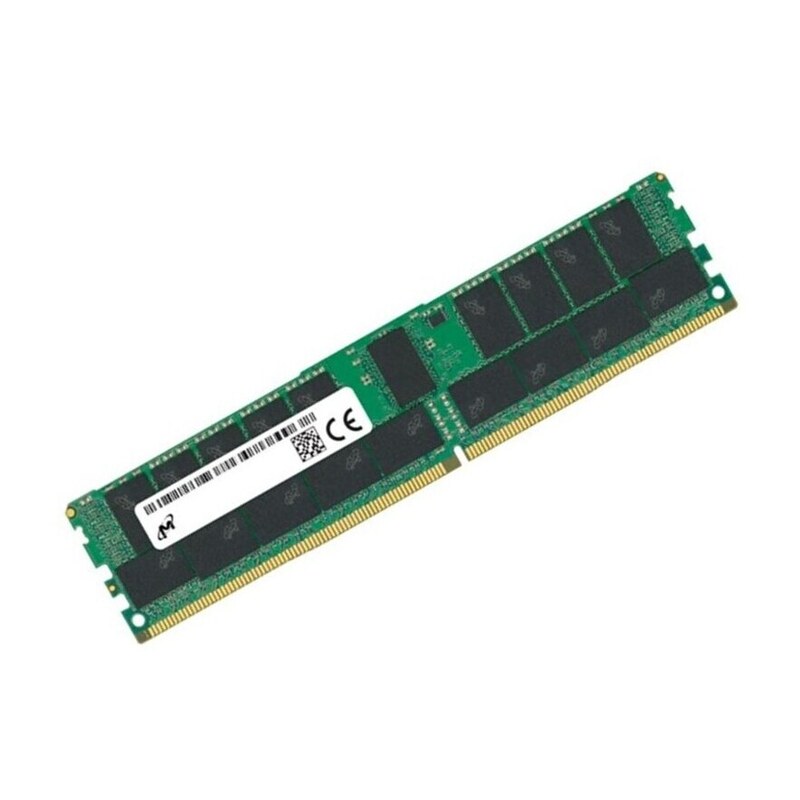
Micron MTA18ASF2G72PDZ-2G3B1 16GB 2400MHZ PC4-19200 Cl17 Ecc Registered Dual Rank DDR4 SDRAM 288-Pin Dimm Memory Module. New Sealed in Box (NIB)
| SKU/MPN | Warranty | Price | Condition | You save |
|---|---|---|---|---|
| MTA18ASF2G72PDZ-2G3B1 | 1 Year Warranty | $184.00 | New (System) Pull | You save: $64.40 (26%) |
| MTA18ASF2G72PDZ-2G3B1 | 1 Year Warranty | $550.00 | New Sealed in Box (NIB) | You save: $192.50 (26%) |
The Micron MTA18ASF2G72PDZ-2G3B1 represents a specific class of server memory engineered for stability, reliability, and data integrity in demanding computing environments. This 16GB module is not a standard desktop DIMM; it is a purpose-built component for servers, high-end workstations, and networking equipment that require continuous, error-free operation. Built to industry-standard specifications, this memory module integrates advanced technologies like Error-Correcting Code (ECC) and a Registered design to manage large memory configurations effectively.
In the realm of enterprise computing, data center operations, and high-stakes workstation environments, memory is not merely a component—it is the bedrock of stability, integrity, and performance. The category of DDR4 ECC Registered DIMMs represents a specialized class of memory engineered explicitly for systems where error-free operation and vast capacity are non-negotiable. Unlike standard unbuffered desktop memory, these modules incorporate advanced technologies to manage heavy workloads, ensure data accuracy, and support scalable system architectures. The Micron MTA18ASF2G72PDZ-2G3B1 is a quintessential example of this category, embodying the specifications and reliability that power servers, sophisticated storage arrays, and high-end computational hardware.
At its heart, the module is defined by a set of key technical parameters that dictate its performance profile and system compatibility. These specifications are not merely marketing points but critical identifiers for IT professionals and system integrators.
The module offers a capacity of 16 Gigabytes (GB). This is achieved as a single module (1x16GB), allowing for flexible system configuration and future upgrades. The "Dual Rank" designation indicates the module's internal organization, which optimizes memory access efficiency by allowing the memory controller to access one rank while preparing the other, improving overall throughput in memory-intensive operations.
A dual-rank module effectively presents two logical banks of memory to the controller on a single physical DIMM. This architecture can provide a performance advantage over single-rank modules in many server workloads by improving interleaving, though it may present a slightly higher electrical load. This specific 16GB dual-rank configuration is a common and optimal density for many single- and dual-processor server platforms.
The module operates at a data rate of 2400 Megatransfers per second (MT/s), commonly referred to as 2400MHz. This speed is defined by the PC4-19200 classification, where "PC4" denotes DDR4 and "19200" represents the theoretical peak bandwidth in megabytes per second (MB/s). The CAS Latency (CL) is specified at CL17, which is the number of clock cycles between a read command and data availability. The 2400MT/s speed with CL17 timings represents a standard, reliable performance tier for DDR4 server memory, balancing speed with stability.
The PC4-19200 designation is calculated by multiplying the data rate (2400 MT/s) by the module's data width (64 bits = 8 bytes). 2400 * 8 = 19200 MB/s. This is the peak theoretical bandwidth for a single module. In a multi-channel server configuration (like dual-channel or quad-channel), this bandwidth aggregates, providing massive data transfer capabilities to the CPUs.
This memory module belongs to a specialized class defined by Error-Correcting Code (ECC) and Registered (or Buffered) technology. These are not performance features in the traditional sense but are fundamental for system integrity and scalability in professional environments.
ECC memory includes extra bits (e.g., 8 bits for a 64-bit word) to detect and correct the most common types of internal data corruption. Single-bit errors are corrected on-the-fly without interrupting system operation, while multi-bit errors are detected and reported. This is non-negotiable for servers handling critical data, financial transactions, scientific computations, or long-duration workloads where even a single soft error could corrupt a database or crash an application.
When data is written to an ECC module, an algorithm calculates a checksum value stored alongside the data. Upon readback, the algorithm recalculates the checksum. A mismatch triggers the correction circuitry to fix a single-bit error or flag a multi-bit error. This process happens transparently at the hardware level, safeguarding against cosmic rays, electrical noise, and other sources of bit flips.
The "Registered" in the product name refers to the inclusion of a register (or buffer) on the module for the address and command lines. This buffer reduces the electrical load on the system's memory controller, allowing for the support of more memory modules per channel and greater total system memory capacity. This module is an RDIMM, distinguishing it from Unbuffered (UDIMM) or Load-Reduced (LRDIMM) types.
By buffering the command/address signals, RDIMMs enable more stable signaling in dense memory configurations. This makes them the default choice for servers and high-end workstations supporting multiple CPUs and large RAM arrays. The trade-off is an added nanosecond of latency due to the buffer, but this is inconsequential compared to the gains in system stability and capacity.
The module conforms to the standard DDR4 DIMM (Dual In-line Memory Module) form factor with 288 pins. The physical design is critical for compatibility with server chassis and motherboards.
The 288-pin edge connector is specific to DDR4 technology and is not compatible with DDR3 or DDR5 slots due to a different notch key position. The pin layout carries power, ground, data, address, command, and control signals. The module is designed to operate at a nominal voltage of 1.2V, which is standard for DDR4 and lower than DDR3's 1.5V, contributing to improved energy efficiency in data centers.
The physical notch on the connector (the "key") is located in a different position than DDR3 modules to prevent accidental insertion into an incompatible slot. Proper installation involves aligning this notch, opening the slot's retaining clips, and firmly seating the module until the clips engage automatically with an audible click.
This memory module is not designed for consumer desktop PCs. Its compatibility is targeted at specific enterprise and professional hardware platforms.
The Micron MTA18ASF2G72PDZ-2G3B1 is engineered for compatibility with server platforms from major OEMs like Dell (PowerEdge), HPE (Proliant), Lenovo (ThinkSystem), Cisco (UCS), and Supermicro, as well as AMD EPYC and Intel Xeon Scalable processor-based systems that support DDR4-2400 RDIMMs. It is crucial to verify the specific server's qualified vendor list (QVL) or memory compatibility guide before purchase.
A server's QVL is a list of memory modules the manufacturer has tested and validated for use in a specific server model. Using a module from the QVL, like this Micron part, guarantees compatibility, ensures optimal performance, and maintains the system's warranty and support agreements. It mitigates the risk of boot failures, post errors, or unstable operation.
This type of memory is essential for workloads where uptime, data accuracy, and capacity are paramount. Typical applications include: virtualization hosts (VMware ESXi, Microsoft Hyper-V), database servers (SQL, Oracle), file and print servers, email servers, business application servers, and high-performance computing (HPC) clusters. The ECC functionality is particularly vital for any task involving large datasets, financial modeling, or extended computational analysis.
While raw speed is a factor, server memory performance is multidimensional, involving bandwidth, latency, capacity, and reliability.
For many server applications, such as large database queries or virtualization, available memory bandwidth—often maximized by installing modules in matching sets to enable multi-channel modes (dual, quad, hexa-channel)—is more impactful than ultra-tight latencies. The 2400MT/s speed provides a solid foundation for these bandwidth-centric tasks. The registered design, while adding minimal latency, is essential for achieving high capacity and stable operation across all installed modules.
For optimal performance in multi-channel architectures, modules should be matched in size, speed, rank, and timing. Mixing modules of different specifications can cause the system to run all memory at the slowest common denominator or, in some cases, lead to instability. When upgrading, it is strongly recommended to use identical part numbers, such as the Micron MTA18ASF2G72PDZ-2G3B1, to existing modules.


 Contact Us
 Information
 Catalog
 Solid State Drives (SSD)
 Network Switches
 Hard Disk Drives
 HBA & Controllers
 PC & Servers
 PC & Server Memory
 CPU & Processors
 Network Routers
 Power Supplies
 Tape Drives & Libraries
 Network Devices
 Computer & Network Cables