
(7% discount is applied at checkout)
Cart is empty
Your go-to destination for cutting-edge server products
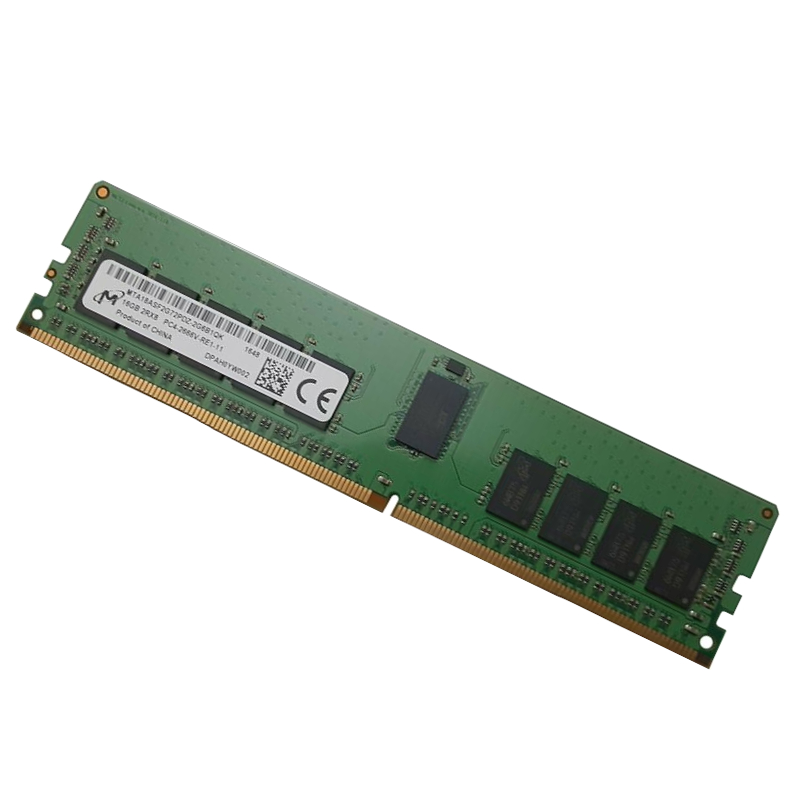
Micron MTA18ASF2G72PDZ-2G6 16GB RAM PC4-21300 DDR4 2666Mhz SDRAM Ecc Registered Cl19 288-pin Module .New Sealed in Box (NIB) with 3 Year Warranty
The Micron MTA18ASF2G72PDZ-2G6 RAM module is equipped with a hefty 16GB capacity, making it an excellent choice for users who require high-performance memory for their computing needs. Whether you are a gamer, a content creator, or a professional in need of multitasking capabilities, the 16GB capacity offers ample space for running demanding applications and ensures smooth and efficient performance.
The evolution of server technology hinges on the performance and reliability of its core components, with memory standing as a critical pillar. Within this landscape, DDR4 SDRAM represents a significant leap forward from its predecessors, offering enhanced speed, improved power efficiency, and greater densities to meet the escalating demands of cloud computing, virtualization, and big data analytics. The category of DDR4 server memory is defined by its adherence to strict standards for stability and error correction, making modules like the Micron MTA18ASF2G72PDZ-2G6 indispensable for enterprise-grade systems.
Not all DDR4 memory is created equal, especially in a server environment. The distinction between unbuffered, registered, and load-reduced DIMMs (LRDIMMs) is crucial for system compatibility and performance under load. The Micron module in question belongs to the Registered DDR4 category (often denoted as RDIMM), a specification designed for mission-critical stability.
ECC is a non-negotiable feature for server and workstation memory. It goes beyond simple parity checking to actively detect and correct the most common types of internal data corruption—single-bit errors. This happens in real-time, preventing silent data corruption that could lead to application crashes, calculation errors, or system instability. In an environment where data integrity is paramount, ECC provides a essential layer of hardware-level protection.
The "Registered" aspect refers to the presence of a register (or buffer) on the memory module itself, situated between the system's memory controller and the DRAM chips. This register buffers the command and address signals, reducing the electrical load on the memory controller. This allows a server motherboard to support a significantly higher number of memory modules per channel (typically 2 for unbuffered vs. 3 or more for registered) without overloading the controller, enabling much higher total system memory capacities. While it introduces a minimal latency of one clock cycle, the gains in system stability and capacity far outweigh this negligible penalty for server workloads.
Micron's part numbering system conveys a wealth of technical information. Breaking down "MTA18ASF2G72PDZ-2G6" provides a precise specification sheet within the code itself.
The "16GB" denotes the total storage capacity of the Dual In-Line Memory Module (DIMM). This capacity is achieved through a specific arrangement of DRAM components on the PCB.
The "2G72" segment is key. "2G" indicates the module uses 2-gigabit (Gb) DRAM chips. "72" signifies the module's data width, including ECC bits. A standard non-ECC module has a 64-bit data path. This ECC RDIMM has an additional 8 bits for error correction, creating a 72-bit total data path. Therefore, the module is organized as a 72-bit wide bank of memory.
The speed is communicated in two ways. "PC4-21300" is the module's theoretical peak bandwidth in megabytes per second (MB/s). 21300 MB/s is calculated as 2666 million transfers per second multiplied by 8 bytes (64-bit data width). The "2666Mhz" (more accurately 2666 Megatransfers per second, or MT/s) refers to the data rate, or how many data transfer operations occur per second on the bus. This is a key performance metric distinguishing it from slower 2133 or 2400 MT/s DDR4 modules.
CAS Latency (CL) is the number of clock cycles between the memory controller issuing a read command and the first piece of data being available. A CL19 rating at 2666 MT/s represents a balanced performance profile for server memory, where stability and capacity are often prioritized over ultra-tight latencies. This timing works in conjunction with the module's other primary timings (tRCD, tRP, tRAS) to define its responsiveness.
All DDR4 modules, whether for desktop or server, utilize a 288-pin edge connector. However, the keying notch is in a different position compared to DDR3, preventing accidental insertion into an incompatible slot. The physical length remains the standard 133.35mm (5.25 inches).
As an ECC Registered DIMM, this module features a more complex PCB than a consumer-grade module. It houses not only the DRAM ICs but also the registering clock driver (RCD) chip that buffers signals and the additional components required for reliable operation at high densities. Micron's manufacturing ensures the PCB meets rigorous specifications for signal integrity and heat dissipation.
Beyond the model number, a deeper technical dive reveals the engineered characteristics that ensure compatibility and performance.
This DDR4 module operates at a standard voltage of 1.2V, a substantial reduction from DDR3's 1.5V. This lower voltage translates directly into lower power consumption and reduced heat output, a critical factor when deploying dozens or hundreds of modules in a single server rack. The module supports advanced power management features like chip-select (CKE) power-down and self-refresh modes to further conserve energy during periods of low activity.
The "1Rx4" or "2Rx4" configuration (implied by the part number and density) is a vital specification for system compatibility. It describes how the memory chips are logically organized into ranks (a set of DRAM chips that work together to fill the 72-bit data bus) and the bit-width of each chip. This module is typically a Dual Rank (2R) configuration. Understanding rank is essential for optimal channel population. Server motherboards have specific guidelines (e.g., "populate with 2DPC 2R for optimal speed") to ensure the memory controller is not overloaded, which can force the system to downclock speeds.
Many modern server-grade DRAM chips, including those likely used in this module, incorporate On-Die ECC. This is a secondary, internal layer of error correction that occurs within the DRAM chip itself, handling internal bit errors before data is sent to the module-level ECC. This multi-tiered approach to reliability—On-Die ECC plus module-level ECC—dramatically increases the mean time between failures (MTBF) and is a hallmark of memory designed for 24/7 operation.
The Micron 16GB 2666MT/s RDIMM is not designed for gaming PCs or standard desktops. Its value is realized in environments where uptime, data integrity, and large memory pools are required.
This is the primary application. Servers from vendors like Dell (PowerEdge), HPE (ProLiant), Lenovo (ThinkSystem), Cisco (UCS), and Supermicro utilize such modules. In virtualization platforms (VMware vSphere, Microsoft Hyper-V, Proxmox), large amounts of reliable RAM are essential to host multiple virtual machines simultaneously. Each VM requires its own allocated memory, making high-capacity, high-stability DIMMs like this one the foundational resource for virtual infrastructure.
Clusters used for scientific computing, financial modeling, and data analytics (e.g., SAP HANA, in-memory databases) often use registered ECC memory. While some HPC applications may prioritize bandwidth with higher-speed modules, the 2666MT/s speed offers a strong balance of performance and cost-effectiveness for many computational workloads where accurate results are critical.
Large-scale cloud providers and storage area network (SAN) or network-attached storage (NAS) controllers use ECC RDIMMs to ensure the integrity of cached data and maintain consistent performance. A memory error in a storage controller could potentially corrupt data being written to or read from disk, making ECC protection mandatory.
For optimal performance and stability, it is strongly recommended to populate memory in identical sets per channel. This means using modules of the same capacity, speed, latency, rank, and ideally from the same manufacturer and batch. Mixing different modules can cause the system memory controller to downclock all modules to the speed of the slowest DIMM or, in some cases, cause boot failures. Modules should be installed according to the server manual's population sequence, typically starting with the lowest-numbered slots.
Evaluating server memory performance differs from evaluating desktop memory. Raw bandwidth and latency, while measurable, are viewed within the context of overall system throughput for targeted workloads.
Many server applications—such as database serving, video transcoding, and large file manipulation—are more sensitive to sustained memory bandwidth than to absolute latency. The 2666MT/s data rate provides a meaningful bandwidth uplift over 2400MT/s or 2133MT/s DDR4, especially when aggregated across multiple channels (e.g., a dual-processor system with six channels per CPU). The CL19 latency is well-suited for the large, contiguous data blocks typically processed in these environments.
The real-world performance gain from this specific module will depend entirely on the application and the existing system configuration. Upgrading from a lower capacity or slower speed to this module can reduce processing times for memory-intensive tasks, support more concurrent users or VMs, and decrease latency in in-memory databases. The ECC functionality, while not boosting performance metrics, prevents costly errors and downtime, which is a form of performance insurance.


 Contact Us
 Information
 Catalog
 Solid State Drives (SSD)
 Network Switches
 Hard Disk Drives
 HBA & Controllers
 PC & Servers
 PC & Server Memory
 CPU & Processors
 Network Routers
 Power Supplies
 Tape Drives & Libraries
 Network Devices
 Computer & Network Cables