
(7% discount is applied at checkout)
Cart is empty
Your go-to destination for cutting-edge server products
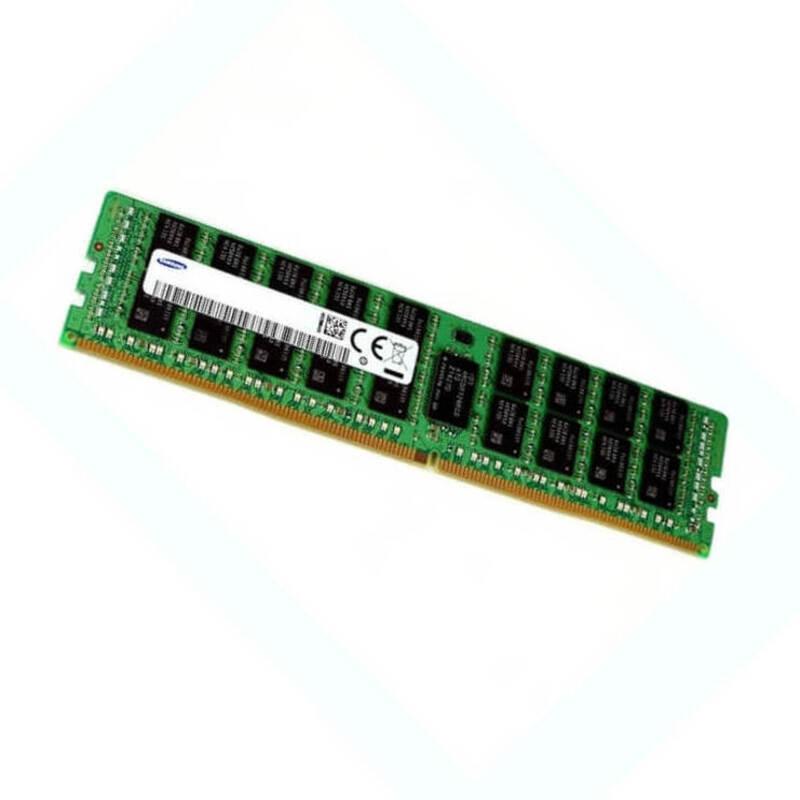
Samsung M393AAG40M32-CAEBY 128GB 3200MHz PC4-25600 ECC DDR4 288-Pin RAM. New Sealed in Box (NIB) with 3 Years Warranty
The Samsung M393AAG40M32-CAEBY 128GB DDR4 SDRAM Memory Module, an advanced memory solution engineered for high-performance computing. This memory module combines speed, reliability, and high capacity to meet the demands of modern data-heavy applications and systems.
Enterprise server memory is a specialized class of RAM engineered for reliability, stability, and continuous operation under demanding workloads. Unlike standard desktop memory, server modules incorporate advanced error-checking and physical architectures designed to ensure data integrity and system uptime in mission-critical environments such as data centers, cloud infrastructure, virtualization hosts, and high-performance computing clusters.
DDR4 Registered Dual In-Line Memory Modules (RDIMMs) represent the workhorse memory standard for contemporary server platforms. They introduce a register, or buffer, placed between the memory controller and the DRAM chips. This register handles electrical load, reducing strain on the memory controller and allowing servers to support higher memory capacities and more modules per channel—a critical requirement for multi-processor systems and memory-intensive applications.
This module is a quintessential example of high-capacity, performance-oriented server memory. Below is a detailed breakdown of its technical specifications and their practical implications for system builders and IT administrators.
The M393AAG40M32-CAEBY "1x128GB" denomination indicates a single module with a massive 128-gigabyte capacity. This high-density design is crucial for maximizing total system memory without consuming all available DIMM slots. In a typical dual-processor server with 12 or 16 slots per CPU, populating slots with 128GB modules enables terabyte-scale memory configurations, essential for in-memory databases (like SAP HANA), large-scale virtualization, and big data analytics.
The module operates on the DDR4 (Double Data Rate 4) standard. The "3200Mbps" refers to its data transfer rate per pin: 3,200 Megabits per second. The "PC4-25600" is a standardized nomenclature representing the module's theoretical peak transfer rate in megabytes per second (MB/s). To calculate: 3200 Mbps per pin * 8 bytes (64-bit data path) / 8 bits per byte = 25,600 MB/s. This high bandwidth is vital for reducing data bottlenecks between the CPU and memory, accelerating application response times and overall system throughput.
CL22 stands for Column Address Strobe (CAS) Latency 22. It is a key timing parameter, measuring the number of clock cycles between the memory controller issuing a read command and the first piece of data being available. While higher CAS latency can imply slower response, it must be evaluated in the context of clock speed. A DDR4-3200 module with CL22 offers a nanosecond-level latency comparable to slower-clocked modules with lower CAS numbers. This balance provides high bandwidth suitable for server workloads where massive data movement is often more critical than ultra-low latency.
These three features define the module's server-grade pedigree and directly impact system reliability and scalability.
ECC is a non-negotiable feature for enterprise servers. It can detect and correct the most common types of internal data corruption (single-bit errors) and detect multi-bit errors. This happens in real-time, transparent to the operating system, preventing software crashes, corrupted calculations, and silent data corruption that could lead to catastrophic outcomes in financial, scientific, or archival systems.
The "Registered" or "Buffered" aspect denotes the presence of a register (buffer) on the module. This component temporarily holds address and command signals from the memory controller, refreshing them before sending them to the DRAM chips. This process reduces electrical load, improves signal integrity, and allows the memory controller to support a greater number of densely packed DRAM chips per channel. This is what enables the high 128GB capacity on a single module.
A "rank" is a set of DRAM chips that work together to fill the data width of the memory channel (typically 64 bits for non-ECC, 72 bits for ECC). "Quad Rank" means the module presents four independent sets of chips to the memory controller. The "x4" refers to the organization of the individual DRAM chips, indicating they have a 4-bit data width. Quad-rank modules offer excellent capacity and performance characteristics but have specific loading rules; server motherboards have limits on how many ranks can be populated per channel for optimal performance. Understanding your server's memory population guidelines is essential when deploying quad-rank modules.
The module's physical design ensures compatibility and proper operation within standardized server environments.
Operating at 1.2 volts, DDR4 memory provides a significant reduction in power consumption compared to DDR3's 1.5V standard. This leads to lower operational costs and reduced heat output in densely packed server racks. The 288-pin edge connector is physically keyed differently from DDR3's 240-pin design, preventing accidental insertion into an incompatible slot. The "RDIMM" suffix in the pin count confirms the physical and electrical layout is specific to Registered modules.
The underlying DRAM chips are organized in a "x4" configuration (4-bit data width per chip). This organization is particularly beneficial for ECC functionality as it allows for efficient use of the additional 8 bits for error correction on a 72-bit bus. High-density modules like this one utilize advanced semiconductor processes to pack more memory cells into a smaller physical space, achieving the 128GB capacity.
Proper integration of this memory module requires careful attention to system compatibility and configuration rules.
The Samsung M393AAG40M32-CAEBY is designed for server platforms that support DDR4-3200 Registered ECC memory. This includes a wide range of systems based on Intel Xeon Scalable processors (Cascade Lake, Ice Lake, and newer generations) and AMD EPYC 7002 (Rome), 7003 (Milan), and newer processors. It is critical to verify the specific memory Qualified Vendor List (QVL) for your server model or motherboard to ensure tested compatibility and support.
Servers have strict rules for populating memory slots to ensure optimal performance and signal integrity. When using high-capacity quad-rank modules like this 128GB RDIMM, the maximum number of modules per memory channel may be reduced compared to dual-rank or single-rank modules. System administrators must consult their server's technical white paper or configuration guide to determine the correct slot installation order and the maximum supported capacity and speed for a given number of populated modules.
Modern server CPUs feature multiple memory channels (e.g., 6 or 8 channels per CPU). To achieve maximum memory bandwidth, modules should be installed in matching sets across these channels. For optimal performance with this 128GB module, a balanced configuration using multiples of the channel count (e.g., 8 modules for an 8-channel CPU) is recommended. Mixing modules of different speeds, ranks, or capacities can cause the entire memory subsystem to run at the lowest common denominator, potentially underutilizing the capabilities of this high-performance component.
The specific combination of high capacity, bandwidth, and reliability makes this module ideal for particular enterprise workloads.
Platforms like SAP HANA, Oracle Database In-Memory, and various real-time analytics engines store working datasets entirely in RAM to eliminate storage latency. The 128GB capacity per module allows for the construction of extremely large, terabyte-scale in-memory pools, dramatically accelerating query performance and transaction processing speeds.
Virtualization hosts (using VMware vSphere, Microsoft Hyper-V, etc.) and private cloud stacks require large memory pools to host dozens or hundreds of virtual machines. High-density RDIMMs maximize the virtual machine per-server ratio, improving consolidation and reducing overall hardware, power, and cooling costs in the data center.
Computational fluid dynamics, finite element analysis, genomic sequencing, and other High-Performance Computing (HPC) workloads often process enormous datasets that must be held in memory. The high bandwidth of DDR4-3200 facilitates faster data feeding to CPUs, reducing computation time and accelerating time-to-solution for complex models.
Large-scale ERP, CRM, and bespoke enterprise applications serve thousands of concurrent users and handle complex transactions. These applications benefit from the large memory capacity for caching and the data integrity provided by ECC, ensuring business continuity and transactional accuracy.


 Contact Us
 Information
 Catalog
 Solid State Drives (SSD)
 Network Switches
 Hard Disk Drives
 HBA & Controllers
 PC & Servers
 PC & Server Memory
 CPU & Processors
 Network Routers
 Power Supplies
 Tape Drives & Libraries
 Network Devices
 Computer & Network Cables