
(7% discount is applied at checkout)
Cart is empty
Your go-to destination for cutting-edge server products
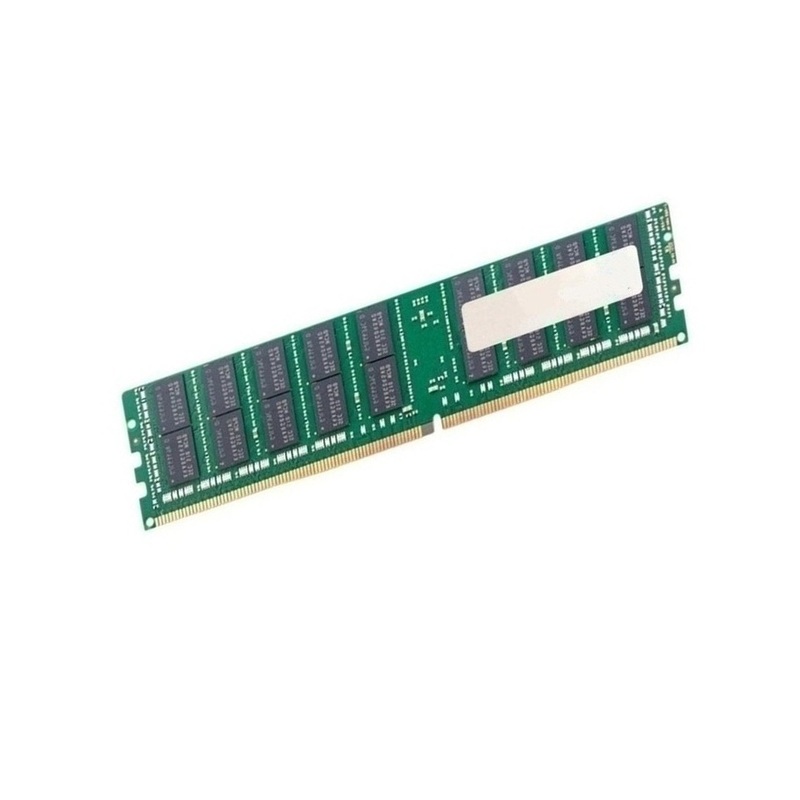
Samsung M393AAG40M32-CAEBQ 128GB 3200Mhz PC4-25600 Cl22 DDR4 SDRAM Ecc Reg Ram. New Sealed in Box (NIB) with 3 Years Warranty
The Samsung M393AAG40M32-CAEBQ is a high-performance memory module designed to offer reliable and efficient computing for enterprise-grade systems. This DDR4 SDRAM memory module provides a storage capacity of 128GB, ensuring seamless multitasking and performance for memory-intensive applications.
The Samsung M393AAG40M32-CAEBQ represents a specific and high-grade class of memory designed exclusively for server and data center environments. This module is a 128GB DDR4 Registered ECC RDIMM, engineered to deliver exceptional capacity, reliability, and data integrity in mission-critical systems. Unlike standard desktop memory, this module incorporates a suite of advanced technologies—Error-Correcting Code (ECC), a Registering Buffer, and a Quad Rank design—to stabilize electrical load and correct data errors in real-time. Operating at a speed of 3200 Mbps (PC4-25600) with a latency of CL22 at 1.2V, it provides a balanced profile of bandwidth, density, and power efficiency essential for modern servers running virtualization, large databases, in-memory computing, and high-performance computing (HPC) workloads.
At its heart, the M393AAG40M32-CAEBQ is a 128GB (1x128GB) module. This massive single-module capacity is a critical feature for modern servers, allowing for higher total system memory in platforms with a limited number of memory slots. It operates at a data transfer rate of 3200 Megatransfers per second (MT/s), commonly marketed as 3200MHz. This speed, coupled with the module's advanced architecture, provides the high bandwidth necessary to feed multi-core CPUs and prevent bottlenecks in data-intensive applications.
Samsung's part numbering convention reveals key details about the module's characteristics. Breaking down M393AAG40M32-CAEBQ: The "M" indicates a memory module. "393" often signifies a registered DIMM (RDIMM). "A" denotes a 1.2V operating voltage. "AG" can be associated with the specific chip configuration and technology. "40" relates to the component density and organization. "M32" indicates the data width and physical bank count. The suffix "CAEBQ" provides revision, rank, and speed information—'C' for revision, 'A' for rank, 'E' for 3200MT/s, and 'BQ' for the specific product line and qualifications. Understanding this nomenclature is crucial for ensuring compatibility and matching exact specifications during procurement.
The designation PC4-25600 provides a direct measure of the module's peak theoretical bandwidth. PC4 indicates it is a DDR4 module. The number 25600 refers to the bandwidth in megabytes per second (MB/s). To calculate this: 3200 MT/s * 8 bytes (64-bit data bus) = 25,600 MB/s. This means the module can theoretically transfer 25.6 gigabytes of data per second. This high bandwidth is essential for servers handling simultaneous requests from multiple virtual machines or processing large in-memory datasets.
The module operates with a CAS (Column Address Strobe) Latency of 22 clock cycles (CL22). Latency measures the delay between a memory controller requesting data and the module delivering it. While higher-speed modules often have slightly higher CL numbers, the overall real-world latency (measured in nanoseconds) is a combination of speed and CAS cycles. For this module, the approximate first-word latency is (22 / 3200,000,000 cycles/sec) * 2 (for DDR) = approximately 13.75 nanoseconds. In server environments, a balance between high bandwidth (speed) and reasonable latency is key for overall system responsiveness.
The true differentiators of this module from standard desktop memory lie in its advanced error management and signal integrity features. These technologies are what make it suitable for 24/7 mission-critical operations.
ECC is a non-negotiable feature for server memory. It detects and corrects the most common types of data corruption. Single-bit errors are corrected on the fly, and multi-bit errors are detected and reported to the system. This prevents silent data corruption—where incorrect data is processed without warning—which can lead to corrupted databases, computational errors, and system crashes. The M393AAG40M32-CAEBQ includes x4 ECC, meaning the ECC bits are generated per nibble (4 bits), providing robust data protection.
This is a Registered (Buffered) DIMM. It incorporates a memory register (or buffer) on the module, situated between the memory controller and the DRAM chips. This register buffers the command, address, and clock signals, reducing the electrical load on the memory controller. This allows a system to support a greater number of memory modules per channel and higher total memory capacities without signal degradation. While the register adds a minimal one-clock-cycle latency, the benefit in system stability and capacity scaling is immense for multi-socket servers and large memory configurations.
The "Quad Rank" designation is a critical aspect of this module's high-density design. A rank is a set of DRAM chips that work together to service a 64-bit (72-bit with ECC) data bus. A quad-rank module essentially packages four independent ranks onto a single physical stick. This allows for the 128GB capacity without requiring impractically large individual DRAM chips. However, system compatibility is paramount; server motherboards have specific guidelines on how many ranks can be populated per channel (e.g., 2DPC - 2 DIMMs Per Channel - with specific rank limitations). Populating beyond the recommended rank count can lead to failure to boot or reduced speed.
The "x4" in the module's description refers to the organization of the individual DDR4 SDRAM chips that populate the PCB. It means each chip has a 4-bit wide data interface. Building a 72-bit wide (64+8 ECC) module with x4 chips requires 18 chips per rank (18 chips * 4 bits = 72 bits). For a quad-rank, 128GB module, this typically implies 72 chips in total (18 chips/rank * 4 ranks). x4 chip organization is particularly advantageous for server memory as it enhances reliability through advanced error correction schemes like SDDC (Single Device Data Correction), which can tolerate a complete failure of a single chip within a rank.
The module adheres to the standard form factor and electrical specifications for enterprise servers, ensuring broad compatibility with qualified platforms.
The module uses the 288-pin DDR4 RDIMM physical layout. The pin count and notch position are different from DDR3 to prevent accidental insertion into an incompatible slot. The RDIMM PCB is typically slightly taller than a standard UDIMM (Unbuffered DIMM), often referred to as a "standard height" module. It is essential to verify the server chassis clearance, especially in dense, blade-server configurations, though this module conforms to the common industry standard.
DDR4 technology operates at a reduced voltage of 1.2V compared to DDR3's 1.5V. This lower voltage translates directly into lower power consumption and reduced heat output—a critical factor when deploying dozens or hundreds of modules in a data center. The power savings contribute significantly and reduced cooling requirements. The module supports power management features like the I2C-based Presence Detect (SPD) and may support additional telemetry for data center management suites.
Server memory modules are designed for continuous operation in controlled, yet sometimes variable, data center environments. The M393AAG40M32-CAEBQ is built with industrial-grade components and is tested for extended temperature ranges. Typical operating temperature ranges for such modules are between 0°C to 85°C (Tc - case temperature). It features temperature sensors (on-DIMM thermal sensor) that report data to the system's Baseboard Management Controller (BMC), allowing for proactive thermal management and fan control to prevent throttling or errors due to overheating.
Deploying high-density, quad-rank RDIMMs requires careful planning. Compatibility is not universal across all server platforms that support DDR4.
This module is designed for specific generations of enterprise servers, primarily those based on Intel Xeon Scalable processors (e.g., Cascade Lake, Cooper Lake, Ice Lake SP) and compatible AMD EPYC platforms that support 3200MT/s RDIMMs. It is absolutely mandatory to consult the server manufacturer's official memory qualification list (QVL) or system configuration guide. The QVL will specify tested and validated part numbers, supported speeds per CPU, and the exact configurations (number of DIMMs per channel, rank limitations) that are guaranteed to work.
When populating a server with 128GB RDIMMs, following the manufacturer's population guidelines is critical. These rules dictate the optimal slots to populate first (usually starting with the slots farthest from the CPU) to maintain signal integrity. They also define the maximum speed achievable based on the number of DIMMs per channel and the total rank count per channel. For instance, populating two quad-rank DIMMs per channel (2DPC QR) may force the memory subsystem to run at a lower speed than the module's maximum rated 3200MT/s, such as 2933MT/s or 2666MT/s, depending on the CPU and platform capabilities.
The extreme capacity and reliability of this module make it ideal for specific high-end computing scenarios. Its primary application is in servers that require massive in-memory datasets. This includes in-memory databases like SAP HANA, real-time analytics platforms, and large-scale virtualization hosts running hundreds of virtual machines. It is also suited for high-performance computing (HPC) workloads in scientific research, financial modeling, and rendering farms, where large problem sets are loaded entirely into RAM for rapid computation. Furthermore, it serves as a foundational component for building high-capacity memory nodes in software-defined storage or hyper-converged infrastructure (HCI) clusters.


 Contact Us
 Information
 Catalog
 Solid State Drives (SSD)
 Network Switches
 Hard Disk Drives
 HBA & Controllers
 PC & Servers
 PC & Server Memory
 CPU & Processors
 Network Routers
 Power Supplies
 Tape Drives & Libraries
 Network Devices
 Computer & Network Cables