
(7% discount is applied at checkout)
Cart is empty
Your go-to destination for cutting-edge server products
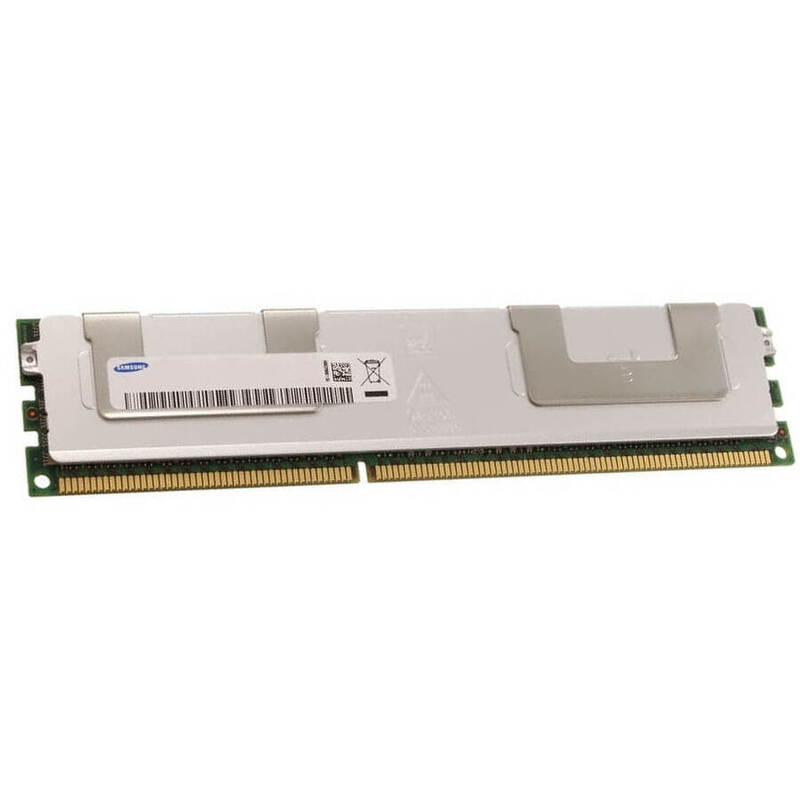
Samsung M393A8G40MB2-CVF 64GB Memory DDR4 SDRAM PC4-23400 Cl21 Ecc 2933MHZ Registered. New Sealed in Box (NIB) with 3 Years Warranty
| SKU/MPN | Warranty | Price | Condition | You save |
|---|---|---|---|---|
| M393A8G40MB2-CVF | 1 Year Warranty | $950.00 | New (System) Pull | You save: $332.50 (26%) |
| M393A8G40MB2-CVF | 1 Year Warranty | $1,099.00 | New Sealed in Box (NIB) | You save: $384.65 (26%) |
The Samsung M393A8G40MB2-CVF 64GB DDR4 RDIMM stands as a testament to engineered reliability and high-throughput performance. This memory module is meticulously designed for servers and workstations where uptime, data integrity, and seamless multitasking are non-negotiable. As a high-density, high-speed Registered ECC DIMM, it caters to memory-intensive applications such as virtualization, in-memory databases, high-performance computing (HPC), and large-scale transactional systems.
The Samsung M393A8G40MB2-CVF represents a pinnacle of reliability and performance in the realm of enterprise server memory. This specific module is a 64GB DDR4 Registered RDIMM (RDIMM) engineered for mission-critical servers, data centers, and high-performance computing environments where stability, large memory capacity, and data integrity are non-negotiable. It operates at a swift 2933 Mbps data rate, conforming to the PC4-23400 standard, and is built with advanced ECC (Error-Correcting Code) technology to ensure flawless data processing.
At its heart, this module is defined by a precise set of technical parameters that dictate its compatibility and performance profile. These specs are crucial for IT professionals and system integrators to verify against server motherboard Qualified Vendor Lists (QVLs).
The module boasts a substantial 64GB capacity as a single, monolithic stick (1x64GB). This high-density design is achieved through advanced semiconductor manufacturing, allowing for greater memory capacity per server slot. The configuration is 2Rx4, meaning it is a dual-rank module with four internal banks. This rank structure optimizes memory access efficiency and is a common design for high-capacity server modules.
The memory operates at a data transfer rate of 2933 million transfers per second (MT/s), marketed as 2933 Mbps. This is also expressed under the peak bandwidth nomenclature as PC4-23400 (which calculates as 2933 MT/s * 8 bytes = ~23400 MB/s). The CAS latency (CL) is 21 cycles. This balance of high speed and moderate latency is tuned for the sustained throughput demands of server applications, from large databases to virtualization hosts.
In a server environment, moving from a standard 2133 Mbps or 2400 Mbps module to a 2933 Mbps module like the M393A8G40MB2-CVF can yield significant performance improvements. Tasks such as real-time analytics, scientific simulations, and virtual machine consolidation see reduced processing times. The faster data rate decreases latency for memory accesses and increases the volume of data that can be handled simultaneously across the memory bus, directly translating to faster application response times and higher transaction throughput.
Operating at a standard DDR4 voltage of 1.2V, this module adheres to the improved power efficiency of the DDR4 generation over the previous 1.35V/1.5V DDR3 standards. This reduced voltage is critical in data center environments where power consumption and heat generation are major operational cost factors, allowing for denser server configurations without excessive thermal output.
The "ECC Registered" designation is the cornerstone of this memory module's reliability. This is not standard desktop memory; it incorporates specialized hardware for enterprise-grade robustness.
ECC is a fundamental feature for any server or workstation handling sensitive or mission-critical data. It works by adding extra bits (the ECC bits) to each data word stored in memory. As data is written and read, the memory controller uses these bits to detect and, most importantly, correct single-bit errors on the fly. It can also detect (but not correct) multi-bit errors. This hardware-level correction prevents silent data corruption, soft errors caused by cosmic rays, and other bit flips that could lead to application crashes, calculation errors, or database corruption. For financial transactions, scientific computing, and 24/7 server uptime, ECC is indispensable.
The "Registered" in RDIMM stands for the presence of a hardware register (or buffer) on the module itself. This register sits between the server's memory controller and the DRAM chips. Its primary function is to buffer the command and address signals, reducing the electrical load on the memory controller. This allows a server system to support a significantly higher number of memory modules per channel—often three or more RDIMMs compared to typically one or two unbuffered DIMMs (UDIMMs). This is essential for building servers with large total memory capacities (e.g., 1TB, 2TB, or more) across multiple CPU sockets. It adds a minimal latency of one clock cycle but is a necessary trade-off for scalability and signal integrity in multi-DIMM configurations.
Physical compatibility is ensured by the industry-standard 288-pin Dual In-Line Memory Module (DIMM) design. However, it is imperative to note that this is an RDIMM (Registered DIMM). It is not electrically compatible with motherboards or systems designed exclusively for Unbuffered (UDIMM) or Load Reduced (LRDIMM) memory. It will only function correctly in server (and select high-end workstation) platforms that explicitly support ECC Registered DDR4 memory. This includes a wide array of servers from OEMs like Dell (PowerEdge), HPE (ProLiant), Lenovo (ThinkSystem), and Cisco (UCS), as well as motherboard platforms from Supermicro, Asus, and Tyan, typically utilizing Intel Xeon Scalable or AMD EPYC processors.
Understanding the DDR4 ecosystem is key to correct procurement. Unbuffered DDR4 (UDIMM) is for desktops and consumer-grade systems; it lacks ECC and a register, limiting capacity per slot and total system capacity. Load Reduced DIMM (LRDIMM) uses a different buffer technology to support even higher densities than RDIMMs but often at a higher cost and latency. The Samsung M393A8G40MB2-CVF, as an RDIMM, sits in the optimal middle ground for most mainstream enterprise servers, offering an excellent balance of capacity, reliability, performance, and cost.
Samsung is a world leader in semiconductor manufacturing, and its server memory modules are held to the highest quality standards. The M393A8G40MB2-CVF is built with Samsung's own rigorously tested DRAM chips, ensuring consistency and longevity.
These modules undergo extensive testing and validation to meet enterprise server requirements. They are designed for 24/7 operation under demanding conditions. Samsung incorporates thermal sensors (on-die or on-module, depending on the specific SKU and platform requirements) to aid in system-level thermal management. The components and PCB are selected for long-term durability, minimizing the risk of premature failure that could lead to costly downtime.
Samsung's part number, M393A8G40MB2-CVF, provides a wealth of information. Breaking it down: "M" indicates a memory module. "393" often denotes an RDIMM form factor. "A" can signify specific product family attributes. "8G40" refers to the density and bit width (8Gigabit chips, 40-bit wide with ECC). "MB2" details the revision and specific design. The suffix "CVF" indicates the speed grade (2933Mbps), voltage (1.2V), and other timing parameters. This precise naming allows for exact matching during procurement and compatibility checks.
This memory module is not a general-purpose component; it is targeted at specific, demanding computing workloads that benefit from its unique combination of high density, ECC protection, and registered stability.
In virtualization hosts (e.g., VMware vSphere, Microsoft Hyper-V, KVM), physical memory is the critical resource that limits the number of virtual machines (VMs) that can run concurrently. High-capacity 64GB modules like the M393A8G40MB2-CVF allow administrators to maximize the RAM per server, leading to higher VM density, reduced hardware footprint, and lower overall power and cooling costs. The ECC feature is vital for protecting the integrity of multiple running VMs and their data.
Technologies like SAP HANA, Oracle Database In-Memory, and various big data platforms (e.g., Apache Spark) leverage vast pools of system RAM to hold entire datasets for ultra-fast processing. The speed of 2933 Mbps provides the necessary bandwidth for rapid data access, while the 64GB capacity contributes to a large total memory pool. ECC is absolutely mandatory in these scenarios, as a single uncorrected memory error could corrupt a massive in-memory dataset, leading to severely flawed business intelligence or financial analysis.
Clusters used for computational fluid dynamics, genetic sequencing, climate modeling, and other scientific research require immense, reliable memory. Jobs often run for days or weeks, and a memory error could invalidate the entire computation. The reliability of Samsung ECC RDIMMs, combined with their high bandwidth, makes them a staple in such environments where both performance and accuracy are paramount.
The single most important step is to consult your server or motherboard manufacturer's official documentation and memory compatibility/QVL (Qualified Vendor List). The QVL will list tested and approved memory models, including specific part numbers like the M393A8G40MB2-CVF. Using memory not on the QVL may work, but it risks system instability and voids vendor support. Verify support for 2933 MHz speed, 64GB RDIMM density, and 2Rx4 rank configuration.
Servers have specific guidelines for memory population order to ensure optimal performance and compatibility. This is detailed in the server's user manual. Rules typically govern which slots to populate first, how to balance memory across CPU sockets (in multi-socket systems), and how to configure for maximum memory bandwidth (often using three DIMMs per channel in a balanced configuration). Following these guidelines is essential for the system to POST and to achieve rated performance.


 Contact Us
 Information
 Catalog
 Solid State Drives (SSD)
 Network Switches
 Hard Disk Drives
 HBA & Controllers
 PC & Servers
 PC & Server Memory
 CPU & Processors
 Network Routers
 Power Supplies
 Tape Drives & Libraries
 Network Devices
 Computer & Network Cables