
(7% discount is applied at checkout)
Cart is empty
Your go-to destination for cutting-edge server products
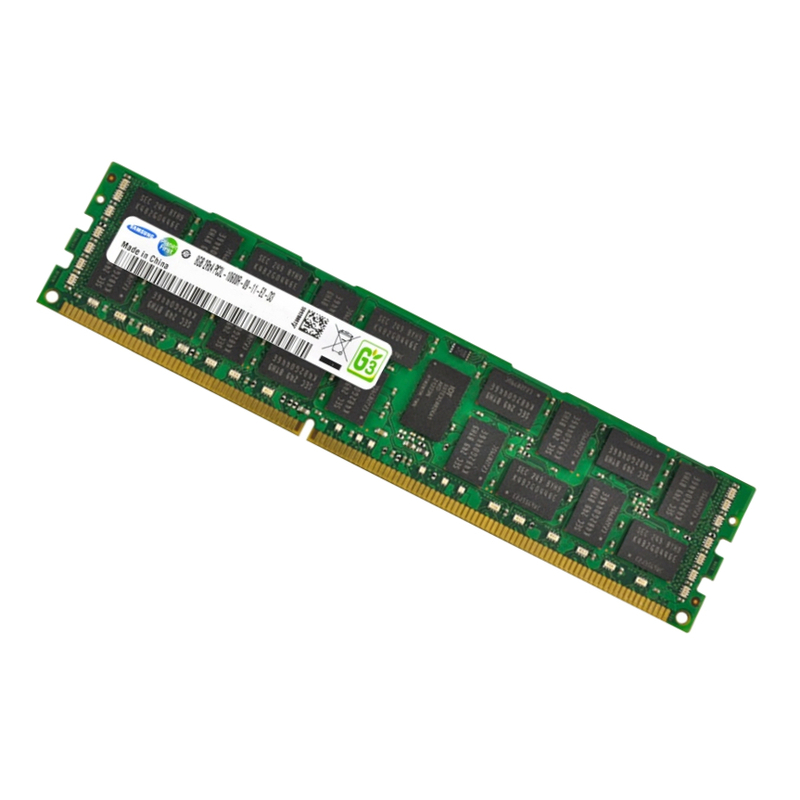
Samsung M393A8G40MB2-CVFBQ 64GB Memory Pc4-23400 Cl21 Ecc Registered DDR4 SDRAM 288-Pin. New Sealed in Box (NIB) with 3 Years Warranty
| SKU/MPN | Warranty | Price | Condition | You save |
|---|---|---|---|---|
| M393A8G40MB2-CVFBQ | 1 Year Warranty | $950.00 | New (System) Pull | You save: $332.50 (26%) |
| M393A8G40MB2-CVFBQ | 1 Year Warranty | $1,099.00 | New Sealed in Box (NIB) | You save: $384.65 (26%) |
The Samsung M393A8G40MB2-CVFBQ stands as a specialized and high-capacity memory component engineered for the demanding operational environment of servers and high-performance computing (HPC) systems. This 64GB DDR4 Registered RDIMM is meticulously designed to deliver not just raw capacity, but also enhanced data integrity, signal stability, and optimal performance in multi-channel configurations typical of enterprise hardware.
In the realm of enterprise computing and data center operations, memory is not merely a component; it is the critical conduit through which data flows to processors, directly impacting system stability, throughput, and overall performance. The Samsung M393A8G40MB2-CVFBQ represents a pinnacle of reliability and performance within the category of DDR4 server memory. This specific 64GB Registered ECC RDIMM is engineered for servers and workstations demanding unwavering data integrity, high capacity, and robust performance in multi-user, virtualized, and memory-intensive application environments.
At its core, this module represents the pinnacle of DDR4 technology for enterprise applications, balancing speed, density, and reliability. The specifications are tailored for systems requiring substantial memory pools, such as database servers, virtualization hosts, and data analytics platforms.
The primary feature of this module is its substantial 64GB capacity in a single Dual Rank (2Rx4) module. This high density allows server administrators to maximize the total memory capacity of a system while minimizing the number of occupied memory slots. For example, a dual-processor platform with 16 memory slots per CPU can achieve a staggering 2 terabytes of RAM using these modules, enabling massive in-memory databases and reducing the need for slower disk-based caching. This density is achieved through advanced semiconductor manufacturing processes utilizing high-capacity memory ICs.
This RDIMM operates at a data rate of 2933 million transfers per second (MT/s), often expressed as 2933 Mbps (megabits per second per pin). The industry-standard designation for this speed is PC4-23400, where '23400' refers to the theoretical peak bandwidth in megabytes per second (MB/s) for a 64-bit module. Calculating this involves multiplying the data rate (2933 MT/s) by the module width (8 bytes or 64 bits), resulting in approximately 23,464 MB/s of peak bandwidth. This high-speed data pathway is crucial for accelerating data-intensive applications, virtualization, and in-memory databases.
The "2Rx4" designation is crucial. "2R" indicates a dual-rank module, meaning the memory chips are organized into two independent sets (ranks) that share the same data path but can be accessed separately by the memory controller, improving efficiency through interleaving. The "x4" refers to the physical organization of the memory chips, specifically that they have a 4-bit wide data interface per chip. This x4 configuration is essential for supporting advanced error correction (ECC) and is standard for server-grade Registered DIMMs, offering optimal reliability and compatibility with server memory controllers.
Performance in server memory is defined by both bandwidth and latency. This module is optimized for high-throughput applications.
The module operates at a data rate of 2933 Megatransfers per second (MT/s), commonly referred to as 2933 Mbps. This translates to a peak theoretical bandwidth of 23,400 MB/s, which is denoted by its PC4-23400 classification (PC4 for DDR4, 23400 for bandwidth in MB/s). This high-speed interface ensures that CPUs are fed with data rapidly, mitigating bottlenecks in data-intensive workloads and improving overall system responsiveness and throughput.
The CAS Latency (CL) is rated at CL21. CAS Latency is the number of clock cycles between a read command and the moment data is available. While this number is higher than typical consumer-grade DDR4, it is a standard and optimal latency for server-grade memory at this density and speed, operating at the standard DDR4 voltage of 1.2 volts. The balance between speed (2933 MT/s) and latency (CL21) is calibrated for server stability and sustained performance under load.
Beyond basic specifications, this Samsung module incorporates several enterprise-specific technologies that are non-negotiable for server environments where uptime and data accuracy are paramount.
The integrated Error Correction Code (ECC) is a cornerstone feature. ECC memory can detect and correct the most common types of internal data corruption (single-bit errors) on-the-fly, without any intervention from the operating system. This prevents soft errors—transient faults caused by cosmic rays, electrical interference, or other factors—from causing system crashes, data corruption, or silent data errors. For financial calculations, scientific research, and enterprise databases, ECC is essential for maintaining data integrity.
ECC works by adding extra memory bits (8 bits for every 64 bits of data in a standard configuration) to store an encrypted code. When data is written, a code is calculated and stored with it. Upon reading, the code is recalculated and compared. A mismatch triggers an automatic correction if it's a single-bit error, or logs an alert for a multi-bit error. This module includes this functionality at the hardware level, requiring support from both the server motherboard and CPU.
The "Registered" or "Buffered" aspect is what makes this an RDIMM (Registered Dual In-Line Memory Module). A register, located on the module itself, acts as a buffer for the address and command signals from the memory controller. This reduces the electrical load on the controller, allowing for the support of more memory modules per channel (typically three RDIMMs vs. two UDIMMs) and enabling higher capacities with greater stability. This comes with a one-clock cycle delay for the buffered signals, a negligible trade-off for the vastly improved system capacity and signal integrity in large-scale configurations.
By buffering the control lines, the RDIMM design minimizes signal degradation and timing issues that become pronounced when populating all memory slots in a multi-CPU server. This ensures that commands reach all memory chips cleanly and simultaneously, which is critical for maintaining the rated speed of 2933 MT/s across a fully populated system. It is the enabling technology for the massive memory configurations seen in modern data centers.
The physical design of the module ensures compatibility and reliable operation within server chassis that run 24/7.
The module uses the standard DDR4 288-pin RDIMM form factor. The pin count and keying notch position are specifically designed to prevent insertion into incompatible sockets (e.g., desktop UDIMM or laptop SODIMM sockets). The RDIMM pins are laid out to interface with the register chip, differentiating it physically and electrically from unbuffered modules.
Operating at a nominal voltage of 1.2V, this DDR4 module offers improved power efficiency over previous-generation DDR3 memory. Reduced power consumption translates to lower operational costs and heat output in the data center. The module is typically equipped with a standard server-grade heat spreader, which helps dissipate heat generated during continuous operation, ensuring thermal reliability and preventing throttling even under sustained load in well-ventilated server enclosures.
This is a specialized component intended for specific enterprise platforms.
The Samsung M393A8G40MB2-CVFBQ is designed for servers and workstations that utilize Intel Xeon Scalable Processors (e.g., Skylake-SP, Cascade Lake-SP, and compatible generations) or AMD EPYC processors that support DDR4-2933 Registered RDIMMs with ECC. It is crucial to verify compatibility with the specific server manufacturer's (Dell, HPE, Lenovo, Supermicro, etc.) qualified vendor list (QVL) for the exact motherboard or system model, as firmware and BIOS can affect stability.
This memory excels in scenarios demanding large, reliable memory pools. Primary applications include: in-memory database servers (SAP HANA, Oracle Database), server virtualization (VMware vSphere, Microsoft Hyper-V) with high VM density, high-performance computing (HPC) clusters for simulation and modeling, data analytics and business intelligence platforms, and large-scale content delivery network (CDN) caching servers. Its high capacity and ECC protection make it unsuitable for consumer desktop platforms, which require non-ECC, unbuffered UDIMMs.


 Contact Us
 Information
 Catalog
 Solid State Drives (SSD)
 Network Switches
 Hard Disk Drives
 HBA & Controllers
 PC & Servers
 PC & Server Memory
 CPU & Processors
 Network Routers
 Power Supplies
 Tape Drives & Libraries
 Network Devices
 Computer & Network Cables