(7% discount is applied at checkout)
Cart is empty
Your go-to destination for cutting-edge server products
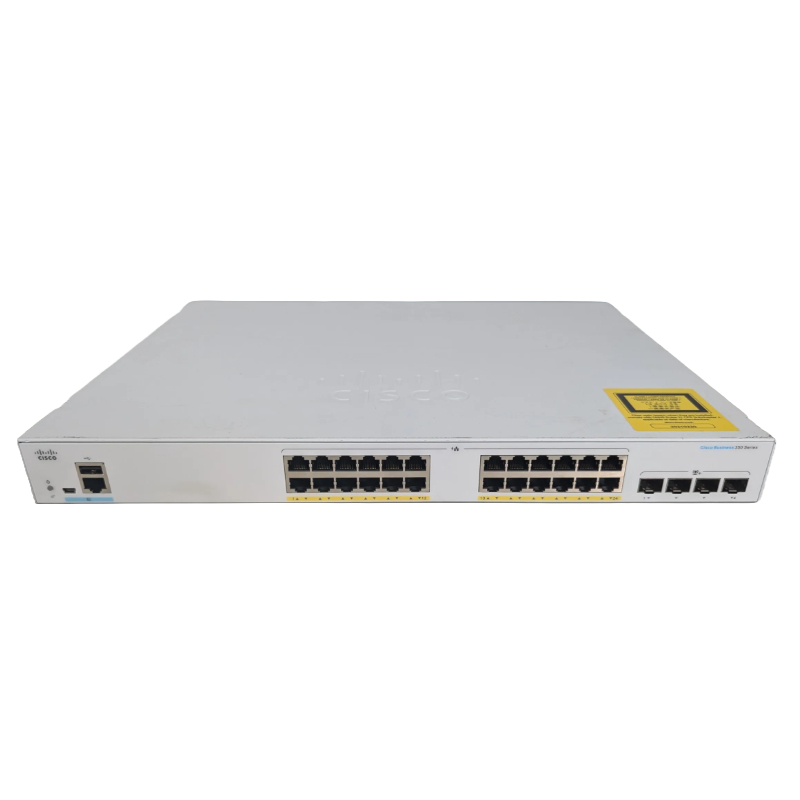


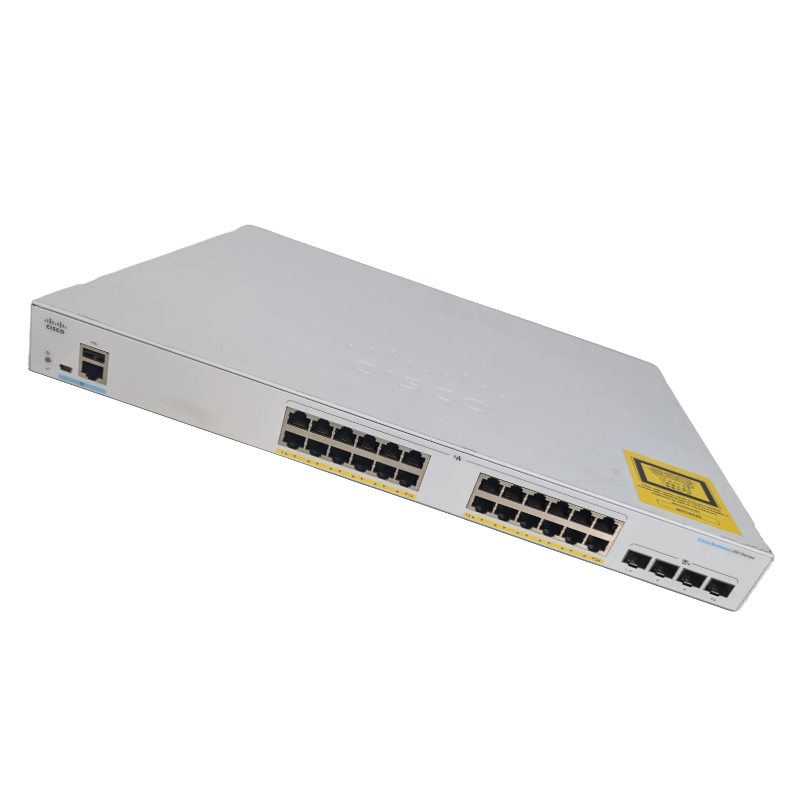
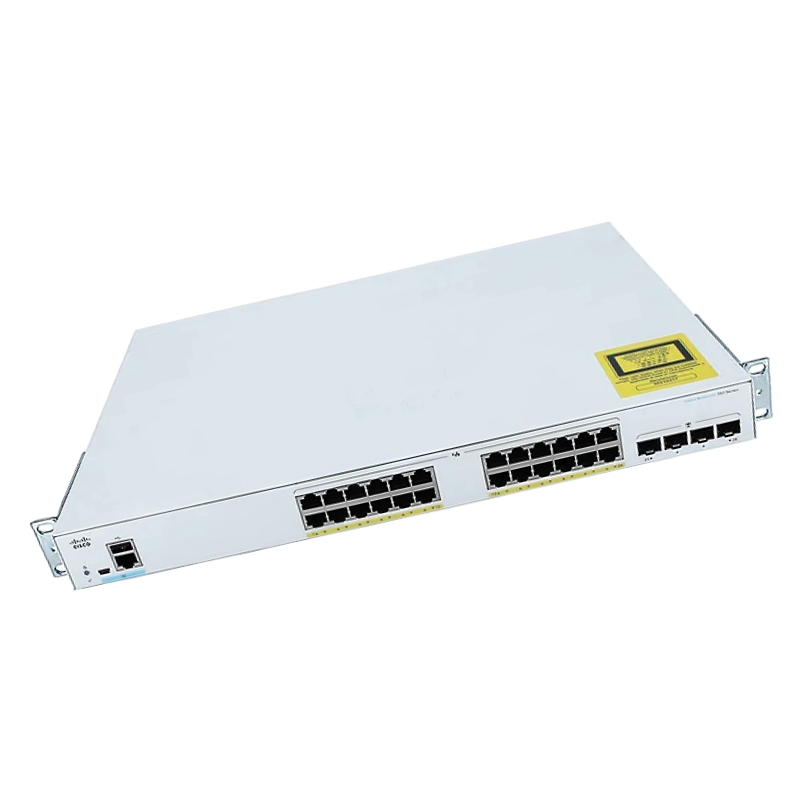
Cisco C1200-24P-4X Catalyst 1200 L3 24-Port Rack Mountable Network Switch with 4 X 10GB Ethernet SFP+ Ports. Excellent Refurbished with 1 year replacement warranty
| SKU/MPN | Warranty | Price | Condition | You save |
|---|---|---|---|---|
| C1200-24P-4X | 1 Year Warranty | $522.00 | Excellent Refurbished | You save: $182.70 (26%) |
| C1200-24P-4X | 1 Year Warranty | $589.00 | Factory-Sealed New in Original Box (FSB) | You save: $206.15 (26%) |
The Cisco C1200-24P-4X Catalyst 1200 is a Layer 3 rack-mountable network switch designed for advanced network performance. With 24 Gigabit Ethernet PoE+ ports and 4 high-speed 10Gb SFP+ uplink ports, this switch offers exceptional connectivity and scalability for modern enterprise networks.
The Cisco C1200-24P-4X Catalyst 1200 L3 Smart 24 × 10/100/1000 (PoE+) + 4 × 10Gb Ethernet SFP+ rackmountable PoE+ (195 W) switch is built for modern access networks that demand reliable power delivery, high throughput, and simplified Layer 3 management. Positioned as a practical, business-ready option, this switch blends advanced features like PoE+ across 24 Gigabit ports with four 10Gb SFP+ uplinks to anchor high-density edge deployments. It offers an approachable, “L3 Smart” control plane for inter-VLAN routing and core network functions, ideal for SMBs, branch sites, retail, education, healthcare, and hospitality.
With Cisco’s well-known hardware resilience, this model emphasizes consistent performance, secure operations, and intuitive administration while keeping total cost of ownership manageable. The 195 W PoE+ budget empowers IP phones, wireless APs, cameras, sensors, and collaboration endpoints without external power injectors. Meanwhile, 10Gb SFP+ uplinks unlock aggregation to core or distribution layers, ensuring scalable bandwidth as traffic grows. The rackmountable form factor, silent or low-noise cooling profiles, and compact depth fit diverse closets and cabinets.
Category buyers evaluating the Cisco Catalyst 1200 series will find the C1200-24P-4X especially compelling where LAN access, VoIP, and Wi-Fi integration converge. Its combination of multi-gigabit-ready design, energy-efficient PoE+, Layer 3 smart feature set, and enterprise-grade security yields a versatile access platform. Whether refreshing legacy switches or standardizing across sites, this model creates a dependable foundation with future-focused connectivity that aligns with hybrid work and IoT expansion.
The hardware architecture of the C1200-24P-4X provides the performance headroom required for data-heavy applications and sustained PoE+ loads. Its 24 × 10/100/1000 RJ-45 ports deliver line-rate switching for laptops, phones, printers, and IoT endpoints, while the 4 × 10Gb SFP+ uplinks enable high-speed aggregation to servers, NAS, distribution switches, or cloud on-ramps. This dual-plane design helps isolate access traffic from uplink flows, reducing bottlenecks and preserving end-user experience.
The switch integrates optimized packet forwarding pathways that minimize latency and jitter, crucial for voice and video traffic. In practical deployments, this reduces call drop risks and improves conferencing quality across unified communications platforms. For data workloads like backups, file sync, and real-time analytics, 10Gb uplinks provide clean, predictable throughput to upstream layers. The chassis and power subsystem are tuned to maintain performance under mixed PoE+ loads, balancing thermal management and consistent voltage delivery.
“L3 Smart” capabilities in the Catalyst 1200 series bridge the gap between unmanaged Layer 2 devices and full enterprise routers. This switch supports inter-VLAN routing for segmenting departmental traffic, enabling clean separation between voice, data, guest Wi-Fi, and IoT zones. Static routes and dynamic features on select models facilitate simple path control across LAN topologies, often eliminating the need for separate routing hardware in smaller sites.
Integrated DHCP utilities, ACLs, and QoS policies provide fine-grained control. Administrators can assign IP scopes to VLANs and enforce traffic rules that limit lateral movement or prioritize business-critical applications. QoS shaping and policing maintain performance for VoIP, video, and collaboration tools by prioritizing latency-sensitive flows. This blend of routing, policy, and prioritization delivers a dependable access layer that upholds service-level objectives.
PoE+ capability is central to the C1200-24P-4X value proposition, enabling direct power delivery to endpoints over Ethernet cables. With a 195 W shared budget, the switch supports a mix of devices like 802.11ac/ax access points, HD IP cameras, SIP phones, paging systems, and IoT sensors. This reduces wiring complexity, lowers installation costs, and improves uptime by centralizing power within the switch.
Smart power management tools help administrators allocate and monitor PoE draw per port. You can set thresholds, pre-assign critical devices to high-priority power pools, and monitor consumption trends to plan capacity growth. For sites deploying many APs or cameras, careful PoE design ensures adequate headroom across peak hours, preserving performance while safeguarding against over-subscription.
Begin with a device inventory and per-port wattage assumptions to estimate total load against 195 W. Balance high-draw endpoints across the 24 ports, and use power prioritization for mission-critical devices like APs in high-density areas. Consider peak demand periods, such as business openings or scheduled events, when usage spikes may occur.
Align cabling with Cat6 or better for PoE+ resilience, and keep cable runs within recommended lengths for voltage stability. Where necessary, stagger device boot times to prevent initial inrush power from exceeding budgets. Document power profiles for each site and review logs regularly to detect anomalies or degrading hardware that increases draw.
The four 10Gb SFP+ uplink ports provide flexible, high-speed connectivity to upstream layers. These ports accommodate a variety of fiber transceiver modules—SR, LR, or DAC cables—depending on distance and budget. In campus or multi-floor buildings, fiber uplinks deliver clean aggregation to distribution switches, preventing access layer saturation during peak usage.
10Gb uplinks are particularly beneficial for environments with heavy traffic from Wi-Fi 6/6E access points, IP video systems, and content collaboration. They help maintain stable throughput even as device counts grow. Administrators can link aggregate two or more uplinks for redundancy and higher bandwidth, supporting resilient designs without complex chassis systems.
Security is integrated throughout the C1200-24P-4X to protect against unauthorized access and lateral movement. Port security features restrict MAC address learning and limit endpoint spoofing. 802.1X network access control with RADIUS or TACACS+ enables robust authentication for users and devices, ensuring only authorized clients enter the network.
ACLs can be applied to VLAN interfaces and specific ports to enforce segmentation and data protection. Storm control and DHCP snooping mitigate common Layer 2 attacks and misconfigurations. With these controls, network operators reduce risk, meet compliance objectives, and maintain clean traffic flows between business units or guest networks.
QoS policies ensure that mission-critical applications receive appropriate priority and bandwidth. Define classes for voice, video, and collaboration tools, and assign DSCP markings at the access ports. Apply queuing and shaping to protect latency-sensitive flows from congestion, especially during peak usage or backup windows.
For guest traffic or bulk data transfers, lower priority classes prevent interruption to core business communications. Regularly review utilization metrics to refine policies as application mixes evolve. This approach maintains a responsive, fair network that supports modern workflows without over-provisioning.
The C1200-24P-4X shines in varied environments where reliable access, power, and uplink capacity are essential. In small and medium office networks, it consolidates wired endpoints and powers VoIP phones, with VLAN-based separation for departments and guest Wi-Fi backhaul. Retail sites use it to connect point-of-sale terminals, security cameras, and digital signage, leveraging PoE+ for clean installations.
Education deployments benefit from distance learning and smart classroom devices, with 10Gb uplinks feeding content servers and campus aggregation. Healthcare clinics employ PoE+ for IP cameras and badge systems, while segmenting sensitive medical data from public networks. Hospitality venues integrate APs and IPTV into VLANs, ensuring smooth guest experiences without compromising internal operations.
Effective VLAN design underpins security and performance in access networks. Assign separate VLANs for voice, data, guest, and IoT, mapping them to distinct subnets. Use inter-VLAN routing to allow controlled communication through ACLs, limiting access to critical servers while permitting necessary services like DNS and printing.
Apply QoS to the voice VLAN with elevated priority and reduced jitter parameters. For guest VLANs, restrict access to internal resources and route traffic to captive portals. IoT VLANs should apply stricter ACLs and monitoring due to device diversity; consider micro-segmentation strategies if endpoint heterogeneity is high.
When enabling inter-VLAN routing, ensure clear IP addressing schemes and document gateway assignments. Consider static routes to upstream firewalls or routers for internet breakout or WAN connectivity. Apply ACLs at VLAN interfaces to explicitly permit essential services while denying unnecessary lateral movement.
Monitor traffic flows to detect misrouted packets or asymmetric paths. Periodically review rules and adjust for new applications or changed compliance requirements. Keep a change log to trace configurations across multi-site deployments and maintain consistent policies.
The C1200-24P-4X is designed to operate efficiently under varying power loads, especially with PoE+ endpoints. Intelligent power allocation prevents over-consumption and optimizes per-port draw. Thermal management preserves component longevity, using controlled airflow and smart fan profiles to keep temperatures within safe ranges even in compact racks.
Energy-saving features may include idle port management and LED controls to limit unnecessary power use. Administrators can track consumption trends over time to plan capacity and justify upgrades. Combined with PoE+ planning, energy stewardship helps reduce operational costs and supports sustainability initiatives.
The C1200-24P-4X integrates smoothly into broader Cisco ecosystems and mixed-vendor environments. Standards-based protocols enable interoperation with common access points, IP phones, and cameras. In multi-layer architectures, it serves as a reliable access switch feeding into Cisco or third-party distribution and core layers via 10Gb fiber.
For unified communications, SIP phones and conferencing devices benefit from QoS enforcement and PoE+ stability. Wi-Fi deployments with 802.11ac/ax APs utilize the switch’s power budget and uplink throughput. Security cameras and IoT sensors connect seamlessly, with VLAN and ACL controls preserving network hygiene.
Within the Catalyst 1200 series, buyers often compare PoE versus non-PoE models, and differing uplink counts. The C1200-24P-4X targets sites needing both PoE+ and multiple 10Gb uplinks. For offices with fewer powered endpoints, a lower PoE budget may suffice, while environments with many APs and cameras benefit from the 195 W allocation.
If future growth includes higher uplink utilization or stacking, ensure fiber module compatibility and link aggregation options. Consider port count across switches to meet endpoint density; some networks prefer multiple smaller switches for localized fault domains. Evaluate management consistency across models to streamline training and operations.
As endpoints and application demands increase, scale by adding switches and leveraging 10Gb uplinks to a distribution layer. Use link aggregation across uplinks for redundancy and higher throughput. Segment traffic into finer VLANs to reduce broadcast domains and improve performance. Consider separate switches for high-PoE zones to balance power loads.
Consolidate configurations with templates and automation scripts. Deploy consistent QoS and ACL policies across sites to maintain predictable behavior. Monitor key metrics like port utilization, CPU usage, and PoE draw to identify scaling thresholds before service degradation occurs.
VoIP and video are sensitive to latency, jitter, and packet loss. Configure QoS policies that classify and mark packets at the access layer, ensuring downstream devices honor these priorities. Use queue management to prevent bulk transfers from dominating bandwidth, and apply shaping to smooth traffic bursts. Verify end-to-end QoS path across switches and routers.
Regularly test call quality and conferencing performance, correlating issues with utilization metrics. Update policies as new applications or codecs are introduced. This proactive approach maintains consistent call experiences and reduces troubleshooting overhead.
Modern Wi-Fi deployments, especially Wi-Fi 6/6E, generate significant traffic. Connect APs to the C1200-24P-4X PoE+ ports and route backhaul through the 10Gb SFP+ uplinks. This ensures that wireless throughput is not constrained at the access layer. For dense coverage, distribute APs across multiple switches and aggregate uplinks for balanced performance.
Implement VLANs for SSID separation (e.g., employee, guest, IoT), and apply ACLs to isolate traffic as needed. Use QoS to prioritize real-time applications over best-effort data. Keep optics inventory aligned with fiber distances and environmental considerations to avoid signal issues.
IP cameras benefit from PoE+ power delivery, simplifying installation and maintenance. Segment camera networks into dedicated VLANs with restricted access to NVRs or cloud storage endpoints. Apply rate limits or QoS where continuous streams coexist with bursts from analytics workloads.
Ensure robust recording paths by using 10Gb uplinks to storage servers or aggregation switches. Monitor PoE power draws, as cameras with PTZ or IR features can spike consumption. Implement logging and alerting to detect offline devices quickly and expedite recovery.
IoT devices—sensors, controllers, and gateways—often vary in behavior and security posture. Place them on dedicated VLANs and apply strict ACLs to confine communication to approved services. Use port security to limit MAC addresses and shut down rogue devices. Track traffic patterns to identify anomalies indicating faults or breaches.
For building systems like access control or environmental monitoring, coordinate with facilities teams to define acceptable traffic flows and maintenance windows. Ensure power availability via PoE+ for devices that support it, and maintain documentation for device onboarding procedures.
Design for resilience by leveraging link aggregation and redundant uplinks to upstream devices. Distribute critical endpoints across multiple access switches to limit the blast radius of failures. Use UPS systems to sustain PoE power during short outages and ensure clean shutdowns during extended events.
Consider dual-home uplinks to separate distribution switches, enabling failover. Maintain spares for optics and patch cords, and document recovery runbooks. Regularly test failover scenarios to validate that redundancy works as intended under live conditions.
For regulated industries, enforce VLAN separation, ACL policies, and authentication to meet compliance objectives. Log administrative actions and network events to centralized systems for audit trails. Implement role-based access controls, limiting configuration rights to authorized personnel.
Conduct periodic reviews to ensure that policies match current requirements. Maintain configuration archives and change control records. Align network segmentation with data classification to protect sensitive information consistently.
Reference designs accelerate deployment in common scenarios. For an SMB office, use one or two C1200-24P-4X switches for access, with VLANs dividing voice, data, and guest. Uplink via 10Gb fiber to a distribution switch or security gateway. Apply QoS for unified communications and ACLs for inter-VLAN control.
In retail, focus on PoS reliability, camera coverage, and signage connectivity. Segment traffic appropriately and ensure redundant uplinks to avoid disruptions. For education, design for high-density APs, classroom devices, and content streaming, prioritizing application traffic while maintaining security.
Mixed workloads are common, combining VoIP, Wi-Fi backhaul, surveillance, and office data. The C1200-24P-4X’s architecture supports these demands through flexible QoS, robust uplinks, and consistent PoE+. Monitor voice and video quality while observing uplink utilization to adjust policies and link aggregation.
Test during peak periods, such as shift changes or school start times, to validate stability. Use analytics from logs and SNMP to detect constraints and guide incremental enhancements. A measured approach ensures that the access layer remains responsive as demands evolve.
Adopt an application-centric model to align network design with business outcomes. Map critical workflows—voice, video, collaboration, surveillance, and IoT—into appropriate VLANs with policies tailored to each. Use 10Gb uplinks to route heavy flows upstream, avoiding congestion in the access layer.
Define performance objectives and monitor results, adjusting QoS and ACLs accordingly. Maintain cross-site consistency with templates and version-controlled scripts. This methodology ensures the switch’s capabilities translate into tangible user experience improvements and operational predictability.


 Contact Us
 Information
 Catalog
 Solid State Drives (SSD)
 Network Switches
 Hard Disk Drives
 HBA & Controllers
 PC & Servers
 PC & Server Memory
 CPU & Processors
 Network Routers
 Power Supplies
 Tape Drives & Libraries
 Network Devices
 Computer & Network Cables