(7% discount is applied at checkout)
Cart is empty
Your go-to destination for cutting-edge server products
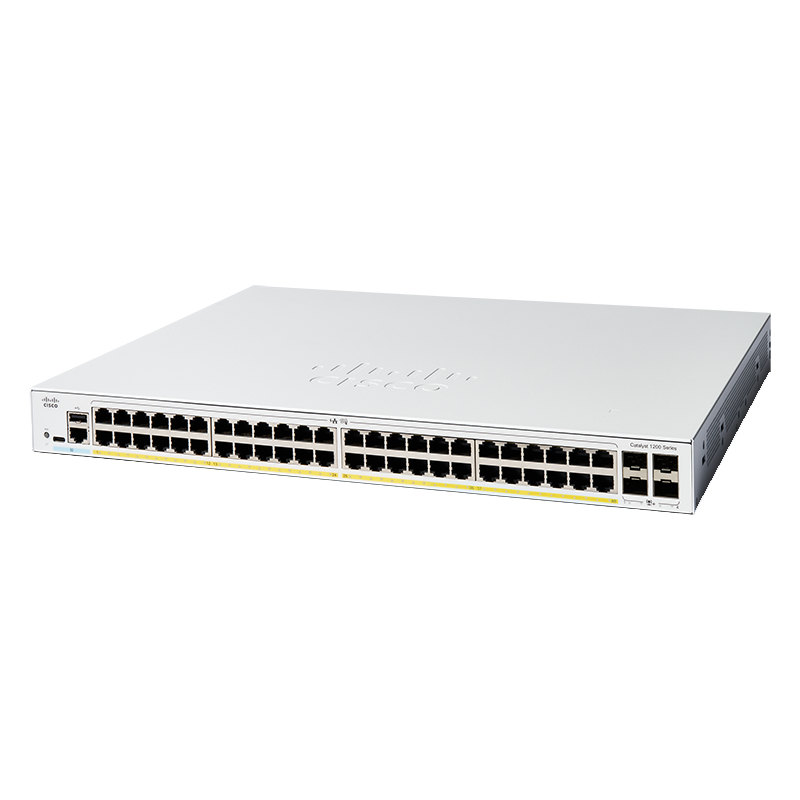


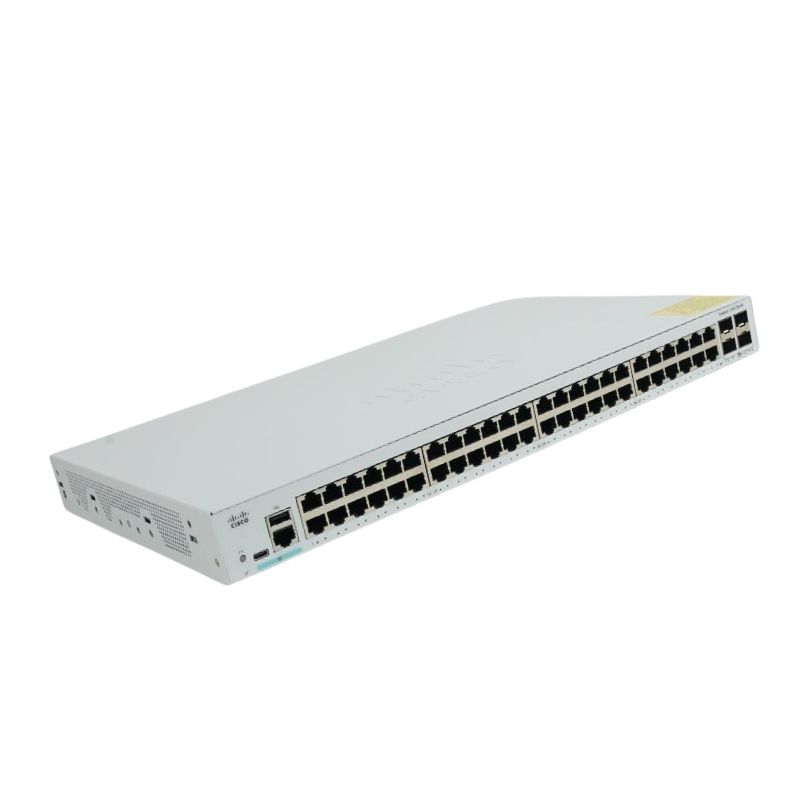
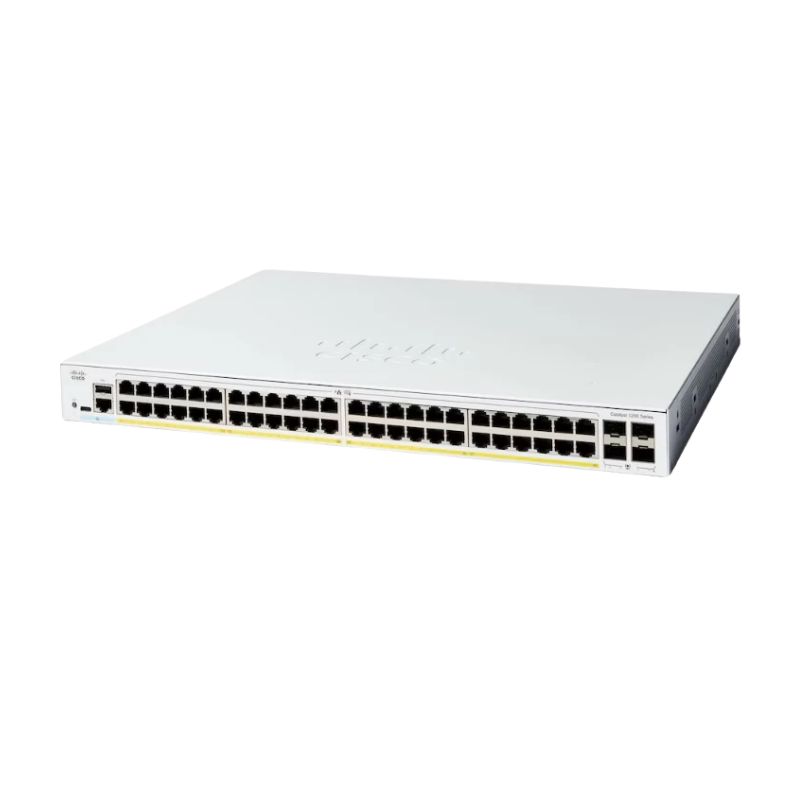
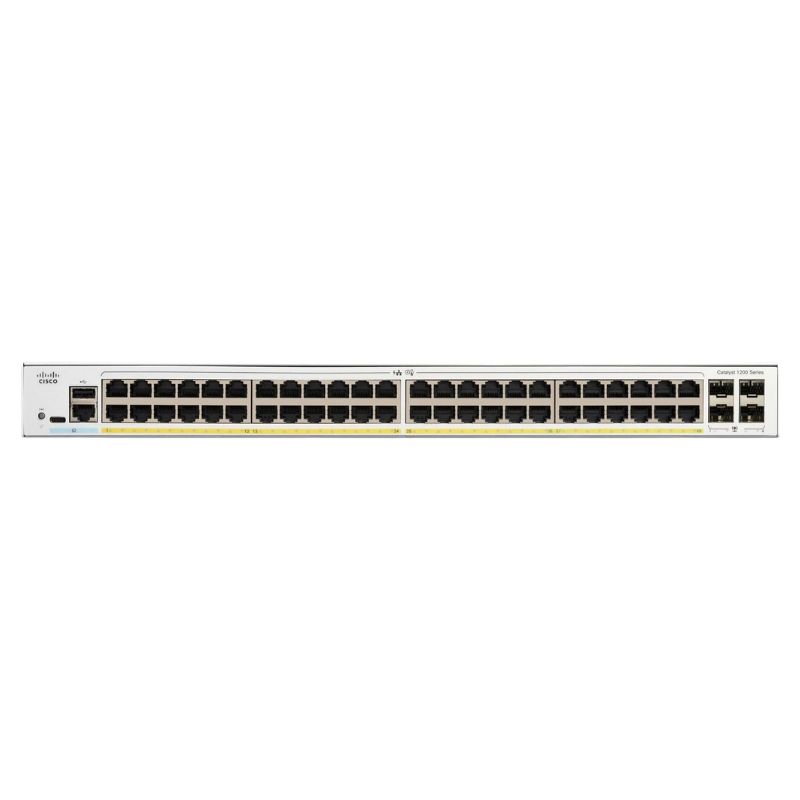
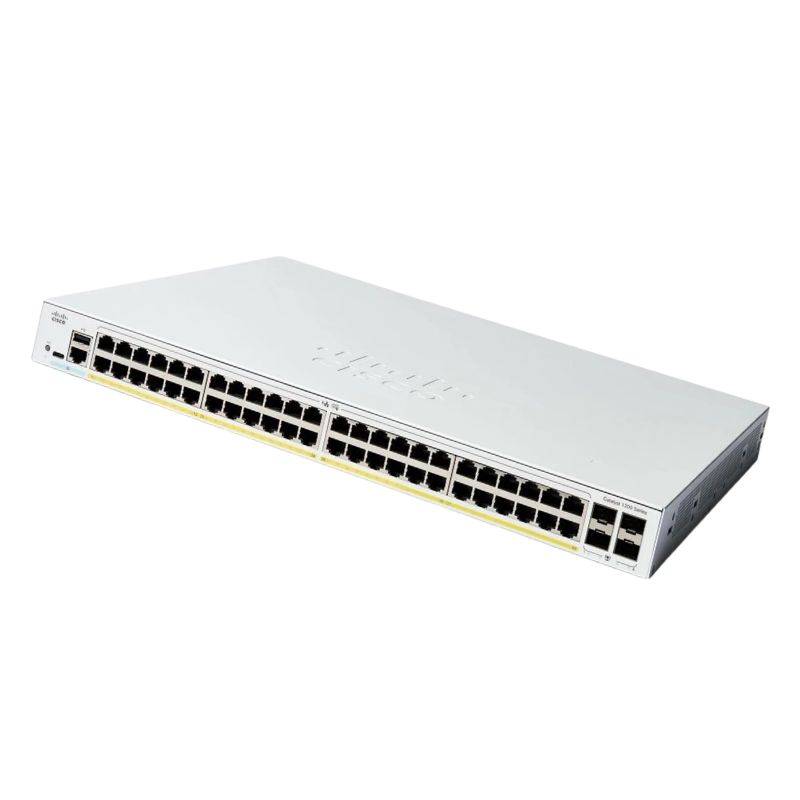
Cisco C1200-48P-4G 48-Port Managed Rack Mountable Network Switch with 4 Gigabit SFP+ Ports. Factory-Sealed New in Original Box (FSB) with 1 year replacement warranty
| SKU/MPN | Warranty | Price | Condition | You save |
|---|---|---|---|---|
| C1200-48P-4G | 1 Year Warranty | $460.00 | Excellent Refurbished | You save: $161.00 (26%) |
| C1200-48P-4G | 1 Year Warranty | $807.00 | Factory-Sealed New in Original Box (FSB) | You save: $282.45 (26%) |
Discover the Cisco Catalyst C1200-48P-4G, a high-performance managed switch designed for enterprise networks. This rack-mountable switch combines advanced Layer 3 features with smart management, making it ideal for secure, scalable, and efficient network operations.
The Cisco Catalyst C1200-48P-4G is a managed, rack-mountable Gigabit Ethernet switch designed to deliver reliable access switching with robust performance and simplified operations for small and medium-sized business networks. With 48 PoE+ Gigabit ports, 4 Gigabit SFP uplinks, and enterprise-grade Layer 3 smart capabilities, it supports high-density device connectivity for cameras, access points, phones, and endpoint clients while maintaining consistent throughput and efficient power distribution across the network.
Built within the broader Cisco Catalyst 1200 Series architecture, this switch benefits from Cisco’s approach to SMB networking: affordable hardware, streamlined management, and security-conscious design. The 1200 Series is managed via the Cisco Business mobile app or dashboard, providing a simple and reliable experience that reduces operational complexity without sacrificing essential features for modern cloud-connected environments.
The C1200-48P-4G offers a total of 52 physical interfaces, combining 48 × 10/100/1000BASE-T RJ-45 PoE+ ports with 4 × Gigabit SFP fiber uplink ports. This layout enables flexible aggregation and distribution designs, letting you segment access devices across multiple VLANs while backhauling traffic through fiber uplinks to distribution or core layers for improved resilience and bandwidth management.
The switch supports a 104 Gb/s switching capacity and a forwarding rate of 77.38 Mpps for 64-byte packets, ensuring wire-speed performance across typical campus access scenarios and minimizing bottlenecks during peak usage. This capacity is well-suited for SMBs deploying IP surveillance, VoIP, and Wi-Fi access points that require predictable throughput and low latency across many concurrent flows.
With a 375 W PoE+ budget, the switch can power a large number of PoE-enabled endpoints such as cameras, APs, and IP phones. PoE+ simplifies installations by removing the need for separate power cabling, reducing deployment costs and accelerating rollouts, especially in retrofits or multi-floor office environments where power outlets may be limited.
As a Layer 3 smart switch, the C1200-48P-4G supports essential routing and segmentation capabilities that help optimize traffic flows, separate departments or device types, and enforce security policies. Smart L3 features provide inter-VLAN routing for scalable network layouts, enabling efficient north–south and east–west traffic handling without requiring a full layer of external routers for basic segmentation tasks.
Spanning Tree capabilities include MSTP (Multiple Spanning Tree Protocol) with up to 8 instances, along with PVST+ and RPVST+ supporting up to 126 instances each. These options allow granular control of spanning tree topologies across VLANs, helping prevent loops and optimize path selection in multi-switch environments where redundancy is a priority.
Link aggregation supports 4 groups with up to 8 aggregated ports, providing higher throughput and redundancy between switches or to servers. By bundling links, you can increase effective bandwidth and improve fault tolerance, ensuring that a single physical link failure does not disrupt access to critical resources or upstream connections.
The integrated PoE+ support with a 375 W power budget ensures the C1200-48P-4G can power a mix of endpoints including high-draw wireless access points, PTZ cameras, and multi-line IP phones. This is particularly effective for converged networks where data and power are centralized through the access layer, streamlining cabling and simplifying moves, adds, and changes in fast-evolving office layouts.
PoE+ simplifies deployments in locations with limited electrical infrastructure, enabling greater flexibility in device placement. For example, ceiling-mounted APs or wall-mounted cameras benefit from PoE+ because they avoid the constraints imposed by nearby outlets, allowing optimal positioning for signal coverage or field of view while maintaining a clean, professional installation aesthetic.
The 4 × Gigabit SFP ports provide versatile uplink and stacking topologies, enabling resilient connections to upstream distribution switches, routers, or network firewalls over fiber. This allows you to extend network reach across floors or buildings while maintaining signal integrity, and it supports topologies where copper cabling length limits or electrical interference may be concerns.
Using multiple SFP uplinks allows for load-sharing or redundant paths, improving uptime and ensuring failover pathways remain available during maintenance windows or link failures. In SMB networks supporting mission-critical apps or cloud services, these uplinks are a foundational building block of reliable access-layer design.
With a 104 Gb/s switching capacity, the C1200-48P-4G handles dense port utilization scenarios and sustained traffic bursts typical of modern office workloads. The 77.38 Mpps forwarding rate indicates robust packet processing efficiency at smaller frame sizes, supporting environments where control traffic and small payload packets are common across many endpoints.
This performance profile aligns with use cases like IP surveillance streams, VoIP signaling and media, and frequent ARP/DHCP operations in large VLAN domains. Efficient handling of these packets reduces jitter, improves call quality, and maintains smooth video streams even as endpoint counts scale across departments and floors.
The Cisco Catalyst 1200 Series emphasizes simplified management for SMBs through the Cisco Business mobile app and dashboard. These tools streamline provisioning, monitoring, and policy enforcement, reducing the need for complex CLI operations and enabling IT teams or MSPs to quickly configure VLANs, QoS settings, and security policies across the access layer.
The management approach is aligned with SMB priorities—reliability, security, and affordability—while also addressing complexity of ongoing operations. This balance allows businesses to maintain control over expanding networks connecting cloud apps, remote offices, and IoT devices, without the overhead typically associated with enterprise-grade network administration.
Cisco positions the 1200 Series as an affordable, easy-to-use set of switches built to support the connectivity-to-cloud journey common in modern SMBs. By focusing on reliability and streamlined operations, the series ensures that small IT teams can handle growth without sacrificing network stability or security posture, making it a practical foundation for digital transformation initiatives.
The combination of enterprise-grade features with approachable management tooling reduces time-to-deploy and lowers total cost of ownership. Businesses gain essential functions—segmentation, QoS, spanning tree control, link aggregation—without needing advanced tuning expertise, accelerating rollouts for new offices, remodels, or technology refresh cycles.
In a typical SMB office or campus, the C1200-48P-4G anchors access connectivity for a broad array of devices: Wi-Fi APs in open offices, cameras in lobbies and stairwells, IP phones at desks and conference rooms, and wired desktops for accounting or engineering teams. The 48 PoE+ ports give ample headroom for growth while keeping power delivery centralized and manageable.
Retail and hospitality deployments benefit from PoE for kiosks, point-of-sale terminals, and digital signage. Centralized power and data reduce cable sprawl and ensure that devices can be repositioned as floor plans evolve, seasonal kiosks are added, or guest spaces are reconfigured. The ability to power a wide range of endpoints directly from the switch is a key differentiator for operational agility.
The switch’s PoE+ budget supports numerous IP cameras, including models with pan-tilt-zoom capabilities requiring more power. Combined with VLAN segmentation, surveillance traffic can be isolated from user and server VLANs, protecting critical video streams and simplifying QoS policies so security monitoring remains prioritized even during peak business hours.
SFP uplinks also make it easy to connect remote camera networks or security closets via fiber, improving resilience against electrical interference, supporting longer cable runs, and enabling failover pathways. For multi-building campuses or multi-floor offices, these uplinks are instrumental in designing robust security networks that remain operational during partial link failures.
Modern wireless deployments often require APs with PoE+ power draw, particularly tri-band units or APs with USB peripherals or IoT radios. The 375 W budget allows many APs to be powered concurrently, enabling dense Wi-Fi coverage in conference areas or open-plan spaces while maintaining a simple and neat cabling setup.
With link aggregation and spanning tree controls, you can build resilient uplink paths to controllers or distribution switches, helping ensure that roaming and client authentication remain stable even during maintenance or transient link issues. The net result is smoother user experiences and fewer helpdesk tickets related to intermittent wireless disruptions.
VLANs are foundational for access-layer design, and the C1200-48P-4G’s Layer 3 smart capabilities facilitate inter-VLAN routing for departmental isolation, guest access policies, and IoT segregation. This design reduces broadcast domain size, improves security boundaries, and allows targeted QoS controls tailored to each traffic class for consistent performance across diverse workloads.
MSTP, PVST+, and RPVST+ instances provide granular spanning tree control to match segmentation patterns, ensuring loop-free topologies and optimizing path selections. In environments with multiple redundant uplinks and aggregated links, fine-tuning spanning tree behaviors prevents suboptimal forwarding choices and maintains stable convergence during topology changes.
Link aggregation groups (up to 4 groups, with 8 ports total) improve throughput by bonding multiple physical links and increase resilience in the event of a single-link failure. This is particularly useful when uplinking to servers hosting critical applications, storage arrays, or upstream switches that carry multi-department traffic or backbone routes.
By distributing flows across aggregated links, you can reduce congestion and better utilize available bandwidth during peak times, ensuring latency-sensitive applications like voice and interactive collaboration remain responsive. Aggregation also simplifies maintenance by allowing individual links to be serviced without dropping connectivity.
The 104 Gb/s switching capacity serves as a core metric for sizing the switch against expected traffic patterns, helping ensure enough headroom for simultaneous Gigabit flows across many ports. When combined with the 77.38 Mpps forwarding rate, SMBs can confidently deploy high-density endpoint configurations without risking packet loss or jitter due to processing constraints.
For PoE planning, the 375 W budget should be allocated against device power profiles. A balanced approach might mix lower-draw phones and cameras with higher-draw APs, ensuring that the budget accommodates peak draw scenarios (e.g., APs at full radio load or PTZ cameras under active movement) while avoiding brownouts or device resets from power oversubscription.
When scaling across multiple floors, deploy one or more C1200-48P-4G units per floor, with SFP uplinks back to a distribution layer. Aggregate uplinks where needed to increase bandwidth, and leverage MSTP instances aligned with VLAN groups to keep convergence times predictable and avoid cross-floor broadcast storms or loops during link transitions.
Departmental segmentation can be achieved through dedicated VLANs per department, with inter-VLAN routing enabled via the switch’s L3 smart features. For sensitive departments (e.g., finance or HR), additional ACLs and DHCP controls at the access layer help preserve confidentiality and enforce least privilege traffic paths while maintaining efficient communication with shared services like printers or file servers.
Redundancy at the access layer starts with multiple uplinks to the distribution or core layer, ideally across independent fiber paths when possible. Spanning tree configurations (PVST+, RPVST+, or MSTP) can be tuned to prefer specific uplinks and block others until needed, preventing loops while providing fast failover options that keep user sessions stable during link changes.
Link aggregation groups further enhance resilience, distributing traffic and ensuring that a single physical link failure does not interrupt critical data flows. In SMB environments where IT resources are limited, these built-in protections reduce the frequency and severity of outages, contributing to better overall productivity and fewer disruptions.
The Cisco Business mobile app and dashboard streamline common tasks such as VLAN configuration, device discovery, port status checks, and basic troubleshooting. This reduces reliance on command-line deep dives for routine tasks, accelerating onboarding of new devices and helping non-specialist IT staff maintain healthy network operations with confidence.
For MSPs or distributed SMBs, centralized dashboards enable consistent policy application across multiple switches, ensuring standardized VLAN schemas, QoS rules, and security settings. This approach lowers configuration drift risk and makes it easier to audit or replicate setups across new branch locations.
Security segmentation at the access layer is essential, and the C1200-48P-4G’s VLAN and L3 smart features allow policy enforcement close to endpoints. By separating guest Wi-Fi, IoT, and user devices, you can restrict lateral movement and minimize the blast radius of potential breaches, while maintaining smooth access to shared services and internet breakout paths.
Controlling spanning tree instances per VLAN or spanning tree domain reduces the chance of topology manipulation or misconfigurations leading to loops and broadcast storms, which can be exploited in poorly managed networks. Combined with link aggregation and uplink redundancy, these features create a robust network fabric with fewer single points of failure.
QoS policies at the access layer help prioritize voice, video, and critical business applications so they remain responsive under load. With 48 ports feeding a diverse set of endpoints, consistent classification and scheduling ensure that essential services—like IP telephony or conferencing—retain precedence over bulk transfers, backups, or guest traffic.
Strategically using VLANs to separate traffic classes simplifies QoS rule application and monitoring. With SFP uplinks carrying aggregated and prioritized flows to upstream devices, the network can maintain end-to-end quality guarantees that improve user experiences and reduce IT support burdens.
The four Gigabit SFP uplinks allow integration with distribution switches or firewalls, facilitating segment isolation and security policy enforcement at higher layers. This is especially important for SMBs adopting zero trust principles, where segmentation and inspection points become key for controlling access to cloud services and sensitive internal applications.
Link aggregation to upstream devices enables aggregated bandwidth and simplifies failover, while spanning tree control ensures loop-free operations in complex access topologies. Together, these features support a robust, scalable architecture that handles growth in endpoint counts, traffic volume, and application diversity.
As SMBs increasingly adopt SaaS solutions and hybrid-cloud architectures, reliable access switching is essential for consistent user experiences. The C1200-48P-4G’s performance and segmentation capabilities support predictable connectivity for identity providers, collaboration platforms, and cloud productivity suites, while PoE+ reduces complexity in powering edge devices that facilitate these services.
Operational simplicity via the Cisco Business dashboard reduces the effort to keep access-layer configurations aligned with evolving cloud security policies. This helps businesses adapt to new requirements—like conditional access or device posture checks—without major disruptions to the underlying connectivity fabric.
For branch offices, the C1200-48P-4G provides a single chassis solution that can power APs, phones, cameras, and wired clients while uplinking securely to a central site over fiber or WAN gateways. VLANs segment local departments and guest traffic, while Layer 3 smart routing enables efficient local inter-VLAN communication without complex external routing overhead.
MSPs can leverage the Cisco Business management experience to standardize deployments across multiple branches, ensuring consistent segmentation, QoS, and spanning tree configurations. This approach reduces per-site customization time, enables rapid deployment, and improves troubleshooting with familiar, repeatable patterns.
In education environments, PoE+ allows powering classroom APs and cameras, while VLANs isolate student, staff, and administrative networks. The switch’s performance profile supports concurrent usage during peak periods like class changes, testing windows, or after-school events that strain wireless and wired connectivity simultaneously.
Healthcare SMBs benefit from segmented networks that separate patient devices and medical IoT from general office traffic, helping protect sensitive data and ensure reliable connectivity for administrative functions. The ability to scale with 48 ports and fiber uplinks supports multi-floor clinics and outpatient centers that demand dependable uptime and clean separations of traffic classes.
With 48 PoE+ ports, the C1200-48P-4G supports devices that require higher power classes beyond standard PoE, enabling installations of advanced APs and PTZ cameras. Ethernet auto-negotiation and standards-based PoE behavior simplify device onboarding, ensuring endpoints receive appropriate power without manual intervention or specialized cabling.
Deploying endpoints across multiple VLANs and applying per-port policies allows granular control of access, QoS, and security. This is especially beneficial when mixing device types—such as phones and cameras—on the same switch, ensuring each class of device receives the appropriate treatment for performance and protection.
The four SFP uplinks provide flexibility for different topology designs: dual-uplink redundancy to two distribution switches, aggregated uplinks for bandwidth scaling, or dedicated uplinks per major VLAN domain. Fiber uplinks remain preferred for longer runs and electrically noisy environments, maintaining signal integrity and future-proofing building interconnects.
In multi-floor deployments, align uplink paths with spanning tree root designations to keep traffic on preferred routes and minimize traversal across less optimal links. Proper uplink planning enhances performance consistency and eases troubleshooting when issues arise.
MSTP’s 8-instance limit pairs well with simplified VLAN groupings, reducing administrative overhead while still allowing differentiated path control across major traffic domains. PVST+ and RPVST+ offer per-VLAN granularity, enabling highly tuned failover behavior in environments that need maximum control over spanning tree convergence and root placement.
Balancing complexity and control is key: choose MSTP for larger, uniform designs, and PVST+/RPVST+ where pinpoint control over specific VLANs benefits application performance or resilience requirements. Document chosen strategies to prevent misalignment during future expansions.
Up to 4 link aggregation groups and 8 aggregated ports allow meaningful bandwidth scaling between the access and distribution layers. This reduces oversubscription risks and supports growth in traffic-heavy applications, such as video conferencing and large file sync operations across knowledge worker teams.
Aggregation also enhances uptime by allowing links to be serviced individually. Combined with spanning tree, it creates a layered resilience approach that protects against both link-level and topology-level faults, improving overall stability of the access network fabric.


 Contact Us
 Information
 Catalog
 Solid State Drives (SSD)
 Network Switches
 Hard Disk Drives
 HBA & Controllers
 PC & Servers
 PC & Server Memory
 CPU & Processors
 Network Routers
 Power Supplies
 Tape Drives & Libraries
 Network Devices
 Computer & Network Cables