(7% discount is applied at checkout)
Cart is empty
Your go-to destination for cutting-edge server products


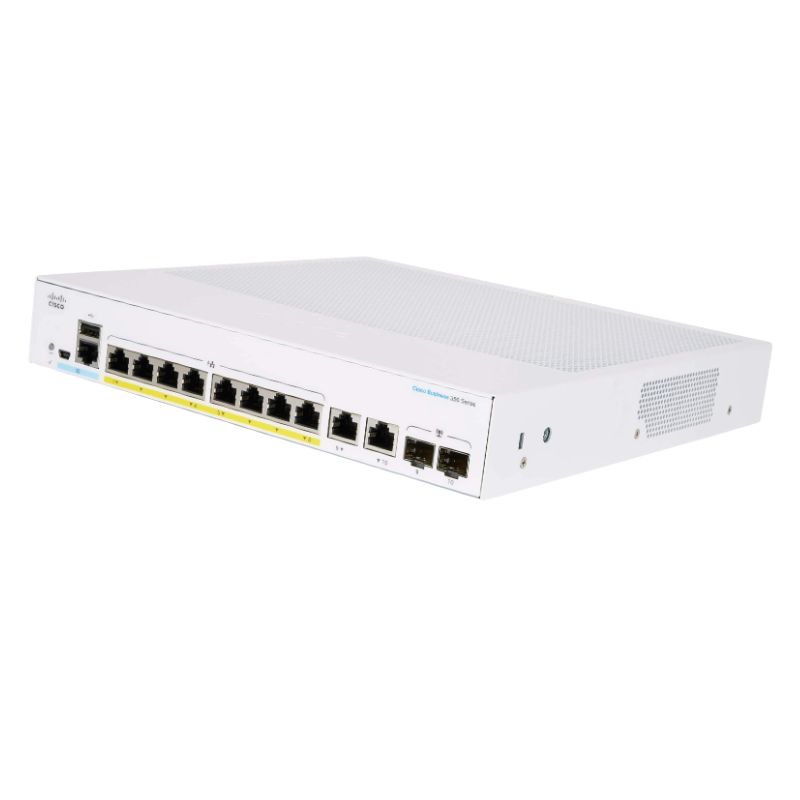
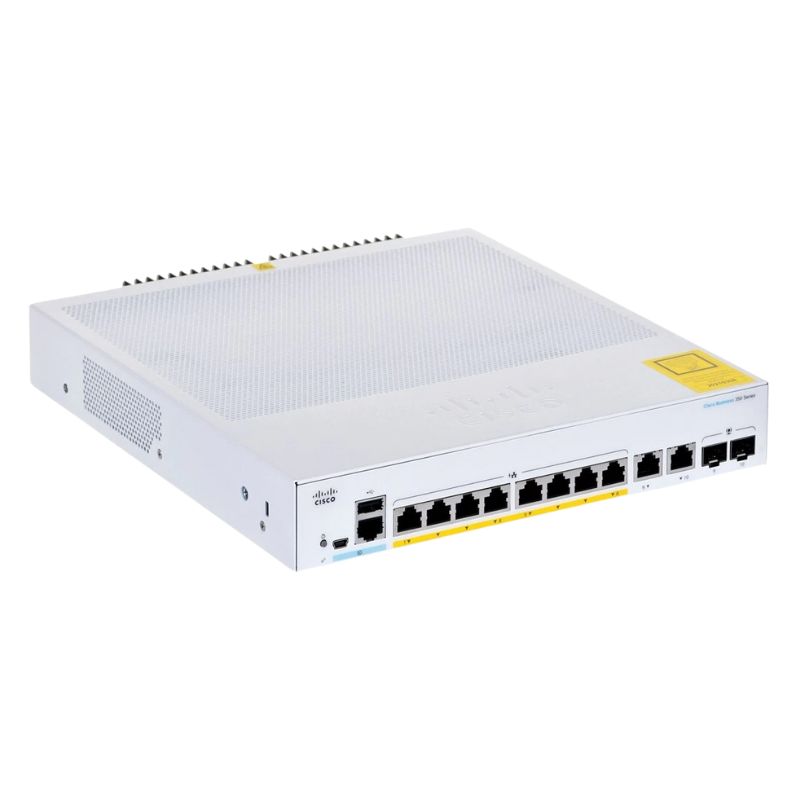
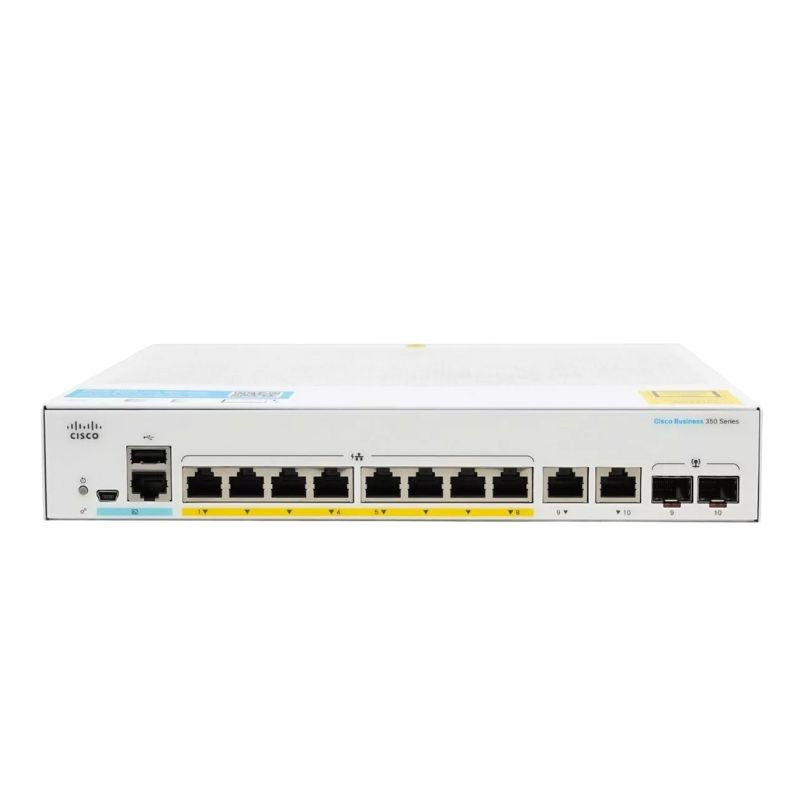
Cisco CBS350-8FP-2G-NA 350 Ethernet Switch 8 Ports Manageable 2 Layer Supported. Excellent Refurbished with 1 year replacement warranty
| SKU/MPN | Warranty | Price | Condition | You save |
|---|---|---|---|---|
| CBS350-8FP-2G-NA | 1 Year Warranty | $190.00 | Excellent Refurbished | You save: $66.50 (26%) |
| CBS350-8FP-2G-NA | 1 Year Warranty | $343.00 | Factory-Sealed New Retail in Original Box (FSB) | You save: $120.05 (26%) |
The Cisco CBS350-8FP-2G-NA is a compact yet powerful managed switch engineered for professional networks that demand stability, intelligent control, and seamless scalability. Its combination of PoE+ support, flexible management options, and advanced Layer 3 features makes it suitable for small to medium-sized business infrastructures.
This switch provides robust connectivity with balanced bandwidth allocation, ensuring smooth performance across multiple devices.
The CBS350-8FP-2G-NA ensures dependable throughput and efficient routing, supporting modern business applications and traffic-heavy workloads.
This switch integrates intelligent automation to reduce deployment time and streamline configuration tasks.
The CBS350 series incorporates technologies that reduce power consumption without compromising performance.
With its blend of high-performance switching, PoE+ flexibility, Layer 3 capabilities, and simplified management, the Cisco CBS350-8FP-2G-NA offers a dependable networking foundation suitable for office networks, surveillance systems, and high-demand digital ecosystems.
The Cisco CBS350-8FP-2G-NA is a compact, business-grade managed Ethernet switch in the Cisco Business 350 series designed to meet the connectivity, power over Ethernet, and manageability needs of small to medium-sized networks. This model provides eight Gigabit Ethernet ports with PoE+ capabilities alongside two combo Gigabit copper/SFP uplink ports, delivering a versatile mix of edge port density and flexible uplink choices for connectivity to aggregation walls, servers, or fiber backbones. The device is part of Cisco’s Business 350 family which balances enterprise-class feature sets—such as advanced VLANs, Quality of Service (QoS), security controls and limited Layer 3 routing—with an approachable management experience that includes Web UI, SNMP and CLI resources suitable for IT teams and channel partners.
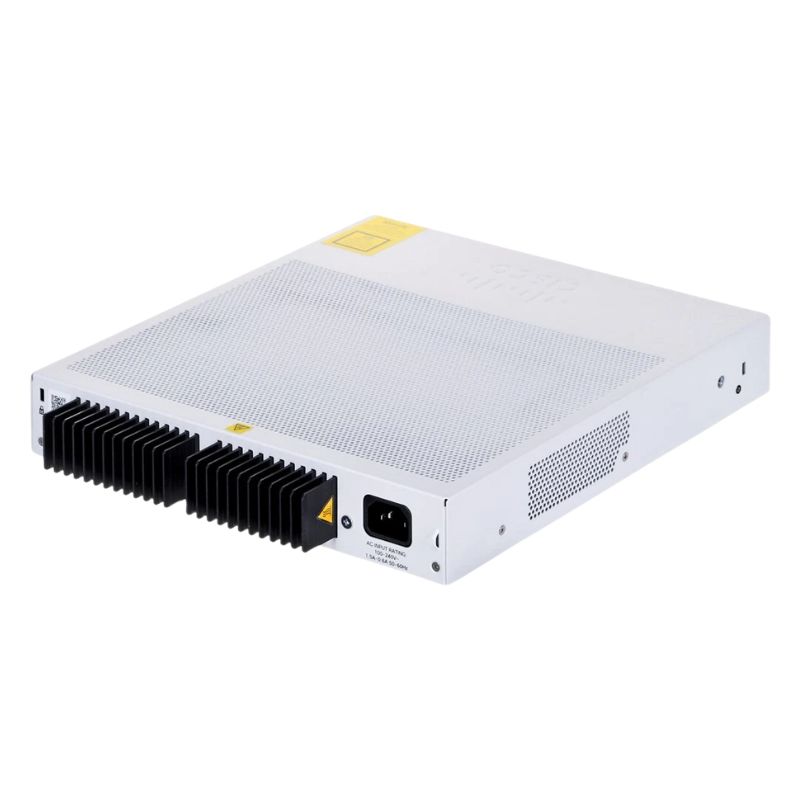
The CBS350-8FP-2G-NA comes in a small form factor that supports desktop placement or rack mounting in small racks. The unit is engineered to be space-efficient while still offering robust PoE+ power delivery, and physical specifications make it easy to deploy in wiring closets, branch offices, retail locations, and compact network closets. Typical product dimensions and shipping weights are suitable for rapid rollouts where space and weight matter. Hardware design focuses on thermal efficiency and predictable power draw, which simplifies planning when multiple switches are aggregated in a single rack or powered from a centralized UPS. For technical teams planning a rollout, the datasheet and product pages provide exact dimensions and power consumption figures to model rack space and electrical load accurately.
At the core of the CBS350-8FP-2G-NA is a combination of eight auto-sensing 10/100/1000 Ethernet ports that support PoE+ and two Gigabit combo ports that give administrators the flexibility to attach fiber SFP modules or use copper uplinks as wiring demands change. The model’s PoE budget is one of its standout attributes for small networks that need to power IP phones, wireless access points, security cameras, and other PoE devices without adding separate power injectors. The CBS350-8FP variant is designed with a higher PoE power budget to support simultaneous powering of multiple devices when required by dense edge deployments. This balance of port density, uplink flexibility, and PoE budget makes it a natural fit for deployments where both data and power need to be consolidated on a single network appliance.
Performance metrics for the Cisco Business 350 series emphasize line-rate forwarding on Gigabit ports with a switching capacity engineered to support the full wire-speed needs of small business environments. Typical switching capacity and forwarding rates are in the range expected from an 8-port Gigabit managed switch in this family, enabling predictable packet forwarding for voice, video and data use cases. Packet buffering and architecture design are optimized to minimize latency and jitter for real-time applications while enabling QoS policies that prioritize voice and video traffic. These capabilities allow network architects to design converged networks that handle mixed workloads without compromising performance. For precise capacity and per-packet forwarding numbers, the official datasheet and product PDF provide the switching capacity and packets-per-second figures used for engineering calculations.
The Cisco Business 350 series is positioned as a managed switch family that offers both a friendly web-based GUI and a more advanced command line interface for administrators who prefer scriptable, repeatable management. The CBS350-8FP-2G-NA supports VLAN segmentation, advanced Quality of Service settings, ACLs, 802.1X authentication, port security, IGMP snooping, and a selection of Layer 2 features that make it easy to implement secure, segmented networks that isolate traffic types such as voice, video, and guest access. The product also includes limited Layer 3 functionality such as static routing and inter-VLAN routing options appropriate for small office networks that require simple routing without the complexity of full dynamic routing protocols. The availability of both GUI and CLI tools, as well as SNMP support, enables centralized monitoring and integration with network management systems, simplifying lifecycle operations for managed service providers and in-house IT teams.
Security features in the CBS350 series are designed to protect both the network and attached devices. The switch supports role-based access control for administrative interfaces, port-based authentication via 802.1X, and flexible Access Control Lists (ACLs) that restrict traffic to the permitted flows between VLANs and endpoints. Port security parameters help prevent MAC flooding or rogue device attachment, while features such as DHCP snooping and dynamic ARP inspection can be applied to mitigate common edge threats. When paired with good network policy design, the switch’s security features give organizations a strong starting point for hardening the edge and enforcing segmentation policies that reflect their security posture and compliance requirements. Cisco’s documentation and support resources provide configuration examples and best practices for applying these controls in production.
Built-in QoS tools on the CBS350-8FP-2G-NA enable administrators to prioritize latency-sensitive traffic such as VoIP and video conferencing. Traffic classification mechanisms combined with queue management and rate-limiting functions allow critical flows to maintain high quality even in congested conditions. The switch supports multiple queues per port and offers control over scheduling and shaping policies, which makes it suitable for mixed workloads where real-time services share bandwidth with bulk data transfers. These QoS capabilities are essential in modern small office deployments where high-quality voice and video are expected alongside normal data traffic. Network engineers should align QoS policies across access, aggregation, and core layers to guarantee end-to-end service quality.
The CBS350-8FP-2G-NA is particularly well suited for a cluster of use cases that are common in branch offices, retail locations, professional services firms, and small campus environments. It is an excellent choice when a small number of powered devices need to be connected and managed centrally; examples include a cluster of PoE access points in a meeting area, a handful of IP phones in a small office, or a combination of surveillance cameras and wireless access points in a retail storefront. The two combo SFP uplink ports provide the flexibility to connect to fiber uplinks for isolation or long-distance links to wiring closets, while the PoE budget supports continued operations of powered devices without requiring separate power supplies. The feature set and manageable nature of the switch also make it a good candidate for networks where IT staff want centralized visibility, monitoring, and remote troubleshooting capabilities without the overhead of enterprise core architectures.
As part of Cisco’s Business 350 family, the CBS350-8FP-2G-NA benefits from a consistent management experience and documentation set that covers the entire series. This family-level consistency makes it easier to standardize configurations across locations and to use shared templates and operational procedures. Administrators can leverage the same support resources, firmware updates, and configuration guides across different CBS350 models, which simplifies training and reduces the time required to roll out new locations. Integration with Cisco’s technical support channels and partner ecosystem adds the advantage of predictable lifecycle management and firmware maintenance paths. For teams that rely on Cisco’s documentation and support, the Business 350 pages and product comparison resources provide the authoritative reference material.
While the CBS350 family includes models that support stacking, the CBS350-8FP-2G-NA is primarily designed as a standalone access switch in small networks. The device’s design philosophy emphasizes port-level PoE delivery and managed features at the access layer rather than deep stacking for large-scale data center style aggregation. For organizations that plan to grow, it is common to use multiple CBS350 switches with consistent configuration templates and upstream aggregation. The combination of manageable features and flexible uplinks makes it straightforward to link devices into logical topologies that can grow by adding additional access switches as demand increases. For deployments that require stacked single-pane management, administrators should review the broader CBS350 family to select models with explicit stacking and higher uplink capabilities.
Configuration patterns that tend to work well for the CBS350-8FP-2G-NA center on treating the device as a secure, power-capable access edge switch. Designers often create separate VLANs for voice, wireless, surveillance and corporate devices to ensure clear traffic separation and to enable QoS policies that prioritize voice and video. Port profiles or templates simplify repetitive configuration when multiple switches are deployed in branch offices. When PoE capacity is a constraint, scheduling or grouping of powered devices onto separate access switches can avoid oversubscription of the PoE budget. For uplinks, pairing the two combo SFP ports with fiber runs to the building’s aggregation switch or network closet increases resiliency and reduces broadcast domains at the access layer. These practical patterns reflect the fundamental characteristics of what the CBS350-8FP-2G-NA is designed to support.
The CBS350-8FP-2G-NA sits among several 8-port, 16-port and higher-density models in the Business 350 series. Some variants prioritize larger PoE budgets, others replace copper ports with SFP-only ports for denser fiber-centric access, and still others provide higher uplink counts or stacking. When comparing models, consider the PoE budget, uplink speed and type, Layer 3 requirements, and whether stacking or centralized management across multiple switches is a requirement. Choosing the right model is ultimately determined by the number of powered devices, connectivity distance to aggregation points and whether future expansion or stacking is planned. Cisco’s model comparison pages and datasheets provide side-by-side details that are useful during the selection process.


 Contact Us
 Information
 Catalog
 Solid State Drives (SSD)
 Network Switches
 Hard Disk Drives
 HBA & Controllers
 PC & Servers
 PC & Server Memory
 CPU & Processors
 Network Routers
 Power Supplies
 Tape Drives & Libraries
 Network Devices
 Computer & Network Cables