(7% discount is applied at checkout)
Cart is empty
Your go-to destination for cutting-edge server products
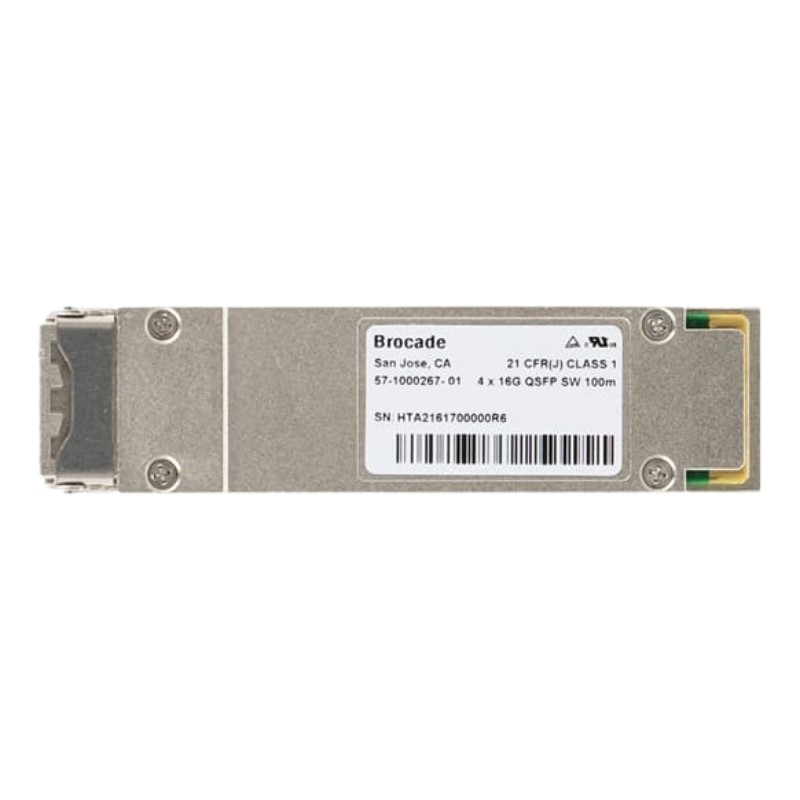


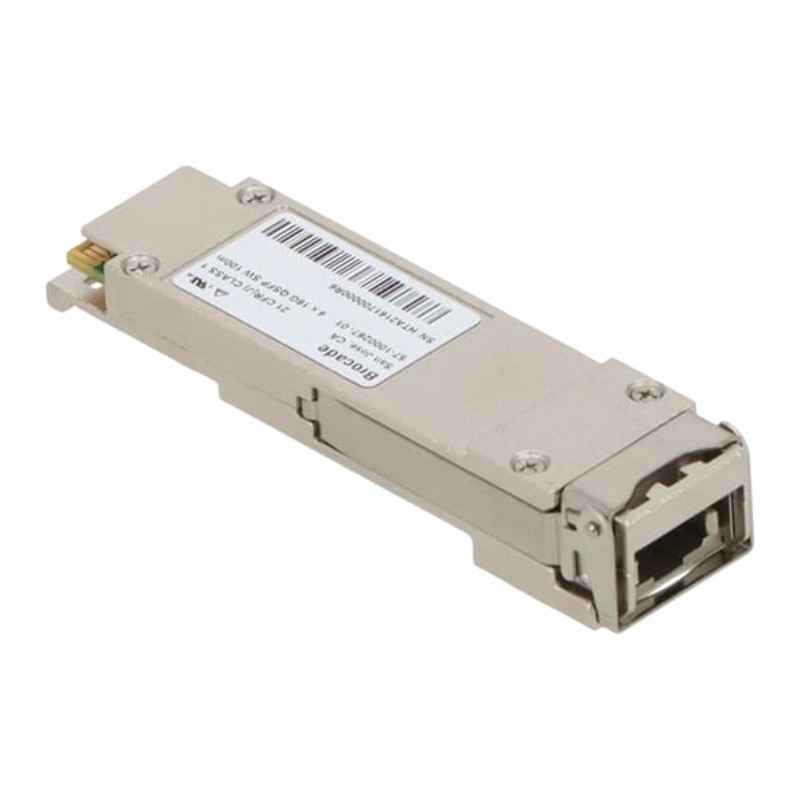
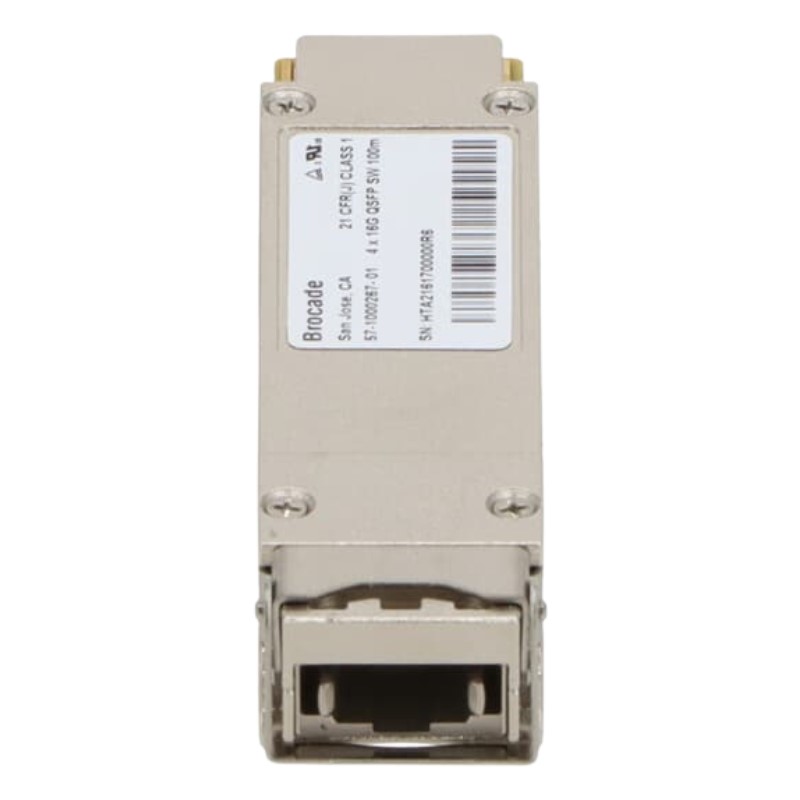
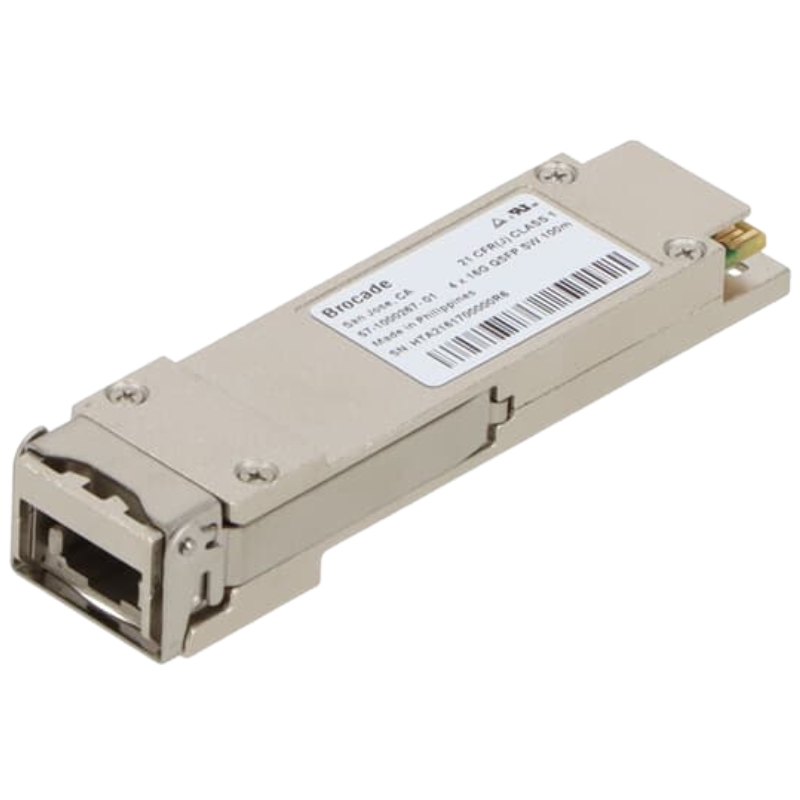
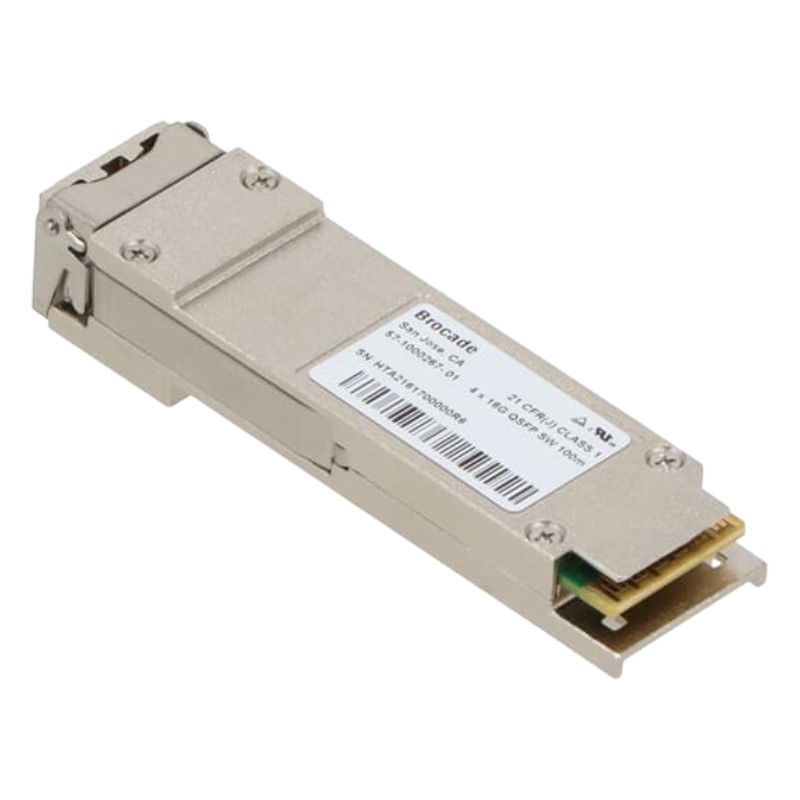
Brocade 57-1000267-01 4 X 16GB FC SWL QSFP 100m Transceiver. Excellent Refurbished with 1 year replacement warranty
The Brocade 57-1000267-01 4x16Gb Fibre Channel SWL QSFP+ Transceiver Module is a high-performance optical networking component designed for modern enterprise storage and data center environments. This hot-swappable QSFP+ transceiver delivers reliable short-wave laser (SWL) connectivity with high-speed Fibre Channel data transmission, making it ideal for high-density switching and storage networking infrastructure.
The Brocade 57-1000267-01 4 x 16GB FC SWL QSFP 100m Transceiver Module is a high-performance optical connectivity component designed for enterprise-class storage area networks (SANs) that require reliable, low-latency, and high-bandwidth fiber channel communication. This module belongs to a specialized category of short-wavelength laser-based QSFP transceivers engineered specifically for 16Gb Fibre Channel environments, enabling dense data center interconnectivity over multi-mode fiber infrastructure. It is widely adopted in mission-critical storage systems where predictable throughput, minimal signal degradation, and stable optical performance are essential.
In contemporary data centers, Fibre Channel technology continues to serve as a backbone for storage networking due to its deterministic performance and lossless transport characteristics. The 16Gb generation represents a significant advancement over earlier 8Gb and 4Gb standards by doubling throughput while maintaining compatibility with established SAN architectures. The QSFP (Quad Small Form-Factor Pluggable) design enables compact, high-density port configurations, making it suitable for high-capacity switching environments.
The Brocade 57-1000267-01 module supports short-wavelength laser transmission over multimode fiber, typically operating within the 850nm wavelength range. This allows reliable communication across distances up to 100 meters, depending on fiber grade and installation conditions. Its design ensures optimal signal integrity in environments where multiple transceivers operate simultaneously within high-density switch chassis.
The module employs short-wavelength laser (SWL) technology optimized for multimode fiber transmission. SWL technology is favored in data centers because it provides efficient coupling into OM3 and OM4 fiber types while maintaining stable signal performance across medium-range distances. The laser source is engineered to maintain consistent modulation rates aligned with 16G Fibre Channel standards, ensuring synchronized communication across SAN fabrics.
The QSFP architecture integrates four independent 16Gb Fibre Channel channels into a single compact module footprint. This quad-channel structure allows aggregation of bandwidth while reducing physical port density requirements on switching hardware. The mechanical and electrical interface is designed for hot-pluggable deployment, enabling seamless installation without interrupting active network operations.
The transceiver supports advanced encoding mechanisms used in Fibre Channel networks, ensuring error-checked transmission and low bit error rates. Signal processing within the module incorporates equalization techniques that compensate for fiber dispersion and attenuation. This ensures that data integrity is preserved even in environments with high electromagnetic interference or dense cable routing.
Efficient thermal control is a critical aspect of the module’s design. The Brocade 57-1000267-01 is engineered to maintain stable operating temperatures even under continuous high-throughput conditions. Power consumption is optimized to reduce heat generation, which is particularly important in densely populated switch environments where airflow may be constrained.
The module is primarily deployed in enterprise SAN environments where storage arrays, backup systems, and virtualization platforms require high-speed interconnectivity. Its low latency and deterministic performance make it suitable for database clusters, ERP systems, and large-scale virtual machine storage pools.
In cloud data centers, scalability and reliability are essential. The 16G FC QSFP module supports high-density switching fabrics that facilitate rapid scaling of storage resources. It enables efficient east-west traffic flow between storage nodes, reducing bottlenecks and improving overall system responsiveness.
The transceiver supports redundant fabric configurations where multiple independent paths ensure uninterrupted data flow. In such environments, failover mechanisms rely on consistent optical performance, and the module’s stable signal characteristics contribute significantly to maintaining continuous availability.
The Brocade 57-1000267-01 module is specifically designed for compatibility with Brocade Fibre Channel switching platforms. It integrates seamlessly with Brocade directors and fixed-port switches that support 16Gb Fibre Channel interfaces. The firmware and hardware alignment ensure that the module is recognized natively without additional configuration overhead.
Beyond switching infrastructure, the module is widely compatible with enterprise storage arrays from multiple vendors. Its adherence to Fibre Channel standards ensures interoperability in heterogeneous environments where storage and compute systems are sourced from different manufacturers.
Although optimized for 16Gb operation, the module is capable of negotiating lower link speeds where necessary. This backward compatibility enables integration into mixed-generation SAN environments where legacy 8Gb or 4Gb devices still exist, ensuring gradual infrastructure upgrades without service disruption.
The 16Gb per channel capability of the module ensures high throughput suitable for demanding workloads such as high-frequency transaction processing and large-scale data replication. The aggregated bandwidth provided by the QSFP interface significantly reduces congestion in backbone SAN links.
One of the defining advantages of Fibre Channel technology is its extremely low latency. The Brocade 57-1000267-01 module maintains minimal transmission delay, making it ideal for applications that require real-time data access, such as financial trading systems and high-performance computing clusters.
The module is designed to maintain very low bit error rates even in environments with dense fiber deployment. This is achieved through a combination of laser precision, signal conditioning, and adherence to strict Fibre Channel physical layer specifications. Reduced error rates translate into fewer retransmissions and improved overall network efficiency.
The module is optimized for multimode fiber infrastructure, typically OM3 and OM4 graded cabling. These fiber types are capable of supporting the bandwidth and distance requirements of 16G SWL transmission while maintaining cost-effective deployment compared to single-mode alternatives.
With a maximum reach of approximately 100 meters, network designers must carefully plan SAN layouts to ensure optimal placement of switching equipment and storage arrays. Proper cable management and adherence to bend radius specifications further enhance signal reliability and performance stability.
The module utilizes LC duplex connectors, which are standard in high-density optical networking environments. These connectors provide secure physical alignment and low insertion loss, contributing to overall link stability and predictable optical performance across deployed systems.
Gradual degradation in performance may be caused by fiber aging, contamination, or improper cable routing. Monitoring tools can detect increased error rates or fluctuating signal strength, allowing proactive remediation before service disruption occurs.
Temperature fluctuations, humidity, and dust accumulation can all influence optical performance. Data center environmental controls play a critical role in preserving the reliability of transceiver modules, ensuring stable operation over extended periods.
Compared to 8G Fibre Channel modules, the 16G SWL QSFP offers double the bandwidth, significantly improving storage throughput and reducing congestion in high-demand environments. This makes it more suitable for virtualization-heavy workloads and modern cloud architectures.
Short wavelength modules like the Brocade 57-1000267-01 are optimized for multimode fiber and shorter distances, while long wavelength variants are used for extended reach over single-mode fiber. The choice between these technologies depends on infrastructure layout and distance requirements.
QSFP modules provide higher port density and aggregated bandwidth compared to SFP+ designs. This makes QSFP-based solutions preferable in environments where space efficiency and scalability are key considerations.
Organizations often deploy these modules as part of a long-term scalability strategy. By standardizing on 16G Fibre Channel infrastructure, enterprises ensure that future expansions can be integrated without major architectural redesigns.
Although high-performance optical modules represent a significant investment, their contribution to reduced downtime, improved throughput, and efficient storage access results in lower total cost of ownership over time. Efficient scaling and reduced maintenance overhead further enhance their economic value.
As data centers evolve toward hyper-converged and hybrid cloud models, high-speed Fibre Channel connectivity continues to play a critical role in ensuring stable storage performance. The Brocade 57-1000267-01 module remains a foundational component in maintaining high-performance SAN fabrics capable of supporting next-generation workloads.


 Contact Us
 Information
 Catalog
 Solid State Drives (SSD)
 Network Switches
 Hard Disk Drives
 HBA & Controllers
 PC & Servers
 PC & Server Memory
 CPU & Processors
 Network Routers
 Power Supplies
 Tape Drives & Libraries
 Network Devices
 Computer & Network Cables