
(7% discount is applied at checkout)
Cart is empty
Your go-to destination for cutting-edge server products
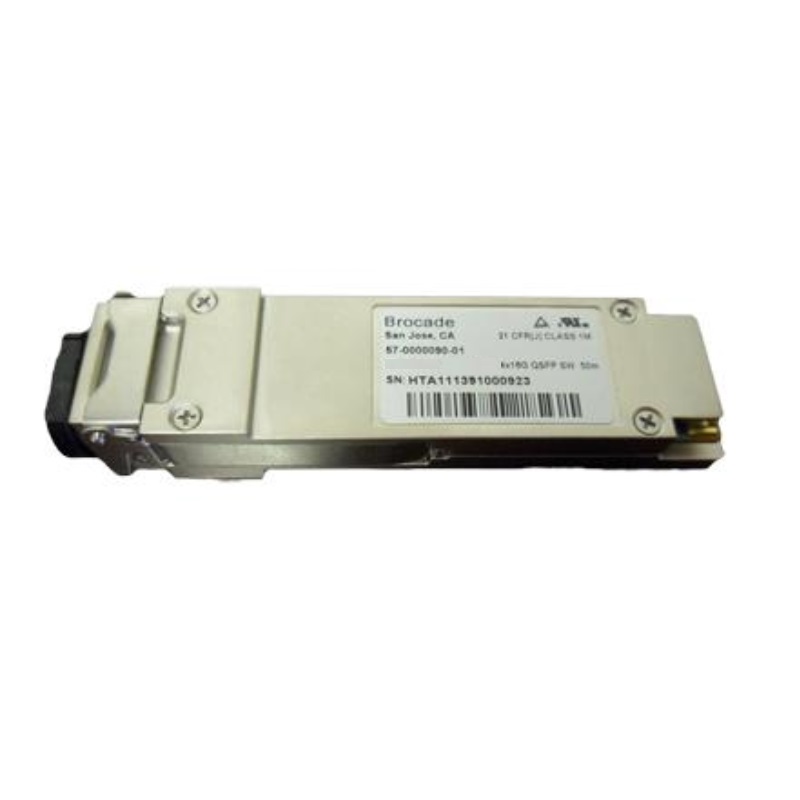
Brocade XBR-000228 16Gigabit Transceiver 50m Fiber Channel Swl Qsfp. Excellent Refurbished with 1 year replacement warranty
The Brocade XBR-000228 is a high-performance 4x16G Fibre Channel Short-Wave QSFP transceiver. Designed for enterprise-grade networking, this optical module delivers reliable connectivity with multi-mode fiber support, ensuring efficient data transfer across storage and data center infrastructures.
The modern enterprise storage ecosystem demands ultra-low latency, high throughput, and resilient connectivity between servers and storage arrays. Within this high-performance networking domain, Fibre Channel (FC) technology remains a cornerstone for mission-critical SAN (Storage Area Network) deployments. The Brocade XBR-000228 4x16G FC SWL QSFP 50m Transceiver is engineered to meet these stringent requirements, delivering reliable short-wave laser optical connectivity optimized for dense, high-speed fabric environments. As part of the advanced optical transceiver category developed under the networking solutions portfolio of this module plays a critical role in enabling scalable 16G Fibre Channel infrastructure.
The XBR-000228 transceiver is built on a quad small form-factor pluggable (QSFP) architecture that aggregates four independent 16G Fibre Channel channels into a compact optical interface. This 4-lane parallel design significantly increases port density while reducing overall footprint within high-capacity SAN switches and directors. Each lane operates at 14.025 Gbps signaling rates to support full 16G FC performance per channel, ensuring deterministic latency and predictable throughput across enterprise workloads.
The SWL (Short Wavelength Laser) technology integrated into this module is optimized for multimode fiber environments. Operating typically in the 850nm wavelength range, it is designed for high-bandwidth short-reach interconnects within data center racks or adjacent networking cabinets. The optical engine ensures minimal signal dispersion and reduced insertion loss, enabling stable data transmission across distances up to 50 meters depending on fiber grade and installation quality.
This transceiver is designed to function efficiently over OM3 and OM4 multimode fiber cabling infrastructures. OM3 fiber supports standard 16G FC distances in controlled environments, while OM4 fiber extends the reach and improves signal integrity through lower modal dispersion characteristics. These fiber types are widely deployed in enterprise SAN topologies where predictable short-range connectivity is essential.
The QSFP form factor provides a compact yet highly scalable interface that consolidates multiple channels into a single hot-swappable module. This design reduces switch port congestion while enabling higher aggregate bandwidth per physical slot. The module’s mechanical and electrical interface conforms to standardized QSFP specifications, ensuring interoperability within supported Fibre Channel switching platforms.
Each XBR-000228 module delivers four independent 16G FC lanes, allowing cumulative bandwidth suitable for high-density storage traffic aggregation. This architecture is particularly beneficial in environments requiring parallel data flows such as virtualization clusters, database farms, and high-performance computing storage fabrics. The aggregated throughput enhances storage responsiveness and minimizes bottlenecks across SAN switching layers.
Advanced signal conditioning techniques are integrated into the transceiver to preserve data integrity across optical paths. These include pre-emphasis, receiver sensitivity tuning, and adaptive equalization mechanisms. These technologies collectively ensure minimal bit error rates even under high utilization scenarios typical of enterprise storage traffic bursts.
The XBR-000228 is engineered for short-reach connectivity up to 50 meters, making it ideal for intra-data center deployments. This distance range is optimized for top-of-rack (ToR) to end-of-row (EoR) switch interconnects and storage array connections within confined infrastructure layouts. The SWL optical signal is precisely tuned to maintain performance consistency within this range without degradation.
Fibre Channel protocols are inherently designed for low-latency transport, and this transceiver further enhances performance by minimizing optical conversion delays. The internal circuitry ensures rapid serialization and deserialization of data streams, supporting near real-time storage communication required for transactional workloads and virtualized environments.
The module incorporates jitter reduction mechanisms that stabilize signal timing across all four lanes. This ensures synchronized transmission and reception, particularly important in environments where multiple parallel data streams must maintain strict alignment for consistent throughput.
Designed for seamless integration into enterprise SAN environments, the XBR-000228 is compatible with high-performance Fibre Channel switching platforms commonly deployed in large-scale data centers. These environments rely on modular scalability, and the transceiver enables flexible expansion of fabric capacity without redesigning existing infrastructure.
In modern SAN fabric architectures, scalability is achieved through modular expansion of switch ports and inter-switch links. The QSFP-based design allows multiple 16G channels to be grouped or split depending on fabric requirements, supporting both edge and core network expansion strategies.
The transceiver is highly effective in virtualized environments where storage resources are abstracted and dynamically allocated. It ensures consistent connectivity between hypervisors and shared storage pools, enabling high availability and efficient resource utilization.
Energy efficiency is a critical consideration in dense data center deployments. The XBR-000228 is designed with low-power optical components that minimize heat generation while maintaining full 16G FC performance. This contributes to reduced cooling requirements and improved operational efficiency in large-scale SAN deployments.
The module is engineered to maintain stable operation under varying thermal conditions commonly found in high-density switch chassis. Internal thermal regulation ensures consistent optical output power and receiver sensitivity, preventing performance degradation under sustained workloads.
Passive heat dissipation is achieved through optimized housing design and material selection. The QSFP casing is structured to facilitate efficient heat transfer away from critical optical and electrical components, ensuring long-term reliability.
In enterprise storage environments, data integrity is paramount. The transceiver is built to support continuous 24/7 operation with minimal error rates, ensuring consistent data transmission even under peak traffic loads. This reliability is essential for banking systems, cloud infrastructures, and large-scale virtualization platforms.
The module supports hot-swappable installation, allowing network administrators to replace or upgrade transceivers without disrupting active SAN operations. This feature significantly reduces downtime and enhances operational flexibility in mission-critical environments.
High-quality optical components and rigorous manufacturing standards ensure extended operational lifespan. The module is designed to maintain stable performance over long deployment cycles, reducing the need for frequent replacement and minimizing total cost of ownership.
In HPC environments, rapid access to distributed storage is essential. The XBR-000228 supports high-throughput data movement between compute nodes and shared storage systems, enabling efficient processing of large datasets in scientific, engineering, and analytics workloads.
Cloud data centers rely heavily on scalable and resilient storage networks. This transceiver supports dense virtualization workloads by ensuring consistent bandwidth availability and low-latency communication between virtual machines and storage arrays.
Backup infrastructures require stable and predictable data transfer rates. The module facilitates efficient replication between primary and secondary storage systems, supporting disaster recovery strategies with minimal data loss risk.
The SWL optical system operates within the 850nm wavelength spectrum, optimized for multimode fiber transmission. This wavelength is ideal for short-distance high-bandwidth communication, providing strong signal integrity and reduced attenuation over supported distances.
The receiver subsystem is engineered for high sensitivity, enabling accurate signal interpretation even in electrically noisy environments. This enhances overall link stability and ensures consistent Fibre Channel performance across all operational conditions.
Internal shielding and signal isolation techniques reduce electromagnetic interference and crosstalk between channels. This is especially important in high-density switch environments where multiple optical modules operate in close proximity.
The module strictly adheres to 16G Fibre Channel standards, ensuring compatibility with compliant SAN equipment across multiple vendors. This interoperability allows seamless integration into heterogeneous network environments without proprietary constraints.
While optimized for 16G FC performance, the transceiver can operate within environments where mixed-speed Fibre Channel components exist, provided appropriate switch configuration is applied. This ensures smooth migration paths from older infrastructure to higher-speed architectures.
Switch firmware plays a critical role in enabling full functionality of optical modules. The XBR-000228 is supported by advanced firmware ecosystems that provide diagnostics, monitoring, and performance optimization features for enterprise network administrators.


 Contact Us
 Information
 Catalog
 Solid State Drives (SSD)
 Network Switches
 Hard Disk Drives
 HBA & Controllers
 PC & Servers
 PC & Server Memory
 CPU & Processors
 Network Routers
 Power Supplies
 Tape Drives & Libraries
 Network Devices
 Computer & Network Cables