
(7% discount is applied at checkout)
Cart is empty
Your go-to destination for cutting-edge server products
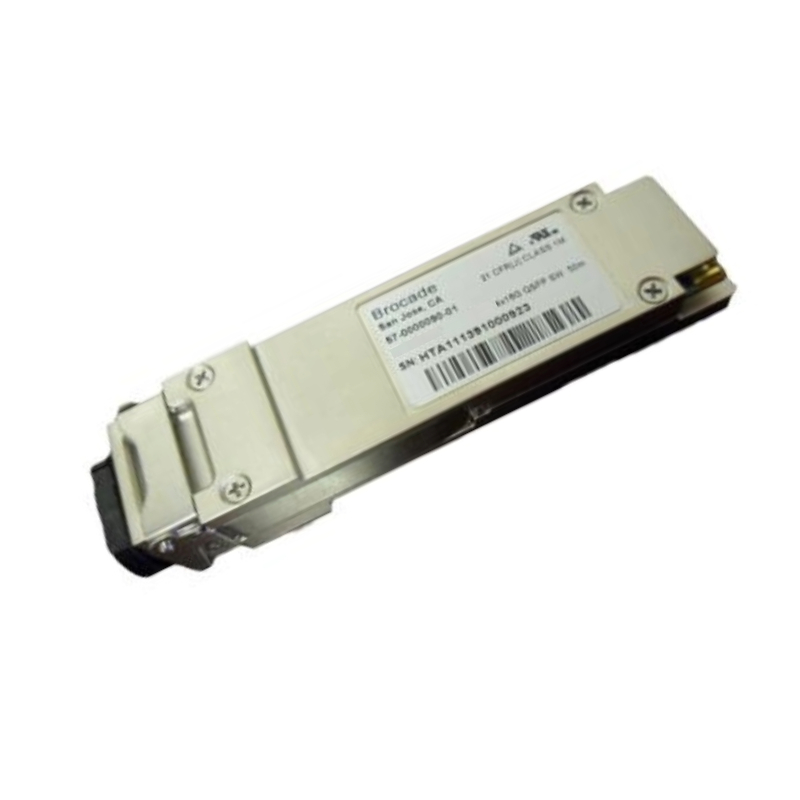
Brocade XBR-000232 16 Gigabit 100m Multimode Fiber On Om4 66m Qsfp Swl. Excellent Refurbished with 1 year replacement warranty
The Brocade XBR-000232 is a high-performance 16Gbps Fibre Channel QSFP transceiver module. Designed for shortwave optical communication, this device ensures reliable multi-mode fiber connectivity with advanced diagnostics and efficient bandwidth utilization for enterprise-grade networking.
The XBR-000232 Brocade 16Gbps Multi-mode Fiber Shortwave 100m 850nm Fibre Channel QSFP Transceiver Module represents a high-performance optical networking component engineered for enterprise storage area networks (SANs), data center interconnects, and high-speed Fibre Channel environments. Designed to deliver reliable 16Gbps data transmission over multimode optical fiber, this module is optimized for shortwave applications using an 850nm wavelength and supports distances of up to 100 meters on OM3/OM4 cabling infrastructures. Built under the Brocade optical networking ecosystem, it ensures seamless interoperability, low latency, and mission-critical uptime for storage networking deployments.
At the heart of the XBR-000232 module lies a 16Gbps Fibre Channel architecture that is optimized for modern storage networking environments. This speed tier enables rapid block-level data transfer between storage arrays, servers, and SAN switches. The 16G FC standard ensures backward compatibility with 8G and 4G Fibre Channel environments through auto-negotiation mechanisms, allowing gradual infrastructure upgrades without service disruption.
The Quad Small Form-Factor Pluggable (QSFP) design of this transceiver allows dense port configurations in enterprise switches and directors. The compact form factor supports high port density while maintaining efficient thermal performance and signal integrity. The electrical interface is designed for low power consumption and optimized signal processing, making it suitable for large-scale SAN deployments where port density and energy efficiency are critical factors.
The module operates using an 850nm shortwave vertical-cavity surface-emitting laser (VCSEL) system, which is specifically optimized for multimode fiber transmission. This wavelength is ideal for short-range data center connections, ensuring minimal signal attenuation and high reliability over OM3 and OM4 fiber types. The optical system ensures consistent modulation performance even in high-density cabling environments.
The XBR-000232 transceiver is engineered to support multimode fiber cabling standards, particularly OM3 and OM4. These fiber types are widely used in enterprise data centers due to their high bandwidth capacity and cost efficiency compared to single-mode fiber. OM3 fiber supports 16G Fibre Channel transmission up to 100 meters, while OM4 fiber can enhance signal quality and stability within the same distance range, making it suitable for dense storage network topologies.
One of the defining features of this module is its ability to maintain stable 16Gbps Fibre Channel connectivity across distances of up to 100 meters. This makes it highly suitable for intra-data center connectivity, including switch-to-switch links, server-to-SAN fabric connections, and storage array interconnects. The shortwave optical design ensures minimal dispersion and jitter, maintaining data integrity across the supported transmission range.
The module incorporates advanced signal conditioning techniques to mitigate optical loss and modal dispersion. These include pre-emphasis, equalization, and real-time monitoring of optical power levels. These mechanisms ensure that the transmitted data remains stable even in complex fiber routing environments with multiple patch panels and interconnects.
The XBR-000232 module is designed to integrate seamlessly into Brocade Fibre Channel switching environments. Brocade SAN fabric architectures are widely deployed in enterprise and hyperscale data centers due to their reliability, scalability, and advanced fabric services. This transceiver ensures full compatibility with Brocade directors and switches, enabling plug-and-play deployment in certified environments.
In mission-critical storage environments, downtime is not acceptable. The transceiver supports redundant SAN fabric designs, allowing dual-path or multipath configurations. This ensures continuous data access even in the event of link failure or maintenance activities. The robust optical design contributes to high availability architectures used in banking, healthcare, cloud computing, and virtualization platforms.
Fibre Channel technology is inherently designed for low latency, and the XBR-000232 module enhances this characteristic by minimizing optical conversion delays. This is especially important for latency-sensitive applications such as real-time database transactions, virtual machine storage access, and high-frequency data replication systems.
The module features a hot-pluggable QSFP interface, allowing installation or replacement without powering down network equipment. This capability reduces operational downtime and simplifies maintenance procedures in live data center environments. The electrical interface is designed for high-speed differential signaling with strong electromagnetic interference resistance.
Energy efficiency is a key design consideration in modern data centers. The XBR-000232 transceiver is optimized for low power consumption while maintaining high optical output performance. Integrated thermal management ensures stable operation under continuous workloads, reducing heat generation and supporting dense switch configurations.
The module utilizes advanced semiconductor design techniques that reduce switching losses and optimize laser driver efficiency. These improvements contribute to lower operational costs and improved sustainability in large-scale SAN deployments.
The transceiver supports Digital Optical Monitoring functionality, enabling real-time access to key performance parameters such as temperature, laser bias current, optical output power, and received signal strength. This allows network administrators to proactively monitor link health and detect potential failures before they impact operations.
With integrated diagnostic capabilities, the XBR-000232 enables predictive maintenance strategies in enterprise SAN environments. Administrators can analyze trends in optical performance metrics to identify degradation patterns and replace components before failure occurs, thereby improving network reliability and uptime.
The module is widely deployed in storage area networks that connect enterprise storage arrays to server clusters. Its high-speed connectivity ensures efficient data replication, backup operations, and storage virtualization tasks. It is particularly valuable in environments that rely on Fibre Channel SANs for block-level storage access.
Virtualized environments require fast and reliable storage connectivity to support multiple virtual machines accessing shared storage pools. The XBR-000232 transceiver provides the bandwidth and stability required for hypervisor platforms such as VMware, Hyper-V, and KVM-based infrastructures.
In high-performance computing (HPC) environments, data transfer speed is critical. The 16Gbps Fibre Channel capability supports rapid data exchange between compute nodes and storage systems, ensuring minimal bottlenecks in scientific computing, simulation, and analytics workloads.
The XBR-000232 module is designed in accordance with established Fibre Channel standards, ensuring interoperability across multi-vendor environments. Compliance with these standards guarantees consistent performance and reliability in heterogeneous SAN deployments.
The transceiver is engineered with shielding and signal conditioning techniques that minimize electromagnetic interference. This ensures stable operation even in high-density rack environments where multiple optical and electrical systems operate in close proximity.
The module typically uses LC duplex connectors for efficient multimode fiber coupling. These connectors are widely adopted in enterprise environments due to their compact size and reliable optical alignment characteristics. The LC interface supports high-density patch panel configurations without compromising signal quality.
Structured cabling plays a crucial role in ensuring optimal performance of Fibre Channel networks. Proper fiber management, bend radius control, and patch panel organization contribute significantly to maintaining the integrity of 16Gbps transmissions across the infrastructure.
Careful planning of fiber routes minimizes insertion loss and prevents signal degradation. The XBR-000232 module performs best when deployed in environments with disciplined cable management practices, ensuring consistent optical performance across all links.
The transceiver ensures optimal utilization of available 16Gbps bandwidth by maintaining low error rates and stable signal transmission. This results in consistent throughput for storage-intensive applications and reduces retransmission overhead.
By minimizing optical conversion delays and optimizing signal processing pathways, the module contributes to ultra-low latency performance. This is essential for transactional systems and real-time data processing environments.
The consistent performance characteristics of the XBR-000232 support predictable quality of service levels in Fibre Channel fabrics. This is crucial for prioritizing mission-critical workloads and maintaining balanced resource allocation across storage networks.


 Contact Us
 Information
 Catalog
 Solid State Drives (SSD)
 Network Switches
 Hard Disk Drives
 HBA & Controllers
 PC & Servers
 PC & Server Memory
 CPU & Processors
 Network Routers
 Power Supplies
 Tape Drives & Libraries
 Network Devices
 Computer & Network Cables