(7% discount is applied at checkout)
Cart is empty
Your go-to destination for cutting-edge server products
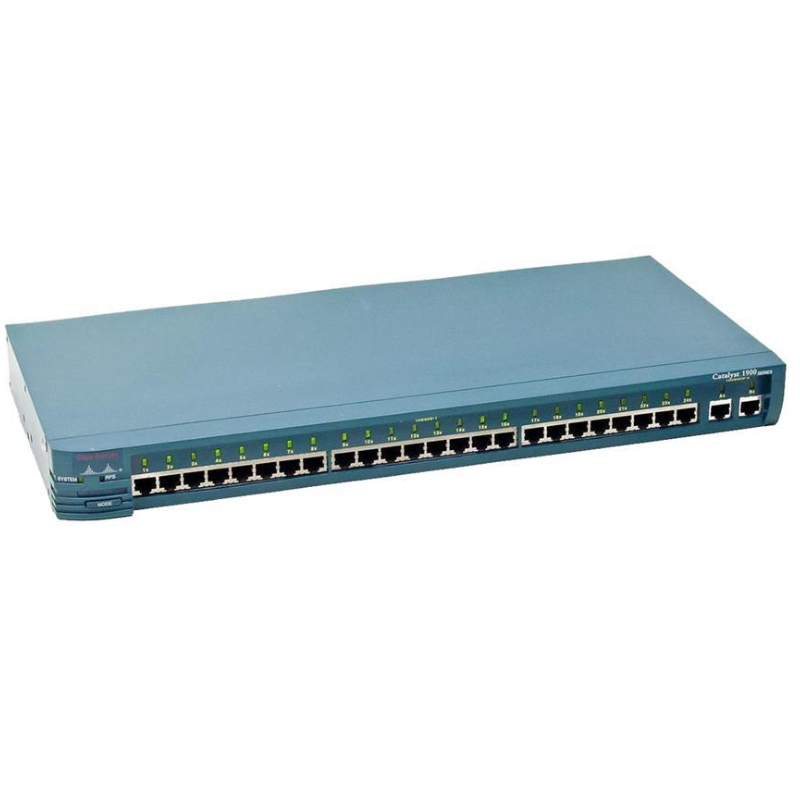


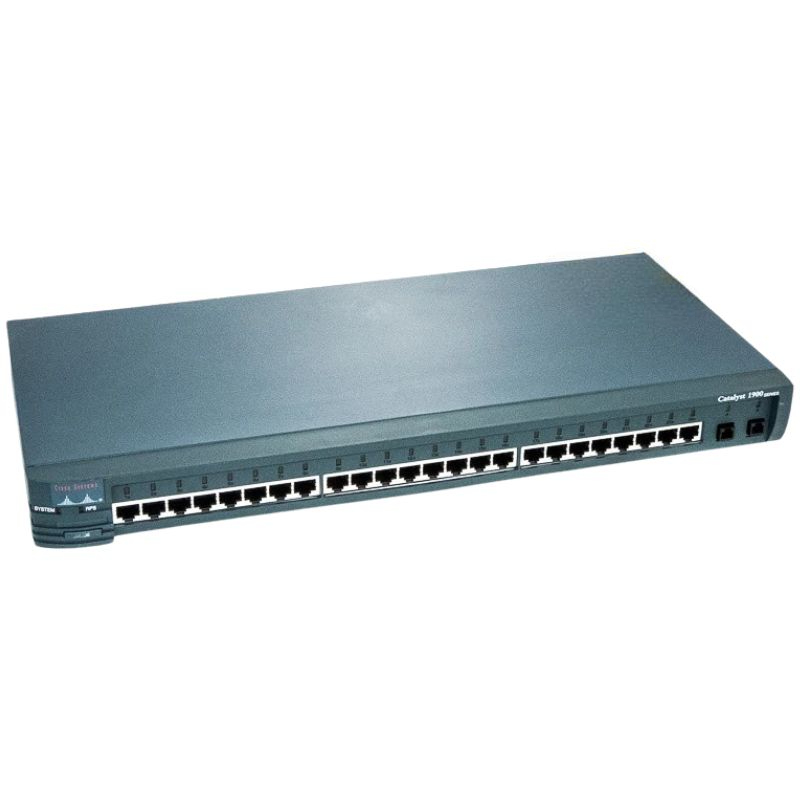
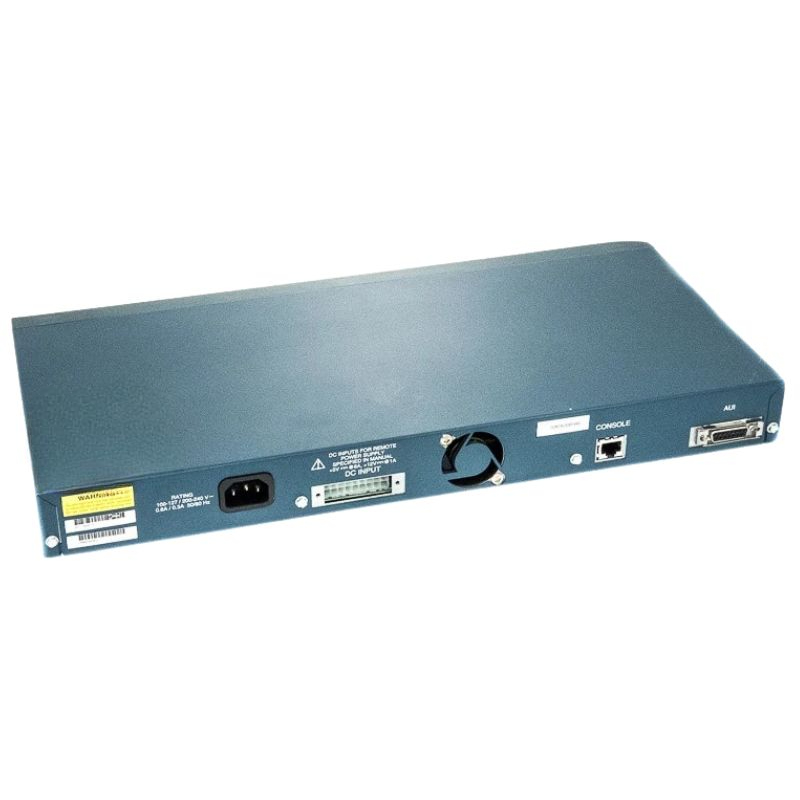
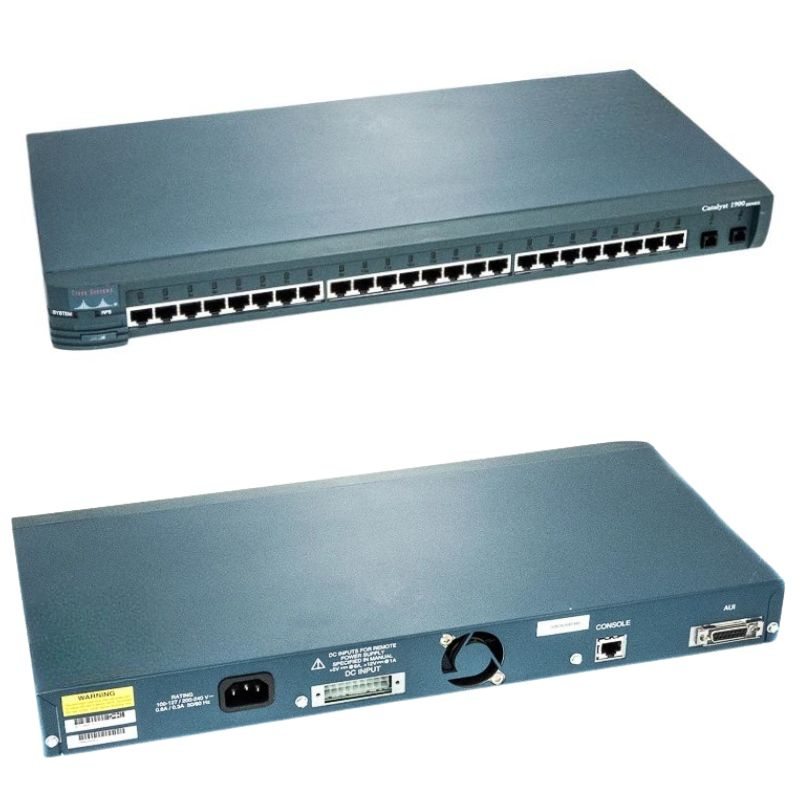
Cisco WS-C1924-A Catalyst Ethernet Switch with 24 Ports. Excellent Refurbished with 1 year replacement warranty
The Cisco WS-C1924-A Catalyst Ethernet Switch is a reliable Layer 2 managed networking solution designed for small to medium-sized business environments. As part of the renowned Catalyst 1900 Series, this switch delivers stable performance, efficient traffic handling, and essential network management features.
This Cisco switch operates using standard Ethernet switching protocols to ensure compatibility with existing network infrastructures.
The Cisco WS-C1924-A is a fixed-configuration, standalone switch designed for dedicated Ethernet connectivity. It operates at Layer 2 of the OSI model, making forwarding decisions based on MAC addresses to efficiently segment network traffic and reduce collisions. Its design philosophy emphasized simplicity, reliability, and improved performance over the prevailing hub technology of its era.
The architecture of the WS-C1924-A is a testament to purpose-built networking hardware. Understanding its specs is key to evaluating its fit for legacy or specialized applications.
The switch features 24 fixed 10Base-T Ethernet ports (RJ-45) for connecting end-user devices, operating at half-duplex 10 Mbps. Crucially, it also includes two 100Base-TX/FX uplink ports (one RJ-45 and one MII-style slot for a 100BASE-FX SC fiber module). These high-speed uplinks were essential for connecting the switch to network backbones or servers, preventing bottlenecks. The switch backplane offers a non-blocking 1 Gbps aggregate bandwidth, sufficient for its port configuration and era.
Equipped with a store-and-forward switching mechanism, the WS-C1924-A receives the entire frame, checks for errors via a CRC check, and then forwards it, ensuring corrupt packets are not propagated. Its MAC address table can store up to 1,024 addresses, and it employs a Cut-Through mode option for reduced latency on error-free segments. The packet forwarding rate is approximately 0.5 Mpps (million packets per second).
The switch boots from 1 MB of flash memory and utilizes 320 KB of shared memory buffering. Management is achieved through several interfaces: a console port (RJ-45) for CLI setup, an out-of-band AUX port (RJ-45) for modem-based remote management, and an integrated web-based interface (Cisco Visual Switch Manager). It is a fanless device, designed for quiet operation in office environments, and is powered by a fixed internal AC power supply.
The Catalyst 1900 Series, including the 1924, was Cisco's strategic answer to the need for affordable, scalable switching at the network edge. It played a pivotal role in the transition from collision-prone Ethernet domains to switched microsegmentation.
Prior to switches like the 1924, most networks used hubs (concentrators), which created a single shared collision domain. As network traffic grew, performance degraded dramatically due to collisions. The WS-C1924-A provided each connected device with a dedicated collision domain, dramatically improving throughput and enabling full-duplex communication on its Fast Ethernet ports.
The WS-C1924-A runs a specialized, menu-driven operating system distinct from the more robust IOS found on later Catalyst models like the 2950. However, it supported key Cisco ecosystem features such as CDP (Cisco Discovery Protocol) for network topology discovery and VLAN Trunking Protocol (VTP) for simplified VLAN management across multiple switches. This integration made it a manageable component within a larger Cisco network infrastructure.
Beyond basic switching, the WS-C1924-A introduced many features that defined professional-grade network hardware.
The switch supports port-based IEEE 802.1Q VLANs, allowing network administrators to logically segment a physical network into multiple broadcast domains. This enhanced security and traffic management by isolating departments (e.g., finance, engineering) or device types. The two uplink ports could be configured as 802.1Q trunks to carry multiple VLAN traffic to a router or core switch.
To prevent network loops in redundant topologies, the WS-C1924-A implements the IEEE 802.1d Spanning Tree Protocol (STP). This protocol allows for the inclusion of backup links without causing broadcast storms, ensuring network stability—a critical feature as businesses began to design for higher availability.
For its time, the switch offered basic QoS through IEEE 802.1p Class of Service (CoS) prioritization. It could classify traffic based on priority tags, ensuring that delay-sensitive voice or video traffic could be given precedence. It also supported IGMP Snooping, which intelligently forwards IP multicast traffic only to ports with interested receivers, conserving bandwidth.
Security features included port security to limit MAC addresses per port and prevent unauthorized access, MAC address filtering, and management password protection. The Cisco Visual Switch Manager provided an intuitive GUI for initial setup and monitoring, lowering the barrier to entry for less-experienced network staff.
While not suitable for a modern data center or high-bandwidth office, the Cisco WS-C1924-A has found niche applications where its attributes are perfectly matched to the requirements.
In industrial settings like manufacturing floors, PLCs (Programmable Logic Controllers), sensors, and HMIs (Human-Machine Interfaces) often communicate via simple, low-bandwidth protocols (e.g., Modbus TCP). The WS-C1924-A's fanless design (no moving parts to fail), rugged metal chassis, and deterministic 10 Mbps performance make it a reliable and cost-effective choice for segmenting OT networks. Its lack of complex features can be an asset, reducing attack surface.
Networking academies and university IT programs frequently use decommissioned Catalyst 1900 and 2900 series switches for hands-on labs. The WS-C1924-A is ideal for teaching foundational concepts: VLANs, STP, trunking, and basic switch configuration. Its physical presence and CLI/GUI provide tangible learning experiences that software simulators cannot fully replicate.
Understanding the WS-C1924-A's place in the lineage of Cisco switches highlights the rapid evolution of networking technology.
The direct successors, like the Cisco Catalyst 2950 and later 2960 series, brought monumental improvements: full 10/100/1000 Mbps ports, full Cisco IOS, advanced security features (802.1X, ACLs), PoE (Power over Ethernet), and much higher backplane speeds. The progression from the 1924's menu-based OS to a full-featured IOS CLI represented a major shift towards greater flexibility and integration.
Today, the market bifurcates into unmanaged switches for simple connectivity and fully managed switches for control. The WS-C1924-A occupied a unique "semi-managed" or "smart" middle ground—offering VLANs and basic QoS without the complexity of full IOS. Modern smart switches from various vendors now fill this role with updated hardware and features.
For those integrating a WS-C1924-A into a lab or legacy environment, understanding its management options is crucial.
Primary configuration is done via the RJ-45 console port using a rollover cable and a terminal emulator (e.g., PuTTY) set to 9600 baud, 8 data bits, no parity, 1 stop bit (8N1). The AUX port allows for remote configuration via an external modem, a feature rarely used today but indicative of the era's management practices.
Once an IP address is assigned via the console, the switch can be managed through a web browser. The CVSM interface provides point-and-click configuration for switch settings, port management, VLANs, and statistics. It is a Java-based application that may require an older browser or Java version to function correctly on modern operating systems.
Unlike IOS-based switches, the CLI is menu-driven. Users navigate through a hierarchy of menus (e.g., `[M] Menus`, `[I] IP Configuration`, `[P] Port Configuration`). While less powerful than IOS, it is straightforward for basic setup tasks like configuring VLANs, setting port duplex, or enabling port security.


 Contact Us
 Information
 Catalog
 Solid State Drives (SSD)
 Network Switches
 Hard Disk Drives
 HBA & Controllers
 PC & Servers
 PC & Server Memory
 CPU & Processors
 Network Routers
 Power Supplies
 Tape Drives & Libraries
 Network Devices
 Computer & Network Cables