(7% discount is applied at checkout)
Cart is empty
Your go-to destination for cutting-edge server products
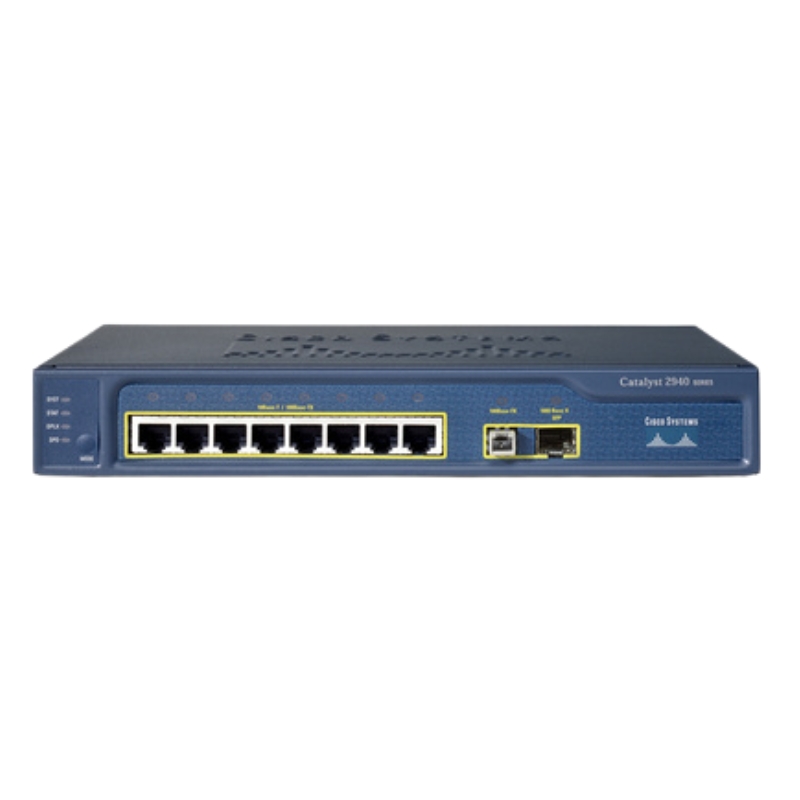


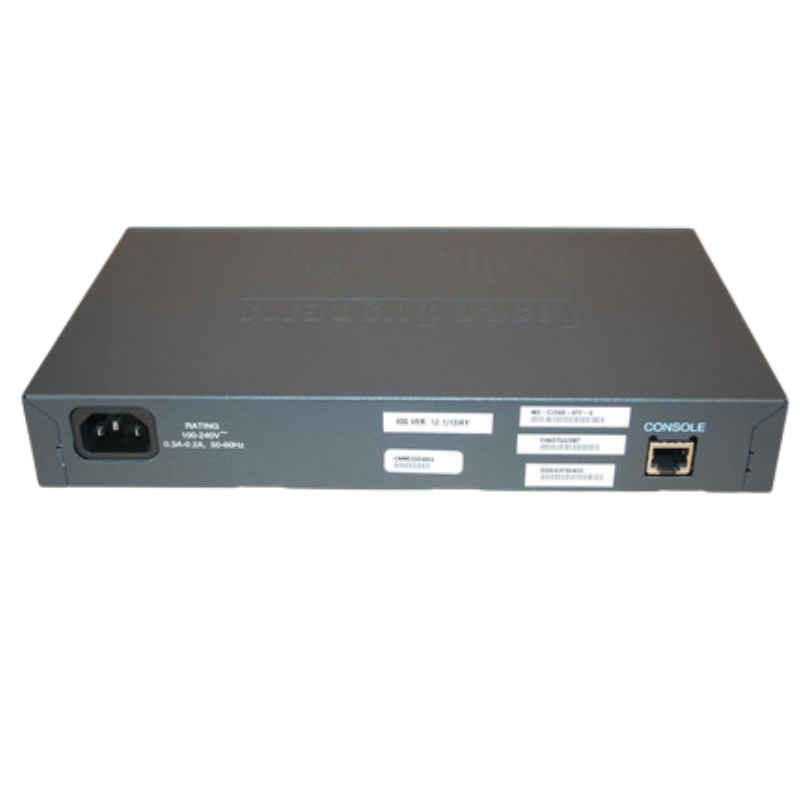
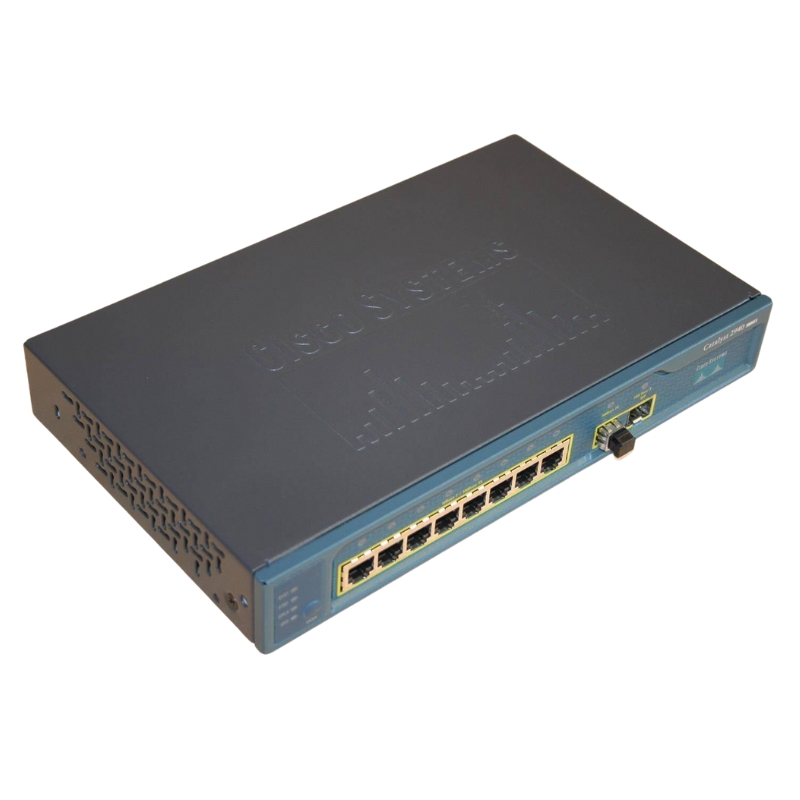
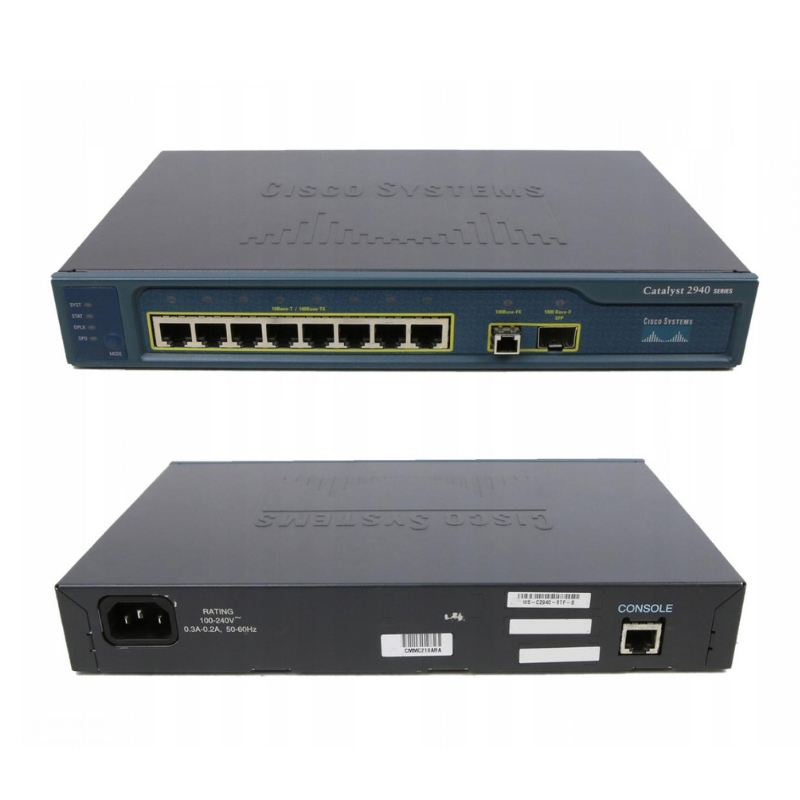
Cisco WS-C2940-8TF-S Catalyst 2940 Series 8-Ports 10/100 Switch. Excellent Refurbished with 1 year replacement warranty
The Cisco WS-C2940-8TF-S Catalyst 2940 Series Ethernet Switch is a reliable and efficient Layer 2 networking solution designed for small to medium-sized business environments. This managed switch delivers stable connectivity, optimized traffic handling, and dependable performance for everyday network operations.
This Cisco Catalyst switch is engineered to support multiple network connections, ensuring seamless data transmission across connected devices.
The switch supports both copper and fiber-based connections, offering flexibility for diverse networking environments.
This Cisco managed switch allows administrators to configure, monitor, and maintain the network with ease, improving overall performance and security.
The Cisco WS-C2940-8TF-S stands as a definitive model within the revered Catalyst 2940 Series of fixed-configuration, standalone switches. Designed during an era when transitioning from hubs to intelligent, managed switching was a key business advantage, this 8-port 10/100 Ethernet switch provided a critical blend of simplicity, essential Cisco IOS features, and robust Layer 2 functionality. While considered an end-of-life product, its legacy and operational role in specific environments—such as industrial settings, small office wiring closets, or as a dedicated access layer device—remain significant. This category page delves into the technical specifications, architectural role, and enduring value proposition of this compact networking workhorse.
Understanding the physical and technical design of the WS-C2940-8TF-S is key to appreciating its place in network history. It was engineered for environments where space, power, and budget were constrained, but where Cisco's reliability and intelligence were non-negotiable.
The switch features a compact, desktop or rack-mountable form factor with eight dedicated 10/100BASE-TX Ethernet ports. These auto-sensing, auto-negotiating ports simplify deployment by automatically detecting connection speed and duplex settings. A key distinguishing feature of the "-TF-S" model is the inclusion of a single, fixed 100BASE-FX uplink port (using an SC connector), providing a fiber optic link for longer distance connections to a backbone switch or server, enhancing deployment flexibility beyond copper limitations. The switch is powered by a fixed internal power supply and utilizes a fanless design, making it exceptionally quiet and suitable for office environments.
Unlike truly "unmanaged" switches, the Catalyst 2940 series runs a specialized, trimmed-down version of Cisco's iconic Internetwork Operating System (IOS). This embedded system software is what transformed this device from a simple frame forwarder into an intelligent network participant. The "S" in the model number denotes a "Standard Image," which includes a specific feature set focused on essential security, Quality of Service (QoS), and manageability. This IOS-based management allows for configuration via a familiar command-line interface (CLI) accessed through the console port, or via a web-based graphical interface for simpler setups.
The WS-C2940-8TF-S was designed to segment collision domains and provide basic, reliable network intelligence. Its feature set, though not expansive by today's standards, addressed the most critical needs of its time.
The switch supports IEEE 802.1Q trunking and VLAN tagging, allowing administrators to create multiple virtual LANs across its ports. This enables logical segmentation of network traffic for departments, user groups, or device types (e.g., separating voice, data, and guest traffic), enhancing security and broadcast containment. While it supports multiple VLANs, its VLAN routing capabilities are limited as it is primarily a Layer 2 device.
To ensure a loop-free topology in redundant network designs, the switch implements IEEE 802.1D Spanning Tree Protocol (STP). This critical protocol prevents broadcast storms and multiple frame transmissions by logically blocking redundant paths, while providing failover capability should a primary link fail. Support for Per-VLAN Spanning Tree (PVST+) allows for optimized spanning tree instances per VLAN, utilizing network bandwidth more efficiently.
Even in entry-level networks, prioritizing latency-sensitive traffic like voice or video is crucial. The Catalyst 2940 offers basic QoS features based on IEEE 802.1p Class of Service (CoS). It can classify incoming traffic based on IP precedence or DSCP values, place it into one of four egress queues, and apply weighted round robin (WRR) scheduling to ensure important traffic gets forwarded promptly during congestion.
In an era of growing network awareness, the WS-C2940-8TF-S provided foundational tools to secure the network edge and simplify administration.
A cornerstone of its security is port security. This feature allows an administrator to statically define or dynamically learn the MAC addresses allowed to communicate on a specific switch port. If an unauthorized device connects, the switch can be configured to shut down the port, send an SNMP trap, or simply discard frames from the offending MAC address. This prevents unauthorized devices from accessing the network.
While newer, faster, and more feature-rich switches have superseded the 2940, understanding its original and potential enduring use cases is vital for those maintaining or encountering legacy infrastructure.
Its primary role was as a desktop or wiring closet switch for small to medium businesses or remote branch offices of larger enterprises. It provided enough ports for a small workgroup, with the fiber uplink offering a reliable connection back to a main distribution switch, often over longer distances where copper was not feasible.
The fanless, rugged metal design, combined with its support for extended temperature ranges in some versions, made derivatives of the 2940 series popular in industrial automation, manufacturing floors, and kiosk or digital signage applications. Its deterministic behavior and Cisco IOS reliability were valued in these controlled settings.
Even today, these switches can be found powering dedicated networks for specific purposes: a segregated VoIP phone network, a lab or testing environment for training on Cisco IOS, or as part of a legacy system that requires a specific, unchanged network topology. Their simplicity is an asset in static, single-purpose applications.
It is critical to acknowledge that the Cisco WS-C2940-8TF-S is a discontinued product. Cisco has ended both sales and standard support, including software updates and security patches. Deploying it on a modern network carries inherent risks.
The most apparent limitations are the lack of Gigabit Ethernet ports and Power over Ethernet (PoE). Modern devices, from computers to IP phones and wireless access points, routinely require Gigabit speeds and often draw power via Ethernet. The 2940 cannot provide either, creating potential bottlenecks and requiring additional power infrastructure.
Running end-of-life hardware poses significant security and compliance risks. The fixed IOS version will contain unpatched vulnerabilities that could be exploited to compromise the network. For any business subject to regulatory standards (PCI-DSS, HIPAA, etc.), using unsupported network gear is typically a violation.
For network professionals and legacy system integrators, a deeper understanding of the switch's internal operation can inform troubleshooting and capacity planning.
The Catalyst 2940 utilizes a store-and-forward switching architecture. Every frame received on an ingress port is completely buffered, its CRC checksum is verified, and any erroneous frames are discarded before forwarding. This ensures error-free traffic but introduces a fixed latency per frame. The switching is handled by a custom Application-Specific Integrated Circuit (ASIC), which is optimized for high-speed MAC address lookup and frame rewriting, allowing the switch to achieve wire-speed performance across all ports simultaneously.
With a shared memory architecture for packet buffering, the switch dynamically allocates buffer space from a common pool to ports as needed during traffic bursts. This is more efficient than dedicating fixed buffers to each port. When congestion occurs, the aforementioned QoS mechanisms (classification, queuing, and WRR scheduling) determine which traffic is buffered and the order in which it is dequeued and transmitted.
The switch maintains a separate MAC address table for each configured VLAN, ensuring complete layer 2 isolation between VLANs. On an 802.1Q trunk port, all frames are tagged with a 4-byte VLAN ID header except for frames belonging to the native VLAN (typically VLAN 1). The switch hardware is responsible for inserting this tag as frames egress a trunk and stripping it as frames ingress a trunk bound for an access port. This process is handled at wire speed by the switching ASIC.


 Contact Us
 Information
 Catalog
 Solid State Drives (SSD)
 Network Switches
 Hard Disk Drives
 HBA & Controllers
 PC & Servers
 PC & Server Memory
 CPU & Processors
 Network Routers
 Power Supplies
 Tape Drives & Libraries
 Network Devices
 Computer & Network Cables