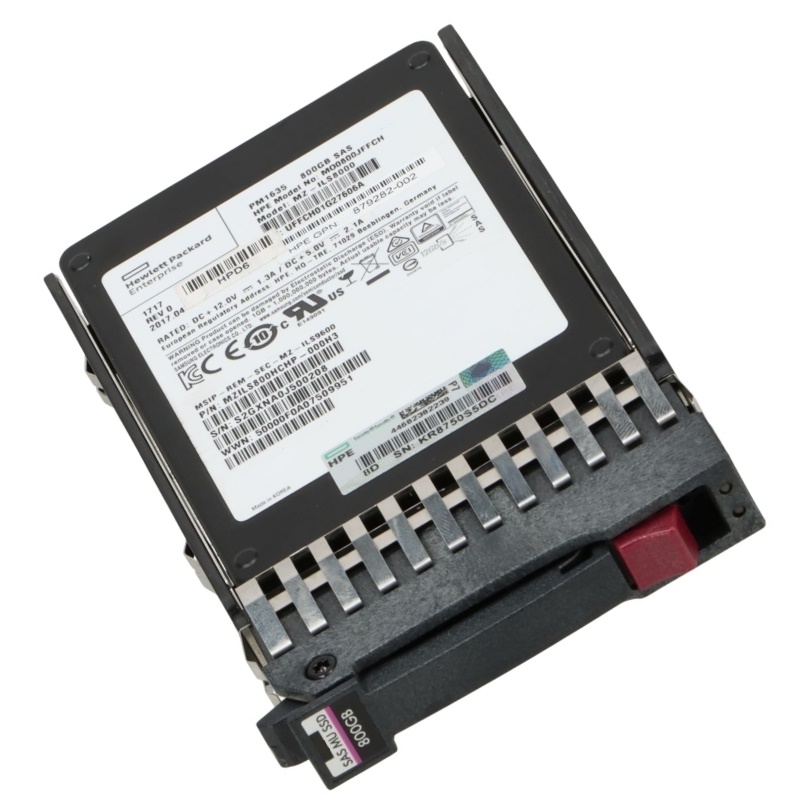
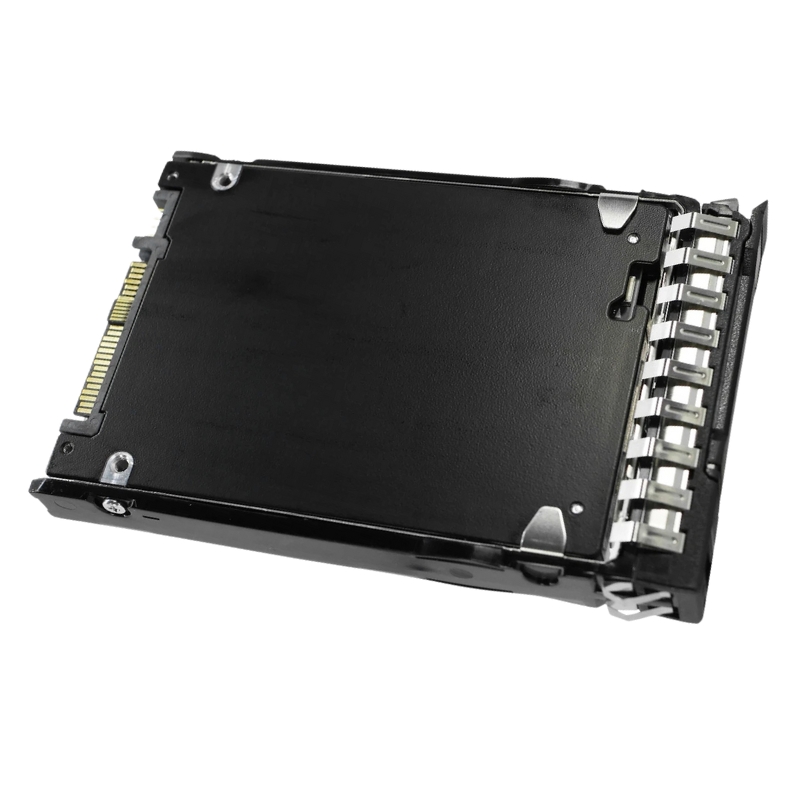
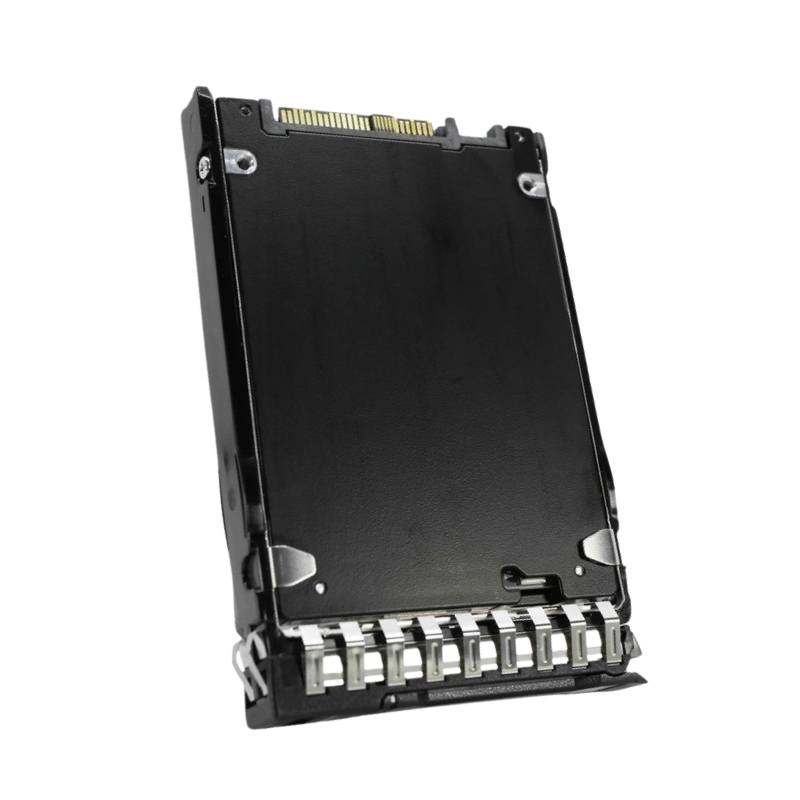
Overview of the HPE P49745-001 800GB SAS SSD
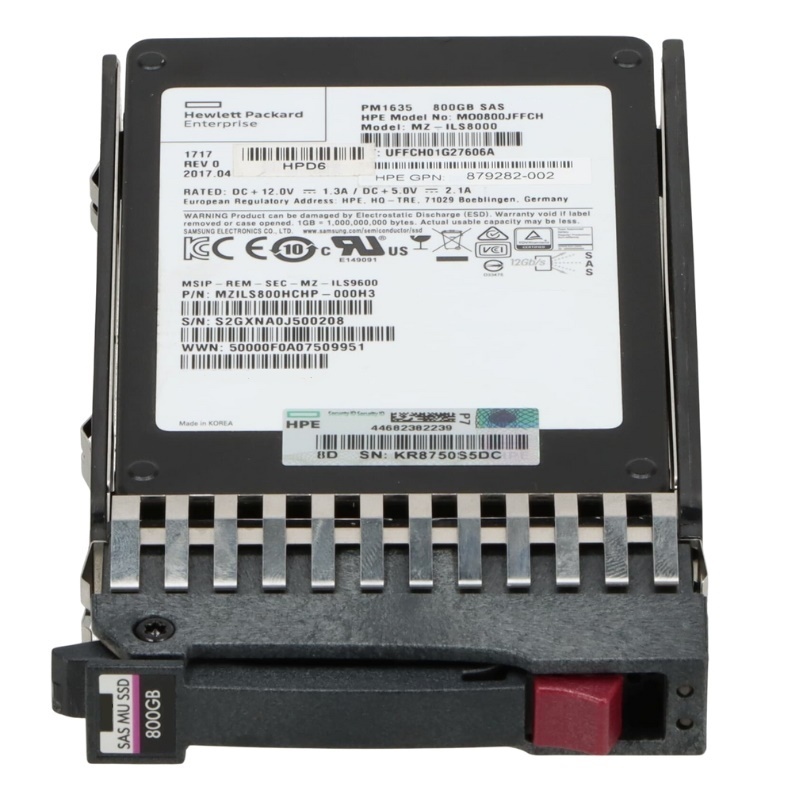
The HPE P49745-001 800GB Solid State Drive delivers exceptional storage efficiency, consistent reliability, and superior speed for enterprise-level computing. Engineered by Hewlett Packard Enterprise (HPE), this drive integrates advanced NAND flash technology and a robust SAS interface, ensuring dependable performance in high-demand data center environments.
General Information
- Manufacturer: HPE
- Manufacturer Part Number: P49745-001
- Product Type: 800GB Solid State Drive
Specifications at a Glance
- Capacity: 800 GB
- Form Factor: SFF, 15 mm height
- Interface: SAS 24 Gbps
- Flash Technology: TLC NAND
- Power: ~8.56 W
- Seq. Read/Write: 1090 / 1040 MB/s
- Random IOPS (R/W): Up to 124k / 118k
- Endurance: ~4,380 TBW
- Compatible Systems: HPE ProLiant Gen10 Plus
Power & Thermal Behavior
- Average operating power around 8.56 watts; plan cooling budgets accordingly in dense enclosures.
- Low-profile chassis installation helps maintain airflow; observe HPE rack and server thermal guidelines.
Reliability & Serviceability
- Hot-plug capability reduces maintenance windows and enables quick field swaps.
- Enterprise-grade error management and wear-leveling algorithms prolong usable life.
Typical Use Cases
Best-fit Workloads
- Virtual machine boot and runtime volumes that require consistent IOPS.
- Database transaction logs and high-concurrency application data stores.
- IOPS-heavy caching tiers and read/write acceleration layers.
Deployment Patterns
- Mixed storage pools where cost-per-GB must be balanced against performance.
- Tiered architectures combining TLC SSDs for capacity-performance balance with NVMe for ultra-high throughput tiers.
Purchase & Identification
Ordering Information
- OEM Part: HPE P49745-001 (use this part number to ensure exact compatibility)
- Verify carrier/holder type when ordering spare drives to match target server trays.
HPE P49745-001 800GB SAS Product Category Overview
The HPE P49745-001 800GB 2.5-inch small form factor (SFF) SAS solid-state drive is positioned in the enterprise Mixed-Use SSD category designed for demanding data center workloads. This category page focuses on drives that combine high I/O performance, predictable latency, and endurance characteristics suitable for database transactions, virtualization, mixed OLTP/OLAP loads, and general purpose server acceleration. The "Multi Vendor Hot Plug Solid State Drive with Tray" phrasing emphasizes compatibility with multi-vendor chassis and the convenience of hot-swap trays optimized for HPE Gen10 Plus server platforms.
Category signals and search intent
Users landing on this category typically search with commercial or technical intent — they look for compatibility with HPE Gen10 Plus servers, SAS 24Gbps connectivity, 2.5" SFF sizing, and enterprise-grade mixed-use endurance levels. The page should therefore answer procurement, compatibility, performance, and deployment questions, offering clear technical information, buying guidance, and operational value statements that help IT buyers, systems engineers, and procurement teams make confident decisions.
Form-factor details
This subcategory centers on enterprise SAS SSDs in the 2.5-inch SFF (Small Form Factor) mechanical profile. These drives offer a balance between capacity, performance, and thermal/space efficiency for rack servers and storage arrays.
Mechanical and electrical characteristics
- Form factor: 2.5-inch SFF — fits standard SFF bays used in modern HPE and multi-vendor rack servers.
- Interface: 12Gb/s or 24Gb/s SAS capable backplanes — specifically marketed for 24Gbps SAS environments for higher throughput and futureproofing.
- Hot-plug capability: Drive and tray designed for hot-swap operations, enabling drive replacement without shutting down the server.
- Drive tray: OEM-style tray included or available — ensures mechanical fit, retention, and LED status compatibility with HPE server sleds.
- Power and thermal: Enterprise power profile supported; optimized for efficient thermal dissipation in dense server enclosures.
Logical and firmware attributes
- SAS features: Full support for enterprise SAS command sets, including error recovery controls and robust link management for high-availability deployments.
- Controller and firmware: Enterprise-grade controller firmware tuned for mixed-use workloads to balance IOPS, throughput, and endurance.
- Data integrity: End-to-end data protection, internal RAID-like flash management and power-loss data protection mechanisms commonly included in enterprise SSDs
Endurance, reliability, and data protection
Enterprise mixed-use SSDs balance endurance and cost. The 800GB capacity targets a midpoint where cost per GB and endurance metrics make sense for tier-1 and tier-2 workloads.
Endurance metrics and what they mean
- Drive writes per day (DWPD): Mixed-use drives advertise endurance appropriate for typical production mixes — write-heavy bursts balanced by sustained reads.
- MTBF and AFR: Enterprise SSDs are rated with high mean time between failures (MTBF) and low annualized failure rates (AFR) to match server uptime expectations.
- Power-loss protection: Many enterprise SSDs include power-loss protection to prevent in-flight data loss during unexpected outages.
Data integrity features
- End-to-end CRC checks: Protect data as it traverses the drive electronics.
- Wear leveling: Even distribution of writes across NAND to maximize usable life.
- Bad block management: Remapping and spare areas to maintain usable capacity and performance over time.
Compatibility and HPE Gen10 Plus integration
Compatibility is a major procurement concern. The "Multi Vendor" descriptor highlights that while these drives are intended to work in HPE Gen10 Plus environments, they can also be deployed across a variety of vendor platforms that adhere to SAS and SFF mechanical standards.
Fitment and mechanical compatibility
- HPE Gen10 Plus servers: Fits standard 2.5" SFF hot-swap bays with OEM trays or 3rd-party compatible sleds.
- Multi-vendor support: Compatible with other server brands that follow industry-standard SAS connectors and bay geometries.
- Tray considerations: Purchase options may include OEM-branded trays or generic multi-vendor trays that ensure mechanical retention and LED compatibility.
Firmware and server management
When deploying in HPE systems, the drive's firmware should be cross-checked against HPE compatibility matrices and iLO/Array controller firmware to ensure full management visibility, SMART attribute reporting and health alerting through HPE tools.
Controller and RAID integration
- Full support for enterprise RAID controllers — ensure controller firmware supports 24Gbps SAS links and enterprise SSD features.
- Verify RAID policies and rebuild times: SSDs change rebuild dynamics compared to HDDs, often accelerating rebuilds but requiring controller tuning for optimal performance.
Use cases and workload profiles
These mixed-use 800GB SAS SSDs fit a wide range of data center roles. Below are the most common deployment scenarios where this drive class offers clear advantages.
Virtualization and cloud hosting
- VM boot and datastore acceleration: Significantly reduces VM start times and improves VM responsiveness under consolidation.
- High VM density hosts: Supports predictable I/O for dozens to hundreds of VMs depending on workload mix.
Databases and transaction systems
- OLTP workloads: Low-latency random IOPS deliver faster transaction commits and higher concurrent user capacity.
- Mixed OLTP/analytical tasks: Mixed-use SSDs are designed to handle both random transactional access and sequential analytical scans.
Cache and tiering
- Read/write caching: Acts as a high-speed cache layer in hybrid arrays, reducing load on spinning media.
- Auto-tiering targets: Frequently accessed data can be elevated to SAS SSD tier for instant responsiveness.
Comparisons and alternatives
Understanding how the HPE P49745-001 class of 800GB SAS SSDs stacks up against other options helps buyers choose the right media for each workload.
Versus higher-capacity enterprise SSDs
- Pros: Lower cost per drive, quicker rebuilds, better fit for cache or tiering functions, lower power per drive.
- Cons: Lower raw capacity may require more slots or more drives for capacity-hungry datasets.
Versus NVMe drives
- Throughput and latency: NVMe typically offers lower latency and higher parallelism; however, SAS 24Gbps mixed-use SSDs remain attractive where existing SAS infrastructure is in place.
- Deployment considerations: SAS SSDs integrate seamlessly with legacy RAID controllers and multi-pathing software common in many enterprise datacenters.
Versus SATA SSDs
- Reliability and performance: SAS SSDs offer better enterprise features, higher availability, and more robust command sets than SATA-based alternatives.
- Management: SAS drives provide richer telemetry and are typically preferred in mission-critical deployments.
Buying checklist and decision matrix
Use this quick checklist to streamline purchase decisions and ensure the selected drives meet operational requirements.
- Confirm physical fit: 2.5" SFF bay compatibility and tray type.
- Validate interface: 24Gbps SAS backplane and controller support.
- Check firmware updates: Controller and drive firmware compatibility tested in staging.
- Review endurance: Ensure DWPD or TBW metrics fit projected write loads.
- Plan lifecycle: Warranty, support, and EOL schedules aligned with procurement cycles.
- Security needs: SED/encryption requirements and supported sanitize methods.
- Budget allocation: Evaluate price-per-performance and TCO across alternatives (HDD, SATA SSD, NVMe).





 Contact Us
 Information
 Catalog
 Solid State Drives (SSD)
 Network Switches
 Hard Disk Drives
 HBA & Controllers
 PC & Servers
 PC & Server Memory
 CPU & Processors
 Network Routers
 Power Supplies
 Tape Drives & Libraries
 Network Devices
 Computer & Network Cables