(7% discount is applied at checkout)
Cart is empty
Your go-to destination for cutting-edge server products
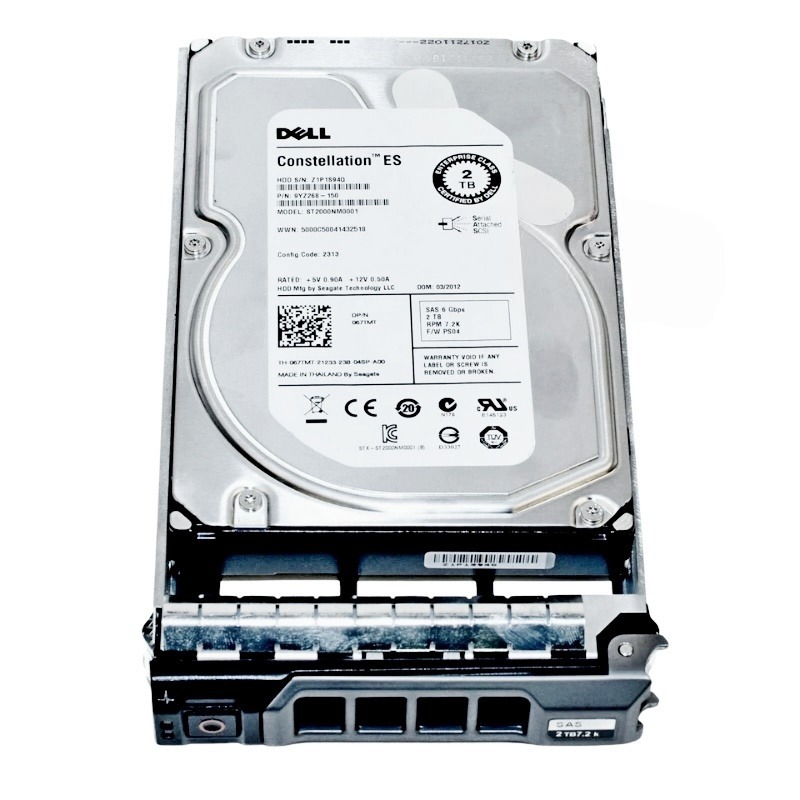


Seagate 9JX248-157 2TB 7.2K RPM SAS-6GBPS 16MB Hard Drive. Excellent Refurbished with 1 year replacement warranty - Dell Version
The Seagate 9JX248-157 2TB 7.2K RPM SAS 6Gbps 16MB Hard Drive is designed for enterprise workloads, offering dependable storage, fast performance, and reliable integration with server environments requiring consistent data access.
The Seagate 9JX248-157 2TB 7.2K RPM SAS-6GBPS 16MB Hard Drive belongs to a specialized class of enterprise mechanical storage devices engineered for continuous workload environments. This category of storage devices is designed to meet the demanding requirements of servers, data centers, and enterprise storage arrays where reliability, sustained performance, and compatibility with high-availability systems are essential. Unlike consumer-grade hard drives, this category emphasizes endurance under 24/7 operational cycles, making it suitable for mission-critical applications where downtime is not acceptable.
The mechanical architecture of this category is centered around a rotational speed of 7,200 RPM, which provides a balanced combination of performance and energy efficiency. This makes it suitable for nearline storage applications where large datasets must be accessed frequently but do not require the extreme speed of solid-state drives. The inclusion of a 16MB cache buffer enhances temporary data handling, allowing smoother read and write operations during burst workloads.
The SAS-6GBPS interface embedded within this storage category enables high-speed serial communication between the drive and the host system. This interface is widely adopted in enterprise environments due to its dual-port capability, improved reliability over SATA, and enhanced error correction mechanisms. The 6Gbps transfer rate ensures that the drive can efficiently handle concurrent data streams in multi-user environments.
This interface architecture is particularly beneficial in RAID configurations, where multiple drives operate together to provide redundancy and performance scaling. The SAS protocol also improves command queuing efficiency, allowing better optimization of input/output operations in large-scale server environments.
The 2TB storage capacity in this category represents a balanced point between storage density and performance sustainability. It is widely used in enterprise storage pools where moderate-to-high capacity is required without compromising on reliability or cost efficiency. This capacity range is ideal for backup systems, archival storage, virtualization environments, and cloud infrastructure nodes.
In large-scale deployments, drives in this category are often combined into arrays to create multi-terabyte or petabyte-level storage systems. The 2TB configuration ensures easy replacement, scalability, and compatibility with existing storage chassis designed for 3.5-inch or 2.5-inch enterprise drive bays depending on enclosure specifications.
The 7,200 RPM rotational speed is a standard in enterprise nearline storage systems, offering a balance between performance and durability. This rotational speed reduces latency compared to lower RPM drives while maintaining lower heat output and power consumption compared to higher RPM enterprise performance drives such as 10K or 15K variants.
In sequential read and write operations, commonly found in backup and archival processes, this speed provides stable throughput. In random access workloads, such as database querying and virtualization file access, the drive maintains predictable performance levels due to optimized firmware algorithms designed for enterprise usage patterns.
The integrated 16MB cache buffer plays a crucial role in improving overall drive efficiency. It temporarily stores frequently accessed data and pending write operations, reducing the need for repeated mechanical movement of the read/write heads. This significantly enhances performance in workloads involving repeated access to similar data blocks.
In enterprise environments, where multiple applications may access the same storage device simultaneously, the cache system ensures smoother workload distribution and reduces bottlenecks. This contributes to improved system responsiveness and lower input/output latency during peak operations.
One of the defining characteristics of SAS-based storage devices in this category is dual-port connectivity. This allows the drive to maintain simultaneous connections to multiple controllers, ensuring uninterrupted data access even in the event of a controller failure. This redundancy is essential in high-availability systems where continuous uptime is required.
The SAS protocol also includes advanced error detection and correction mechanisms that improve data integrity during transmission. This ensures that enterprise workloads involving sensitive or critical data maintain consistency and reliability across storage operations.
Drives in this category are commonly deployed in RAID configurations, including RAID 0, RAID 1, RAID 5, RAID 6, and RAID 10 setups. Each configuration provides a different balance between performance, redundancy, and storage efficiency. The SAS interface ensures efficient coordination between multiple drives within these arrays, enabling high-speed data reconstruction and fault tolerance.
In large storage arrays, scalability is a critical factor. The 9JX248-157 category supports seamless expansion, allowing additional drives to be integrated into existing infrastructure without disrupting ongoing operations.
In modern data centers, this category of hard drive is commonly used in tiered storage architectures. It serves as both primary bulk storage and secondary archival storage depending on system configuration. In hybrid storage systems, it works alongside solid-state drives, where SSDs handle high-speed transactional workloads while HDDs manage large-scale data retention.
This hierarchical approach ensures optimal cost-performance balance while maintaining data accessibility and redundancy across enterprise systems.
Cloud service providers frequently deploy drives in this category within distributed storage clusters. These clusters support virtualization platforms, containerized applications, and large-scale data repositories. The 2TB capacity and SAS interface ensure efficient integration into virtual machine storage pools and cloud backup systems.
Virtualized environments benefit from the predictable performance and reliability of these drives, especially when handling multiple virtual workloads simultaneously.
Enterprise backup systems rely heavily on mechanical hard drives for cost-effective long-term data storage. The Seagate 9JX248-157 category is well-suited for such applications due to its durability and sustained performance characteristics. It is commonly used in compliance-driven industries where data must be retained for extended periods under regulatory requirements.
Archival systems benefit from the drive’s ability to maintain data integrity over long operational lifespans, making it a dependable choice for cold storage environments.
In automated backup systems, these drives are used to store scheduled snapshots, system images, and incremental backups. The SAS interface ensures smooth integration with backup software solutions that manage large-scale data protection workflows across enterprise networks.


 Contact Us
 Information
 Catalog
 Solid State Drives (SSD)
 Network Switches
 Hard Disk Drives
 HBA & Controllers
 PC & Servers
 PC & Server Memory
 CPU & Processors
 Network Routers
 Power Supplies
 Tape Drives & Libraries
 Network Devices
 Computer & Network Cables