(7% discount is applied at checkout)
Cart is empty
Your go-to destination for cutting-edge server products
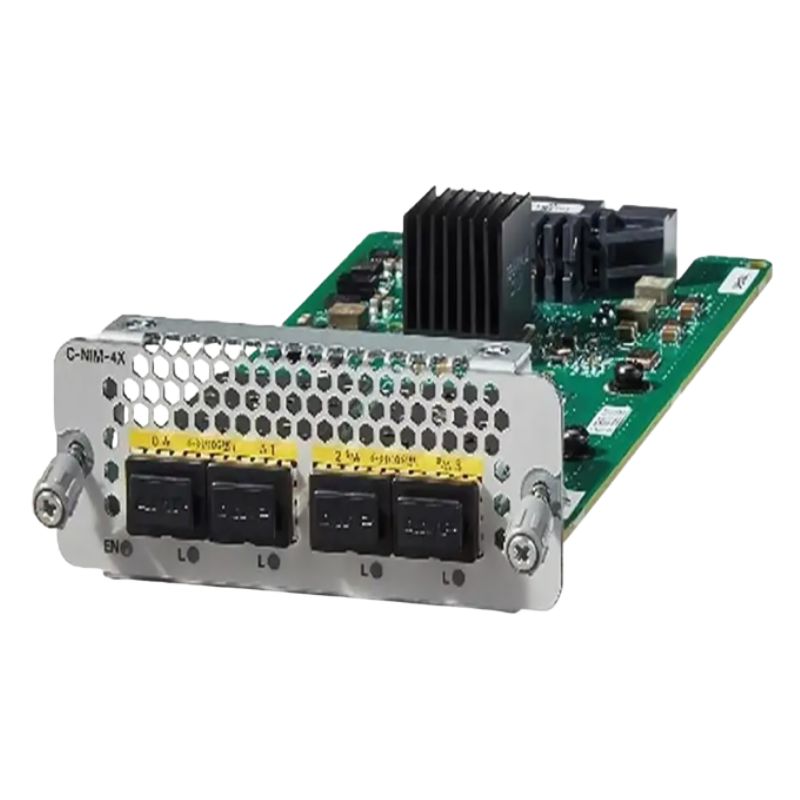


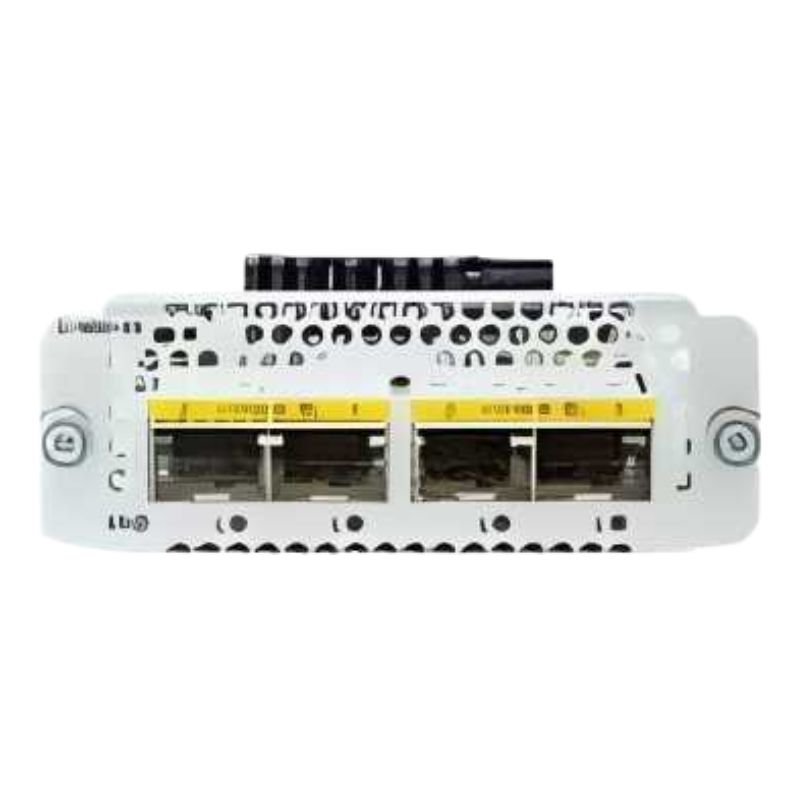
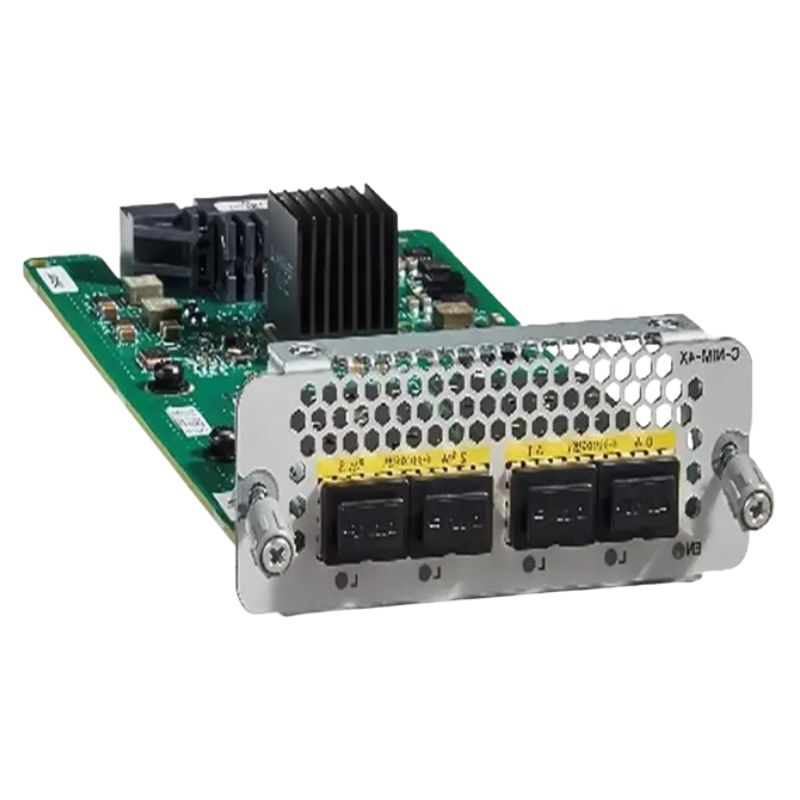
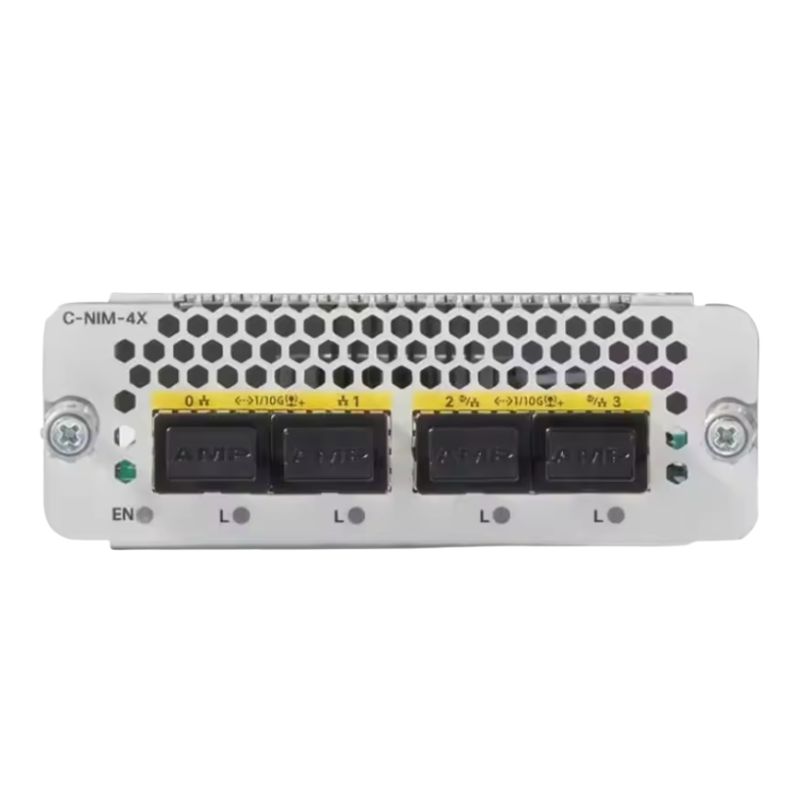
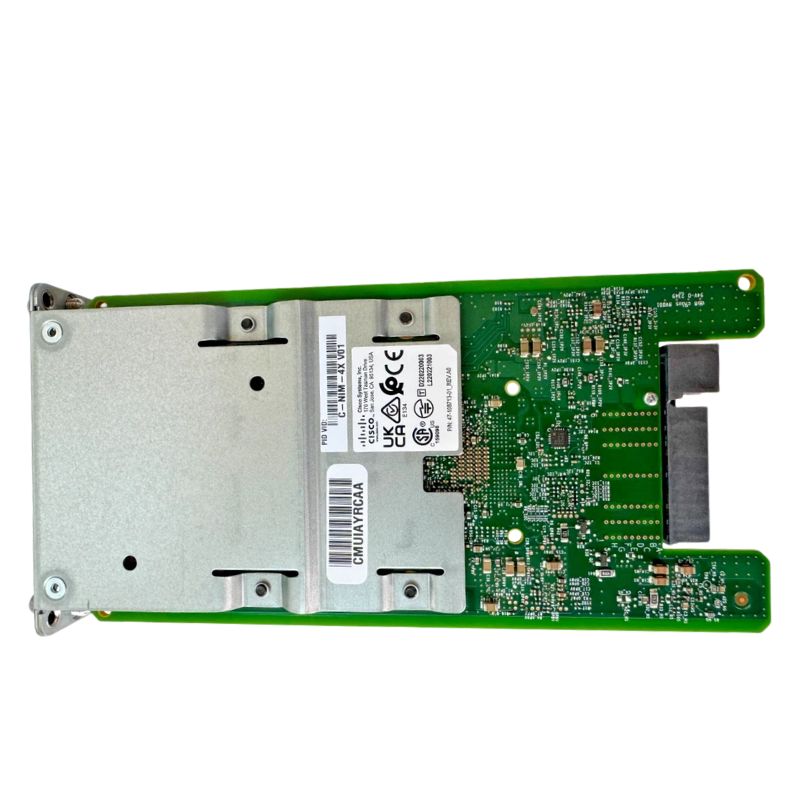
Cisco C-NIM-4X Catalyst 8300 Series 4 Ports 1g/10g Sfp/sfp+ Lan/wan Network Interface Module with Layer 2/3 Support. Factory-Sealed New in Original Box (FSB) with 1 Year Replacement Warranty
The Cisco C-NIM-4X for Catalyst 8300 Series routers delivers a flexible, high-performance networking solution designed to enhance enterprise connectivity. This advanced interface card supports versatile LAN/WAN deployment scenarios, offering stable throughput, optical-fiber compatibility, and efficient Layer 2/3 functionality for demanding infrastructures.
This module is engineered to streamline data communication with its multi-port architecture, enabling smooth traffic flow across various applications. Users benefit from consistent performance, robust optical connectivity, and versatile deployment options.
The C-NIM-4X is optimized for optical-fiber deployments, ensuring rapid data transmission, reduced latency, and dependable performance. Its design enables seamless operation in high-traffic networks that rely on fast, continuous data flows.
The Cisco C-NIM-4X Catalyst 8300 Series Network Interface Module is a high-performance, modular expansion option designed to extend the connectivity and service capabilities of Catalyst 8300 platforms. This category covers the line of 4-port 1G/10G SFP/SFP+ LAN/WAN interface modules engineered for modern enterprise edge deployments where flexibility, throughput, and advanced Layer 2 and Layer 3 features are essential. Describing this module within its product family means focusing on how it transforms base routing and security platforms into versatile multi-service edge systems that support a mix of optical and copper transceivers, scale demanding branch and aggregation use cases, and integrate with software-driven architectures such as Cisco SD-WAN and intent-based networking.
The C-NIM-4X provides four physical SFP or SFP+ ports that accept either 1 Gbps or 10 Gbps small form-factor pluggable transceivers, enabling administrators to choose the exact media type needed for each connection. The module supports both LAN and WAN attachments, offering the flexibility required for direct fiber links to upstream transport, high-bandwidth connections to data centers, or low-latency links to cloud onramps. Because the module implements Layer 2 and Layer 3 support, it can act as a simple switching extension for local VLAN segmentation and bridging, and simultaneously perform advanced routed services, including static and dynamic routing, route redistribution, and policy-based forwarding. This blend of switching and routing functionality makes the module suitable for use cases that require tight integration between distributed switching and routing domains, such as converged campus/edge environments and multi-tenant sites.
Each of the four SFP/SFP+ sockets on the module supports a wide array of transceiver types, which permits deployments over single-mode fiber, multimode fiber, or copper where SFP copper transceivers are used. The ability to mix 1G and 10G links on the same module allows IT teams to right-size uplinks and access links based on real traffic patterns rather than guessing future needs. In practice, this means a remote office can use 1 Gbps optics for most local links while retaining the option to provision a 10 Gbps connection for a high-throughput backup or a direct cloud connection. This level of modularity reduces hardware sprawl and simplifies inventory management because one C-NIM-4X module can serve multiple roles across different sites.
The category emphasizes robust Layer 2 switching with support for VLANs, trunking, and bridging features that align with standard campus and branch topologies. On the Layer 3 side, the module supports key routing protocols and advanced routing constructs often required in enterprise edge architectures. Dynamic routing protocols, route maps, redistribution facilities, and scalable routing tables make the module capable of participating in complex network topologies while preserving performance. Additionally, support for policy-based routing and advanced access control lists enables granular traffic steering and security enforcement directly at the interface layer, reducing the need to backhaul traffic for inspection and enabling localized enforcement of service policies.
Built-in Quality of Service mechanisms permit administrators to prioritize critical application traffic, such as real-time voice and video, and to shape or police bulk data flows that could otherwise saturate uplinks. The C-NIM-4X supports classification and queuing techniques that help ensure predictable performance for latency-sensitive services while still allowing high-throughput data transfers. Traffic management is essential in hybrid WAN deployments where limited transport resources must be shared among business-critical applications. Using these QoS primitives on the interface module allows operators to maintain service-level objectives consistently at the physical edge of the network.
Performance with the C-NIM-4X is driven by the Catalyst 8300 platform’s forwarding architecture, which is optimized to handle aggregated multi-gigabit flows with low latency and minimal packet loss. The module supports line-rate forwarding for its configured ports, enabling high-throughput WAN links and fast local switching. Reliability comes from Cisco’s long-standing design principles for modular network hardware: hot-swappable components where supported by the chassis, resilient control plane capabilities on the host platform, and extensive compatibility testing with a wide range of transceivers and optical transport gear. In operational terms, this means predictable uptime, fewer service interruptions during upgrades, and a clear upgrade path for sites that need to scale bandwidth without forklift replacements of existing hardware.
Enterprises often deploy the C-NIM-4X as part of a high availability design that pairs the module with redundant upstream links and routing protocols such as HSRP, VRRP, or GLBP. Combining the module’s multi-port capability with dynamic routing and link-monitoring features allows traffic to fail over seamlessly in the event of a link outage. Redundancy can be achieved at multiple layers: multiple transceivers to different transport providers, port-level load sharing, and control-plane redundancy provided by the host router. This layered approach to availability ensures that mission-critical services remain reachable even when individual components fail.
Security on modern edge modules goes well beyond physical port control. The C-NIM-4X supports interface-level security features including access control lists, MAC address filtering, storm control, and other mitigation techniques that help preserve availability and isolate threats. When paired with the Catalyst 8300 platform, the module can participate in deeper security services such as encrypted tunnels, segmentation strategies that enforce tenant and application isolation, and local policy enforcement for zero trust initiatives. The ability to apply segmentation and inspection as close to the source of traffic as possible reduces attack surface and simplifies compliance with data separation requirements.
One of the key strengths of the Cisco Catalyst 8300 ecosystem is its integration with advanced software-defined networking constructs. The C-NIM-4X plays a role in SD-WAN deployments where branch appliances need multiple WAN attachment options to ensure transport diversity and optimized path selection. The interface module can host physical WAN links that feed into a secure overlay, enabling local breakout of cloud-bound traffic while preserving central policy control. In intent-based networking scenarios, the module’s state and metrics can be continuously monitored and adjusted through management platforms, allowing operators to define high-level business intent while the system optimizes port-level handling automatically.
Use cases for this category stretch across branch offices, retail stores, campus aggregation points, service provider demarcations, and cloud on-ramps. In a typical branch deployment, the C-NIM-4X provides multiple uplinks to different carriers or to a local aggregation switch, enabling both redundancy and traffic segmentation. In retail chains, the module allows for secure separation of point-of-sale traffic from guest Wi-Fi and back-office services while enabling high-speed connections for inventory synchronization. For campus or data center edge aggregation, the module serves as a flexible copper-to-fiber or fiber-to-fiber interface, offering operators the ability to adapt physical ports to changing fiber types and wavelengths without replacing entire line cards.
As enterprises increasingly route traffic directly to cloud providers, the C-NIM-4X enables reliable, high-performance onramps. A direct 10G SFP+ link provisioned through the module can carry traffic to cloud service edge locations or co-location providers with minimal latency and jitter. This direct approach complements overlay technologies by giving predictable, high-bandwidth paths for latency-sensitive applications and large data migrations. The result is a hybrid architecture where critical workloads benefit from both the flexibility of cloud resources and the deterministic characteristics of physical transport.


 Contact Us
 Information
 Catalog
 Solid State Drives (SSD)
 Network Switches
 Hard Disk Drives
 HBA & Controllers
 PC & Servers
 PC & Server Memory
 CPU & Processors
 Network Routers
 Power Supplies
 Tape Drives & Libraries
 Network Devices
 Computer & Network Cables