(7% discount is applied at checkout)
Cart is empty
Your go-to destination for cutting-edge server products
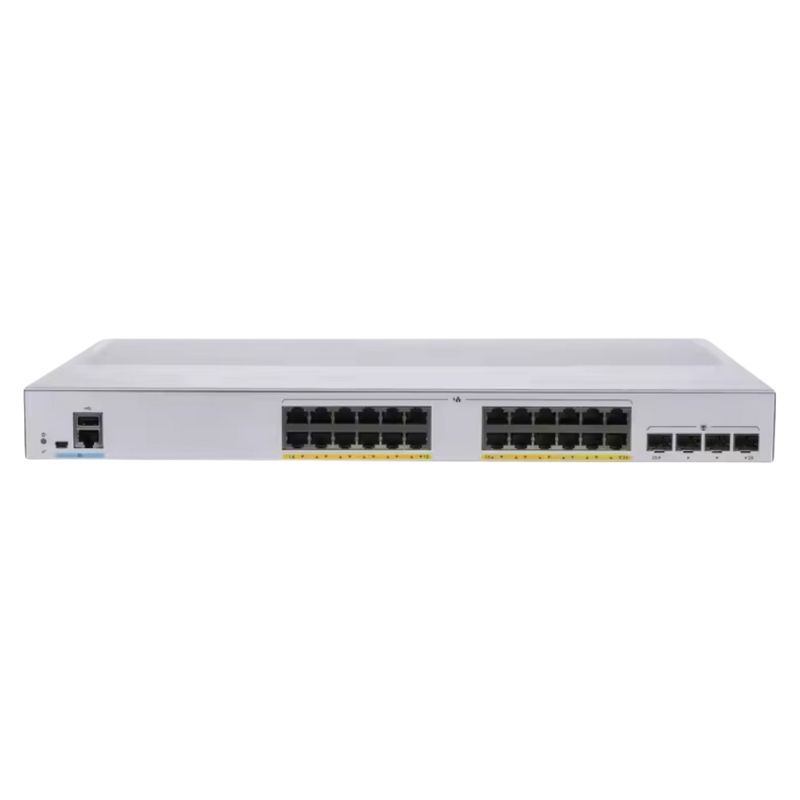


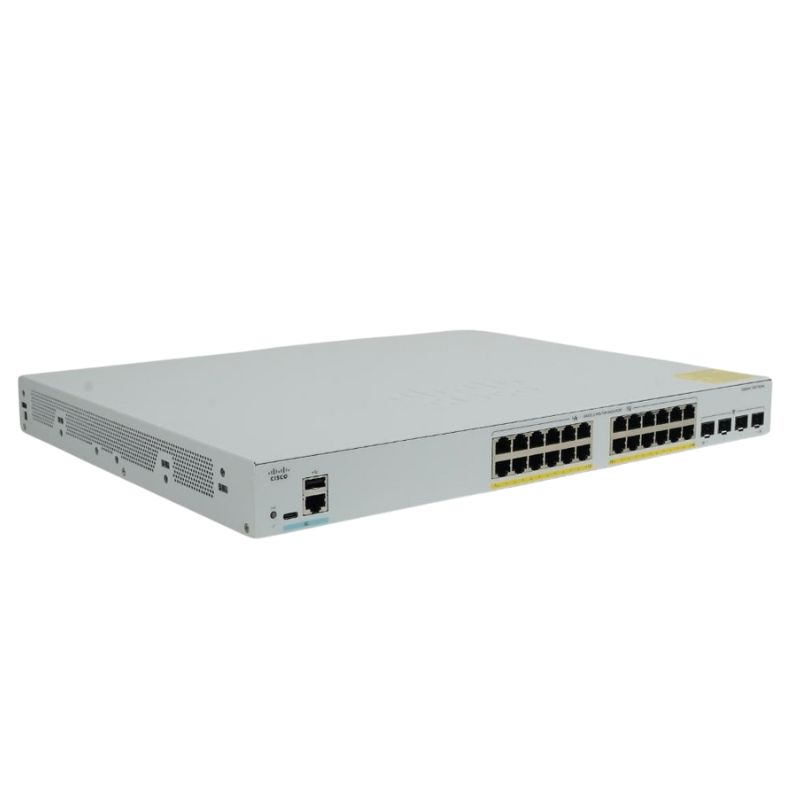
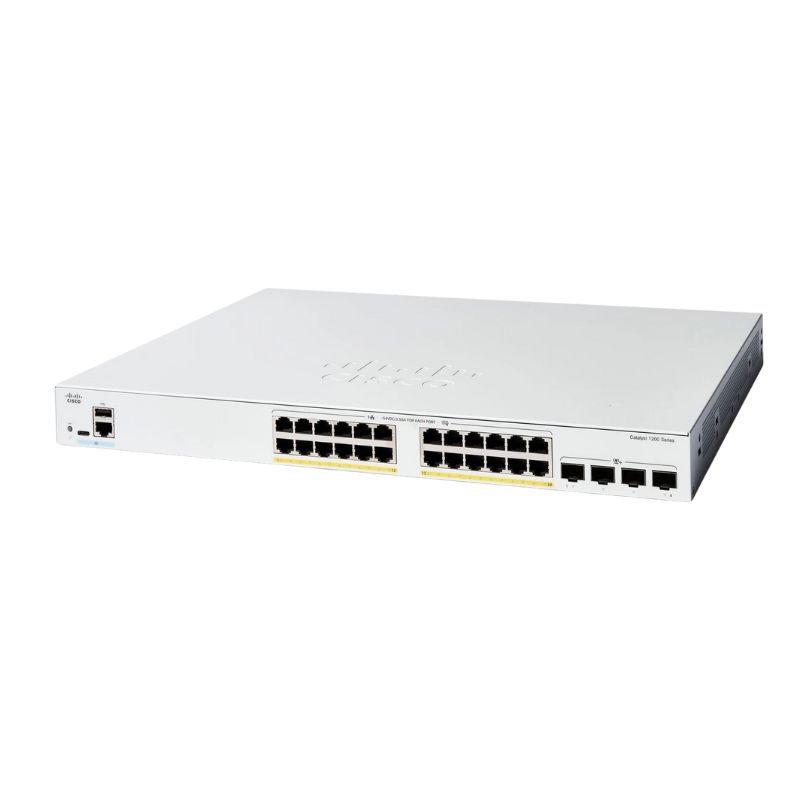
Cisco C1200-24T-4X Catalyst 1200 24-port Ethernet Switch. Excellent Refurbished with 1 year replacement warranty
| SKU/MPN | Warranty | Price | Condition | You save |
|---|---|---|---|---|
| C1200-24T-4X | 1 Year Warranty | $235.00 | Excellent Refurbished | You save: $82.25 (26%) |
| C1200-24T-4X | 1 Year Warranty | $425.00 | Factory-Sealed New in Original Box (FSB) | You save: $148.75 (26%) |
The Cisco Catalyst C1200-24T-4X is a high-performance 24-port Gigabit Ethernet switch designed for modern network environments. It supports Layer 3 smart switching, making it ideal for small to medium-sized enterprise networks. With advanced features and flexible connectivity, this switch ensures reliable, high-speed networking.
The Cisco C1200-24T-4X sits in the Catalyst 1200 Series, engineered for small and medium-sized business access switching where reliability, security, and affordability converge with simplified management workflows. This category focuses on 24-port Gigabit Ethernet access density paired with 4 dedicated 10G SFP+ uplinks, enabling high-performance aggregation to core, server, and storage tiers while maintaining cost-efficiency for edge deployments. Managed through Cisco Business tools that streamline configuration and monitoring, the C1200-24T-4X is positioned to reduce operational complexity without compromising on performance or essential enterprise features.
As a smart, managed switch, the C1200-24T-4X provides a switching capacity of 128 Gbps and a forwarding rate around 95.23 Mpps, aligning with typical SMB throughput needs and allowing sustained multi-Gig backplane utilization when uplinks are active. With 24x Gigabit Ethernet (RJ-45) access ports for endpoint connectivity and 4x SFP+ 10G uplinks for high-speed backbone connections, it balances edge density and uplink bandwidth in compact racks and network closets. The model’s dual-core ARM CPU architecture supports responsive management operations and modern embedded services integral to business-ready environments.
Within this category, buyers often prioritize predictable performance, easy management, and support longevity. The C1200-24T-4X is frequently highlighted with limited lifetime hardware protection in retail listings, reflecting Cisco’s emphasis on product confidence and lifecycle value for SMB buyers evaluating TCO over multiple years of service.
The C1200-24T-4X combines a 24-port 10/100/1000BASE-T access layer with four 10G SFP+ uplink cages designed for fiber or DAC connectivity to distribution/core layers, storage appliances, or virtualization hosts. This layout ensures the switch can anchor a floor or branch network while delivering sufficient uplink headroom for burst traffic, backup windows, or east-west flows among servers. Its platform-level throughput is specified at 128 Gbps switching capacity, enabling wire-speed forwarding across multiple VLANs and interfaces without sacrificing control-plane responsiveness.
A dual-core ARM processor at 1.4 GHz supports the management plane, contributing to faster interface state transitions, SNMP polling responsiveness, and dashboard interactions. This processor profile reinforces the switch’s positioning as “smart managed,” providing enough horsepower to run features needed in SMB deployments without the energy profile or cost of high-end campus aggregation gear. In practice, it supports routine monitoring, basic automation tasks, and policy enforcement dispositions at the access edge.
Forwarding performance (approximately 95.23 Mpps) is aligned with the switching fabric and port density, ensuring the device can maintain near line-rate forwarding across a wide range of packet sizes common in office and branch scenarios. This performance means endpoints consuming rich media, collaboration tools, and cloud applications enjoy consistent packet delivery and minimal bottlenecks during normal operation windows, provided uplinks are provisioned with appropriate optics and spanning mechanisms.
In this category, the 24x Gigabit Ethernet access ports serve user endpoints, IP phones, printers, cameras (non-PoE), and edge IoT devices. Concurrently, the 4x 10G SFP+ uplinks are designed for aggregation—connecting to higher-tier switches, firewalls, or servers—thus providing the backbone speed required for modern deployments adopting hybrid cloud and virtualization patterns. This split of port roles gives network designers predictable access density with high-bandwidth egress, reducing contention and enabling segmentation strategies that avoid oversubscription on the uplink layer.
Fiber uplink choices with SFP+ afford a range of distances and media options, from short DAC twinax runs within racks to long-range fiber modules for building-to-building links. The flexibility of 10G SFP+ interfaces supports modular growth and varied cabling standards, allowing businesses to upgrade uplinks as their performance needs evolve. This also permits direct connections to storage arrays or hyperconverged nodes where low-latency and higher throughput paths are preferred for backup or replication workflows.
For managed deployments, administrators leverage the Cisco Business mobile app or dashboard to configure VLANs, monitor port states, and check system health. This approach to management reduces learning curves for small IT teams and consultants, presenting a streamlined UI that includes topology visibility and guided configuration options appropriate for access layer devices. The emphasis on simplified operations is a hallmark of the Catalyst 1200 Series design brief and a key differentiator in the SMB segment.
Switching capacity of 128 Gbps provides adequate internal bandwidth to sustain simultaneous traffic across many active ports, especially when endpoints are distributed among multiple VLANs and dynamic workflows. Importantly, the forwarding rate (about 95.23 Mpps) indicates that under realistic packet sizes, traffic is processed at speeds expected of a modern Gigabit access switch with 10G uplinks, preventing performance dips during peak concurrency. When matched with QoS policies and consistent uplink provisioning, the switch forms a stable access tier for cloud-driven office environments.
For use cases involving bursty traffic—such as video conferencing spikes, large file transfers, or cloud synchronization—the 10G uplinks reduce bottlenecks leading out of the access layer. Employing SFP+ ports to connect up-stack improves deterministic performance for downstream resources, including centralized Wi-Fi controllers, NAT/firewall appliances, and core routing devices. Coupled with smart management via Cisco Business dashboards, performance assurance hinges on proper VLAN segmentation and monitoring, not on constant CLI babysitting.
SMB buyers often prefer a blend of enterprise-grade stability with approachable management. The Catalyst 1200 Series emphasizes this through compatibility with Cisco Business mobile app and dashboard experiences that de-emphasize complex command syntaxes, focusing instead on guided templates, graphical topologies, and contextual alerts. This focus lowers administrative overhead and enables faster deployments and routine changes even for small teams that lack full-time networking specialists.
Administrators can consolidate visibility through the dashboard, checking port performance, link status, and basic security postures. When rolling out changes—such as VLAN additions, trunk definitions, or uplink reconfigurations—the UI helps avoid common pitfalls by presenting profile-based flows that align with SMB best practices. This approach is aligned with the Catalyst 1200 Series positioning as an affordable yet reliable networking foundation for small and medium-sized environments and remote sites.
Common personas for the C1200-24T-4X include branch IT coordinators, managed service providers assisting SMEs, and office administrators tasked with infrastructure oversight. These roles benefit from the centralized dashboard, reducing the frequency of on-site troubleshooting for routine tasks. When escalations occur, the switch’s clear port labeling and diagnostics facilitate rapid identification of cabling issues, speed/duplex mismatches, or misconfigured uplink modes, minimizing downtime in environments where network interruptions impact business continuity.
Access switching starts with sound segmentation, and the C1200-24T-4X category supports VLAN-based isolation models for separating departments, IoT endpoints, and guest traffic. Appropriate segmentation—combined with uplink policies—helps enforce least-privilege access patterns and reduces broadcast domains that can strain devices or expose endpoints unnecessarily. The switch’s managed capabilities and dashboard integration make creating and maintaining these VLAN structures more approachable for non-expert administrators.
Basic security hardening on managed SMB switches typically involves strong admin authentication, port security practices, and monitoring for anomalies. While policy complexity is lower than high-end campus distribution, the core tenets of security—authenticating management sessions, ensuring firmware currency, and limiting open trunk exposure—apply equally at the access layer. For organizations scaling from a flat network to segmented subnets, the C1200-24T-4X category offers a practical platform to implement foundational network security measures with minimal friction.
Having four 10G SFP+ uplinks allows flexible link design: dual uplinks to upstream switches for redundancy, dedicated uplinks to server racks for east-west traffic isolation, and backup uplinks for NVR/storage lanes. These designs mitigate single points of failure, distribute load, and enable traffic engineering that aligns with application criticality. The 10G bandwidth headroom is particularly valuable when multiple Wi-Fi APs, collaboration endpoints, and content-heavy workflows share the same access tier.
Whether using copper DAC cables for short interconnects or optics for extended runs, SFP+ lets businesses tailor their uplink infrastructure as physical layouts evolve. This modularity ensures that the switch remains relevant as floors are reconfigured, tenants change, or remote work patterns drive new traffic distributions. Ensuring optical budgets and link stability falls into standard operational practices, which are well supported by the device’s management capabilities within the Cisco Business ecosystem.
In multi-switch access designs, the C1200-24T-4X can connect upstream via multiple 10G links to a pair of distribution switches, enabling link redundancy and faster convergence. While advanced stacking features may vary across models within the series, the principle of resilient uplink configurations holds: spread risk across paths, monitor link health, and design for failover to maintain service continuity. This strategy is aligned with typical SMB resilience goals and limited downtime expectations for business-critical networks.
The C1200-24T-4X category is well-suited for offices running cloud SaaS, VoIP, and high-definition conferencing, where low-latency Gigabit access and assured uplink capacity are essential. Endpoints such as desktops, thin clients, IP phones, and non-PoE cameras benefit from consistent L2 forwarding and segmentation. For small-scale server rooms or edge compute nodes, the switch’s 10G uplinks deliver fast lanes to storage or virtualization hosts, enabling smoother backups and intra-rack syncs when paired with appropriate optics and cabling.
Education centers, design studios, and retail operations also fit this profile, where bulk data transfers, content updates, and multi-user collaboration create periodic traffic peaks. With 24 ports, a single device can anchor a modest floor, and the manageable platform supports incremental growth until an additional switch is required. For MSPs, uniform deployment of these switches across multiple SMB clients creates operational consistency—shared playbooks, repeatable configurations, and simplified remote oversight via the Cisco Business dashboard.
As a 24-port Gigabit managed switch, the C1200-24T-4X’s key highlights include the 4x 10G SFP+ uplinks, modern dual-core ARM CPU at 1.4 GHz, strong switching capacity, and business-friendly management tooling. These features position it above unmanaged or lightly managed commodity gear by delivering performance consistency, configuration flexibility, and structured oversight. Its role is the backbone of small offices or branch environments where uptime, basic segmentation, and single-pane-of-glass management matter.
The device’s inclusion in the broader Catalyst 1200 Series means it benefits from Cisco’s design philosophies for SMB: reduced complexity, practical feature sets, and affordability without stripping essential capabilities. The combination of 24 GE access ports and 4 SFP+ uplinks is a deliberate balance—dense enough for most floors, powerful enough for modern uplink needs, and straightforward to manage at scale using dashboard workflows.
Typical office floors combine workstations, phones, and printers segmented into VLANs by department or function. The C1200-24T-4X’s 24 GE ports provide ample density for a mid-sized office pod, while 10G uplinks connect to a central distribution switch or firewall. VLAN-based policy enforcement minimizes unintended lateral movement and aligns with basic compliance expectations. Through the Cisco Business dashboard, administrators can visualize port assignments and maintain segmentation without deep CLI expertise.
Retail sites need stable connectivity for POS terminals, digital signage, and back-office systems. Hospitality environments similarly rely on consistent access for service stations and back-of-house endpoints. With reliable L2 forwarding and 10G uplinks back to core services, the C1200-24T-4X ensures latency-sensitive transactions and content updates remain fluid. Management simplicity and limited lifetime protection claimed in listings add confidence for distributed deployments where onsite IT staffing is minimal.
In labs and collaborative spaces, simultaneous high-throughput traffic—software updates, media streaming, and shared project files—can strain undersized uplinks. The 4x SFP+ uplinks can be allocated to different traffic domains or redundancy pairs, maintaining performance even during peak times. Structured VLANs for student, faculty, and IoT devices uphold segmentation and simplify troubleshooting via the dashboard approach that targets non-expert administrators.
Operational efficiency hinges on predictable configurations, visible health metrics, and rapid remediation. In the Catalyst 1200 Series, Cisco positions the C1200-24T-4X within a management stack emphasizing guided workflows through the Cisco Business mobile app and dashboard. These tools reduce low-level command operations for common tasks—VLAN builds, trunk setups, port monitoring—making network hygiene more attainable for SME teams and MSPs overseeing many sites.
Standardizing on the C1200-24T-4X across multiple locations offers playbook consistency: similar port layouts, unified firmware practices, and repeatable uplink designs. It streamlines documentation and reduces the variability that complicates remote support sessions. In multi-tenant buildings or franchise operations, this uniformity contributes to faster onboarding and conflict resolution when changes are requested by tenants or business units.
Growth planning with the C1200-24T-4X centers on adding more switches as headcount increases and leveraging the 10G uplinks to maintain backbone integrity. As new departments or functions come online, VLAN frameworks and trunk definitions can be extended, preserving segmentation and manageable broadcast domains. The switch’s performance envelope provides room for additional endpoints and applications before reconsidering uplink distribution or layering strategies.
When capacity thresholds loom—driven by more APs, video conferencing rooms, or server expansion—uplink planning ensures that distribution/core tiers can absorb added load. Fiber and DAC choices enable incremental upgrades without full recabling of the access layer. This incremental approach allows SMBs to scale confidently, matching capital expenditure to business growth rather than preemptive overbuilds.
Deployment best practices include thoughtful rack placement, cable management, and airflow planning. With 24 access ports, neat patch panel integration keeps changes organized and ports easily traceable. For the 10G SFP+ uplinks, DAC is efficient for short-run, low-cost links inside the same rack, while optical modules are chosen for distance or building interconnects. Ensuring correct transceiver types and verifying link stability are standard pre-cutover checks aided by the switch’s management visibility.
Labeling VLANs and trunk configurations improves long-term operability, preventing errors during moves, adds, and changes. In branch sites, remote visibility via the dashboard helps guide onsite personnel through safe cable swaps and uplink reterminations. The overall installation footprint fits well in compact network closets typical of SMB buildings, with structured cabling managing growth in an orderly fashion over time.
Compared to unmanaged or web-managed commodity switches, the C1200-24T-4X adds substantive performance, structured management, and better integration into a comprehensive vendor ecosystem. Its 10G uplink capacity differentiates it from many entry-level 24-port devices that cap at 1G uplinks, which can bottleneck modern hybrid workflows. The balance of switching capacity, forwarding rate, and dual-core CPU makes it a practical middle-ground for SMEs that want predictable operation without premium campus features they won’t use daily.
In multi-vendor environments, standard L2 features and SFP+ interoperability provide flexibility, but the Cisco Business dashboard tie-in is a clear operational advantage for teams invested in Cisco’s SMB tooling. This synergy reduces time-to-value and improves consistency across sites, strengthening the argument for standardizing on the Catalyst 1200 Series for the access layer.


 Contact Us
 Information
 Catalog
 Solid State Drives (SSD)
 Network Switches
 Hard Disk Drives
 HBA & Controllers
 PC & Servers
 PC & Server Memory
 CPU & Processors
 Network Routers
 Power Supplies
 Tape Drives & Libraries
 Network Devices
 Computer & Network Cables