(7% discount is applied at checkout)
Cart is empty
Your go-to destination for cutting-edge server products
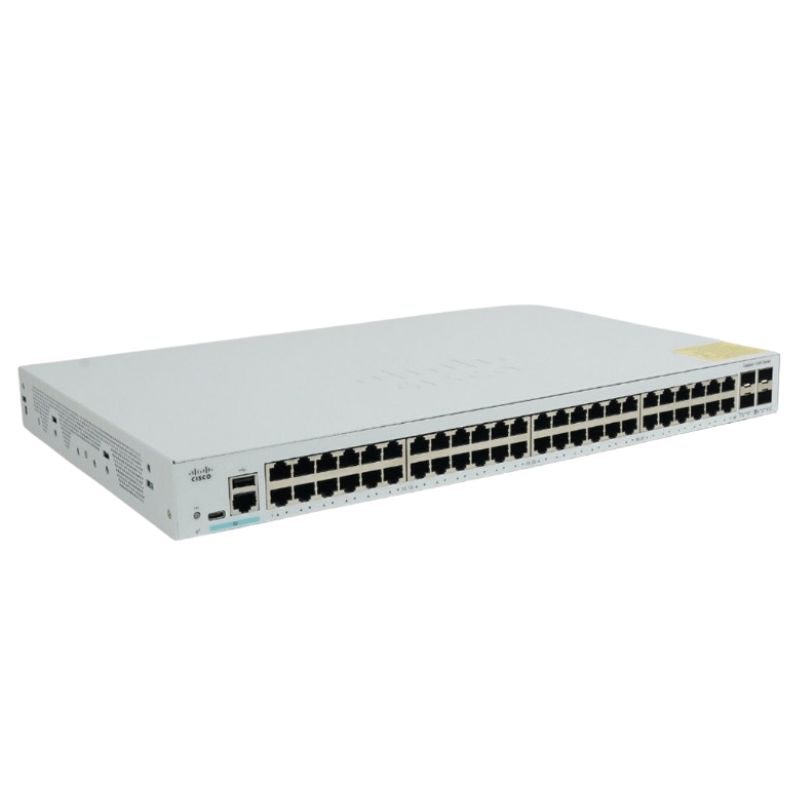


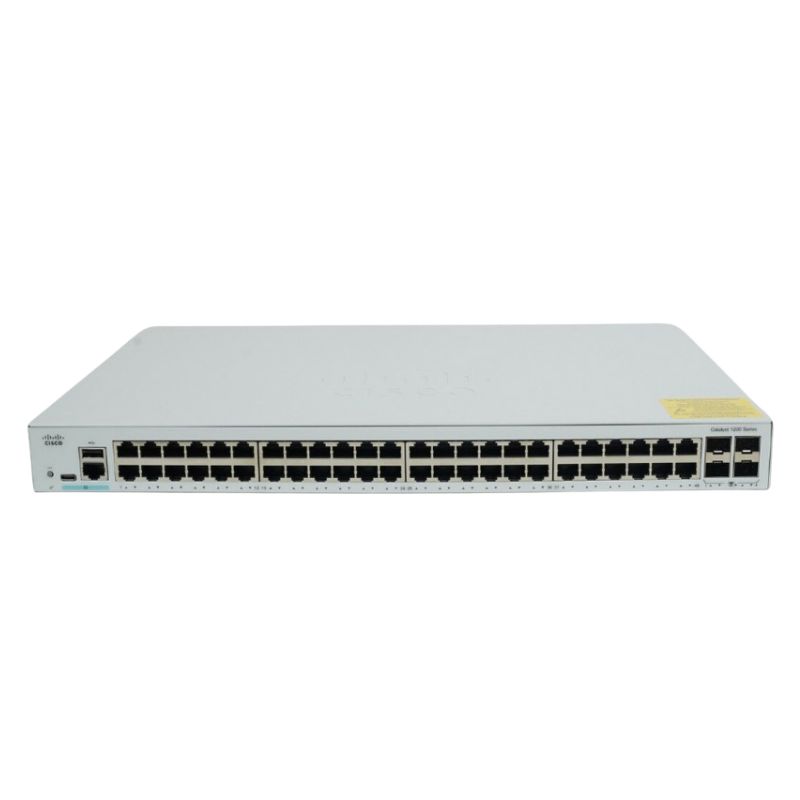
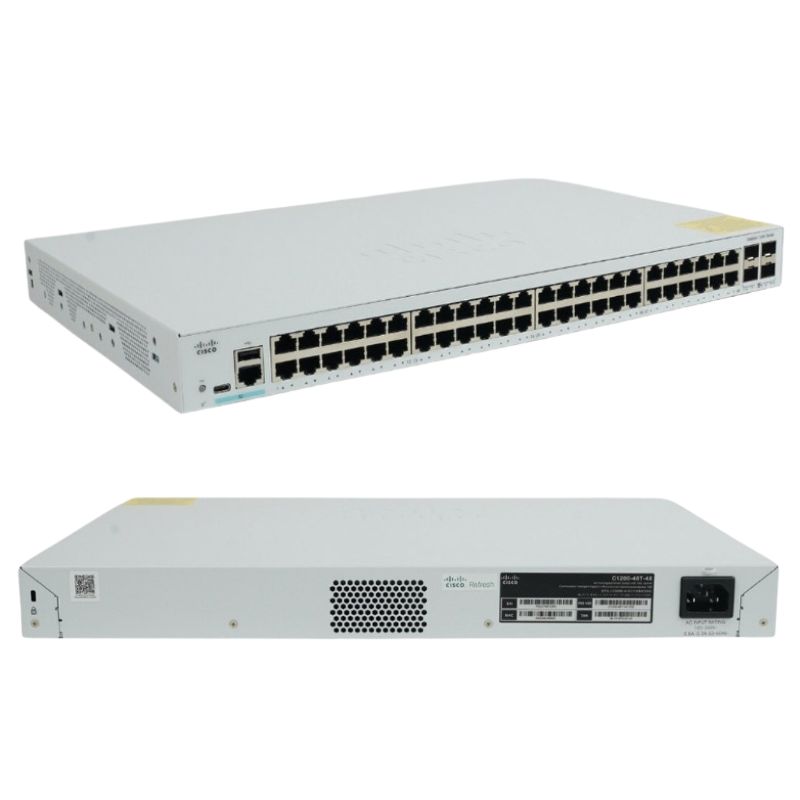
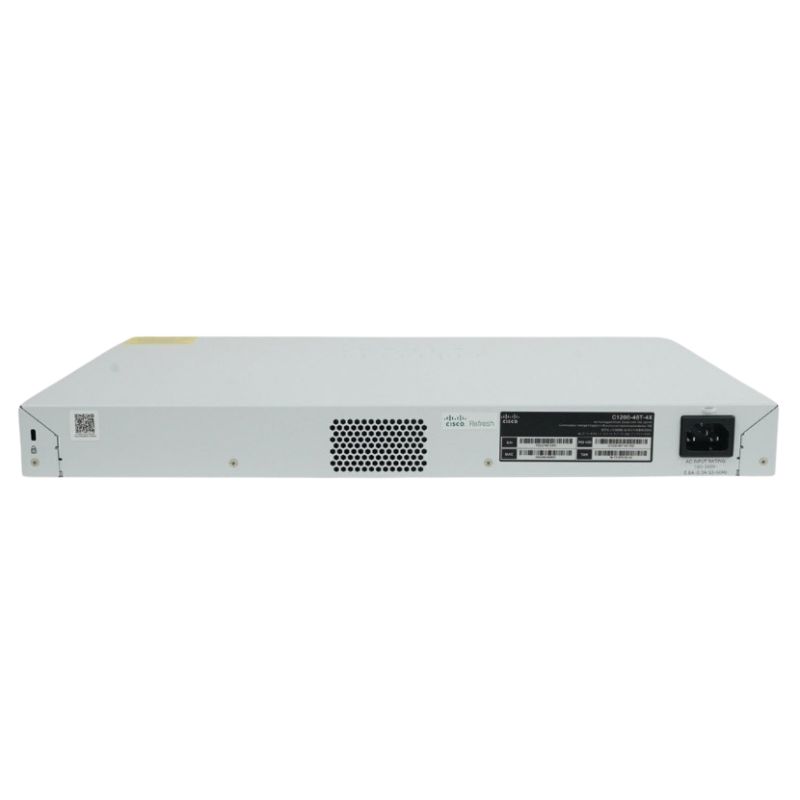
Cisco C1200-48T-4G Catalyst 1200-48T-4G 48 Ports Smart Rack-mountable Switch. Factory-Sealed New in Original Box (FSB) with 1 year replacement warranty
| SKU/MPN | Warranty | Price | Condition | You save |
|---|---|---|---|---|
| C1200-48T-4G | 1 Year Warranty | $310.00 | Excellent Refurbished | You save: $108.50 (26%) |
| C1200-48T-4G | 1 Year Warranty | $699.00 | Factory-Sealed New in Original Box (FSB) | You save: $244.65 (26%) |
The Cisco C1200-48T-4G Catalyst is a high-performance, 48-port smart switch designed for rack-mounted network environments. Ideal for medium-scale enterprises, it provides robust Layer 3 capabilities and energy-efficient operation.
The Cisco C1200-48T-4G Catalyst 1200-48T-4G is positioned in the smart, rack‑mountable switching category for midsize networks that require dependable Layer 2 functionality with simplified management workflows. It offers forty‑eight Gigabit Ethernet access ports for user, device, and server connectivity, complemented by four dedicated Gigabit uplink interfaces that streamline aggregation and backbone connections in multi‑switch environments. This category emphasizes energy‑efficient operation, versatile network segmentation, and standards‑based interoperability to support diverse deployments across offices, campuses, branch locations, and industrial‑adjacent spaces that benefit from robust wired connectivity. The smart management profile focuses on practical features that enhance monitoring and control without the learning curve of complex enterprise configurations.
Designed for 19‑inch rack installations, this switch category balances density, thermal stability, and cabling flexibility, helping network administrators scale ports while preserving space and airflow. The platform aligns with common use cases such as VLAN‑driven segmentation, quality‑of‑service policies for voice and video, and secure access practices based on authentication, inspection, and monitoring. The category also prioritizes operational resilience, offering link bundling and loop prevention to maintain uptime under evolving traffic loads. The net effect is a reliable backbone for wired endpoints, printers, IP cameras, point‑of‑sale systems, and collaboration devices that depend on predictable performance.
This description explores the capabilities expected in the C1200‑48T‑4G category and its immediate subcategory, including management, security, performance, design, deployment topologies, and long‑term operational considerations. It aims to help technical buyers, IT generalists, and systems integrators understand how the switch fits into a layered network strategy and what features matter most when planning upgrades or expansions. While details vary by firmware releases and specific operational contexts, the core themes outlined here reflect typical features and best practices for a smart Layer 2 rack‑mount switch with 48 access ports and 4 uplinks.
The essential value of this category lies in efficient port density, standards‑aligned features, and approachable tools that compress deployment time. Forty‑eight access ports deliver gigabit connectivity for high device counts, reducing the need for multiple smaller switches in distributed closets. The four dedicated uplink interfaces provide a clean path to distribution or core layers, empowering administrators to centralize routing, security analytics, and Internet access while keeping access switching straightforward. Combining VLANs, QoS, and link aggregation produces a resilient and organized data plane that scales with the organization’s needs.
Smart management in this category emphasizes intuitive controls, guided workflows, and visibility into the data and control plane without requiring advanced certifications to operate. This allows resource‑constrained teams to implement segmentation, prioritize critical application flows, and monitor switch health through dashboards and logs. Interoperability with common network protocols supports multi‑vendor environments, helping the switch coexist with existing infrastructure in a repeatable and supportable manner. Firmware updates and configuration backups protect this investment, while energy‑efficient features reduce long‑term operating costs.
Port density: Forty‑eight 10/100/1000 access ports enable large endpoint counts without cascading multiple small devices.
Uplink versatility: Four dedicated gigabit uplinks streamline connections to aggregation and core, simplifying backbone design.
Layer 2 segmentation: VLAN support organizes departments, devices, and security zones to control broadcast domains and policy scopes.
Traffic prioritization: QoS capabilities enhance performance for real‑time services like voice, video, and interactive collaboration.
Resilient links: Link aggregation and loop prevention provide stability under load and mitigate topology risks.
Smart management: Web‑based controls, role‑based settings, and standards support reduce complexity for day‑to‑day operations.
Security hygiene: Network access control, DHCP inspection, and ACLs help block unauthorized behaviors and contain threats.
Energy efficiency: Power‑saving modes optimize consumption for endpoints and idle ports to lower operating overhead.
A rack‑mountable chassis is central to this category, fitting standard 19‑inch racks and commonly delivered with mounting ears or brackets for secure installation. The front‑facing port arrangement simplifies patching and labeling, with status LEDs for per‑port activity and link indication that accelerate troubleshooting at a glance. Airflow considerations typically favor front‑to‑back or side‑to‑side cooling in wiring closets; consistent ventilation helps the switch sustain throughput and uptime. The overall footprint balances port density with thermal management to support steady operation in mixed workloads.
Power design in this category emphasizes reliability and serviceability, typically including internal PSU architecture sized for sustained gigabit access operation. Energy‑efficient features can reduce power draw during low utilization windows or when ports are quiet, benefiting organizations with constant uptime requirements but variable usage patterns. The absence of power draw for down or idle ports supports greener practices, particularly in shared commercial facilities or branch locations. Clear labeling and standard connectors reduce installation errors and speed up moves, adds, and changes.
Gigabit access across 48 ports is the core performance model, supporting endpoint bandwidth for modern productivity applications, cloud services, and file synchronization. With VLAN segmentation, broadcast traffic is controlled, reducing noise in busy environments and improving effective throughput. QoS policies prioritize latency‑sensitive flows, shaping egress and ingress behavior to protect voice calls, streaming media, and interactive sessions. Combined, these capabilities deliver consistent performance even during high concurrent usage.
Link aggregation on uplinks can enhance throughput between access and distribution layers, spreading traffic across bundled links and providing redundancy if a member link fails. Loop prevention mechanisms safeguard the topology from broadcast storms, which would otherwise degrade performance and reachability. Efficient buffering, cut‑through or store‑and‑forward forwarding strategies, and hardware‑assisted switching enhance determinism in packet handling. This category aims for predictable performance rather than speculative acceleration, favoring stability and compatibility.
QoS in this category typically utilizes classification and prioritization based on DSCP, CoS, or port‑level rules to align traffic treatment with business needs. Voice VLAN implementations can isolate and prioritize IP telephony, while queuing strategies and rate limiting ensure fairness among departments and devices. Administrators can shape policies to give conferencing tools a higher class of service than bulk data transfers or background synchronization. The outcomes are smoother calls, fewer glitches in video collaboration, and protected bandwidth for key workflows.
VLANs are foundational to this category, creating logical segments for departments like finance, engineering, HR, and guest access, while narrowing broadcast domains to improve both performance and security posture. Spanning Tree variants manage path selection and loop mitigation, ensuring convergence remains orderly as links or nodes change state. Link aggregation provides higher bandwidth virtual links that are treated as single logical interfaces, simplifying design and failover planning. IGMP snooping can control multicast flows to prevent flooding in segments that host streaming or surveillance traffic.
Port‑based isolation and access lists add granularity, enabling administrators to impose controls at the edge where devices connect. Many deployments use these features to restrict lateral movement between VLANs, advancing zero‑trust principles by default. Trunk ports carry multiple VLANs to upstream switches or routers, while access ports are assigned single VLANs for endpoints, building a clear separation of roles. The segmentation toolkit is designed to support growth without sacrificing manageability.
Loop prevention is mandatory for a dense access layer, and this category typically supports standards‑aligned spanning tree practices to keep traffic flowing predictably. Portfast‑style behavior for edge ports accelerates endpoint bring‑up while maintaining safety for trunk or uplink interfaces. When paired with storm control and broadcast thresholding, administrators can dramatically reduce risk from mispatches or faulty devices. These measures make large floors and distributed closets easier to operate.
Security controls in this category emphasize practical defenses at the access layer, starting with authentication and continuing through inspection and enforcement. Network access control can leverage 802.1X or MAC‑based paradigms to validate endpoints before granting VLAN membership or permissions. DHCP snooping helps prevent rogue servers from assigning malicious IP configurations, while dynamic ARP inspection can deter spoofing attempts. Layer 2 ACLs assist in limiting specific protocols or device classes, contributing to least‑privilege connectivity.
Storm control, broadcast limitation, and port security measures are helpful against common misuses and simple intrusions. Administrators can define thresholds for traffic types and disable or alert on ports that behave suspiciously. Guest VLAN constructs and limited segmentation enable safe connectivity for contractors or visitors without exposing internal resources. These measures align with fundamental IT compliance goals, making audits and policy checks more predictable.
Implementing strong authentication improves resilience by ensuring only authorized devices receive network services. 802.1X provides per‑session control and can integrate with directory services to evaluate credentials; MAC‑based options offer simpler onboarding for devices that lack supplicants. Role‑based policies allow different classes of devices—such as printers, VoIP phones, and workstations—to receive tailored VLANs and QoS without manual reconfiguration. This modular approach simplifies compliance while enhancing asset visibility.
An effective administration model in this category favors clarity and guardrails: changes are staged, reviewed, and applied in controlled windows. Predefined profiles for common device types speed up provisioning, while port descriptions and notes record intent for future audits. Scheduled tasks help roll out firmware updates and capture backups without impacting business hours, and syslog integration gathers state changes in a centralized location. Taken together, these habits improve uptime and reduce surprise behavior in complex networks.
The 48‑port access model suits open office floors with high endpoint density, departmental closets with mixed devices, and campus wings where multiple rooms converge on a single wiring center. Uplinks connect to distribution switches or routers that handle inter‑VLAN routing, firewalling, and WAN access. VLANs separate staff devices from guests, video surveillance from general traffic, and sensitive workloads from routine office flows. QoS ensures that interactive and real‑time applications remain responsive during backups or software updates.
Branch offices benefit from simple management and standards‑based controls that can be replicated across locations; templates take the guesswork out of port roles and policies. Retail stores can use segmentation to isolate point‑of‑sale terminals and inventory systems from visitor Wi‑Fi or signage controllers. Small campus networks can dedicate uplinks to different distribution nodes to create alternate paths and planned maintenance windows. The switch serves as a reliable bridge between user devices and centralized services wherever consistent wired performance is needed.
Interoperability is a core tenet of this category, with support for widely used Ethernet, VLAN, link aggregation, and loop prevention standards. Neighbor discovery and inventory protocols improve cross‑vendor visibility and ease troubleshooting during multi‑party deployments. QoS marking schemes and traffic classification rules align to industry expectations, ensuring consistent treatment across heterogeneous networks. Authentication and inspection features integrate with directory services and network access frameworks commonly found in enterprise and midmarket environments.
The switch category emphasizes backward compatibility and incremental modernization; adopting layered designs preserves investments in distribution and core while refreshing access ports. This makes phased migrations possible, where legacy endpoints continue to operate alongside newer devices. Standards‑based design decisions also reduce vendor lock‑in and the cost of re‑architecting. The result is a straightforward path to scale features and throughput over time.
In mixed environments, consistent VLAN trunking, link aggregation practices, and discovery protocols streamline connectivity. Administrators can map policies and segments across switches from different makers, and core routers or firewalls can enforce inter‑VLAN controls without special accommodations. Access layer switches function as predictable building blocks, enabling reusable patterns for closets, wings, or floors. This composability improves resilience and reduces configuration friction.t
For dense office floors, forty‑eight gigabit ports cover docking stations, phones, wired laptops, and printers without needing extra switches. In educational wings, the port count supports computer labs, instructor stations, and lab equipment while maintaining separate VLANs for faculty and students. Surveillance networks benefit from segmented camera traffic and prioritized monitoring flows, while retail environments isolate POS systems and inventory devices from guest connectivity. The four uplinks provide flexible options to connect upstream spans with redundancy and capacity in mind.
Manufacturing support areas and research labs can use the switch to segment specialized devices that require deterministic connectivity without direct access to general office traffic. High‑density collaboration spaces—such as conference centers or training rooms—benefit from QoS that protects voice and video even during file sharing and software distribution. Branch headquarters consolidate typical business units within a single closet while pushing routing and firewalling upstream for centralized control. In every case, the management model remains approachable for day‑to‑day operation.


 Contact Us
 Information
 Catalog
 Solid State Drives (SSD)
 Network Switches
 Hard Disk Drives
 HBA & Controllers
 PC & Servers
 PC & Server Memory
 CPU & Processors
 Network Routers
 Power Supplies
 Tape Drives & Libraries
 Network Devices
 Computer & Network Cables