(7% discount is applied at checkout)
Cart is empty
Your go-to destination for cutting-edge server products
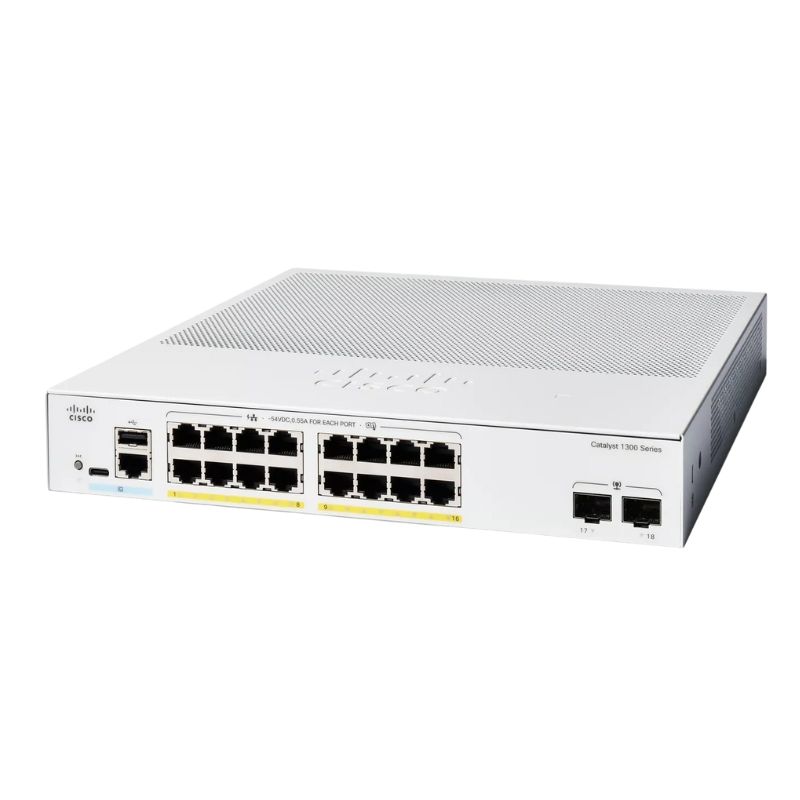


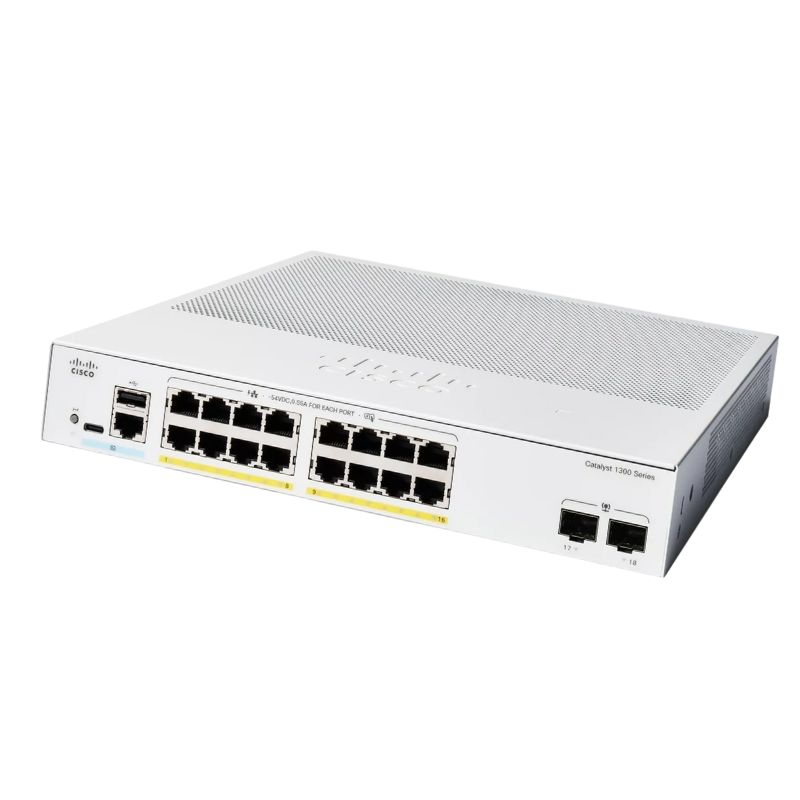
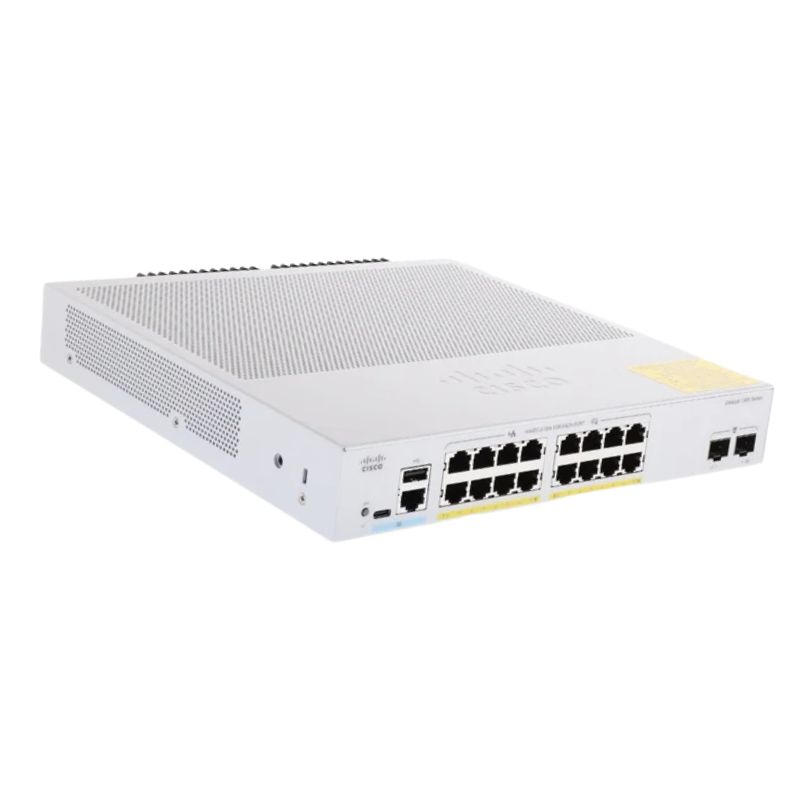
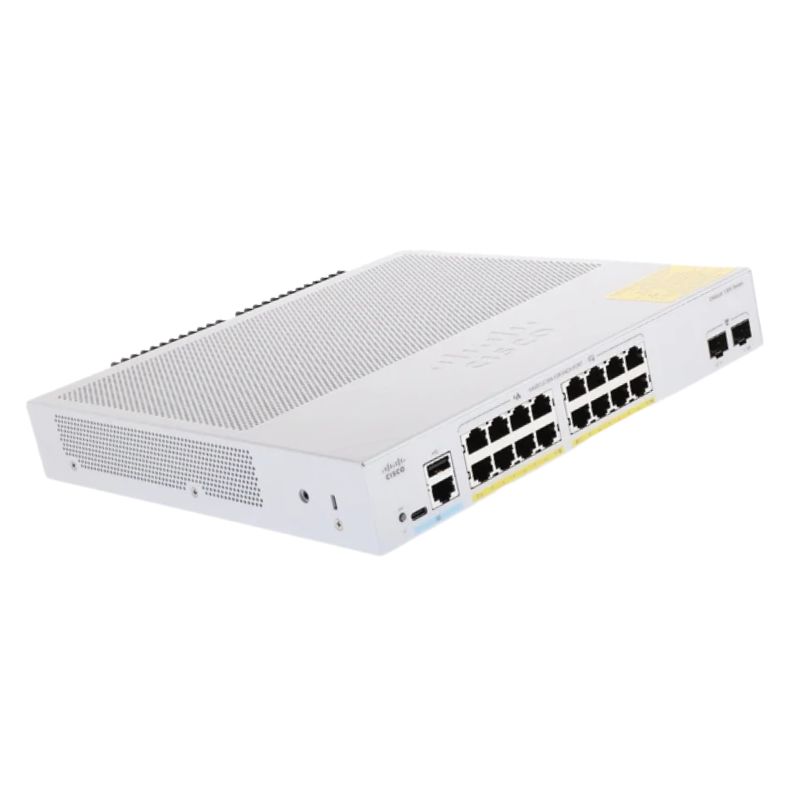
Cisco C1300-16FP-2G Catalyst 16 Ports Gig PoE+ 2 Exp 2 SFP Managed Network Switch. Factory-Sealed New in Original Box (FSB) with 1 year replacement warranty
The Cisco C1300-16FP-2G is a high-performance, enterprise-grade managed Gigabit Ethernet switch designed for modern business networks. Built for reliability and scalability, this Catalyst series switch delivers robust Layer 3 capabilities, Power over Ethernet Plus (PoE+), and flexible fiber uplink options, making it ideal for offices, campuses, and industrial deployments.
This Cisco Catalyst switch is engineered to support both copper and fiber connections, ensuring seamless integration into diverse network infrastructures.
Optimized for high-throughput environments, the Cisco C1300-16FP-2G ensures smooth data forwarding with minimal latency.
This switch supports a wide range of routing and traffic optimization technologies to ensure efficient and secure data flow.
This Cisco managed switch complies with a broad range of IEEE networking standards, ensuring compatibility and long-term reliability.
The Cisco C1300-16FP-2G is part of the Cisco Catalyst 1300 Series, an affordable, enterprise-grade switch family designed for branch offices and small to medium-sized businesses that need reliable, secure, and simple-to-operate LAN access. Within this category, the 16-port Gigabit PoE+ model stands out for offering 16 PoE+-capable copper ports, two SFP fiber uplinks, and a managed feature set that supports modern business requirements like IP surveillance, Wi‑Fi access backhaul, and VoIP, all under a unified, dashboard-driven management experience developed for ease of deployment and ongoing operations. This category emphasizes resilient performance, straightforward configuration, and compatibility with cloud and on-premise workflows, making it an ideal backbone for converged networks that power users, devices, and applications in a single compact footprint.
In practical terms, the C1300-16FP-2G model delivers a 36 Gbps switching capacity and a forwarding rate of 26.78 Mpps, enabling it to handle typical SMB and branch office traffic patterns without bottlenecks. This capacity aligns well with densified edge environments—think dozens of endpoints, APs, and cameras—where wire-speed forwarding and predictable latency are essential to user experience and application performance. It is particularly suited to deployments that need per-port PoE power up to 30W (PoE+), with an overall budget of 240W, allowing simple, single-cable power and data for a range of devices from access points to door controllers and IP phones.
PoE+ support on all 16 Gigabit Ethernet ports allows the switch to energize and connect endpoint devices that require up to 30W, simplifying cabling infrastructure and reducing dependency on local power supplies. With a 240W total budget, sites can power multiple high-draw access points or cameras concurrently while maintaining headroom for future growth. The two SFP uplinks provide dedicated fiber pathways for upstream connectivity, improving aggregation performance and isolation, and enabling more resilient topologies when combined with dual-homing or protected links.
For businesses implementing smart workspaces, PoE+ consolidates power and data to front-of-house kiosks, digital signage, or interactive panels, reducing complexity and installation time. In branch IT closets, the PoE+ provisioning simplifies lifecycle changes—when a device is replaced or relocated, the switch ports can be reprogrammed remotely without electrical rewiring. This flexibility is central to the category’s value proposition, balancing performance with operational simplicity.
The C1300 series is designed for straightforward administration, enabled through the Cisco Business Dashboard and supporting Cisco Business mobile app workflows for streamlined provisioning, monitoring, and troubleshooting. This management approach helps IT teams standardize configurations, enforce policies, and maintain visibility across sites without needing highly specialized CLI-only skillsets. The category targets operational efficiency—especially for distributed teams managing multiple branches—by reducing time-to-deploy and the overhead associated with routine maintenance.
By bringing centralized oversight to edge switching, administrators can manage VLANs, QoS, security rules, and firmware lifecycles consistently across the fleet. For SMBs without a large IT staff, the dashboard-driven model cuts complexity while still offering advanced control when needed. The result is a cleaner, more predictable network with fewer misconfigurations and faster troubleshooting cycles.
With 36.0 Gbps of switching capacity and a forwarding rate of 26.78 Mpps, the C1300-16FP-2G is engineered to sustain typical enterprise edge loads such as high-definition IP camera streams, VoIP calls, and multiple Wi‑Fi AP backhauls without saturating the fabric. These performance characteristics ensure that even during peak periods—like video analytics or large file transfers—the switch maintains low latency and consistent throughput, preserving user experience and application quality.
The inclusion of two 1 Gb/s SFP uplinks enables segmented oversubscription management, so downstream PoE device traffic can be aggregated and uplinked efficiently without impacting LAN broadcast domains. This category prioritizes edge scalability—allowing IT teams to logically grow services and ports while keeping upstream pathways clean and resilient.
The switch features 16 Gigabit Ethernet copper ports that support PoE+, making it straightforward to connect and power a variety of endpoints. Complementing these are two Gigabit SFP uplinks, which accommodate 1 Gb/s fiber transceivers for clean upstream connectivity to distribution or core layers. This balanced I/O profile fits common branch designs: copper edge to users and devices, fiber uplink to aggregation switches or routers, protecting bandwidth and isolating local broadcast traffic.
Beyond power and connectivity, the switch’s managed capabilities include standard features expected in enterprise-grade access switches, such as VLAN segmentation, differentiated QoS, and secure management interfaces. These attributes reflect the category’s aim: to deliver a compact yet robust access platform that aligns with modern network segmentation and traffic engineering practices.
With a 240W power budget, planners can design for mixed loads—for example, eight access points drawing approximately 18–22W each, plus several cameras in the 12–15W range, and some low-power endpoints like phones. The per-port PoE+ ceiling of 30W ensures compatibility with higher-draw APs and certain PTZ cameras, while granular allocation helps prevent over-subscription. This approach lets IT teams map power to business-critical devices first, then allocate remaining budget to less critical endpoints.
In environments with evolving device mixes, administrators can monitor and tune PoE allocations per port, enabling dynamic adjustments to accommodate peak draws or device replacements. This flexibility is essential in retail, hospitality, and healthcare applications where device turnover and expansions are common, and where uptime for cameras, APs, and phones directly impacts operations.
Compact access switches like the C1300-16FP-2G are typically mounted in wiring closets, small racks, or wall cabinets. To maintain performance, ensure adequate airflow and avoid cable congestion in front or rear areas to prevent heat buildup. Using structured cabling with labeled patch panels helps manage PoE loads and keep installation clean, minimizing accidental disconnects and simplifying port identification during troubleshooting. The category benefits from such disciplined installation, reducing risk of thermal throttling or power instability under sustained PoE loads.
For environments with dust or variable ambient temperatures, plan for proper enclosure ratings and ventilation. Power considerations should include UPS-backed circuits to maintain switch operation during short outages, preserving critical services like VoIP and security camera feeds. This ensures the network continues to function through normal power fluctuations and protects against corrupt firmware events caused by abrupt shutdowns.
The managed nature of the C1300-16FP-2G supports creating VLANs to separate user groups, IoT devices, guest traffic, and management domains. Assigning VLANs by port or via dynamic mechanisms ensures that traffic is logically isolated, reducing broadcast noise and improving security posture. IT can implement policy controls for inter-VLAN routing on upstream devices, while the switch enforces access constraints at the edge to prevent lateral movement.
For deployments with multiple services on the same physical infrastructure—like IP cameras, Wi‑Fi APs, and digital signage—VLANs provide a clean boundary that helps maintain deterministic behavior for each service. Combined with QoS, this segmentation ensures real-time applications receive priority while bulk traffic is shaped appropriately.
QoS features on a managed switch enable traffic classification and prioritization, ensuring voice, video, and control-plane traffic remain responsive. Edge policies can tag and queue packets to prevent jitter and latency spikes on oversubscribed links. This is particularly valuable in networks with VoIP phones and surveillance systems, where packet loss or delay immediately impacts service quality.
When configured properly, QoS at the access layer cooperates with upstream policies to maintain end-to-end performance. IT teams can define per-port QoS profiles that match device roles—for example, high priority for VoIP, medium for management, and lower for bulk file transfers—resulting in smoother operation across applications.
Best practices for managed access switches include using secure management protocols, role-based administration, and strong authentication. While the C1300 series emphasizes simplicity through its dashboard approach, administrators should still enforce password policies, restrict management access by IP, and enable logging/alerting to catch anomalous events. Segmenting management traffic into dedicated VLANs and limiting remote administration over untrusted networks provides additional defense-in-depth.
Port security, MAC limiting, and 802.1X-based authentication—where applicable—are standard strategies to prevent unauthorized devices from joining the network. Edge security measures paired with centralized visibility help detect rogue endpoints and enforce acceptable use, keeping the access layer clean and reliable.
A 16-port PoE+ switch with a 240W budget is well-suited to medium-density camera deployments. Installers can power fixed dome cameras at roughly 7–13W and PTZ models at higher draws, balancing loads across ports. Using VLANs for camera traffic improves containment, and QoS can prioritize real-time streams to protect against jitter. The two SFP uplinks allow dedicated fiber backhaul to the recording/NVR environment, minimizing interference with general user traffic.
For campuses with multiple buildings, fiber uplinks from edge switches to a central aggregation point improve resilience and simplify monitoring. PoE+ reduces the need for local injectors, cutting installation complexity and potential points of failure. This category supports scalable surveillance architectures that remain manageable and robust over time.
Most modern access points benefit from PoE+ power, particularly dual- and tri-radio models with higher channel utilization. A 16-port PoE+ switch can support a wing of APs—like office floors or retail zones—providing consolidated power and data with centralized management. Fiber uplinks create clean paths to controllers or gateway devices, and VLAN segmentation separates SSIDs (e.g., guest vs. corporate) into distinct broadcast domains.
This approach makes it easy to expand coverage as business needs grow. Adding APs is as simple as terminating a cable, enabling the port, and associating it with the right VLAN and QoS profile. The switch’s performance envelope ensures backhaul remains stable even under high client concurrency typical of busy retail or hospitality environments.
By delivering PoE+ to phones and conference devices, the switch streamlines deployment of unified communications at the edge. With proper QoS tagging, call quality remains consistent, and VLANs can isolate voice traffic from general data. This configuration simplifies troubleshooting and improves security by limiting cross-domain exposure.
For branch sites, integrating phones, small video endpoints, and collaboration bars is straightforward: power is provided via PoE+, and ports are assigned appropriate policies. The result is a clean, maintainable topology that supports modern collaboration without complex cabling or dedicated power injectors.
The C1300-16FP-2G’s 36 Gbps switching capacity and 26.78 Mpps forwarding rate provide headroom for typical SMB edge traffic mixes. Designers should map expected device types—APs, cameras, phones, PCs—to estimate aggregate throughput needs and ensure uplinks can handle peak loads. The two SFP ports allow creation of isolated uplink paths or redundant connectivity to upstream devices, helping reduce contention during busy periods.
To avoid oversubscription issues, plan VLAN and QoS configurations that preserve real-time traffic priority. When aggregating multiple PoE devices, segment per service (e.g., voice vs. video vs. data) to maintain predictable behavior. This disciplined edge design supports scalable growth and minimizes troubleshooting complexity.
With a 240W PoE budget and up to 30W per port, admins should inventory endpoint draws and design allocations that leave reserve capacity. Prioritize critical devices—like cameras covering entrances or APs covering core work areas—and allocate PoE with margin to accommodate unexpected draw increases (e.g., firmware upgrades temporarily increasing consumption). Monitoring per-port power usage helps validate assumptions and detect anomalies early.
For sites with many endpoints, consider staggered power cycles and port scheduling to prevent inrush issues when the switch or UPS comes online. Intelligent use of PoE budgets contributes to stable operations, especially in branches where physical access for remediation may be limited.
Branch networks often use a star topology with access switches like the C1300-16FP-2G at the edge, feeding into a distribution/core via fiber. This model simplifies fault isolation and keeps broadcast domains contained at the access layer. The two SFP uplinks enable redundant or segmented paths, enhancing resilience and performance for critical services.
For multi-building sites, hub-and-spoke designs route fiber from satellite wiring closets to a central hub. In these cases, PoE+ access switches simplify endpoint deployment while the hub handles routing, firewalling, and WAN uplinks. The category’s focus on simplicity and reliability suits these common enterprise patterns.
Modern edge networks benefit from segmentation as a default posture. Using VLANs, policy-based ACLs at upstream devices, and QoS shaping preserves application experience and prevents lateral threats. The managed feature set in this category supports these strategies without requiring complex, heavyweight configurations. As deployments scale, standardized templates ensure new switches inherit the same posture automatically.
Where guest or IoT traffic is present, isolating these domains and strictly controlling east-west flows is essential. The switch’s role is to enforce port-based assignments and cooperate with upstream routing and security services. This approach delivers both operational simplicity and robust security alignment.
The Cisco Catalyst 1300 and 1300X Series portfolio targets affordability and simplicity for SMB and branch office networks. Managed through Cisco Business Dashboard and the mobile app, the product line is built to be easy to use while maintaining enterprise-grade reliability. The C1300-16FP-2G model sits in the mid-density PoE+ bracket, ideal for sites with a moderate number of powered endpoints needing fiber uplinks and predictable performance envelopes.
Larger variants in the series may offer additional port counts or different power budgets, while smaller ones provide a compact footprint for minimal endpoint clusters. Across the portfolio, the management consistency and design ethos remain focused on streamlined operations and reduced complexity.


 Contact Us
 Information
 Catalog
 Solid State Drives (SSD)
 Network Switches
 Hard Disk Drives
 HBA & Controllers
 PC & Servers
 PC & Server Memory
 CPU & Processors
 Network Routers
 Power Supplies
 Tape Drives & Libraries
 Network Devices
 Computer & Network Cables