(7% discount is applied at checkout)
Cart is empty
Your go-to destination for cutting-edge server products
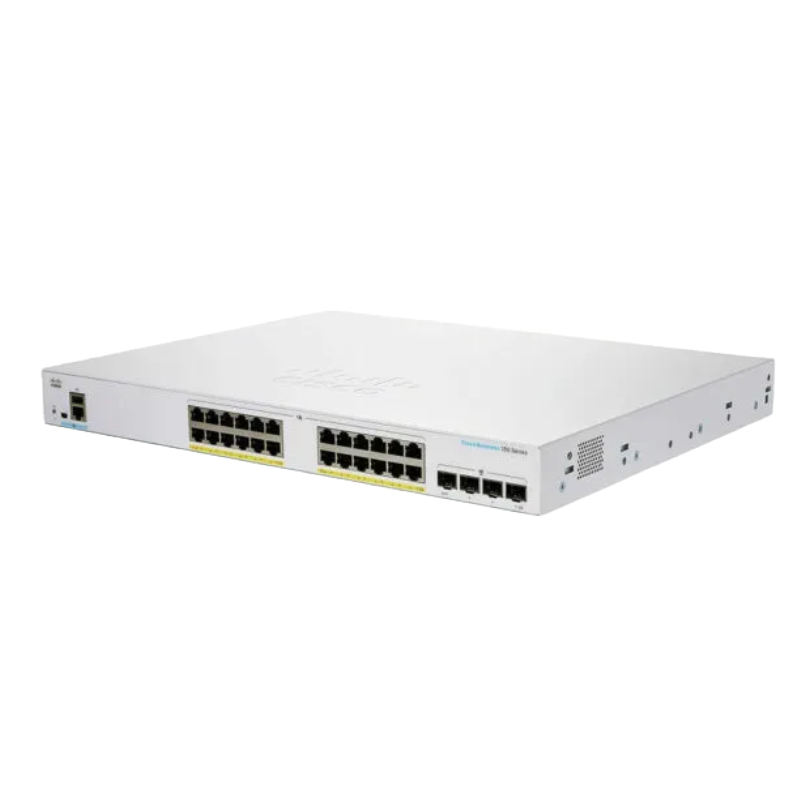


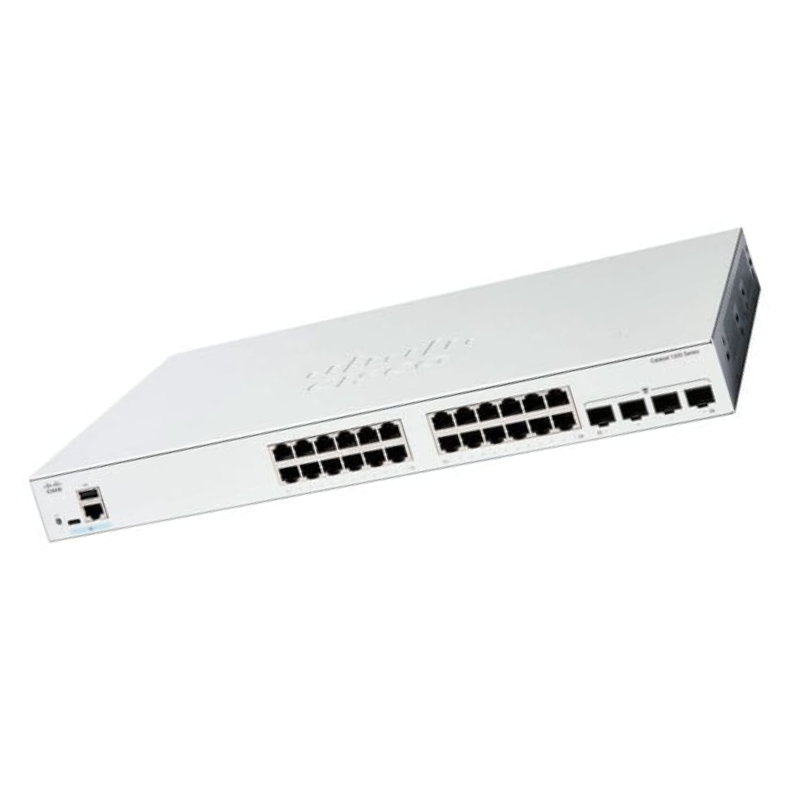
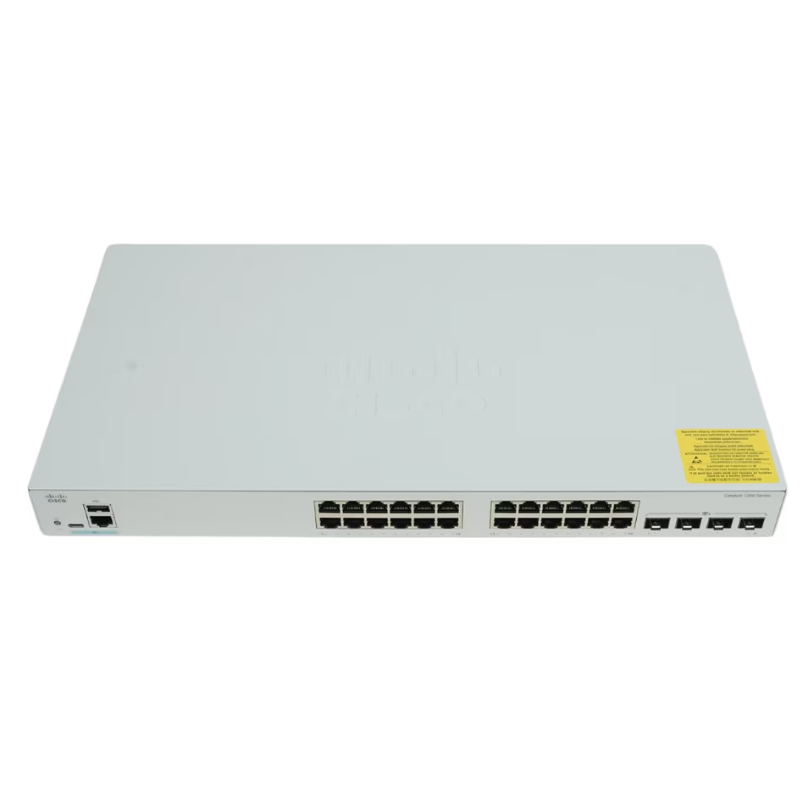
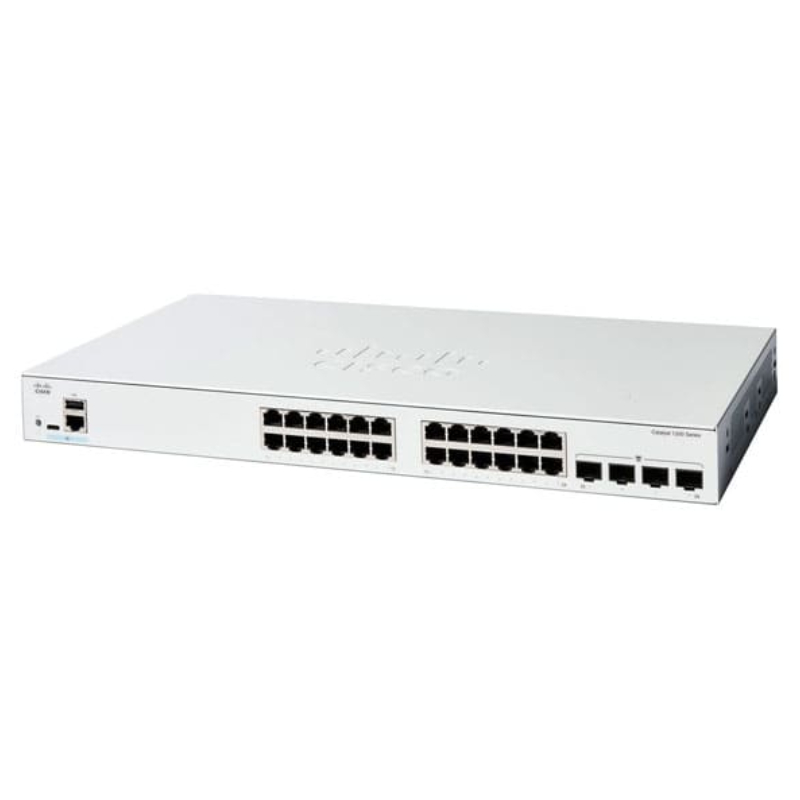
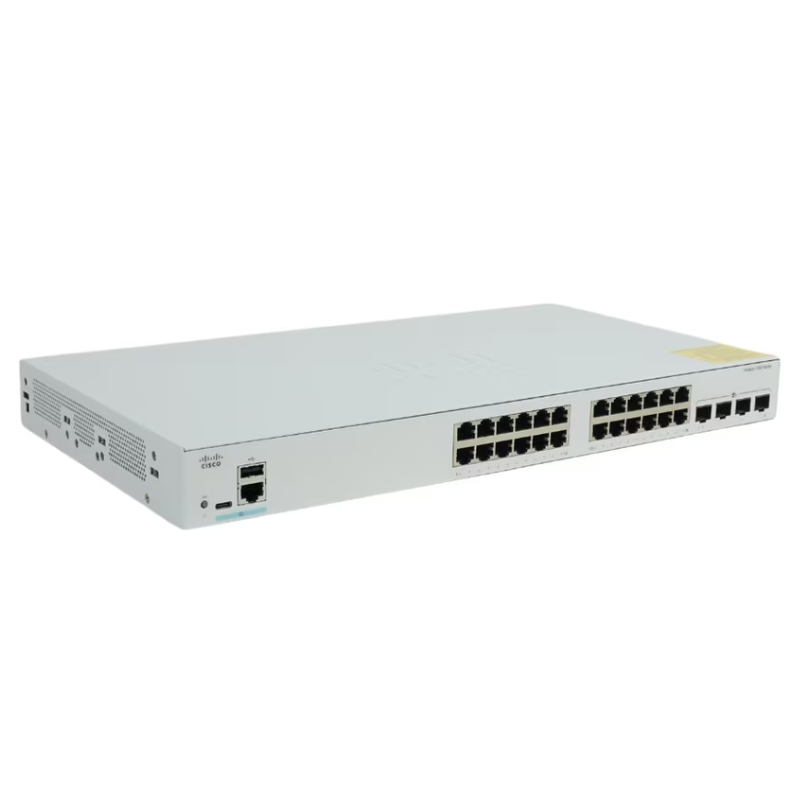
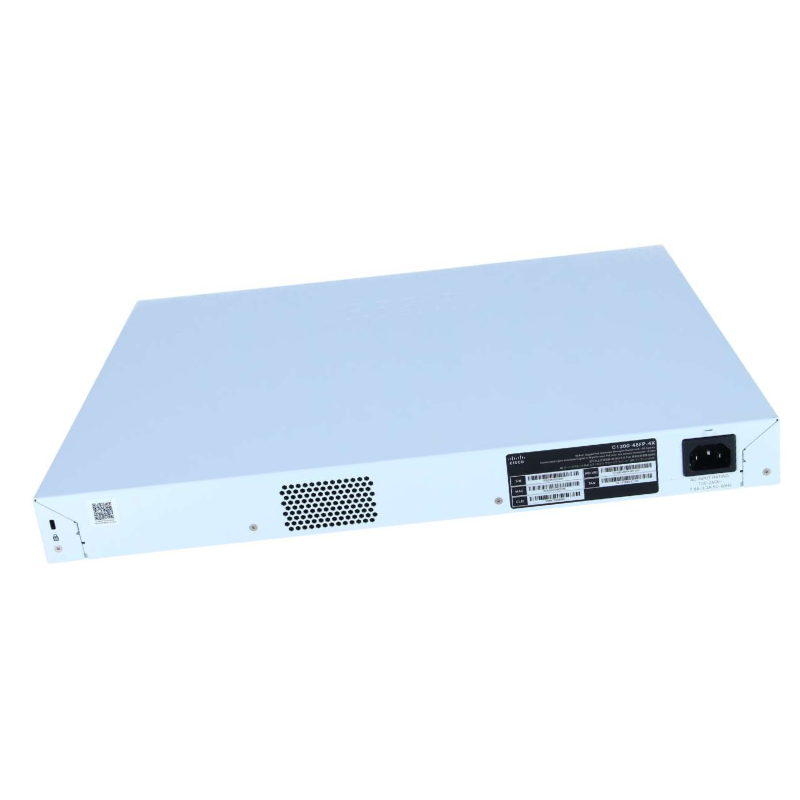
Cisco C1300-24FP-4G Catalyst 1300-24FP-4G L3 PoE+ Managed Network Switch with 4 Gigabit SFP Ports and 24 Ports. Factory-Sealed New in Original Box (FSB) with 1 year replacement warranty
| SKU/MPN | Warranty | Price | Condition | You save |
|---|---|---|---|---|
| C1300-24FP-4G | 1 Year Warranty | $615.00 | Excellent Refurbished | You save: $215.25 (26%) |
| C1300-24FP-4G | 1 Year Warranty | $1,660.00 | Factory-Sealed New in Original Box (FSB) | You save: $581.00 (26%) |
The Cisco C1300-24FP-4G Catalyst 1300 Series switch is a high-performance Layer 3 managed network solution designed for enterprise, SMB, and growing business environments. With advanced Power over Ethernet Plus (PoE+) capabilities, robust security features, and scalable routing performance, this rack-mountable switch ensures reliable connectivity and efficient traffic management.
The Cisco C1300-24FP-4G Catalyst 24 Ports Managed Rack-mountable Switch is designed to deliver enterprise-grade performance, security, and simplicity for modern wired access networks. As part of the Cisco Catalyst family, this switch brings advanced Layer 2 and foundational Layer 3 features, robust Power over Ethernet capabilities, and stack-ready scalability in a compact 1U rack-mountable form factor. Whether you are building out a campus access layer, modernizing a branch office, or standardizing IT for multi-site retail, the C1300-24FP-4G balances performance with operational efficiency while aligning tightly to zero-trust security frameworks.
This category page explores the subcategories and use cases related to the C1300-24FP-4G model, including PoE deployments, VLAN segmentation, QoS for voice and video, network automation, energy efficiency, and high-availability design patterns. You will also find detailed guidance on deployment best practices, lifecycle management, security hardening, and integration with Cisco management and analytics tools. By understanding the capabilities and scenarios for the C1300-24FP-4G, you can design a resilient, scalable access network that supports today’s hybrid work and IoT demands.
The C1300-24FP-4G provides 24 Gigabit Ethernet access ports with Power over Ethernet (PoE) support and four uplink ports to aggregate traffic to distribution or core layers. Its fixed-configuration design simplifies deployment while still offering the flexibility needed for growth, such as stacking options, modular uplink choices (depending on exact submodel), and standards-based interoperability across diverse environments. The platform’s switching fabric is engineered to handle high traffic densities from endpoint-rich floors, ensuring predictable performance for business-critical applications.
The switch is a 1U rack-mountable chassis built for stability, ease of installation, and airflow efficiency. Tool-less mounting mechanisms and included rack ears streamline setup in standard 19-inch racks. Front-access ports simplify cable management while status LEDs and a front-panel console/management port support quick diagnostics. Rear fan placement and smart airflow patterns minimize heat recirculation, making the unit appropriate for shallow-depth cabinets and structured wiring environments in offices, schools, and small data rooms.
With 24 downlink ports, the C1300-24FP-4G is ideal for typical floor distributions where each access switch serves a cluster of workstations, phones, APs, cameras, and IoT sensors. The “4G” designation indicates four Gigabit uplink interfaces for redundancy and aggregated throughput. A flexible uplink strategy—such as using two uplinks for link redundancy and two for traffic segmentation—can reduce failure domains and ensure bandwidth is available during peak usage. EtherChannel (port channel) capabilities enable multi-link aggregation to upstream switches for higher throughput, resilience, and simplified routing decisions.
The “FP” variant emphasizes full PoE capability across the access ports, supporting devices such as IP phones, wireless APs, indoor cameras, door controllers, and building sensors. A generous PoE budget helps sustain mixed endpoint deployments throughout a floor without additional midspan injectors. The switch supports intelligent power management, including power allocation per port, measurement of power draw, and prioritization to keep critical devices supplied during brownouts. Deploying PoE across VLANs with tight QoS and ACL policies ensures both the electrical and network layers operate together seamlessly.
The switching fabric is designed to provide wire-rate forwarding for standard Ethernet frames across access ports and uplinks. Dedicated hardware resources manage MAC address learning, VLAN segmentation, and QoS queuing to minimize jitter and latency. In practice, the C1300-24FP-4G can sustain high-throughput workloads such as HD video feeds from cameras, voice calls across IP telephony, and bulk data transfers without sacrificing stability. Careful queue scheduling and policing ensure that mission-critical traffic cuts through congestion and that background tasks never starve important applications.
At the access layer, Layer 2 technology remains the backbone of segmentation and simple, efficient traffic forwarding. The C1300-24FP-4G supports a comprehensive set of Layer 2 capabilities including 802.1Q VLAN tagging, port-based VLAN assignment, trunking, and advanced Spanning Tree options. These features help administrators separate guest devices from corporate endpoints, isolate IoT domains, and maintain deterministic broadcast boundaries that scale cleanly across floors and sites.
VLANs define broadcast domains that align with organizational policies—such as separating finance PCs from production IoT sensors or establishing a dedicated SSID-to-VLAN mapping for wireless access points. Trunk ports connect access switches to upstream distribution devices, carrying multiple VLANs with tags for centralized routing and firewalling. The C1300-24FP-4G supports configuration profiles that make trunk provisioning repeatable and less error-prone, improving consistency across sites and reducing risk during changes.
Spanning Tree Protocol (STP), along with Rapid STP (RSTP) enhancements, prevents Layer 2 loops that can destabilize networks. Fine-tuning STP root priorities ensures predictable path selection, while portfast and BPDU guard features protect against misconfigurations and unsafe edge connections. In campus designs, administrators often pair STP with link aggregation at the uplinks to balance redundancy with deterministic failover behavior. The C1300-24FP-4G includes per-port controls to enforce safe edge policies, protecting the network against accidental loops from unmanaged switches.
Efficient MAC learning and aging helps keep the CAM table optimized for active endpoints. Features like port security can limit the number of MAC addresses permitted on a port and restrict unknown endpoints from joining. Combined with 802.1X authentication, the switch defines a strong access control posture at Layer 2. Administrators can audit MAC usage to detect anomalies, such as unusually frequent address churn or duplicate MACs indicating spoofing attempts.
While the C1300-24FP-4G is an access-focused model, it typically supports a foundational Layer 3 feature set for inter-VLAN routing, static routes, and essential routing functions. This allows for local segmentation and traffic steering without requiring every packet to traverse upstream routers. Placing basic routing at the access layer can simplify campus designs and reduce latency for east-west traffic between local segments.
By enabling SVIs (Switch Virtual Interfaces), the switch can act as the default gateway for local VLANs. This reduces hop count for common tasks like printers, cameras, and phones communicating within the same floor. Pairing SVIs with ACLs lets admins define allowable flows—for example, permitting voice VLAN traffic to reach call managers while isolating guest VLANs from corporate resources. Local routing often yields faster recovery during upstream outages by preserving essential services on the floor.
Static routes enable precise control over traffic paths, especially in branch offices and small campuses where simplicity is favored. Combining static routes with route tracking or object-based monitoring can provide graceful failover between uplinks. Policy-based ACLs applied at Layer 3 allow coarse-grained filtering between VLANs to enforce zero-trust models—only explicitly allowed flows are permitted, while all others are denied by default.
The access switch integrates cleanly with upstream routing and SD-WAN edges. Clear VLAN-to-VRF mappings and consistent tagging ensure deterministic handoffs into firewalls and WAN gateways. This strategy supports distributed security policies, efficient traffic steering to cloud applications, and centralized monitoring of flows. For remote sites, pairing the C1300-24FP-4G with an SD-WAN device provides resilient internet breakout while keeping local services performant.
Modern access networks rely heavily on PoE to power devices without local adapters or complex electrical runs. The C1300-24FP-4G’s abundant PoE capacity makes it a centerpiece for converged building systems—voice, wireless, surveillance, and operational technology. Thoughtful planning around power budgets, device priorities, and redundancy ensures continuous service even under constrained power conditions.
Enterprise Wi-Fi deployments increasingly demand consistent PoE to power dual-radio, tri-radio, and Wi-Fi 6/6E access points. The C1300-24FP-4G supports powering APs while providing the VLAN trunking needed for SSID mapping and fast roaming. Although the switch offers Gigabit access ports, it integrates well with multi-gig uplinks at the distribution layer to prevent bottlenecks. QoS profiles prioritize control frames and voice-over-Wi-Fi traffic to maintain call quality and low latency during peak times.
For IP phones, PoE eliminates desk clutter and ensures phones return to service immediately after power events. Voice VLANs with DHCP options streamline onboarding, while LLDP-MED assists with device classification and automated QoS settings. The switch’s QoS features prioritize voice packets, implement jitter buffers, and prevent background traffic from degrading conversations. Built-in resiliency, coupled with upstream call managers, keeps voice services consistent across campus or branch environments.
PoE cameras, intercoms, and door controllers rely on stable power delivery and predictable network paths. The C1300-24FP-4G can segment cameras into dedicated VLANs, isolate management channels, and throttle non-essential traffic to preserve video quality. Administrators often deploy redundant uplinks and per-port power priority to maintain feed continuity during failures. Careful bandwidth planning and flow policies prevent recording systems from being overwhelmed while ensuring critical streams have guaranteed throughput.
Smart lighting, environmental sensors, and access controls frequently use PoE for centralized power and monitoring. The switch’s granular power controls and per-port administration help facilities teams manage maintenance windows and staged rollouts. Paired with 802.1X and MACsec, these IoT devices can be securely admitted and continuously verified, reducing the risk of rogue or compromised endpoints. Administrators can leverage ACLs to limit IoT devices to specific controllers and prevent lateral movement.
Security is a central pillar of the C1300-24FP-4G’s value. The switch supports strong identity-based access controls, encryption at the link level, and policy enforcement at Layer 2/3. Adopting zero-trust principles requires continuous validation of entity identities, least-privilege access, and segmentation across user, device, and application tiers. The C1300-24FP-4G helps operationalize these controls at the network edge, where threats often originate.
802.1X enables port-based authentication using RADIUS, ensuring only authorized users and devices connect. Dynamic VLAN assignment based on user groups allows granular policy enforcement without manual per-port configuration. Guest devices can be steered to restricted VLANs, while corporate endpoints receive full privileges under posture-compliant conditions. Integration with NAC platforms and certificate-based authentication elevates trust and reduces reliance on static credentials.
Media Access Control Security (MACsec) encrypts traffic on wired links, protecting against eavesdropping and injection at the physical layer. Deploying MACsec on uplinks and critical access ports helps secure sensitive zones such as finance, R&D, or healthcare endpoints. The low-latency nature of MACsec ensures performance remains consistent even with encryption enabled. Administrators can selectively enable MACsec where risk and compliance requirements demand.
Access Control Lists (ACLs) enforce per-VLAN and per-port policies to permit or deny traffic flows. DHCP snooping protects against rogue DHCP servers by validating legitimate offers and maintaining bindings. IP Source Guard leverages snooping bindings to prevent IP/MAC spoofing at the edge. These tools together provide strong guardrails against common Layer 2/3 attacks originating from unmanaged or malicious endpoints.
Separating guests and BYOD devices into distinct VLANs limits exposure and simplifies compliance. IoT VLANs with restricted east-west movement prevent lateral spread in case of compromise. Pairing segmentation with route filtering and firewall policies yields deterministic trust boundaries. The C1300-24FP-4G’s per-port configuration profiles make it straightforward to standardize segmentation across access floors and sites.
Quality of Service (QoS) ensures that important traffic—like voice calls, real-time video, and transactional applications—receives priority and guaranteed resources. The C1300-24FP-4G includes classification, marking, queuing, policing, and shaping features designed to handle mixed media environments without performance degradation.
Traffic can be classified based on DSCP values, VLAN, port, or application signatures. Appropriate marking at the access edge ensures end-to-end QoS consistency across distribution and core. Standardized profiles—such as EF for voice, AF classes for video streaming and interactive applications—help align teams on a uniform QoS policy. The switch supports trusting markings from known devices while remarking inconsistent flows to comply with policy.
Multiple hardware queues per port allow fine-grained prioritization, ensuring voice traffic receives strict priority while bulk data uses weighted fair queues. Congestion avoidance techniques, like WRED, minimize buffer overruns and keep latency predictable. Administrators can tune queue weights based on utilization patterns and application SLAs. The result is smoother performance for conference calls, broadcasts, and interactive sessions during peak hours.
QoS is most effective when policies are consistent across the network. The C1300-24FP-4G’s access-side configurations should mirror distribution and core QoS strategies, including DSCP preservation and priority queues. With policy-based templates, teams can push consistent QoS across multiple sites, preventing drift and simplifying troubleshooting. This approach keeps legacy and modern applications performant even as endpoint counts grow.
The versatility of the C1300-24FP-4G makes it a strong fit across many sectors. Each environment has distinct traffic profiles, compliance requirements, and endpoint types. The switch’s combination of security, PoE, QoS, and manageability helps standardize best practices while accommodating local nuances.
In modern offices, wired access complements Wi-Fi for fixed workstations, collaboration devices, and video endpoints. The switch supports voice VLANs for IP telephony, segmentation for guests, and QoS for conference room systems. Secure onboarding with 802.1X and device profiling keeps unmanaged endpoints contained. Centralized templates allow uniform access policies across floors and locations.
Schools rely on consistent connectivity for eLearning platforms, smart boards, cameras, and faculty devices. The C1300-24FP-4G’s PoE supports APs in hallways and classrooms while cameras protect facilities. VLAN segmentation isolates student devices from administrative systems, and QoS prioritizes real-time instruction tools. Compliance-friendly logging helps track access and protect sensitive student data.
Retail sites benefit from dependable wired connections for PoS terminals, inventory scanners, kiosks, and digital signage. The switch’s PoE powers cameras and APs, while ACLs restrict guest access to the internet only. QoS ensures payment transactions get priority even during promotional video playback. Automation streamlines setup across chains, reducing dispatch time and onsite configuration.
Healthcare environments require segmentation and encryption to protect patient data and connected medical devices. MACsec, 802.1X, and ACLs enforce strict access controls while QoS prioritizes telemedicine and voice. PoE supports cameras in corridors and APs for clinician mobility. Consistent management and logging assist with compliance and audit readiness.
Hotels and event spaces rely on robust access networks for guests, back-of-house operations, and smart building systems. The C1300-24FP-4G’s VLANs isolate guests, while per-port policies protect payment systems. QoS maintains performance for VoIP and streaming services in conference rooms. Centralized management applies consistent branding and captive portal integration across sites.


 Contact Us
 Information
 Catalog
 Solid State Drives (SSD)
 Network Switches
 Hard Disk Drives
 HBA & Controllers
 PC & Servers
 PC & Server Memory
 CPU & Processors
 Network Routers
 Power Supplies
 Tape Drives & Libraries
 Network Devices
 Computer & Network Cables