(7% discount is applied at checkout)
Cart is empty
Your go-to destination for cutting-edge server products
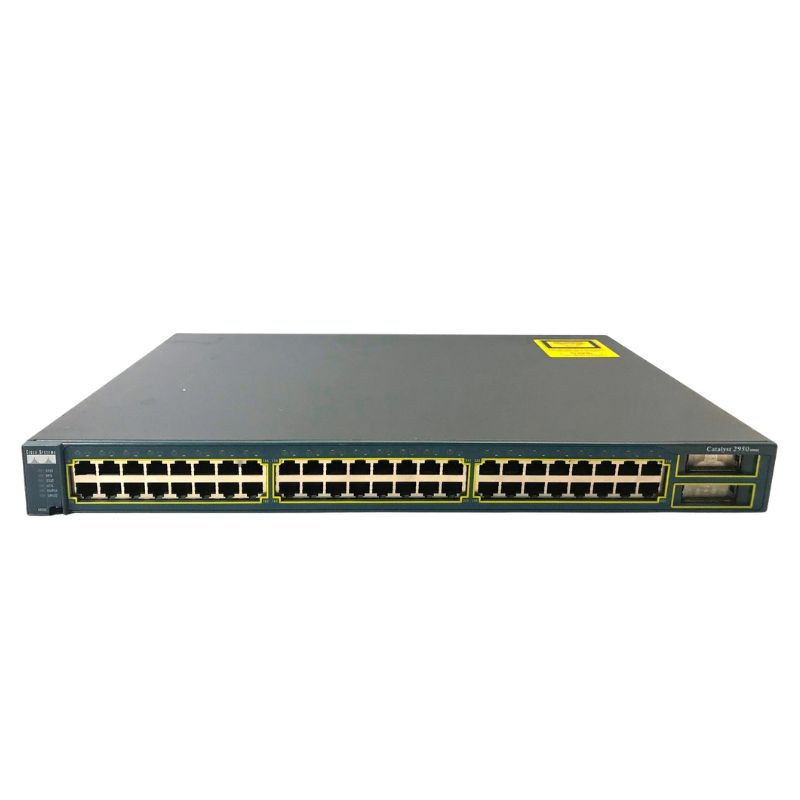


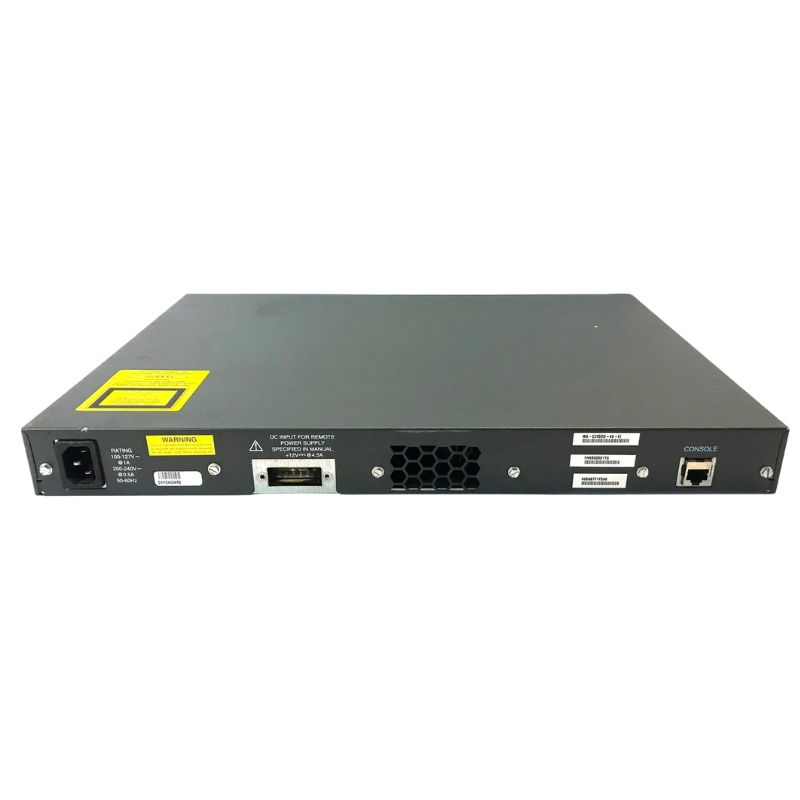
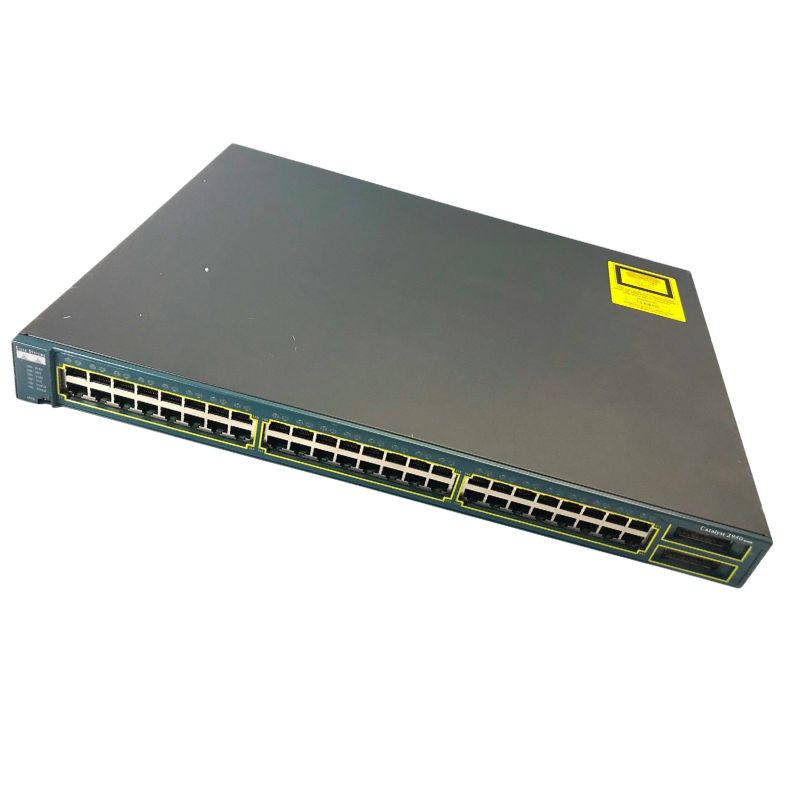
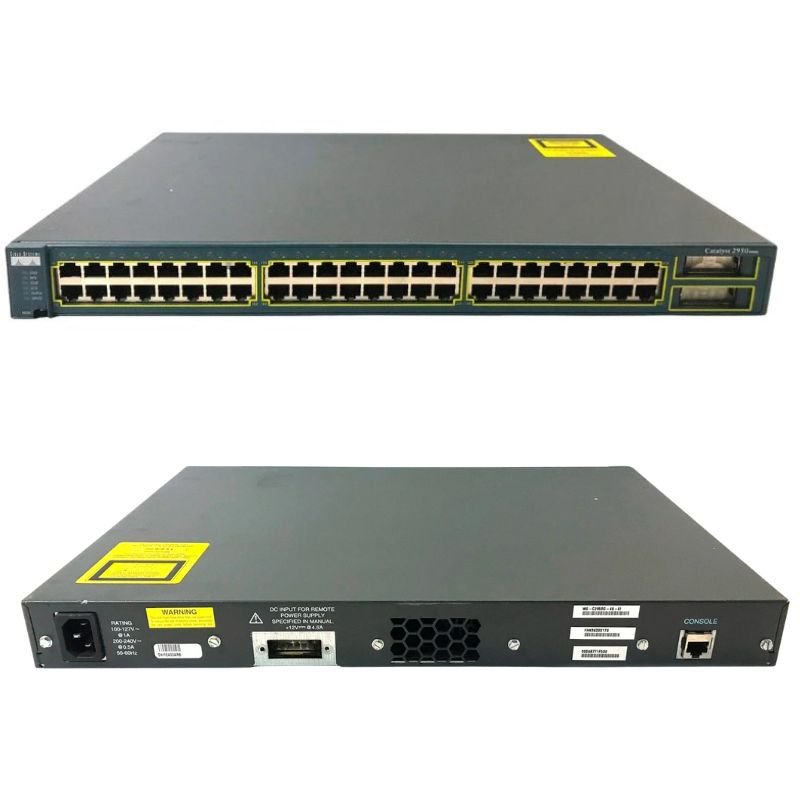
Cisco WS-C2950G-48-EI Catalyst 2950, 48 Ports Switch 10/100 with 2 GBIC. Excellent Refurbished with 1 year replacement warranty
The Cisco WS-C2950G-48-EI Catalyst 2950 is a reliable and high-performance managed network switch designed for enterprise and business environments. It delivers robust Layer 2 switching capabilities with 48 Fast Ethernet ports and additional GBIC uplink flexibility, making it suitable for scalable and secure network infrastructures.
The naming convention of the Cisco Catalyst 2950 series provides clear insight into its capabilities. Decoding the model WS-C2950G-48-EI is key to understanding its role.
The "2950" identifies the series family, renowned for its fixed-configuration, stackable design. The "G" suffix in "2950G" signifies that this model features integrated Gigabit Ethernet uplinks, a critical upgrade from the standard 10/100-only models, providing essential bandwidth headroom for aggregating traffic from the 48 access ports.
The "48" denotes the number of downlink ports: 48 10/100 (Fast Ethernet) ports. This high port density made it an ideal choice for wiring closets, supporting a large number of users, IP phones, or workstations within a single rack unit.
The Cisco WS-C2950G-48-EI was built with a robust hardware design to ensure non-stop operation in business-critical settings.
This model features a high-performance switching fabric capable of forwarding packets at wire speed on all ports simultaneously. With a forwarding bandwidth of up to 13.6 Gbps, it handles intense traffic loads without becoming a bottleneck. The switch employs a store-and-forward switching mechanism, ensuring error-free transmission by checking the entire frame before forwarding.
Each of the 48 RJ-45 ports supports 10BASE-T and 100BASE-TX connections. They feature auto-negotiation and auto-MDI/MDIX, eliminating the need for crossover cables and simplifying installation. These ports are typically used for connecting end-user devices like computers, printers, and early-generation IP phones.
The dual GBIC slots are the defining feature of the "G" series. They provide flexible, modular uplink connectivity to the network core or distribution layer.
1000BASE-SX (WS-G5484): Multi-mode fiber for short-distance connections (up to 550m).
1000BASE-LX/LH (WS-G5486): Single-mode fiber for long-distance connections (up to 10km).
1000BASE-T (WS-G5483): Copper Gigabit Ethernet over Cat 5e/6 for up to 100m.
1000BASE-ZX (WS-G5487): Extended reach single-mode fiber for up to 70km.
This modularity allowed network architects to tailor uplink media and distance to exact site requirements.
The switch is equipped with sufficient DRAM and flash memory to store and run the full Cisco IOS Software feature set, maintain MAC address tables, and support complex access control lists (ACLs) and QoS policies without performance degradation.
While considered a legacy device, the Cisco WS-C2950G-48-EI remains functionally excellent for specific, cost-sensitive applications.
Its primary historical role was in the enterprise wiring closet. It would aggregate traffic from dozens of users and funnel it via high-speed Gigabit fiber uplinks to a distribution switch (like a Catalyst 3550 or 3750), forming a classic hierarchical network design.
This switch is a staple in networking labs. Its full Cisco IOS command-line interface (CLI), support for VLANs, trunking, STP, and EtherChannel provides an authentic platform for learning CCNA and CCNP-level switching concepts without the cost of new hardware.
In controlled industrial settings (e.g., manufacturing floors, warehouses), where environmental factors are managed and network demands are stable, these rugged, proven switches can still reliably connect machinery, sensors, and terminals.
Perfect for creating separate physical networks for security cameras, building management systems, or legacy equipment that requires a reliable, air-gapped Layer 2 network without internet access.
The Enhanced Image (EI) software on the WS-C2950G-48-EI provides a comprehensive toolkit for network control.
The switch runs a dedicated version of Cisco IOS, providing a consistent, command-line driven management experience familiar to network engineers. This allows for scripting, precise configuration, and deep troubleshooting.
Supports 802.1Q trunking and up to 255 VLANs (normal range 1-1005), allowing for logical segmentation of network traffic for security and broadcast control.
Supports IEEE 802.1D (STP), 802.1w (Rapid STP), and 802.1s (Multiple STP), ensuring loop-free Layer 2 topologies with fast convergence times.
Supports IEEE 802.1x for user authentication using a RADIUS server. Combined with port security for MAC address limiting and sticky MAC learning, it provides strong access control at the edge.
Can use ACLs to filter traffic based on MAC addresses (MAC ACLs) or IP addresses (IP ACLs), providing basic firewall capabilities at the switch port level.
The 10/100 access ports lack Power over Ethernet (PoE), precluding them from powering modern IP phones, wireless access points, or cameras. Additionally, modern workstations with Gigabit NICs will be limited to 100 Mbps.
This is a pure Layer 2 switch. It cannot perform inter-VLAN routing (requires a separate router or Layer 3 switch), and it lacks advanced features like DHCP server functionality, dynamic routing protocols, or IPv6 support in hardware.
The switch uses a fixed internal power supply. Its fans, while reliable, can be audible, making it less suitable for ultra-quiet office environments compared to modern, fanless, energy-efficient switches.


 Contact Us
 Information
 Catalog
 Solid State Drives (SSD)
 Network Switches
 Hard Disk Drives
 HBA & Controllers
 PC & Servers
 PC & Server Memory
 CPU & Processors
 Network Routers
 Power Supplies
 Tape Drives & Libraries
 Network Devices
 Computer & Network Cables