
(7% discount is applied at checkout)
Cart is empty
Your go-to destination for cutting-edge server products
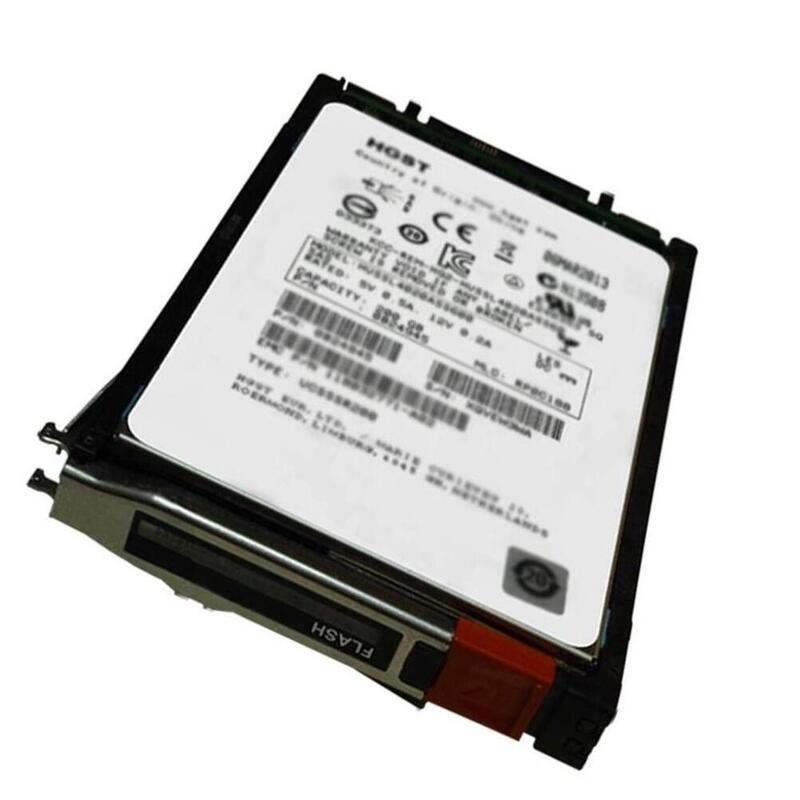
EMC D32S12FX400 400GB SAS-12GBPS Unity Small Form Factor Enterprise Solid State Drive. Excellent Refurbished with 1 year replacement warranty
The EMC D32S12FX400 is a robust 400GB solid-state drive engineered for demanding enterprise environments. Designed with a compact footprint and blazing-fast SAS-12Gbps interface, it delivers exceptional performance and reliability for mission-critical applications.
The EMC D32S12FX400 400GB SAS-12GBPS Unity Small Form Factor Enterprise Solid State Drive belongs to a class of storage components engineered for mission-critical enterprise environments where predictability, availability, and sustained performance matter more than raw headline throughput alone. As a category, Unity-compatible SAS-12Gb/s small form factor SSDs are designed to slot into dense storage arrays and hybrid systems to accelerate latency-sensitive workloads, consolidate mixed-read / mixed-write application stacks, and deliver consistent response under sustained load. This continuous category description explores the capabilities, architectural rationale, deployment patterns, lifecycle considerations, and procurement guidance relevant to buyers, system architects, and operations teams that evaluate the EMC D32S12FX400 and comparable drives for Unity storage platforms and other enterprise SAS ecosystems.
Enterprise SSDs in this category are optimized to serve as high-performance, durable building blocks inside array-level configurations such as Dell EMC Unity. The 400GB capacity point occupies a practical sweet spot: it delivers meaningful usable capacity per drive while keeping rebuild times, garbage-collection windows, and data reduction effectiveness balanced for mixed workloads. Architecturally, SAS-12Gb/s connectivity provides backward and forward compatibility across a wide variety of enterprise backplanes and controllers, enabling these drives to be deployed in hot-plug short-depth trays while benefiting from enterprise-class management features such as power-loss protection and drive-level telemetry. For storage architects planning array topologies, the category is attractive when predictable I/O latency and tight integration with array firmware are higher priorities than chasing the absolute highest sequential throughput available from alternative interfaces.
SAS-12Gb/s technology continues to be a mainstay in many enterprise deployments because it offers a robust combination of reliability features, multipath support, and mature management ecosystems. For Unity and similar midrange-to-enterprise arrays, SAS drives enable straightforward serviceability, hot-swap replacement, and standardized firmware workflows, which streamline operations in data centers where driving down unplanned downtime and simplifying maintenance are top of mind. The EMC D32S12FX400 sits within this context as a purpose-built option for customers who care about sustained IOPS under full queue depth, deterministic latency profiles, and the operational conveniences of SFF hot-pluggable storage devices.
Drives in the EMC D32S12FX400 category are typically validated for a range of workload mixes, including database transaction processing, virtualization, VDI boot storms, and mixed application consolidation. On the Unity platform these drives provide the low-latency, high-random-I/O performance required to improve application response times and increase consolidation ratios. While raw sequential bandwidth is an important metric, the value for enterprise applications is often in consistent random I/O performance, low tail latencies, and the drive’s ability to maintain throughput during steady-state writes and rebuild operations. System designers should focus on how these drives affect array-level behavior—smaller drive capacities can lead to faster resilver times and lower exposure during rebuilds, while still offering a cost-effective density profile compared to larger-capacity options.
Enterprise SSDs are judged not only by average latency but by their tail latency characteristics under load. The EMC D32S12FX400 category is intended to support QoS-aware arrays where consistent 99th-percentile response times are required. In production environments, the benefits of a well-chosen SFF SAS SSD manifest as reduced application stalls and improved user-perceived performance for interactive workloads. For administrators, monitoring metrics such as outstanding commands, queue depth distribution, and firmware-reported health counters is essential to ensuring that the drives continue to meet service-level agreements over their deployed lifetime.
One of the defining aspects of this category is close firmware integration with the array vendor’s management stack. Drives intended for Unity arrays are typically firmware-matched and validated for interoperability, enabling features like predictive failure analytics, seamless firmware roll-ups, and coordinated array-level updates. Certified firmware is crucial not only for stability but also for ensuring that advanced features—such as native drive-level logging, secure erase capabilities, and robust error-handling in the face of power events—work as expected. Purchasing drives that are on the Unity compatibility list helps reduce support friction and simplifies lifecycle management when rolling out firmware or replacing hardware in the field.
Endurance considerations play a central role when selecting an enterprise SSD. The 400GB label denotes a balance between usable capacity and endurance—smaller capacity generally equates to a higher endurance-per-GB ratio compared to very large devices, which can be an advantage in write-heavy environments. For long-term lifecycle planning, teams should factor in the expected workload write rates and apply conservative write amplification and over-provisioning estimates. The category is engineered to support a multi-year service life under enterprise use, but prudent provisioning and monitoring will extend uptime and reduce the probability of field failures. In addition, having clear firmware and replacement policies in the operations playbook will help ensure predictable maintenance windows.
Enterprise deployments frequently require built-in data-at-rest encryption, secure erase capabilities, and audit-friendly lifecycle controls. Drives in this category often support self-encrypting drive (SED) features and vendor-specific secure erase commands that, when combined with array management, help organizations meet regulatory and industry compliance requirements. Integration with key management solutions—either array-native or external KMIP-compliant systems—ensures that encryption can be managed without disrupting business workflows. For security-conscious environments, choosing certified, firmware-vetted drives reduces the compliance burden and simplifies audits related to data sanitization and cryptographic controls.
Hot-pluggable SFF drives dramatically reduce service windows because failed drives can be replaced without shutting down the array. This operational convenience is central to the value proposition for many enterprise teams: it enables rapid remediation, minimizes disruption to applications, and allows technicians to perform in-field replacements guided by the array’s diagnostics. Drive trays, captive screws, and clear indexing mechanisms are small but important usability features that enhance mean time to repair and lower the risk of human errors during maintenance operations.
Deploying 400GB SAS SFF SSDs can take many forms: as cache acceleration layers, as primary performance tiers for databases and virtual machines, or as part of hybrid configurations that combine SAS SSDs with higher-capacity HDDs for capacity-tier storage. For migration scenarios, the drives can be used to seed new arrays, accelerate data rebalancing, or provide temporary burst capacity during application upgrades. Hybrid architectures benefit from drives in this category by enabling tiering policies that funnel hot data to low-latency media while cold data resides on economical disks, producing a balance of performance and cost efficiency.
When assessing alternatives, organizations should weigh SAS-12Gb/s SFF enterprise SSDs against higher-density SATA SSDs, NVMe/U.2 options, and newer architectures depending on workload needs and budget. NVMe drives often present higher throughput and lower protocol overhead for ultra-low-latency applications, while SAS SSDs remain compelling for broad compatibility, simple serviceability, and a mature management ecosystem. The EMC D32S12FX400 category is especially advantageous for customers who value array-certified firmware, predictable maintenance workflows, and tight integration with Unity management features.
Capacity planning should incorporate expected data growth, the impact of snapshot and replication policies, and realistic data reduction estimates. For growth strategies, organizations often scale horizontally by adding drives or vertically by introducing larger-capacity tiers; the 400GB SFF category is particularly suited to horizontal scaling in array chassis that support many drive bays. Planning for predictable growth preserves performance headroom and avoids sudden forklift upgrades, enabling gradual expansion that aligns with budget cycles.


 Contact Us
 Information
 Catalog
 Solid State Drives (SSD)
 Network Switches
 Hard Disk Drives
 HBA & Controllers
 PC & Servers
 PC & Server Memory
 CPU & Processors
 Network Routers
 Power Supplies
 Tape Drives & Libraries
 Network Devices
 Computer & Network Cables