
(7% discount is applied at checkout)
Cart is empty
Your go-to destination for cutting-edge server products
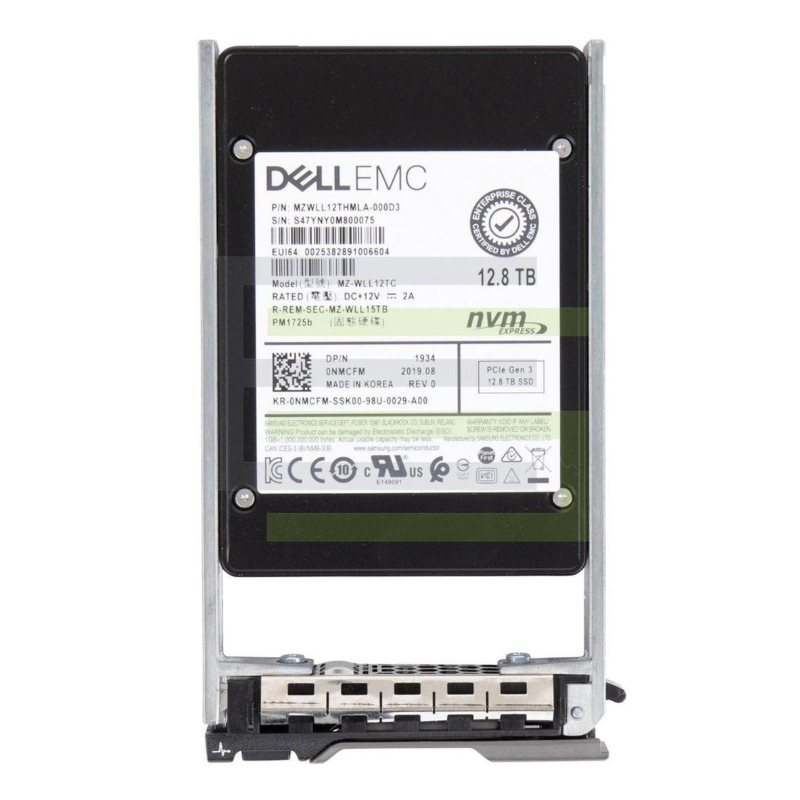
Dell 1VGG0 12.8TB 2.5inch PCI-E 4.0 x8 NVMe Enterprise Internal Solid State Drive. New Sealed in Box (NIB) with 1 year Replacement Warranty
The Dell 1VGG0 is a high-performance 12.8TB 2.5-inch PCIe 4.0 x8 NVMe Enterprise Internal Solid State Drive (SSD), engineered to meet the demanding requirements of enterprise environments. This SSD offers substantial storage capacity and exceptional data transfer speeds, making it ideal for data-intensive applications.
Designed For mission-critical storage in modern data centers, the Dell 1VGG0 12.8TB 2.5inch PCI-E 4.0 x8 NVMe Enterprise Internal Solid State Drive represents a top-tier category of high-capacity, low-latency storage engineered for heavy-duty workloads. Built To deliver large sustained throughput, excellent random I/O performance and predictable latency, this class of enterprise NVMe SSDs is optimized for virtualization, database acceleration, high-performance computing and storage-dense server platforms. Focused On providing an ideal balance between capacity and performance, the 12.8TB capacity point allows system architects to consolidate more hot data per drive bay without sacrificing the speed benefits of NVMe and PCIe Gen4 connectivity.
The 2.5-inch Form factor remains the preferred physical profile for enterprise servers and storage arrays seeking density and interoperability. Leveraging a PCI-E 4.0 x8 NVMe interface, drives in this category exploit double the per-lane bandwidth compared with PCIe Gen3, enabling higher sequential throughput and enabling parallelism across controller channels. Compatibility With common enterprise enclosures and hot-plug bays ensures these SSDs can be integrated into existing fleets while delivering forward-looking performance headroom.
Enterprise NVMe SSDs such as the Dell 1VGG0 rely on advanced controllers that implement host interface translation, NVMe command queuing, low-latency garbage collection, and sophisticated error correction. Paired With high-endurance NAND — often enterprise-grade TLC or QLC with over-provisioning strategies — and tuned firmware, this category is engineered to provide consistent throughput and extended durability for sustained write workloads. Firmware Optimizations commonly include power loss protection, adaptive thermal throttling, and workload-aware garbage collection routines.
Performance Within this category is typically characterized by multi-GB/s sequential read/write numbers and hundreds of thousands to millions of IOPS for 4K random reads and writes under optimized conditions. Latency Profiles are engineered to be sub-millisecond for read operations and consistent under load for mixed I/O patterns, making these SSDs suitable for latency-sensitive applications like databases and real-time analytics.
The high Capacity and low latency of 12.8TB NVMe drives make them natural fits for virtualized environments where many virtual machines contend for I/O. Consolidation Ratios can increase because each drive holds more active disk images while NVMe performance reduces storage bottlenecks. In Hyperconverged Deployments where compute and storage share server nodes, these SSDs reduce storage footprint and simplify cluster topology.
For OLTP, data warehousing and NoSQL databases, the low random latency and high IOPS of this category accelerate transaction throughput and query responsiveness. Many Organizations Deploy a tiered model where NVMe enterprise drives act as hot tiers or write-back caches in front of larger, lower-cost storage tiers, drastically improving application performance without needing to migrate all data to more expensive media.
In AI model training, scientific simulation and big data analytics, the ability to stream large datasets and handle parallel workloads is critical. Enterprise NVMe drives at 12.8TB provide the capacity to store large datasets locally and the throughput to feed GPUs and compute nodes, reducing I/O wait and allowing pipelines to process more data per training epoch.
Enterprise SSDs are rated by Drive Writes Per Day (DWPD) or total terabytes written (TBW) over the warranty period, and drives in this class typically offer higher endurance characteristics suitable for mixed use and write-intensive workloads. Enterprise Buyers Should compare endurance claims against their expected daily write profiles and select the appropriate drive grade to avoid premature wearout.
To Protect stored data, enterprise NVMe SSDs integrate end-to-end data path protection, power loss protection capacitors or firmware mechanisms, and strong ECC to detect and correct bit errors. These capabilities ensure that on-device transient failures do not lead to silent data corruption, a critical requirement for financial, healthcare and compliance-sensitive workloads.
Although a single SSD can be highly reliable, system designers should architect redundancy at a higher level using RAID, erasure coding, or replication. Drives In the 12.8TB NVMe category enable smaller arrays of high-capacity drives to reach target total capacities while maintaining service-level objectives, simplifying rebuild operations and minimizing storage sprawl.
High-capacity NVMe SSDs deliver greater storage density, but they also concentrate power and heat into fewer bays. Power Draw per drive must be factored into rack power budgets, and power-efficient components in this category help to reduce total cost of ownership by lowering both energy consumption and cooling requirements.
Thermal Throttling is a common safeguard in SSDs to preserve longevity; enterprises should expect that sustained maximum throughput may trigger thermally induced performance curves. Many Solutions include thermal pads, heat sinks or server airflow designs to keep drives within optimal operating ranges, preserving both performance and endurance under heavy sequential workloads.
Because the 1VGG0 2.5-inch Form factor and NVMe interface have become standard across modern server platforms, drives in this category are widely compatible with mainstream Dell PowerEdge and other OEM servers. Administrators Should verify BIOS/UEFI and RAID controller firmware support for NVMe devices to ensure correct enumeration, boot capability and optimal performance.
Firmware Management Is critical: updates often deliver performance improvements, bug fixes and security patches. Enterprises Should maintain a disciplined firmware update cadence coordinated with testing in staging environments to avoid unexpected regressions, while using vendor tools to automate and validate updates at scale.
Many Enterprise NVMe SSDs offer built-in AES-256 encryption or similar hardware crypto to protect data at rest without imposing CPU overhead. When Combined with secure key management and support for TCG Opal or enterprise key management solutions, drives in this category help organizations meet regulatory requirements for data protection.
Secure Erase capabilities and validated data sanitization procedures are essential for decommissioning drives that stored sensitive information. Enterprises Should require verifiable erasure mechanisms and certificates where regulations mandate demonstrable destruction or sanitization of stored data prior to disposal or resale.


 Contact Us
 Information
 Catalog
 Solid State Drives (SSD)
 Network Switches
 Hard Disk Drives
 HBA & Controllers
 PC & Servers
 PC & Server Memory
 CPU & Processors
 Network Routers
 Power Supplies
 Tape Drives & Libraries
 Network Devices
 Computer & Network Cables