
(7% discount is applied at checkout)
Cart is empty
Your go-to destination for cutting-edge server products
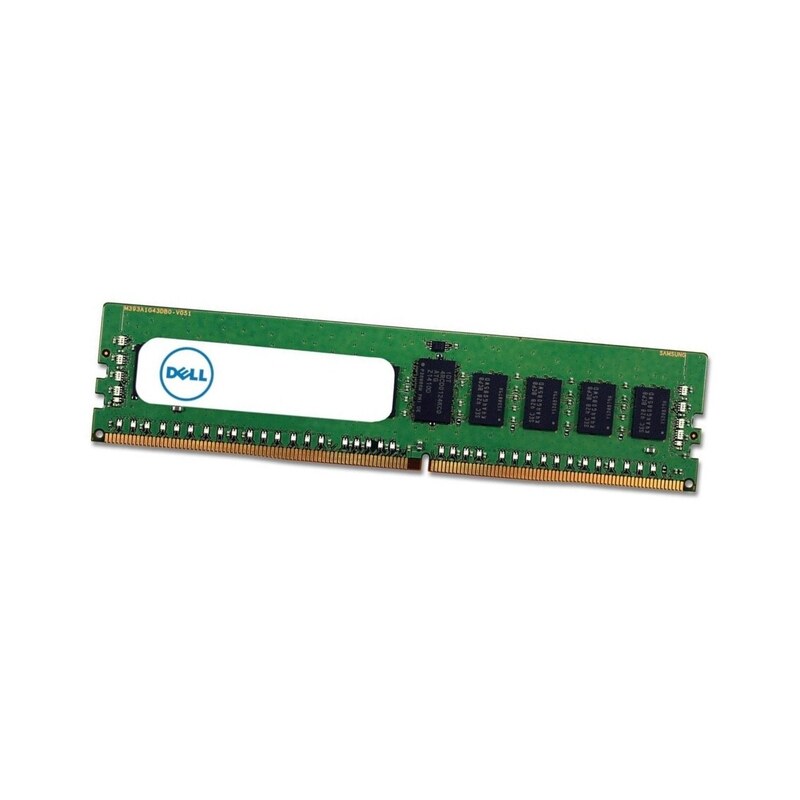
Dell 370-AHJZ 128GB 3200MT/s PC4-25600 CL22 ECC Registered Dual Rank X4 1.2v DDR4 SDRAM 288-Pin RDIMM Memory for Poweredge Server. New (System) Pull with 1-Year Replacement Warranty - Samsung Version
This category focuses on high-density, enterprise-grade DDR4 Registered DIMMs engineered for Dell PowerEdge servers and comparable server platforms that accept RDIMM memory modules. The Dell 370-AHJZ 128GB module is built to deliver industry-standard 3200MT/s throughput under the PC4-25600 specification while providing error-correcting code (ECC) and register buffering for robust data integrity in mission-critical workloads. As an ECC Registered Dual Rank X4 module operating at the JEDEC-standard 1.2V supply and conforming to the 288-pin DIMM form factor, it is designed to combine large capacity, fast data transfer rates, and the resilience required by virtualization, database, analytics, and memory-intensive compute tasks.
The Dell 370-AHJZ module adheres to the PC4-25600 standard, which implies a peak transfer rate of 25,600 MB/s per module when operating at 3200MT/s. This throughput is the combined result of DDR4’s double data rate signaling and the memory’s internal organization. Operating at a CAS latency of 22 (CL22), the module balances access latency with very high sustained bandwidth — a tradeoff commonly accepted in server-class DIMMs where throughput and reliability are more critical than the absolute lowest latency. ECC Registered memory integrates a register between the DRAM chips and the memory controller to reduce electrical load on the memory bus, enabling larger capacities and higher population counts without compromising signal integrity. The Dual Rank configuration means the module presents two independent sets of memory banks to the controller, which can increase overall effective memory capacity and sometimes improve performance through rank interleaving in multi-threaded and multi-channel environments.
ECC (error-correcting code) memory detects and corrects single-bit errors in DRAM contents and detects multi-bit errors, a capability that materially reduces silent data corruption and contributes to predictable uptime in business-critical servers. Registered (RDIMM) modules add a register to buffer command, address, and control signals; this buffering reduces electrical load on the memory controller and allows higher DIMM counts per channel. Together, ECC plus register buffering provide a high-reliability platform for workloads where data correctness and system availability are paramount, such as transactional databases, virtual machine hosts, high-performance computing clusters, and storage controllers in RAID or software-defined storage arrays. The Dell 370-AHJZ 128GB RDIMM is therefore positioned as a solution to meet the dual aims of maximizing available system memory while maintaining enterprise-grade reliability.
Dual Rank describes the logical grouping of memory chips on the module into two ranks that the memory controller can address separately. Rank interleaving, where the controller alternates access between ranks, allows greater effective concurrency in memory access and can reduce perceived latency under multi-threaded loads. The X4 notation refers to the data width of each memory chip — in X4 organization, each chip has a 4-bit data path. Modules built with X4 chips typically use more chips to achieve the same module width as X8 devices, but they also provide advantageous error-handling characteristics and are often used in high-density RDIMM designs. For server engineers, the Dual Rank X4 combination on a 128GB module means the module attains high capacity using multiple DRAM die while remaining compatible with server controllers that support RDIMM dual-rank modules and JEDEC-standard X4 configurations.
Performance on a memory module is measured by several interrelated metrics: frequency (here 3200MT/s), latency (CL22 in this case), capacity (128GB), and the presence of ECC and registration. In sustained throughput scenarios — heavy dataset streaming, large in-memory caches, page cache usage for database engines, or memory-bound simulation jobs — the 3200MT/s rating provides a strong baseline for both single-module and multi-module configurations. Although CAS latency is higher than low-latency DIMMs used in some performance-sensitive desktop scenarios, server workloads typically benefit more from aggregate bandwidth and capacity than minimal CAS values. Virtualized environments that host dozens or hundreds of small VMs can leverage the 128GB capacity per DIMM to reduce memory overcommit and swap, improving application response times. For in-memory databases and large-scale caching layers, increased capacity often yields outsized performance returns because it reduces disk I/O and allows larger working sets to stay resident in RAM.
Server motherboards organize memory into multiple channels, each of which can accept one or more DIMMs. The Dell 370-AHJZ module’s registered design enables higher DIMM population across those channels without overwhelming the memory controller. When scaling to four, six, or eight DIMMs per CPU socket, the use of RDIMMs permits manufacturers to provide higher total memory capacities per socket compared to unbuffered or non-registered alternatives. The Dual Rank structure can influence whether a server operates in single-rank or dual-rank mode depending on population, but either way, effective memory throughput benefits from multi-channel, multi-rank configurations.
CL22 at 3200MT/s represents a latency-bandwidth tradeoff chosen for stability and high-density operation; the absolute CAS latency in nanoseconds is a function of both clock speed and CAS cycles. In enterprise software stacks where I/O waits, cache misses, and storage latency dominate, the higher capacity and bandwidth often outweigh small differences in CAS cycles. Systems running large-scale virtualization, distributed databases, analytics engines, or containerized microservices typically experience more meaningful performance uplift from increased RAM capacity and reduced page swapping than from marginal improvements in CAS latency. When optimizing, administrators should profile the workload to determine whether their bottleneck is memory capacity, memory bandwidth, CPU, or storage latency, and invest accordingly.
Although this category centers on a Dell-labeled RDIMM for PowerEdge servers, compatibility is ultimately determined by the server’s BIOS/firmware and memory controller capabilities. Dell PowerEdge platforms are engineered to work with pre-qualified memory SKUs validated through manufacturers’ compatibility lists and firmware testing. Many server BIOSes will auto-negotiate DIMM speeds based on population and controller limits; for example, a fully populated set of high-capacity DIMMs may cause the controller to operate at a lower speed to preserve signal integrity.
Every RDIMM contains an SPD (Serial Presence Detect) profile that describes the module’s timings, speeds, and voltage parameters. Modern server BIOS options allow administrators to select default JEDEC speeds or to apply XMP-like profiles when supported; however, server environments typically rely on JEDEC-standard settings for predictability.
Enterprise memory undergoes a stricter testing regimen than commodity consumer modules. Burn-in testing, temperature cycling, JEDEC compliance tests, ECC validation, and compatibility testing on target server platforms are standard quality control steps for RDIMM memory in this category. The presence of ECC and registered logic is itself a design decision intended to reduce fault rates in multi-year deployments.
High-capacity RDIMMs can generate more heat than lower-capacity consumer modules, particularly under sustained high-bandwidth loads. The Dell 370-AHJZ RDIMM uses standard server-grade components and thermal profiles, but proper chassis airflow, rack cooling, and adherence to recommended operating temperatures are essential. Physically, the 288-pin RDIMM form factor is standardized, but clearance around CPU coolers, heatsinks, and adjacent components should be checked, especially in high-density rack deployments where space is at a premium.
This class of module is optimized for workloads that need large memory footprints combined with dependable error correction and server-grade stability. Key use cases include virtual machine dense hosts where guest memory allocation is the primary driver of capacity planning; in-memory databases and caching layers that benefit from larger working sets remaining resident in RAM; analytics platforms performing large-scale dataset processing in memory; and HPC workloads where per-node memory capacity can accelerate data-parallel computations. Storage controllers and software-defined storage nodes also benefit from RDIMM ECC when they act as metadata caches or buffer large I/O queues.
When evaluating the Dell 370-AHJZ 128GB RDIMM against alternatives, buyers should weigh capacity-per-DIMM, module rank and chip organization, supported speeds, vendor qualification for the target server platform, and cost-per-GB. Alternatives may include RDIMMs with different data widths (X8), different rank configurations (single vs dual vs quad rank), or different JEDEC speed tiers (e.g., 2933MT/s vs 3200MT/s). There are also LRDIMM (Load-Reduced DIMM) options that use an advanced buffer to further increase capacity and lower electrical load at the cost of a different performance and power profile. Choice among these options depends on the server’s maximum supported DIMM type, the desired total capacity per socket, acceptable latencies, and budget constraints. For many PowerEdge deployments, validated RDIMMs strike the best balance of cost, performance, and compatibility.


 Contact Us
 Information
 Catalog
 Solid State Drives (SSD)
 Network Switches
 Hard Disk Drives
 HBA & Controllers
 PC & Servers
 PC & Server Memory
 CPU & Processors
 Network Routers
 Power Supplies
 Tape Drives & Libraries
 Network Devices
 Computer & Network Cables