
(7% discount is applied at checkout)
Cart is empty
Your go-to destination for cutting-edge server products
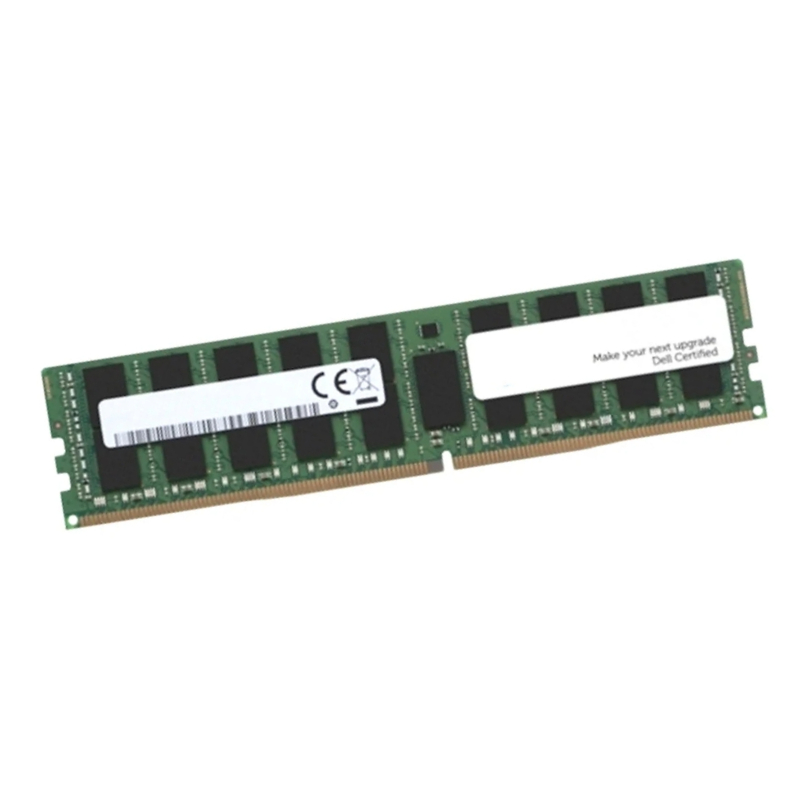
Dell 370-BCDG 128GB DDR5-4800MHz RDIMM ECC Registered SDRAM 288-Pin Server Module Memory. New Sealed in Box (NIB) - Samsung Version
| SKU/MPN | Warranty | Price | Condition | You save |
|---|---|---|---|---|
| 370-BCDG | 1 Year Warranty | $4,185.00 | New (System) Pull | You save: $1,464.75 (26%) |
| 370-BCDG | 1 Year Warranty | $7,584.00 | New Sealed in Box (NIB) | You save: $2,654.40 (26%) |
The Dell 370-BCDG 128GB DDR5 memory solution (8×16GB modules) is tailored for enterprise-grade servers, delivering robust features like ECC fault correction and buffered signal architecture to ensure peak reliability. Designed for intensive computing tasks, it runs at a blazing speed of 4800MHz, enabling swift data throughput and optimized processing efficiency.
DDR5 server memory represents a significant leap forward in memory technology, offering substantial improvements over previous DDR4 generations. The Dell 370-BCDG module operates at 4800MT/s (Mega Transfers per second), providing increased bandwidth that directly translates to faster data processing and improved system responsiveness. This enhanced speed is particularly crucial in server environments where rapid data access and transfer are essential for optimal performance across virtualized environments, database operations, and high-performance computing applications.
The fundamental architecture of DDR5 introduces several key innovations that distinguish it from earlier memory technologies. Unlike DDR4, DDR5 incorporates onboard power management through the Power Management IC (PMIC), which enables more stable voltage regulation and improved power efficiency. This distributed power architecture reduces signal noise and provides better power delivery to the memory chips, resulting in enhanced reliability and performance consistency under heavy server workloads.
The Error Correction Code (ECC) functionality embedded in the Dell 370-BCDG memory module provides critical data integrity protection for enterprise server environments. ECC technology detects and corrects single-bit memory errors in real-time, preventing data corruption that could lead to system crashes, computational errors, or data loss. This capability is especially vital in mission-critical applications where data accuracy is non-negotiable, such as financial transactions, medical record systems, and scientific computations.
Registered DDR5 modules, also known as Registered DIMMs (RDIMMs), incorporate a register between the memory controller and the DRAM chips. This register buffers the command and address signals, reducing the electrical load on the memory controller and enabling support for higher memory capacities per channel. The Dell 370-BCDG utilizes this technology to maintain signal integrity across large memory configurations, ensuring stable operation even in fully populated server memory configurations.
The Dell 370-BCDG memory module adheres to the standard 288-pin DDR5 RDIMM form factor, ensuring mechanical compatibility with Dell PowerEdge servers and other compatible server platforms designed for DDR5 technology. The physical dimensions conform to JEDEC standards, with a total module height optimized for proper clearance within server chassis and compatibility with various CPU cooling solutions. The module's construction incorporates high-quality PCB materials with optimized trace routing for signal integrity preservation at high operating frequencies.
Operating at 1.1 volts, the Dell 370-BCDG demonstrates significant power efficiency improvements compared to DDR4 modules, which typically operate at 1.2 volts. This reduced operating voltage contributes to lower overall power consumption in data center environments, where energy efficiency directly impacts operational costs. The integrated PMIC efficiently manages power distribution to various components on the module, providing stable voltage rails while minimizing power losses and heat generation.
The Dell 370-BCDG operates at CL40 (CAS Latency 40) timing, which represents the number of clock cycles between a read command and data availability. While DDR5 typically exhibits higher CAS latencies than DDR4 due to its increased operating frequencies, the overall latency in nanoseconds is often comparable or improved. The balanced combination of 4800MHz frequency and CL40 timing provides optimal performance for server workloads that benefit from both high bandwidth and responsive memory access.
The PC5-38400 designation indicates the module's peak transfer rate of 38,400 MB/s (megabytes per second). This calculation derives from the base data rate of 4800MT/s, multiplied by 8 bytes (64-bit data width), resulting in 38,400 MB/s of theoretical bandwidth per module. In practical server applications, this substantial bandwidth enables faster data processing for memory-intensive operations, including in-memory databases, virtualization, and scientific simulations.
When configured properly across multiple channels, the Dell 370-BCDG modules enable memory interleaving, a technique that spreads memory accesses across physical modules to increase effective bandwidth. This configuration allows simultaneous access to multiple modules, significantly improving performance for sequential memory access patterns common in server applications. The 8-module bundle is particularly well-suited for creating optimized interleaved configurations in dual-processor server platforms.
After installation, proper memory recognition should be verified through the server BIOS/UEFI interface and operating system utilities. The total memory capacity should reflect the combined 128GB from all eight modules, with the system reporting the correct speed and module type. Most modern server operating systems automatically detect and configure themselves to utilize the available memory capacity without additional configuration, though specific applications may benefit from manual memory tuning.
In virtualized environments, the Dell 370-BCDG 128GB bundle enables higher virtual machine density by providing substantial memory resources for multiple concurrent guest operating systems. The 4800MHz operating frequency ensures responsive performance across virtual machines, while the ECC protection maintains data integrity critical for production workloads. The registered architecture supports the sustained memory access patterns typical of virtualized infrastructure, where multiple VMs simultaneously access memory resources.
Modern database systems increasingly leverage in-memory processing for improved performance, requiring large, fast memory configurations. The Dell 370-BCDG bundle's 128GB capacity can accommodate substantial database working sets in memory, reducing disk I/O and improving query response times. The DDR5 4800MHz bandwidth ensures rapid data access for complex joins, sorts, and aggregations, while ECC protection safeguards against data corruption in critical database records.
Computationally intensive applications in scientific research, engineering analysis, and financial modeling benefit significantly from the Dell 370-BCDG memory characteristics. The high bandwidth facilitates rapid data movement between processors and memory, reducing computation time for large datasets. ECC protection is particularly valuable in these applications, where computational accuracy is critical and undetected memory errors could compromise results.
Big data platforms such as Apache Spark often perform in-memory processing to accelerate analytical queries and machine learning algorithms. The 128GB capacity provided by the Dell 370-BCDG bundle enables larger datasets to be processed in memory, reducing disk-based operations that typically bottleneck performance. The DDR5 bandwidth supports the parallel processing nature of these frameworks, where multiple nodes simultaneously access memory resources.
Beyond basic single-bit error correction, the ECC implementation in DDR5 RDIMMs like the Dell 370-BCDG provides enhanced error detection capabilities. The technology can detect multi-bit errors within the same DRAM device while correcting single-bit errors, providing an additional layer of data protection. This advanced error handling helps prevent uncorrectable errors that could lead to system crashes or data corruption in critical server applications.
Server platforms utilizing the Dell 370-BCDG memory typically implement patrol scrubbing, a background process that systematically reads memory locations to detect and correct errors before they can accumulate. This proactive approach, combined with comprehensive error logging, allows system administrators to identify potentially failing modules through correctable error rate analysis. The logged error information assists in predictive maintenance and timely replacement of components before catastrophic failures occur.
The Dell 370-BCDG memory module is engineered for compatibility with specific Dell PowerEdge server generations designed for DDR5 technology. Compatibility spans multiple server models within supported generations, including rackmount, tower, and modular infrastructure platforms. The modules undergo rigorous testing and validation within Dell's qualification process to ensure reliable operation across the supported server portfolio, with firmware optimizations specifically tuned for Dell system architectures.
While the Dell 370-BCDG offers theoretical bandwidth of 38,400 MB/s per module, practical achievable bandwidth depends on numerous factors including processor architecture, memory configuration, and workload characteristics. Real-world performance typically reaches 70-85% of theoretical maximums due to memory controller overhead, access patterns, and system architecture constraints. Nevertheless, the 4800MHz operating frequency represents a substantial improvement over previous-generation memory technologies in actual server deployments.
Different server applications exhibit varying sensitivity to memory bandwidth and latency. Memory-intensive applications such as in-memory databases, scientific simulations, and video processing typically show significant performance improvements with DDR5 4800MHz memory compared to lower-speed alternatives. Less memory-intensive workloads may demonstrate more modest gains, though the increased bandwidth still contributes to overall system responsiveness and ability to handle concurrent operations.
The Dell 370-BCDG operates at 1.1V, representing approximately 8% reduction in operating voltage compared to standard DDR4 memory. This voltage reduction, combined with architectural efficiency improvements, translates to better performance per watt in memory-intensive operations. In large-scale data center deployments, these efficiency gains accumulate significantly, reducing power consumption and associated cooling requirements while maintaining or improving computational throughput.
DDR5 technology incorporates enhanced power management states that allow the Dell 370-BCDG modules to reduce power consumption during periods of low memory utilization. These states are managed automatically by the memory controller in coordination with operating system power management policies. The granular power control enables efficient operation across varying workload intensities, contributing to overall server power efficiency without compromising performance when memory resources are required.


 Contact Us
 Information
 Catalog
 Solid State Drives (SSD)
 Network Switches
 Hard Disk Drives
 HBA & Controllers
 PC & Servers
 PC & Server Memory
 CPU & Processors
 Network Routers
 Power Supplies
 Tape Drives & Libraries
 Network Devices
 Computer & Network Cables