
(7% discount is applied at checkout)
Cart is empty
Your go-to destination for cutting-edge server products
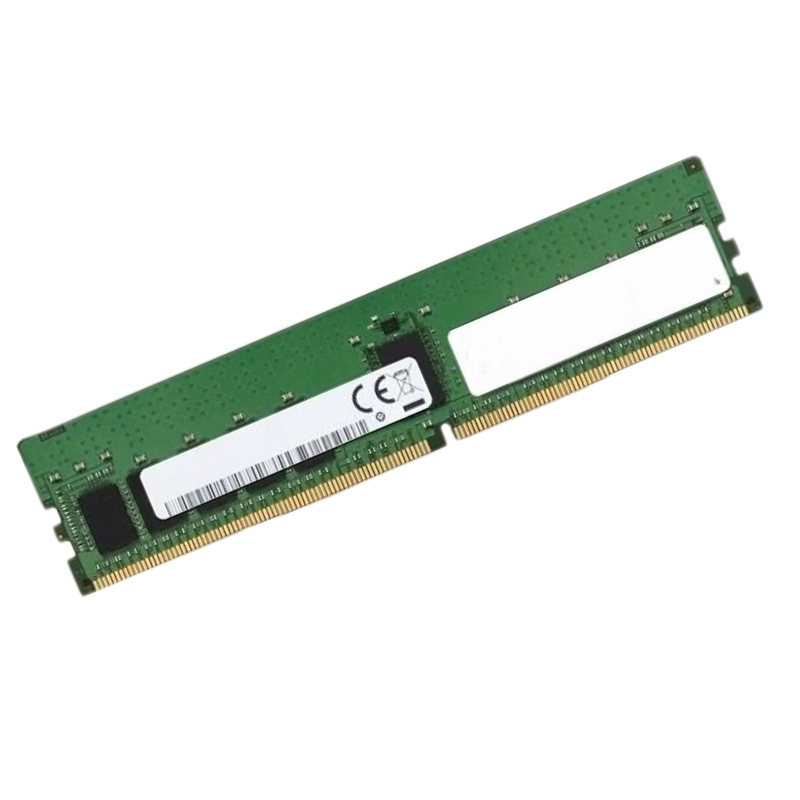
Dell 370-BCRR 32GB 4800MHz Pc5-38400 Ecc Registered 1.1v Cl40 DDR5 SDRAM 288-pin RDIMM Memory Module For Server. New Sealed in Box (NIB) - Samsung Version
| SKU/MPN | Warranty | Price | Condition | You save |
|---|---|---|---|---|
| 370-BCRR | 1 Year Warranty | $1,147.00 | New (System) Pull | You save: $401.45 (26%) |
| 370-BCRR | 1 Year Warranty | $1,425.00 | New Sealed in Box (NIB) | You save: $498.75 (26%) |
Upgrade your server's reliability and throughput with the Dell 370-BCRR memory module — a 32GB DDR5 RDIMM engineered for enterprise-class systems. Ideal for data centers, virtualization hosts, and mission-critical applications, this registered, error-correcting memory combines high speed with robust data integrity.
This RDIMM uses DDR5 architecture for increased bandwidth and improved power efficiency. Registered signaling reduces electrical load on the memory controller, enabling more modules per channel for scalable configurations.
Designed for enterprise environments, the module supports ECC to detect and correct memory errors in real time, minimizing downtime and data corruption risks.
The module fits standard 288-pin RDIMM slots used in many Dell server platforms and compatible OEM motherboards that accept DDR5 RDIMM modules.
The Dell 370-BCRR represents a significant leap forward in server memory technology, embodying the cutting-edge performance and reliability demanded by contemporary enterprise environments, cloud computing infrastructure, and high-performance computing (HPC) applications. As a 32GB DDR5 module operating at 4800MHz, it is engineered specifically for servers requiring uncompromising data integrity and massive throughput.
The transition from DDR4 to DDR5 is not merely an incremental speed boost; it's a fundamental architectural shift. The Dell 370-BCRR leverages this new standard to deliver profound improvements in bandwidth, power efficiency, and scalability, establishing a new foundation for data-intensive workloads.
DDR5 introduces several core innovations that differentiate it from previous generations. Unlike DDR4, which featured a single 64-bit data channel per module, DDR5 splits this into two independent 32-bit data channels. This change, known as "Dual Sub-Channels," allows for more efficient data handling and reduces latency by enabling concurrent operations. Furthermore, the Power Management IC (PMIC) is now integrated directly onto the memory module. This decentralizes power delivery, providing more stable and cleaner power, which is crucial for the stability of high-density server configurations.
The designation "PC5-38400" is a module classification that directly relates to its bandwidth. The "PC5" prefix indicates it is a DDR5 module. The number "38400" refers to the module's theoretical peak transfer rate in megabytes per second (MB/s). Calculating this: 4800 MT/s (MegaTransfers per second) x 8 bytes (width of a 64-bit channel) = 38,400 MB/s. This immense bandwidth is essential for handling the parallel data streams found in virtualization, large-scale databases, and AI processing.
For any mission-critical system, data integrity is non-negotiable. The Dell 370-BCRR incorporates two key technologies to ensure this: Error Correcting Code (ECC) and Registered (or Buffered) architecture. These features are what fundamentally separate server-grade memory from standard consumer RAM.
ECC is a sophisticated algorithm that detects and corrects the most common types of data corruption in real-time. Cosmic rays, electrical interference, and other factors can cause single-bit "soft errors" in memory cells. While rare for a single module, in a data center with thousands of modules running 24/7, these errors become a statistical certainty. ECC can automatically identify and fix single-bit errors, and can typically detect (though not correct) multi-bit errors, alerting the system administrator before data corruption leads to application crashes, computational errors, or corrupted databases.
Registered (RDIMM) memory includes a register, or buffer, situated between the server's memory controller and the DRAM chips. This register's primary function is to buffer the command and address signals, reducing the electrical load on the memory controller.
In a server, a memory controller may need to drive dozens of DRAM chips across multiple memory modules. Without a buffer, this electrical load can be immense, leading to signal degradation and timing issues, which limits the number of modules that can be reliably installed per channel. The register in an RDIMM absorbs this load, allowing the memory controller to see only a single electrical load per module. This enables servers to support much higher total memory capacities and more DIMMs per channel (often 2 DPC) while maintaining signal integrity and stable operation at high speeds. The trade-off is a one-clock-cycle latency penalty, which is vastly outweighed by the benefits of capacity and stability in a server context.
It's crucial to distinguish ECC RDIMMs from other memory types. Unbuffered (UDIMM) memory lacks a register and is typically used in desktops and workstations; it offers lower latency but severely limits capacity and scalability. Load-Reduced DIMMs (LRDIMMs) take buffering a step further by also buffering the data lines, allowing for even greater capacities but at a higher cost and latency. The Dell 370-BCRR ECC RDIMM strikes the ideal balance for the majority of enterprise servers, offering high capacity, excellent performance, and robust data integrity.
CAS Latency (CL) is the most prominent of several timing parameters that describe the delay between various memory operations. A CL40 rating means it takes 40 clock cycles of the 4800MHz clock to access the first bit of data from a column after a row has been opened. While a lower CL is generally better, it's critical to view it in the context of the clock speed. The actual time in nanoseconds (ns) is a more accurate measure. For DDR5-4800 CL40, the absolute latency is calculated as (40 / 2,400,000,000 Hz) * 2 ≈ 16.67 nanoseconds, which is competitive with or better than higher-clocked DDR4 modules with lower CL numbers when the full data burst is considered.
The 1.1V operating voltage of the Dell 370-BCRR is a key contributor to the DDR5 standard's improved power efficiency. Compared to DDR4's 1.2V, this represents an 8.3% reduction in voltage. Since power consumption in semiconductors is proportional to the square of the voltage (P ∝ V²), this reduction leads to significant power savings at scale. In a large server rack with hundreds of memory modules, this efficiency translates directly into lower electricity costs and reduced heat dissipation, easing the burden on cooling systems.
The high bandwidth and reliability of the Dell 370-BCRR make it exceptionally well-suited for a wide range of demanding enterprise and data center applications.
In virtualized environments, such as those using VMware vSphere or Microsoft Hyper-V, physical memory is a critical resource shared among multiple virtual machines (VMs). High memory bandwidth ensures that VMs can access data quickly, reducing "I/O wait" times and improving overall guest OS performance. The large 32GB capacity per module allows administrators to consolidate more VMs onto a single physical host, maximizing hardware utilization and ROI.
Platforms like SAP HANA, Oracle Database In-Memory, and Redis store entire datasets in RAM to eliminate disk I/O bottlenecks. For these applications, both the total memory capacity and the speed of access are paramount. The 38,400 MB/s bandwidth of the Dell 370-BCRR enables faster query processing, real-time analytics, and quicker transaction times, allowing businesses to derive insights from their data almost instantaneously.
AI and ML training workloads involve processing enormous matrices of data. The model's parameters and the training data are often staged in system memory before being shuttled to GPUs or other accelerators. Faster memory bandwidth, as provided by DDR5, reduces the time spent in this data preparation and transfer phase, accelerating the overall training cycle and enabling data scientists to iterate on models more rapidly.
HPC applications in fields like computational fluid dynamics, financial modeling, and genomic sequencing perform complex calculations on massive datasets. These workloads are often memory-bound, meaning their performance is limited by the speed at which the CPU can access memory. The Dell 370-BCRR, when installed in multi-channel configurations, provides the sustained high bandwidth necessary to feed multiple CPU cores simultaneously, minimizing idle time and speeding up time-to-solution.


 Contact Us
 Information
 Catalog
 Solid State Drives (SSD)
 Network Switches
 Hard Disk Drives
 HBA & Controllers
 PC & Servers
 PC & Server Memory
 CPU & Processors
 Network Routers
 Power Supplies
 Tape Drives & Libraries
 Network Devices
 Computer & Network Cables