(7% discount is applied at checkout)
Cart is empty
Your go-to destination for cutting-edge server products


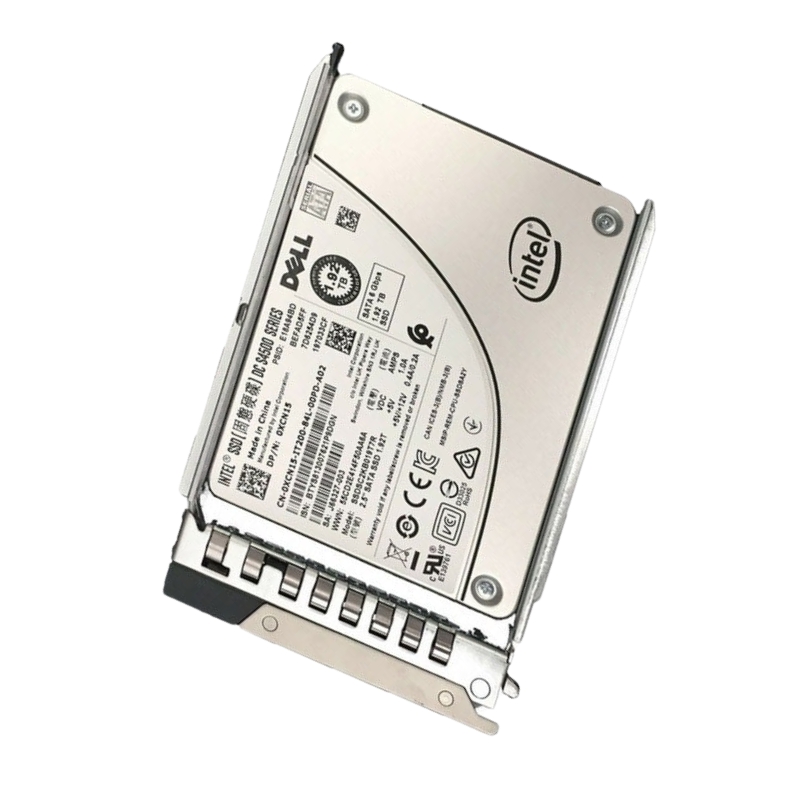
Dell 400-APUW 1.92TB Read Intensive TLC SATA 6GBPS 2.5 Inch Hot Plug SSD. New Sealed in Box (NIB) with 1 Year Warranty
The Dell 400-APUW 1.92TB Read Intensive TLC SATA-6GBPS 2.5inch Hot Swap Solid State Drive for PowerEdge Server is designed to address a very specific class of enterprise workloads that demand high read throughput, predictable latency, and efficient density in standard 2.5-inch drive bays. Engineered to integrate seamlessly with Dell PowerEdge platforms, this model brings together contemporary NAND flash characteristics with enterprise-grade firmware optimizations to prioritize read-centric performance while balancing cost-per-gigabyte through Triple-Level Cell (TLC) NAND. Its SATA-6GB/s interface ensures backward-compatible connectivity to a broad range of RAID controllers, host bus adapters, and server backplanes that remain standard in many datacenter deployments. The hot-swap capability supports operational continuity in production environments, enabling fast replacement without powering down systems—critical for maintaining high availability across clustered applications, virtualization hosts, and scale-out storage nodes.
The 2.5-inch form factor is an industry staple for dense server configurations, allowing server designers to pack more usable capacity into chassis optimized for compute and memory. Because this drive conforms to the standard caddy dimensions of PowerEdge servers, it can be installed into drive sleds and trays supplied by Dell without requiring adaptation. The SATA 6 Gb/s signaling maintains wide compatibility with legacy and modern controllers, but when planning an upgrade or integration, it is essential to verify that the host supports the drive’s power and thermal envelopes. Compatibility is optimized for PowerEdge series models whose backplanes and firmware expect Dell-qualified components; using drives from the manufacturer’s validated parts list often yields better management interoperability, such as drive health reporting within iDRAC and lifecycle firmware update frameworks. For multi-drive arrays, the drive’s behavior under sustained reads and varying queue depths should be considered when matching it with controllers and caching tiers.
Read-Intensive SSDs like the Dell 400-APUW prioritize consistent read operations over mixed or write-heavy performance. This means random and sequential read latency and throughput are tuned to minimize stalls and reduce tail latencies for read-bound services. Typical use cases include large-scale content delivery, object and file serving, database read replicas, analytics query caches, boot and image servers, and virtualization workloads where the working set is highly read-dominant. TLC NAND is leveraged in a way that enhances storage density while maintaining acceptable endurance for read-heavy patterns; firmware strategies such as read caching, intelligent wear-leveling, and over-provisioning are calibrated to favor read predictability. In deployments where reads vastly outnumber writes, drive lifetimes are extended and TCO is optimized compared to general-purpose or write-intensive SSDs.
Enterprise administrators evaluate SSDs not only on peak MB/s numbers but also on how consistently the drive responds across varying queue depths and concurrent workloads. The Dell 400-APUW is tuned to keep latency low across the queue depths typical of virtual machine density per host and high-concurrency read requests coming from clustered services. In real-world benchmarking scenarios, drives of this category demonstrate steady sequential reads at near the limits of SATA-6Gb/s throughput while preserving acceptable random read IOPS at common queue depths. For architects, this means predictable performance for layers that serve large volumes of read requests; for caching tiers fronting slower disk-based tiers, a read-optimized SSD reduces latency spikes and delivers a smoother application experience.
Triple-Level Cell NAND stores three bits per cell, enabling higher capacity density and better cost efficiency. In a read-intensive SKU, the firmware and over-provisioning are configured so that endurance characteristics match the expected write profiles of read-heavy workloads. Enterprise reliability features such as dynamic wear leveling, error correction algorithms, and bad-block management are crucial because they operate behind the scenes to preserve data integrity and extend usable life. While TLC has lower raw program/erase cycles compared to SLC or MLC, the drive’s architecture mitigates this with aggressive internal management and reserved flash capacity. Administrators planning long-term deployments should factor in write amplification and provisioning strategies to align the drive’s endurance with their expected write volume, and implement monitoring for SMART metrics and telemetry to detect trends before they impact operations.
Maintaining data integrity requires a blend of hardware capabilities and firmware intelligence. Error Correction Code (ECC) layers correct transient bit errors, while background scrubbing and read-retry algorithms handle marginal cells as they age. The drive’s firmware also maintains mapping tables and spare block pools to replace worn-out blocks, preserving logical-to-physical mapping without exposing wear artifacts to the host. For enterprise environments that demand stringent integrity guarantees, these mechanisms provide predictable outcomes even as the drive cycles through heavier read workloads. Additionally, drives qualified by Dell for PowerEdge systems can present health information through platform management tools, enabling centralized visibility and proactive replacements as part of preventive maintenance practices.
Hot-swap capability is a fundamental design characteristic for enterprise storage components where uptime is paramount. The Dell 400-APUW’s hot-swap design supports ergonomic drive extraction and insertion, rapid field replacement, and compatibility with standard server sleds. This means that technicians can replace failed or aged drives without powering down the server, avoiding scheduled downtime for mission-critical applications. Server orchestration frameworks and monitoring systems can orchestrate data rebalancing or rebuild operations automatically once a replacement is inserted. Serviceability also extends to firmware updates and secure erase operations. Administrators should ensure drives are labeled and tracked within the inventory system and that replacement policies reflect availability of identical or compatible replacement parts to preserve RAID resiliency and predictable rebuild times.
In many datacenters, read-optimized SSDs are deployed as part of hybrid storage architectures where they pair with HDD tiers or faster write-tier solutions. The Dell 400-APUW can serve as an ideal read cache for spinning-disk arrays, absorb read requests for hot datasets, or host read replicas for distributed databases. When integrated into RAID arrays, the drive’s consistent read performance helps maintain predictable rebuild times and avoids affecting service levels during resilvering activities. Architects should evaluate RAID levels and controller cache options to avoid write amplification on the SSD tier; for example, combining SSD read tiers with write-back caching on controllers that have battery or capacitor-backed units helps ensure write safety without unduly stressing the TLC flash. Tiering policies can be crafted so that frequently-read objects reside on the SSD layer while colder data resides on higher-capacity HDDs, balancing cost and performance across the storage estate.
The Dell 400-APUW 1.92TB model excels where read operations dominate and where a balance between capacity and cost is a priority. Typical deployment patterns include acting as a read cache layer for content distribution networks, hosting deduplication and backup indexes where searches are frequent, serving virtual machine disk images in VDI farms where many sessions boot from the same images, and supporting analytics clusters where data nodes are read-intensive. The drive can also be part of scale-out object stores where frequent GET requests are the primary workload. Because of its hot-swap capability and standardized interface, it is straightforward to integrate these drives into expansion plans as the dataset grows, replacing or augmenting drives without complex reconfiguration of host systems.
Enterprises commonly evaluate storage options across a spectrum that includes low-cost NL-SAS HDDs, mixed-use SSDs, write-intensive SSDs, and high-endurance SLC/MLC alternatives. The read-intensive TLC SATA model is positioned to deliver the best cost efficiency for read-heavy workloads, allowing organizations to stretch budget allocations while still achieving meaningful performance gains over spinning disks. When compared to NVMe or SAS SSDs, SATA-based drives may not reach the absolute peak throughput or IOPS, but they offer an attractive value proposition in environments that retain SATA backplanes or where the existing infrastructure does not justify a wholesale move to NVMe. Cost-per-GB and density considerations often make these drives the economical choice for broad read-acceleration strategies across large clusters.


 Contact Us
 Information
 Catalog
 Solid State Drives (SSD)
 Network Switches
 Hard Disk Drives
 HBA & Controllers
 PC & Servers
 PC & Server Memory
 CPU & Processors
 Network Routers
 Power Supplies
 Tape Drives & Libraries
 Network Devices
 Computer & Network Cables