
(7% discount is applied at checkout)
Cart is empty
Your go-to destination for cutting-edge server products
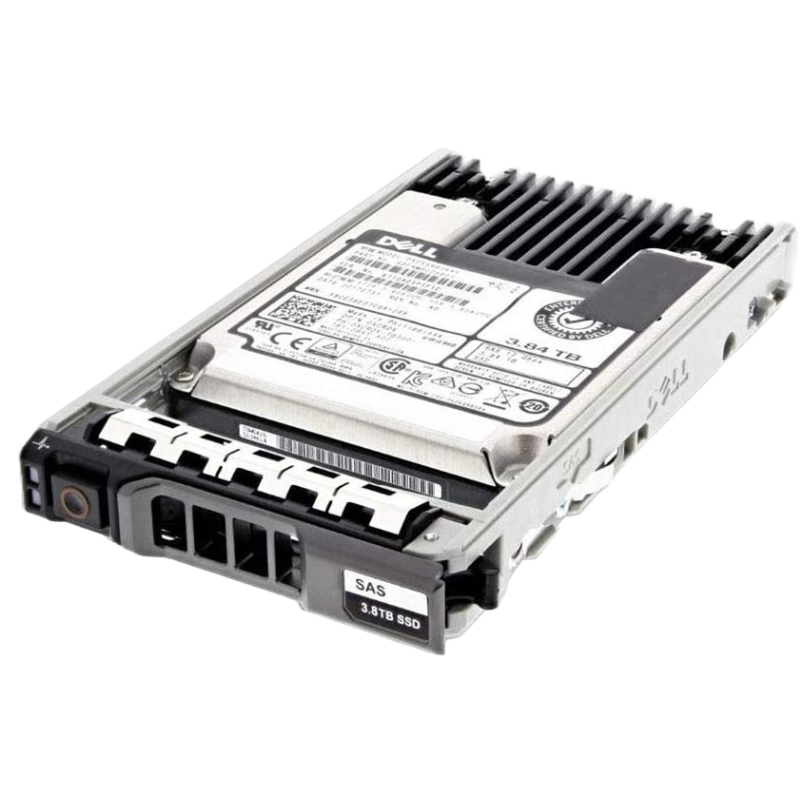
Dell 400-ASWC Hybrid 3.84TB SSD Mixed Use Mlc SAS-12GBPS hot Plug for Server. Excellent Refurbished with 1 year replacement warranty
The Dell 400-ASWC Hybrid 3.84TB SSD is a high-performance mixed-use solid state drive designed for enterprise-grade servers. Engineered with Multi-Level Cell (MLC) NAND technology and a SAS 12Gbps interface, this hot-plug drive ensures superior speed, efficiency, and reliability for demanding business environments.
This Dell mixed-use SSD delivers exceptional performance for enterprise workloads. It ensures reliable storage handling for both read-intensive and write-intensive applications.
The Dell 400-ASWC Hybrid SSD is fully tested and validated for a wide range of Dell PowerEdge platforms, ensuring smooth deployment and optimal performance.
With 3.84TB of storage capacity, this hybrid SSD is tailored for environments requiring large data storage along with consistent performance. The mixed-use MLC design ensures long lifespan under heavy workloads.
The hot-plug feature allows quick drive replacement without shutting down the server, ensuring maximum uptime and smooth IT operations.
Its 2.5-inch drive in a 3.5-inch hybrid carrier ensures compatibility with a wide range of server infrastructures, making it a versatile storage solution.
Being an OEM-certified Dell SSD, the 400-ASWC guarantees seamless integration, advanced reliability, and compatibility with PowerEdge systems.
In the demanding landscape of modern enterprise computing, storage is not merely a component; it is the backbone of performance, reliability, and data integrity. The Dell 400-ASWC Hybrid 3.84TB Solid State Drive (SSD) represents a pinnacle of storage engineering, specifically designed for mixed-use workloads in server environments. This drive is a critical solution for IT administrators and data center managers who require a perfect balance between high-performance read and write operations, exceptional endurance, and unwavering reliability. As part of Dell's esteemed enterprise storage portfolio, the 400-ASWC is engineered to handle the rigorous Input/Output Operations Per Second (IOPS) demands of applications ranging from high-transaction databases and virtualized infrastructures to collaborative hosting environments and data analytics platforms.
This category page delves deep into the specifications, technologies, and ideal use cases for the Dell 400-ASWC Hybrid SSD. We will explore what "Mixed Use" truly means in an enterprise context, the advantages of the Multi-Level Cell (MLC) NAND architecture, the high-speed SAS 12Gbps interface, and the critical feature of hot-pluggability. Understanding these elements is paramount for making an informed decision that aligns with your server's performance requirements and your organization's long-term data strategy.
Unlike consumer-grade SSDs or even enterprise drives labeled as "Read-Intensive" or "Write-Intensive," a "Mixed Use" SSD like the Dell 400-ASWC is built for equilibrium. It is engineered to sustain high performance under a balanced ratio of read and write commands, typically around a 50/50 or 70/30 split. This makes it an exceptionally versatile storage solution for server applications where data is both constantly retrieved and frequently updated.
At the heart of the Dell 400-ASWC's endurance is its use of Multi-Level Cell (MLC) NAND flash memory. While the consumer market has largely moved to Triple-Level Cell (TLC) and Quad-Level Cell (QLC) NAND for higher densities and lower costs, the enterprise sector still relies heavily on MLC for its superior performance and durability, especially in mixed-use scenarios.
MLC NAND stores two bits of data per memory cell. In contrast, TLC stores three bits, and QLC stores four. While storing more bits per cell increases storage density (and lowers cost per gigabyte), it also increases the stress on the cell and reduces its program/erase (P/E) cycle lifespan. The Dell 400-ASWC's MLC NAND offers a significantly higher endurance rating—often by an order of magnitude—compared to TLC-based drives. This directly translates to a longer operational life under heavy write conditions, which is a core requirement for a mixed-use drive.
It is important to note that the MLC used in enterprise drives like the 400-ASWC is often a higher-grade variant, sometimes referred to as eMLC. This NAND is sourced from the highest-quality silicon wafers and is coupled with sophisticated firmware algorithms for wear leveling, bad block management, and error correction. These enhancements further extend the drive's lifespan and data integrity far beyond what is possible with consumer-grade MLC.
The interface connecting the SSD to the server is a critical bottleneck or a highway for data. The Dell 400-ASWC utilizes the Serial Attached SCSI (SAS) interface, specifically the 12 gigabits per second (12Gbps) generation, which is the standard for high-performance enterprise storage.
In a 24/7 data center, server downtime for maintenance is costly and often unacceptable. The "hot-plug" feature of the Dell 400-ASWC SSD is designed specifically to address this need for continuous operation.
For enterprise SSDs, capacity is only one metric; endurance is equally critical. Endurance defines how much data can be written to the drive over its lifetime before the NAND cells begin to wear out. The Dell 400-ASWC 3.84TB model is rated with specific endurance values that justify its mixed-use classification.
The Dell 400-ASWC is not a generic component; it is a Dell-branded drive engineered for seamless integration with Dell's ecosystem, particularly PowerEdge servers. This ensures optimal performance, management, and support.
This SSD is validated and certified to work flawlessly with a wide range of Dell PowerEdge servers, including the Rx40, Rx50, and newer generations. This compatibility guarantees that the drive will be recognized correctly by the system BIOS and iDRAC (Integrated Dell Remote Access Controller).
Data integrity is non-negotiable in an enterprise setting. The Dell 400-ASWC incorporates advanced features to protect data against corruption, especially during unexpected power loss events.
SSDs have volatile cache memory (DRAM) that temporarily holds data before it is written to the non-volatile NAND flash. A sudden power loss can corrupt this data in transit. The 400-ASWC is equipped with a robust Power Loss Protection system. This typically consists of capacitors that store enough electrical charge to power the drive for a few milliseconds after a main power failure. This "hold-up" time allows the drive's controller to complete any ongoing writes from the DRAM cache to the NAND flash, ensuring data consistency.
This feature maintains a checksum or cyclic redundancy check (CRC) for data throughout its journey—from the host system, through the drive's DRAM cache, and finally to the NAND media. If any data corruption is detected at any stage, the drive can correct the error or request a retransmission from the host, guaranteeing the integrity of the stored information.
To fully appreciate the value proposition of the Dell 400-ASWC, it is helpful to compare it to other tiers of enterprise SSDs available in the Dell portfolio.
Read-Intensive (RI) SSDs, often based on TLC NAND, are designed for applications where write operations are infrequent, such as web serving, streaming, and boot drives. They offer a lower cost per gigabyte but have a much lower DWPD rating (often 1 or less). The 400-ASWC, with its higher endurance, is a far safer and more performant choice for any workload with significant write components.
Write-Intensive (WI) SSDs, which often use even more enduring SLC or high-grade MLC, are built for extreme write environments like write caching, logging, and high-frequency trading. They offer the highest DWPD ratings (10+). While the 400-ASWC may not match the extreme write endurance of a WI drive, it provides a more balanced and cost-effective solution for the vast majority of mixed workloads, avoiding the premium price of a WI drive where it is not strictly necessary.


 Contact Us
 Information
 Catalog
 Solid State Drives (SSD)
 Network Switches
 Hard Disk Drives
 HBA & Controllers
 PC & Servers
 PC & Server Memory
 CPU & Processors
 Network Routers
 Power Supplies
 Tape Drives & Libraries
 Network Devices
 Computer & Network Cables