
(7% discount is applied at checkout)
Cart is empty
Your go-to destination for cutting-edge server products
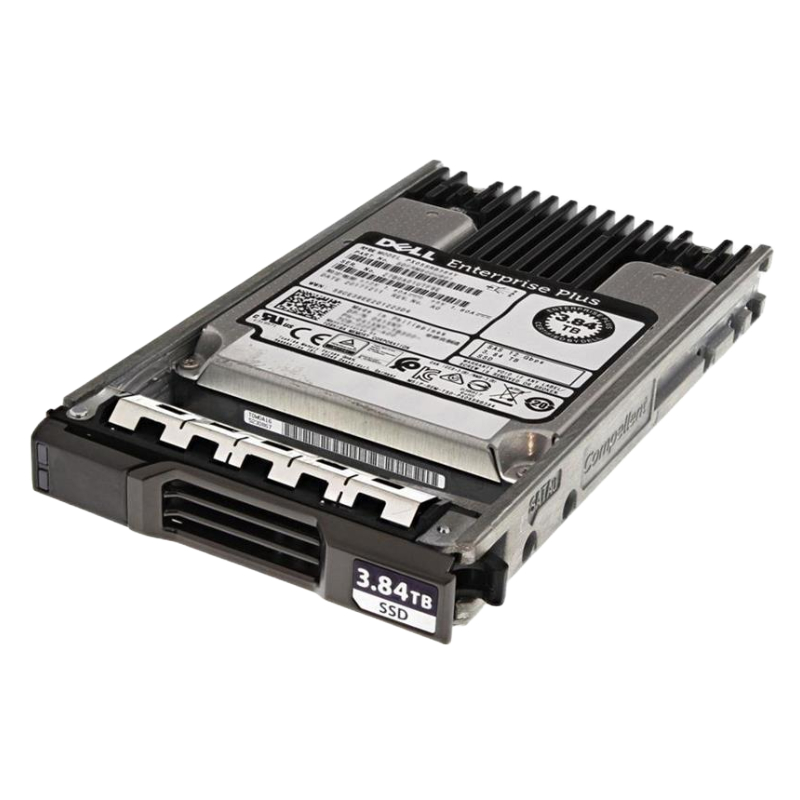
Dell 400-ASZU S4500 Hot Swap DC 3.84TB SATA 6Gbps Series Solid State Drive For Server Read Intensive Triple Level Cell (TLC) Hybrid Carrier. New Sealed in Box (NIB) with 1-Year Replacement Warranty
The Dell 400-ASZU S4500 is a high-capacity, enterprise-grade solid state drive (SSD) designed for data-centre and server environments that require dependable, read-optimized storage. Built in a 2.5-inch flash package mounted in a 3.5-inch hybrid carrier, this hot-swappable drive combines the reliability of 3D NAND TLC flash with a SATA 6Gbps interface for consistent throughput and low-latency data access.
Engineered for read-heavy workloads, the Dell 400-ASZU S4500 offers sustained sequential throughput and strong random read I/O performance—making it ideal for large-scale file serving, caching and analytics platforms where read latency and data availability are critical.
The drive ships as a compact 2.5" flash module mounted inside a 3.5" hybrid carrier, allowing legacy server bays to accept modern high-density SSDs without modifying chassis infrastructure. The hybrid tray ensures compatibility with a wide range of Dell PowerEdge systems while retaining enterprise latch and hot-plug mechanics.
This model is validated for use in numerous Dell PowerEdge servers—ideal for fleet-wide rollouts of standardized storage media.
The Dell 400-ASZU is best suited for environments where read performance, low latency and large capacity matter. Typical deployment scenarios include:
In the demanding landscape of modern data centers, storage is not merely a component; it is the foundation of performance, reliability, and efficiency. The Dell 400-ASZU, part of the esteemed S4500 Series of Solid State Drives, represents a pinnacle of SATA-based storage technology engineered specifically for read-intensive and mixed-use enterprise applications. This 3.84TB model, with its Hot-Swap capability and SATA 6Gbps interface, is designed to deliver consistent, high-quality service levels for a wide array of business-critical workloads, from cloud infrastructure and web hosting to virtualized environments and data analytics.
The Dell S4500 SSD is built upon a foundation of robust 3D TLC (Triple-Level Cell) NAND flash memory. This architectural choice strikes an optimal balance between cost, capacity, and endurance, making it an ideal solution for the target workloads. Unlike consumer-grade SSDs, the S4500 incorporates advanced enterprise features such as power-loss protection (PLP), which safeguards data in the event of an unexpected power failure by ensuring that all data in the volatile cache is written to the non-volatile NAND. This is a critical differentiator for maintaining data integrity in server environments.
At the heart of the S4500 lies a sophisticated controller paired with intelligent firmware. This combination manages essential tasks like wear leveling, which distributes write and erase cycles evenly across all the memory cells to maximize the drive's lifespan. It also handles garbage collection, which reclaims blocks of memory that are no longer in use, and error correction code (ECC), which detects and corrects data errors in real-time. The firmware is tuned for predictable low latency, ensuring that response times remain consistent even under heavy, sustained workloads, a key requirement for enterprise service level agreements (SLAs).
While newer NVMe protocols offer higher peak speeds, the SATA 6Gbps interface remains a workhorse in the data center due to its ubiquity, compatibility, and cost-effectiveness. The Dell S4500 maximizes this interface, delivering sequential read speeds of up to 560MB/s and sequential write speeds of up to 510MB/s. For many read-intensive applications, this level of performance is more than sufficient and provides a significant upgrade from traditional hard disk drives (HDDs) without requiring a complete infrastructure overhaul to NVMe.
Enterprise SSDs are rated for endurance, typically expressed as Total Bytes Written (TBW) or Drive Writes Per Day (DWPD). The 3.84TB capacity point of the Dell S4500 is rated for a substantial TBW, reflecting its ability to handle a significant amount of data written over its lifetime. This makes it suitable not just for purely read-centric tasks but also for mixed-use scenarios where a moderate amount of data writing occurs, such as in database logging, email servers, and collaborative applications.
The performance profile of the Dell S4500 3.84TB SSD makes it an exceptional choice for a specific class of enterprise applications. Its strengths are best utilized in environments where consistent read performance and high capacity are paramount.
In server virtualization, hosting hundreds of virtual machines (VMs) on a single physical host, the boot process for all VMs can create a significant I/O load. Using high-endurance, high-capacity SSDs like the S4500 for storing VM boot images dramatically reduces boot storms and improves overall host responsiveness. The drive's consistent low latency ensures that VM performance remains stable.
Virtual Desktop Infrastructure (VDI) is a classic example of a read-intensive workload. During peak hours, such as the start of the workday, thousands of virtual desktops may boot simultaneously and launch similar applications. The S4500 excels in this "boot storm" scenario, serving up operating system and application files rapidly to ensure a smooth user experience.
Web servers that deliver static content—images, videos, HTML pages, and software downloads—are inherently read-heavy. The large 3.84TB capacity allows a significant amount of content to be cached directly on the server's local storage, reducing latency compared to fetching data from a networked storage array. The high read throughput of the S4500 enables it to serve a large number of concurrent requests efficiently.
Analytics workloads often involve scanning massive datasets to generate reports and insights. While the initial data load is a write-intensive operation, the subsequent querying and analysis are primarily read-oriented. The fast read speeds of the S4500 accelerate data retrieval times, allowing analysts to run complex queries more frequently and obtain results faster, leading to more agile decision-making.
In a tiered storage architecture, the hottest, most frequently accessed data resides on the fastest storage media (like NVMe), while warm data—still important but accessed less often—is placed on a more cost-effective tier. The Dell S4500 is a perfect candidate for a "warm storage" tier. It provides much better performance than hard drives for warm data at a lower cost per gigabyte than high-performance NVMe SSDs, optimizing the overall cost-performance ratio of the storage infrastructure.
Understanding where the S4500 fits requires comparing it to other tiers of storage.
The differences are profound. Consumer SSDs lack power-loss protection, have significantly lower endurance ratings (lower TBW), and are not designed for the constant, heavy workload of a server. Their performance can degrade unpredictably under sustained writes. The S4500 is built from the ground up for 24/7 operation with predictable latency and enhanced data integrity features.
Dell's own portfolio includes write-optimized drives like the S4610 and S4620, which feature higher DWPD ratings. These drives are more expensive and are intended for workloads with extreme write patterns, such as high-frequency transaction processing, write caching, or logging. For many applications, the S4500 provides the perfect balance of endurance and cost for its target workloads.
NVMe drives connected via PCIe offer vastly higher I/O operations per second (IOPS) and lower latency. They are ideal for the most performance-sensitive applications. However, they require specific hardware support (NVMe-capable slots) and are more expensive per gigabyte. The S4500 offers a compelling solution for applications that are well-served by SATA speeds, leveraging existing SATA infrastructure for a lower total cost of ownership.
Integrating the Dell 400-ASZU S4500 into an IT ecosystem is streamlined thanks to Dell's enterprise-focused management tools.
When used in a Dell PowerEdge server, the drive can be monitored and managed through Dell OpenManage systems management. This provides a unified view of server health, including detailed SSD status, SMART (Self-Monitoring, Analysis, and Reporting Technology) attributes, and predictive failure alerts. This proactive monitoring allows IT staff to address potential issues before they impact operations.
The drive reports a comprehensive set of SMART attributes that go beyond consumer-grade drives. These include metrics like media wearout indicator, power-on hours, host read/write counts, and temperature. Monitoring these values over time allows for predictive analysis of drive health, facilitating planned maintenance and reducing unplanned downtime.
Dell backs the S4500 Series with a robust warranty, typically 5 years or a certain TBW threshold, whichever comes first. This warranty reflects the confidence in the drive's design and endurance. The Mean Time Between Failures (MTBF) is rated at an exceptionally high figure, often exceeding 2 million hours, underscoring its reliability for mission-critical deployments.
As a Dell-branded drive, the 400-ASZU is fully validated and tested for compatibility with Dell PowerEdge server families. This ensures seamless integration, optimal performance, and reliable firmware interoperability. Using a validated drive eliminates the risk of compatibility issues that can sometimes arise with third-party drives.
Choosing the Dell S4500 3.84TB SSD is an investment in a storage solution that balances performance, capacity, and endurance. As data continues to grow exponentially, having a reliable, high-capacity SATA SSD tier will remain a crucial part of a holistic data center strategy. Its role in tiered storage, as a boot drive, and for warm data ensures its relevance for years to come, even as newer technologies like NVMe become more prevalent for the hottest data tiers.


 Contact Us
 Information
 Catalog
 Solid State Drives (SSD)
 Network Switches
 Hard Disk Drives
 HBA & Controllers
 PC & Servers
 PC & Server Memory
 CPU & Processors
 Network Routers
 Power Supplies
 Tape Drives & Libraries
 Network Devices
 Computer & Network Cables