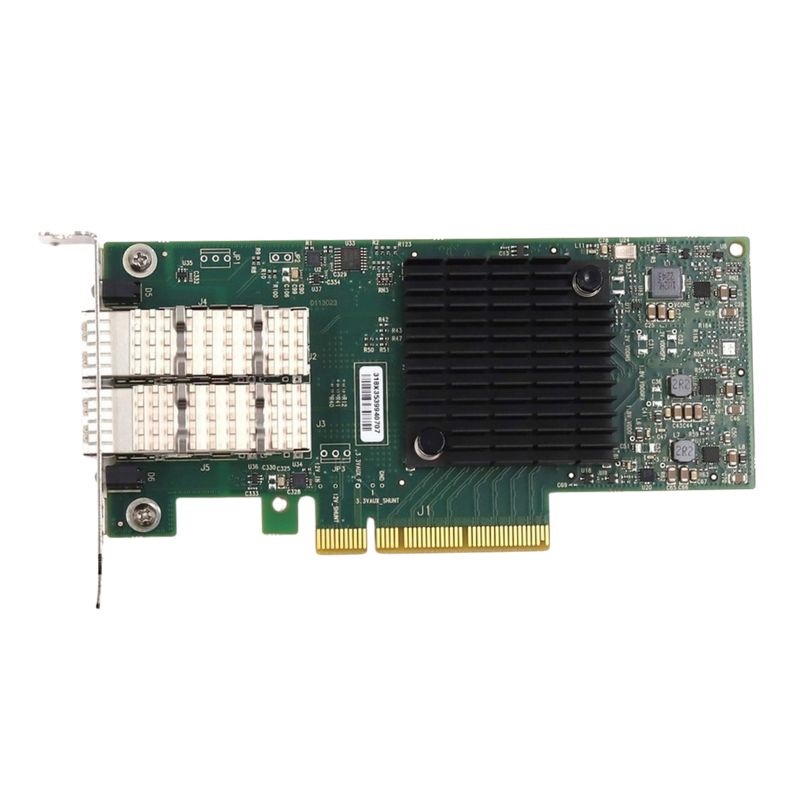
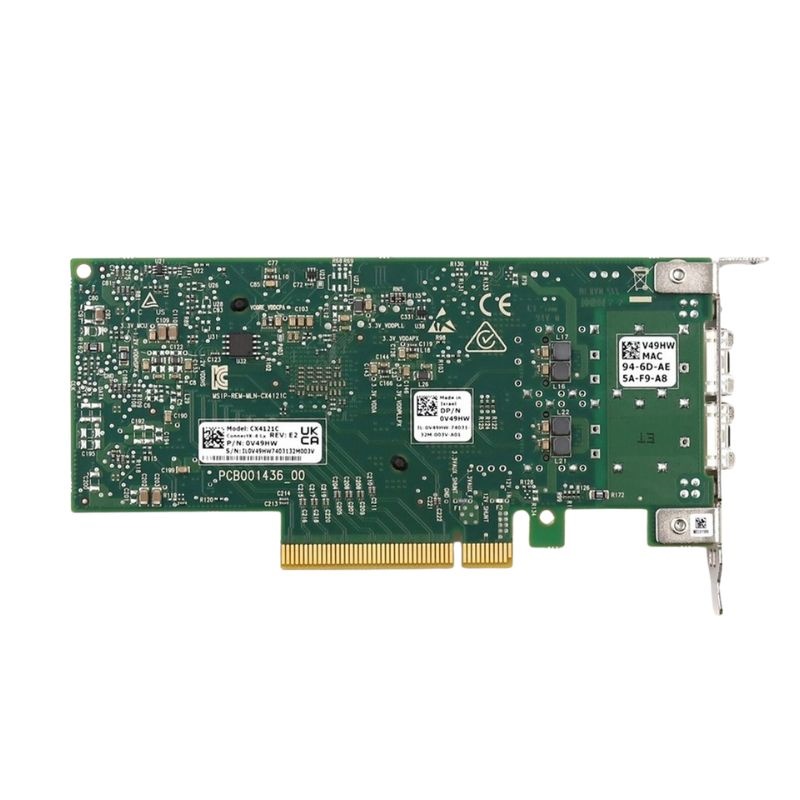
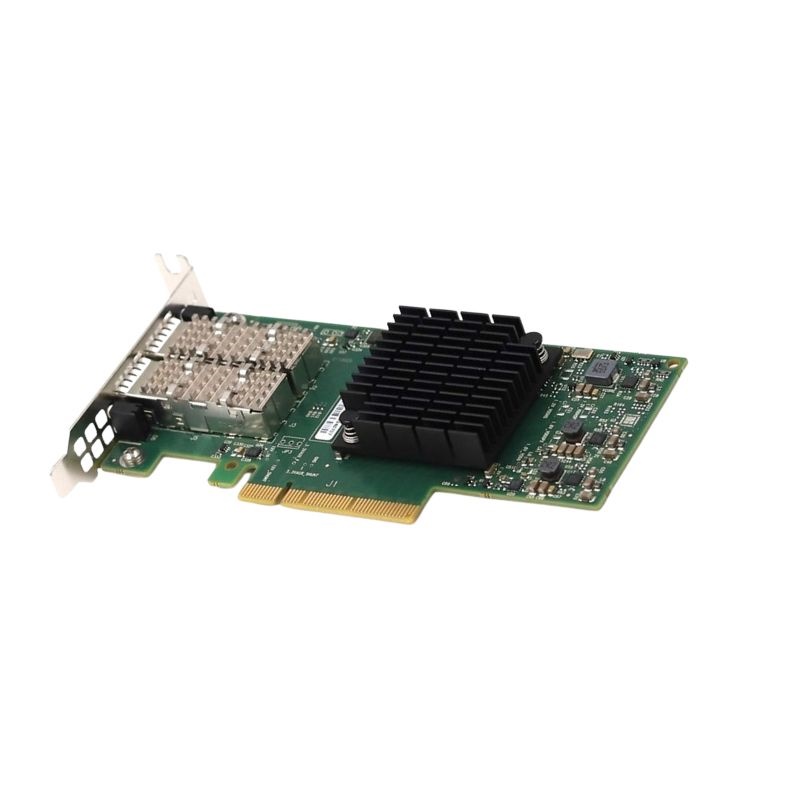
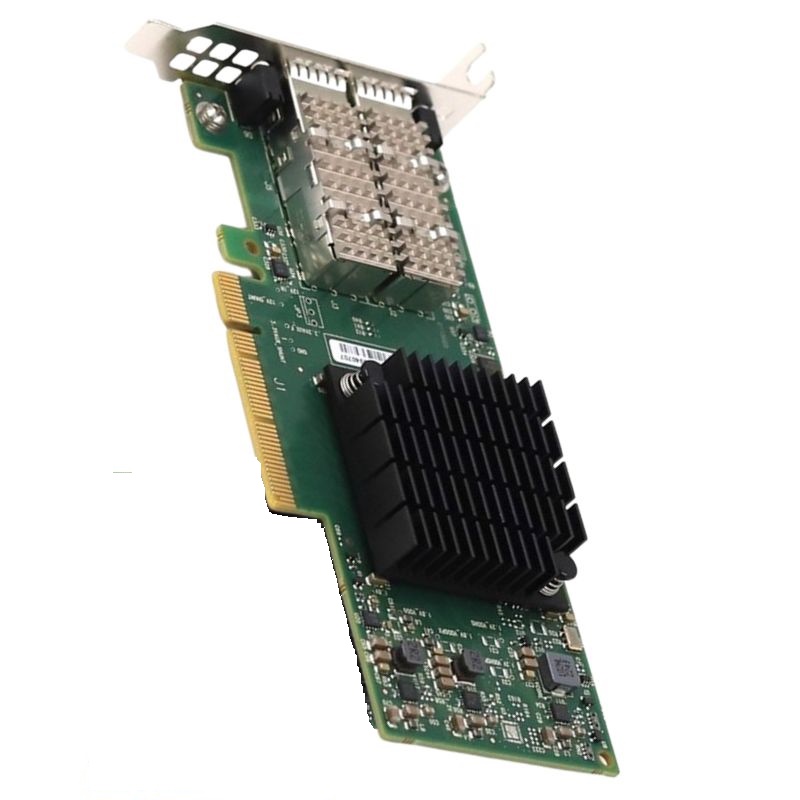
Overview of Dell 540-BDIX Dual-Port Network Adapter
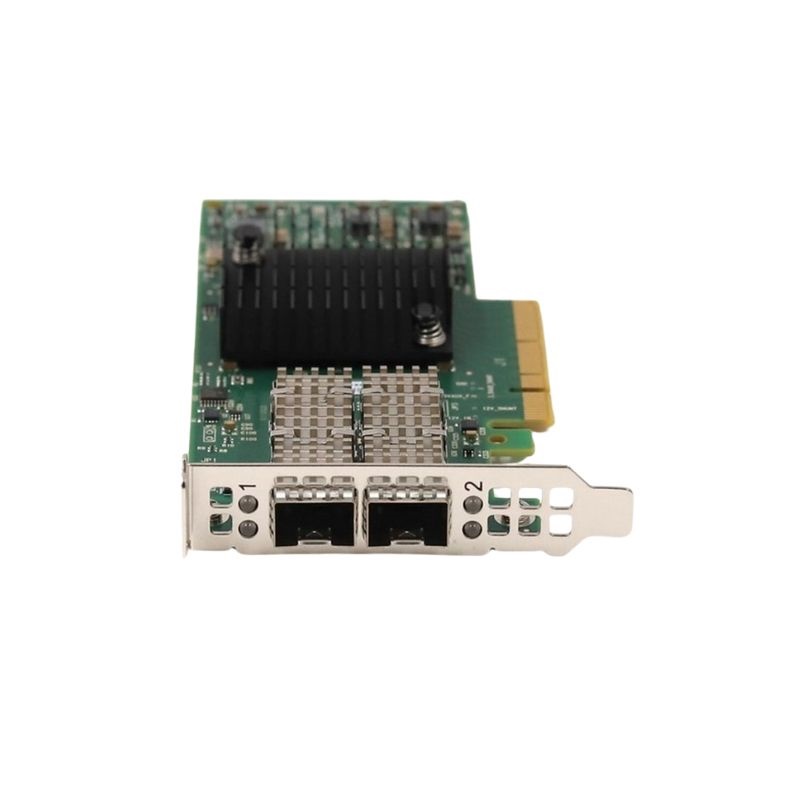
The Dell 540-BDIX Mellanox ConnectX-4 Lx CX4121C is a high-performance dual-port Ethernet adapter built to deliver superior networking speed, flexibility, and scalability for enterprise-grade data centers. Engineered to meet the requirements of cloud infrastructure, virtualization, and storage-intensive workloads, this adapter provides 25 Gigabit Ethernet connectivity, ensuring faster data transfer, lower latency, and consistent throughput. It is designed for Dell servers but remains highly compatible with modern IT environments that demand advanced networking capabilities.
Main Specification
- Brand: Dell
- Part Number: 540-BDIX
- Product Type: 25GbE Network Adapter
Key Features of Dell 540-BDIX 25GbE Dual-Port Adapter
- Dual-port 25GbE connectivity for high bandwidth and redundancy
- Based on Mellanox ConnectX-4 Lx architecture for reliable performance
- Low latency and optimized throughput for heavy workloads
- Supports virtualization technologies such as VMware, Hyper-V, and KVM
- Enhanced scalability for cloud, storage, and enterprise applications
- Energy-efficient design to reduce operational costs
Performance and Reliability Benefits
Designed for mission-critical operations, the Dell 540-BDIX Mellanox CX4121C provides exceptional throughput and minimal packet loss even under heavy network loads. Its dual 25 Gigabit Ethernet ports ensure that large volumes of data are transmitted smoothly, making it suitable for modern applications such as high-performance computing (HPC), big data analytics, AI workloads, and advanced cloud infrastructures.
By offering RDMA over Converged Ethernet (RoCE) support, it reduces CPU utilization and speeds up application performance, creating an environment that is efficient and optimized for real-time data processing.
Technology of Mellanox ConnectX-4 Lx
The Mellanox ConnectX-4 Lx technology integrated into the Dell 540-BDIX ensures consistent networking reliability. It provides advanced congestion control, security enhancements, and excellent scalability for growing data center needs. With dual-port flexibility, organizations can achieve both redundancy and high availability, minimizing downtime and increasing productivity.
Compatibility with Modern Server Environments
Fully optimized for Dell PowerEdge servers, this adapter also integrates seamlessly with a variety of operating systems and hypervisors. Its broad compatibility ensures smooth deployment in different IT landscapes, supporting Linux, Windows Server editions, and virtualization environments.
Enterprise Use Cases and Applications
- Cloud Data Centers: Ensures high scalability and efficiency in multi-tenant environments.
- Virtualization: Provides robust SR-IOV support for VM-to-VM communication and workload optimization.
- Storage Networking: Enhances data access speeds for iSCSI and NVMe over Fabrics protocols.
- High-Performance Computing: Delivers ultra-low latency and superior throughput for HPC workloads.
- Enterprise Applications: Optimized for ERP, CRM, and business intelligence platforms requiring fast data handling.
Technical Specifications
- Product Model: Dell 540-BDIX Mellanox ConnectX-4 Lx CX4121C
- Interface: PCI Express Gen3 x8
- Port Configuration: Dual 25GbE SFP28
- Protocols Supported: TCP/IP, RoCE, iSCSI, NVMe-oF
- Virtualization Support: SR-IOV, Hyper-V, VMware ESXi
- Form Factor: Low-profile adapter with optional full-height bracket
- Power Efficiency: Optimized energy consumption with adaptive cooling
Security and Data Protection
The Dell 540-BDIX comes with advanced hardware-level security features designed to protect sensitive data during transmission. By supporting secure boot and enhanced encryption standards, it ensures network integrity and compliance with enterprise security requirements.
Highlights for IT Administrators
- Reduced CPU overhead through RDMA technology
- Effortless scalability in multi-node environments
- Simple integration with existing Dell server infrastructure
- High availability design with dual-port redundancy
Advantages Over Traditional Network Adapters
Unlike conventional 10GbE adapters, the Dell 540-BDIX Mellanox ConnectX-4 Lx CX4121C doubles bandwidth capacity, providing a future-proof solution for growing data demands. It minimizes network congestion, reduces jitter, and ensures stable connections for business-critical workloads. This makes it a preferred choice for organizations migrating from legacy 10GbE networks to 25GbE infrastructure.
Scalability for the Future
With the rapid evolution of networking requirements, enterprises need a flexible and future-ready adapter. The 540-BDIX dual-port 25GbE card ensures long-term scalability, supporting emerging workloads such as machine learning, IoT integration, and next-generation virtualization platforms.
Key Takeaways
- Superior 25GbE performance with dual-port flexibility
- Based on Mellanox ConnectX-4 Lx CX4121C architecture
- Optimized for virtualization, cloud, storage, and HPC
- High efficiency with reduced CPU utilization
- Secure and reliable networking for enterprise use
In-Depth Outline of Dell 540-BDIX Dual-Port 25GbE Network Adapter
The Dell 540-BDIX, built on the Mellanox ConnectX-4 Lx CX4121C controller, represents a versatile class of dual-port 25 Gigabit Ethernet (25GbE) adapters tailored for modern data center fabrics, virtualization clusters, and high-throughput enterprise workloads. This category combines dependable Dell OEM qualification with Mellanox’s hardware offload engines to deliver consistent low latency, efficient CPU utilization, and simplified network scaling across rack, leaf-spine, and hyperconverged designs. The result is a family of network interface cards (NICs) that thrive in dense servers, cloud-native stacks, and virtualization hosts requiring both performance and predictable operations.
Positioning in the Data Center Networking Landscape
Dual-port 25GbE adapters sit at a strategic sweet spot between 10GbE’s ubiquity and 40/100GbE’s extreme throughput. They allow organizations to:
- Increase per-host bandwidth without the power and cabling complexity of higher-speed optics.
- Consolidate links by moving from multiple 10GbE connections to fewer 25GbE ports.
- Preserve investment through backward compatibility with SFP+ optics for 10GbE where needed.
- Enable RDMA-accelerated fabrics using RoCE to speed up east-west traffic and storage access.
Core Value Proposition of the ConnectX-4 Lx Class
ConnectX-4 Lx hardware is known for its balanced design: strong packet processing, quality offloads, and dependable driver support across mainstream operating systems. For administrators targeting high virtual machine density, microservices traffic, or NVMe-over-Fabrics (NVMe-oF) over TCP/RoCE, this class delivers practical acceleration without exotic tuning.
Hardware Characteristics
While SKU-specific details vary by server generation and OEM packaging, the category shares foundational hardware traits that matter for planning and compatibility.
Dual SFP28 Ports Designed for 25GbE
- Port type: Two SFP28 cages for 25GbE per port.
- Backward compatibility: Supports 10GbE operation with SFP+ modules, easing phased upgrades.
- Cabling flexibility: Works with direct-attach copper (DAC), active optical cables (AOC), and optical transceivers for short-reach and long-reach deployments.
PCI Express and Server Integration
- Bus interface: PCIe 3.0 x8—adequate bandwidth for sustained dual-port 25GbE throughput under real workloads.
- Form factors: Typically available in low-profile and full-height brackets; select SKUs align to Dell server bezels and tool-less carriers.
- Thermals and airflow: Heatsink and airflow alignment optimized for front-to-back chassis cooling common in rack servers.
On-Card Acceleration Engines
- Checksum and segmentation offloads: Offload TCP/UDP checksums and TSO/LRO/GRO to reduce CPU overhead.
- Virtualization offloads: SR-IOV, VMware NetQueue, and advanced queueing/steering for multi-tenant isolation.
- Tunnel offloads: VXLAN, NVGRE, and related encapsulation offloads to sustain overlay performance at scale.
- RDMA over Converged Ethernet (RoCE & RoCE v2): Hardware-level transport that enables ultra-low-latency east-west and storage traffic on lossless or near-lossless fabrics.
Performance and Latency Considerations
Enterprises evaluating this category often focus on not only peak throughput but also tail latencies and consistency under mixed loads.
Deterministic Throughput Under Mixed East-West Loads
The dual-port design helps isolate traffic classes or aggregate them with link-level redundancy. With proper queue configuration, RSS, and pinning strategies, hosts avoid buffer contention even at high packet rates.
Tuning Highlights
- Receive Side Scaling (RSS): Distributes flows across CPU cores to maintain throughput and avoid soft IRQ bottlenecks.
- Interrupt moderation: Adjust coalescing to balance latency and CPU utilization; lower for latency-sensitive microservices, higher for bulk transfers.
- MTU optimization: Jumbo frames (e.g., 9000 bytes) can reduce per-packet overhead for storage and VM migration traffic, when end-to-end support exists.
Latency Under Realistic Virtualization Workloads
SR-IOV and vSwitch offloads substantially reduce virtualization tax. In practice, this can translate to fewer vCPU cycles per packet, smoother p99 latencies, and better consolidation ratios for busy hypervisors.
RoCE for Storage, HPC Lite, and Microservices
RoCE and RoCE v2 are central to why the ConnectX-4 Lx based category is widely adopted in converged networks. By moving transport mechanics into silicon, the NIC accelerates small-message transactions common in storage metadata, distributed caches, and service meshes.
Designing a RoCE-Friendly Fabric
- Priority Flow Control (PFC): Enable on relevant classes to limit packet loss.
- Explicit Congestion Notification (ECN): Use ECN marking and congestion control to avoid head-of-line blocking.
- DSCP and Class-of-Service: Classify storage or RDMA queues to preserve low latency under contention.
- End-to-end visibility: Monitor buffer occupancy and queue depths to validate lossless operation.
Use Cases That Benefit from RoCE
- Hyperconverged storage: RDMA accelerates replication and rebuild tasks.
- Database clustering: Low-latency internode chatter and transaction logs benefit from hardware assist.
- AI/ML pipelines (edge inference): Faster shuffle phases for distributed preprocessing and feature stores.
Virtualization and Cloud-Native Fit
Whether running traditional hypervisors or Kubernetes on bare-metal, this category aims to streamline packet processing and overlay networks.
SR-IOV and Network Slicing
Single Root I/O Virtualization lets you expose Virtual Functions (VFs) directly to guests, providing near-bare-metal network performance while retaining policy control in the host. This is especially helpful in multi-tenant environments, NFV stacks, and high-density VDI.
Best Practices for SR-IOV
- Right-size VF counts: Over-provisioning VFs can complicate interrupt steering and NUMA locality.
- NUMA awareness: Align VFs and queue pairs to the same NUMA node as the workloads.
- Security boundaries: Combine SR-IOV with vSwitch or CNI policies; maintain host-level audit trails.
Overlay and Service Mesh Offloads
VXLAN/NVGRE offloads keep encapsulated traffic efficient, sustaining microservice density even with multiple layers of policy and observability agents. Host CPU cycles stay available for applications rather than packet shims.
Compatibility and Interoperability
Dell-qualified Mellanox adapters are engineered to integrate cleanly with Dell PowerEdge servers and mainstream operating systems.
Operating Systems and Hypervisors
- Linux distributions: Enterprise kernels with in-tree drivers; out-of-tree packages are available when newer features are needed.
- Windows Server: Certified drivers with performance counters and QoS hooks for data-center bridging.
- VMware vSphere/ESXi: Native driver support with SR-IOV and NetQueue optimization, plus vendor add-ons for lifecycle management.
Switching and Optics
- SFP28 ecosystem: Wide compatibility with 25G DACs, AOCs, and optical transceivers from many vendors, subject to platform qualification.
- 10G SFP+ fallback: Enables flexible cabling when migrating from 10G top-of-rack to 25G leaf switches.
- Link training and autonegotiation: Smooth lane alignment and downshift behavior for mixed-speed environments.
Deployment Patterns and Reference Topologies
To get the most out of the Dell 540-BDIX / ConnectX-4 Lx class, map desired outcomes to practical, repeatable designs.
Leaf-Spine at 25GbE to the Host
- Topology: 25GbE from server NICs to 25/100GbE leafs; leaf-to-spine at 100GbE or higher.
- Benefits: Predictable east-west latency, linear scaling, and simplified change control with uniform port speeds.
- Considerations: ECN/PFC consistent across the fabric for RoCE workloads; QoS alignment between endpoints and switches.
Hyperconverged Infrastructure (HCI)
- Use case: Consolidate compute and storage, leveraging RDMA for fast replication and rebuilds.
- Dual-port strategy: Pin one port to storage/data paths and the other to VM/tenant traffic; or bond both for redundancy per class.
- Outcome: Faster node recovery, smoother rebalancing, and better VMotion/Live Migration times.
Edge and Remote Pods
- Drivers: Limited space and power budgets in compact servers require efficient NICs with capable offloads.
- Result: The category’s balanced watt-per-Gb metrics support higher consolidation without thermal penalties.
Security, Isolation, and Governance
Security is a first-order design concern in shared infrastructure. This category supports controls at multiple layers to maintain strong isolation under high load.
NIC-Level Controls
- Traffic steering and filtering: Queue-pair policy, VLAN tagging, and hardware-assisted flow isolation help segment workloads.
- Telemetry and counters: Per-queue statistics and drop counters assist in root-cause analysis and audits.
Platform and Fabric Controls
- DCB and QoS: Enforce lossless priority for RDMA while rate-limiting best-effort classes.
- ACLs and micro-segmentation: Apply policy at the vSwitch/CNI and at the fabric for defense-in-depth.
Management and Observability
Ongoing operations hinge on clear telemetry and reliable update paths.
Lifecycle and Firmware
- Update alignment: Keep NIC firmware, drivers, and OS kernels in tested combinations to avoid regressions.
- Dell management tooling: Integrate with server updates and inventory for consistent fleet-wide baselines.
Capacity Planning and Right-Sizing
Sizing network adapters is about more than summing link speeds. Consider concurrency, packet sizes, and growth trajectories.
From 10GbE to 25GbE
- Bandwidth headroom: 25GbE can often replace multiple 10GbE links, reducing cable count and simplifying LACP design.
- Future-proofing: As CPU cores multiply and east-west traffic grows, 25GbE protects against unexpected bottlenecks.
Dual-Port Economics
- Redundancy: Bonding or independent fabrics prevent single points of failure.
- Segmentation: Dedicated ports per traffic class reduce interference and simplify troubleshooting.
Reliability, Redundancy, and High Availability
Network design must assume partial failures. The dual-port nature enables clean high-availability strategies.
Bonding and Teaming Patterns
- Active/Active: Load-balance flows across both ports for higher aggregate throughput.
- Active/Standby: Keep a hot spare for maintenance windows or fault isolation.
- Per-VLAN/Per-Class: Pin storage vs tenant networks to different ports and fabrics.
Failure Domain Isolation
- Cross-fabric cabling: Connect each port to independent leafs; align with independent ToR power domains.
- Maintenance resilience: Firmware and driver updates can be staggered by port or fabric.
Energy Efficiency and Sustainability
Performance per watt matters in dense racks. This category’s acceleration features reduce CPU wakeups and cycles per packet, trimming overall platform power draw.
Practical Steps
- Right-size coalescing: Fewer interrupts at high packet rates mean lower CPU power states churn.
- Overlay offloads: Free cores for applications instead of encapsulation overhead.
Migrations and Upgrades
Smooth upgrades are as important as peak performance. The 25GbE category excels at staged migrations.
Phased Cabling
- Start with 10GbE optics: Operate the SFP28 ports at 10GbE in mixed racks while leafs are upgraded.
- Transition to 25GbE: Swap optics or DACs and update switch profiles when ready, minimizing downtime.
Driver and Firmware Cohesion
- Golden images: Bake known-good driver/firmware combos into templates for consistent rollouts.
- Canary hosts: Validate new builds on a subset of nodes to catch regressions early.
Best Practices Checklist
- Firmware & drivers: Keep to validated combinations; document versions fleet-wide.
- NUMA alignment: Pin queues and interrupts to local NUMA nodes for high-packet-rate workloads.
- QoS hygiene: Ensure PFC/ECN and DSCP policies match between hosts and switches.
- Telemetry: Track per-queue counters, FEC events, and ECN marks for proactive tuning.
- Jumbo frames: Use end-to-end where compatible for storage and replication paths.
Optics and Cable Guidance
Cabling choices affect cost, reach, and operational simplicity.
Direct-Attach Copper (DAC)
- Pros: Low cost, low power, simple.
- Cons: Limited reach; ensure passive/active support within spec for 25GbE.
Active Optical Cables (AOC)
- Pros: Longer reaches than DAC, straightforward to deploy, reduced EMI concerns.
- Cons: Higher cost than DAC; fixed module and cable as one unit.
SFP28 Optical Transceivers
- Pros: Flexible fiber runs, varied reaches (SR, LR, etc.).
- Cons: Higher initial cost; validate compatibility and DOM monitoring features.
Observability Tooling and Metrics
Visibility accelerates tuning and troubleshooting.
Host-Side Metrics to Watch
- Per-queue drops and errors: Early indicators of saturation or misconfiguration.
- Interrupt and softirq times: Reveal CPU cost per packet and imbalance across cores.
- Latency histograms: p95/p99/p99.9 for critical flows to assess jitter.
Network-Side Metrics
- ECN marks and PFC pauses: Validate congestion behaviors align with expectations.
- FEC and CRC rates: Spot optical or cabling issues before they degrade performance.
Security Considerations in Multi-Tenant Environments
Multi-tenant and regulated environments require granular control and auditability.
Isolation Patterns
- SR-IOV with policy: Combine VF assignment with hypervisor or CNI policy controls for per-tenant boundaries.
- Micro-segmentation: Enforce east-west policies in software and validate with NIC telemetry.
Compliance and Logging
- Immutable logs: Maintain change history for firmware/drivers and QoS policies.
- Flow records: Export flow telemetry for incident response and capacity planning.
Operational Runbooks and Change Control
Repeatable operations reduce risk and speed recovery.
Pre-Change Checklist
- Config snapshot: Save current NIC, driver, and switch configs.
- Staging validation: Test on a canary cluster with synthetic load.
- Rollback plan: Have a known-good driver/firmware bundle ready.
Post-Change Validation
- Link and errors: Verify stable link and clean counters.
- Latency SLOs: Confirm p95/p99 within target bands under load.
- Throughput: Validate expected throughput with representative traffic (small/large packets, overlay on/off).
Scalability and Future Direction
25GbE remains a durable server-edge speed due to its cost-performance ratio and broad ecosystem support.
Interoperability with Faster Fabrics
- Leaf uplinks: 100GbE or faster uplinks avoid oversubscription as you add more 25GbE hosts.
- Fabric services: Keep QoS, telemetry, and automation standardized to add capacity without re-architecture.
Documentation and Knowledge Management
As your environment grows, institutional memory matters as much as hardware choice.
Keep Clear Records
- Version matrices: Track driver/firmware/OS combos that are approved.
- Runbooks: Capture step-by-step procedures for deployment and remediation.
- Postmortems: After incidents, document findings and tuning changes.
Evaluating Alternatives and Adjacent Categories
It’s useful to understand nearby options and why dual-port 25GbE remains compelling.
10GbE Adapters
- Pros: Mature, cost-effective for modest workloads.
- Cons: Can become a bottleneck for consolidated hosts or storage-heavy designs.
40/100GbE Server Adapters
- Pros: High throughput for specialized nodes.
- Cons: Higher optics cost/power; not always necessary for general-purpose hosts.
Dual-Port 25GbE
- Balance: Excellent price/performance with robust offloads and broad ecosystem support.
- Flexibility: Backward-compatible with 10GbE optics/cables.
- Operational simplicity: Fewer cables than aggregating multiple 10GbE, easier scaling than jumping to 100GbE at every host.
Server Fit and Platform Notes
While specifics depend on the platform, Dell-qualified cards are designed to align with OEM server thermals, BIOS, and management tooling.
BIOS and Firmware Considerations
- PCIe slot mapping: Ensure x8 PCIe 3.0 connectivity for full performance.
- Power and thermals: Validate adequate airflow, especially in high-ambient or dust-prone environments.
- Boot support: Where supported, network boot profiles should match desired VLAN/MTU and security policies.
Change Windows and Operational Safety
Plan changes to minimize impact and capture useful data.
Before the Window
- Health baseline: Snapshot counters and latency SLOs.
- Backup configs: Save host network and switch settings.
- Notify stakeholders: Communicate expected risk and rollback plan.
During and After
- Stepwise updates: Update one domain at a time; validate before proceeding.
- Observe telemetry: Watch for abnormal CRC, pause flood, or microburst outcomes.
- Document outcomes: Record lessons learned for future cycles.
KPIs and Success Metrics
Define what “good” looks like for your environment and measure consistently.
Suggested KPIs
- p95/p99 latency: For critical service flows and storage operations.
- CPU cycles per packet: Should trend down with offloads and tuning.
- Packet drops: Zero or near-zero under normal load; bursts analyzed promptly.
- Throughput consistency: Stable across maintenance windows and fabric changes.
Sourcing and Lifecycle Planning
Maintain a predictable supply chain and lifecycle cadence.
Spare Strategy
- Cold spares per row or pod: Reduce time to repair.
- Standardize SKUs: Limit variation to simplify optics and driver management.
End-of-Life Considerations
- Plan refresh: Align NIC lifecycle with server refresh to streamline validation and downtime scheduling.
- Data sanitization: Follow procedures for firmware and config baselines during decommissioning.
Practical Tips from the Field
- Validate optics early: Mix-and-match labs reveal surprises before production.
- Document MTU: MTU mismatches are a common cause of elusive performance problems.
- Treat telemetry as a feature: Invest in dashboards and alerts before you need them.
- Respect NUMA: Queue locality pays dividends at scale.
Glossary of Key Terms
- RoCE: RDMA over Converged Ethernet; a transport leveraging Ethernet for low-latency, low-overhead data movement.
- SR-IOV: Single Root I/O Virtualization; enables slicing a physical NIC into multiple virtual functions for direct assignment to guests.
- VXLAN: Virtual Extensible LAN; an overlay protocol encapsulating L2 frames over L3 networks.
- PFC: Priority Flow Control; IEEE 802.1Qbb mechanism to pause traffic selectively by priority.
- ECN: Explicit Congestion Notification; signals congestion without dropping packets.





 Contact Us
 Information
 Catalog
 Solid State Drives (SSD)
 Network Switches
 Hard Disk Drives
 HBA & Controllers
 PC & Servers
 PC & Server Memory
 CPU & Processors
 Network Routers
 Power Supplies
 Tape Drives & Libraries
 Network Devices
 Computer & Network Cables