
(7% discount is applied at checkout)
Cart is empty
Your go-to destination for cutting-edge server products
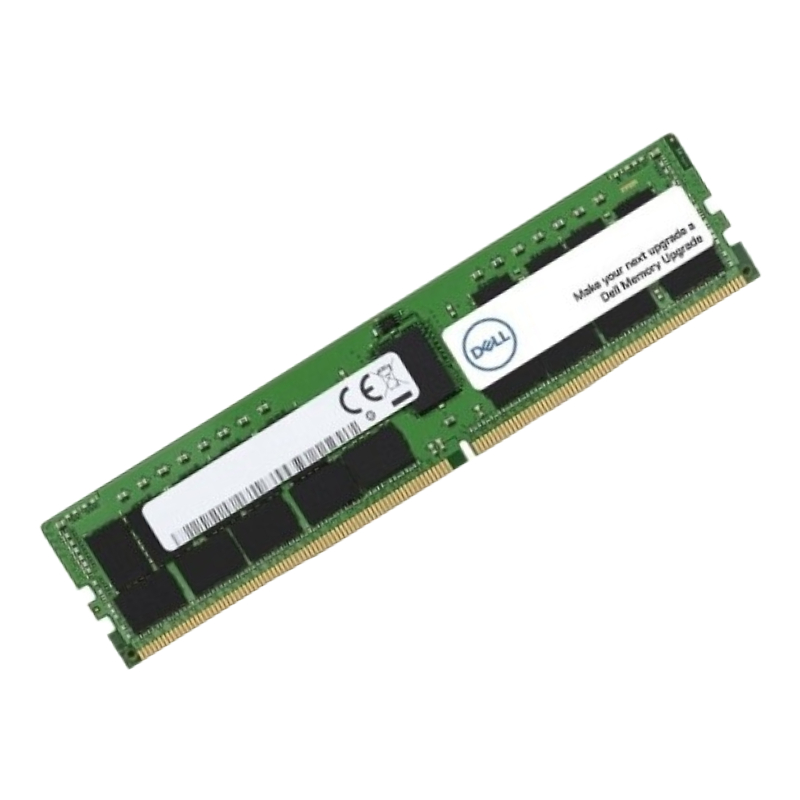
Dell 370-BBRN 64GB PC5-44800 DDR5 5600MT/S 2RX4 ECC Registered 1.1V CL46 SDRAM 288-Pin RDIMM Module Memory. New Sealed in Box (NIB) - Samsung Version
| SKU/MPN | Warranty | Price | Condition | You save |
|---|---|---|---|---|
| 370-BBRN | 1 Year Warranty | $3,446.00 | New Sealed in Box (NIB) | You save: $1,206.10 (26%) |
| 370-BBRN | 1 Year Warranty | $2,688.00 | New (System) Pull | You save: $940.80 (26%) |
Dell 370-BBRN 64GB DDR5 5600MT/s PC5-44800 Memory Module
Boost server performance with the Dell 370-BBRN 64GB DDR5 SDRAM memory module. Engineered for enterprise workloads, this registered DIMM delivers high-speed data transfer, advanced error correction, and reliable scalability for mission-critical applications.
This Dell DDR5 memory module is validated for a wide range of Dell PowerEdge servers, ensuring seamless integration and dependable performance.
In the realm of enterprise computing, server memory represents one of the most critical components determining overall system performance, stability, and scalability. The Dell 370-BBRN 64GB DDR5 RDIMM module exemplifies the cutting-edge of server memory technology, engineered specifically for demanding workloads in data-intensive environments. This category encompasses memory solutions designed not for consumer PCs, but for robust server platforms where error-free operation and maximum uptime are non-negotiable requirements.
The transition from DDR4 to DDR5 technology marks the most significant advancement in memory architecture in nearly a decade. DDR5 modules like the Dell 370-BBRN operate at fundamental voltage of 1.1V, a reduction from DDR4's 1.2V, enabling substantial power savings that compound significantly across an entire server rack or data center. Beyond power efficiency, DDR5 introduces a revolutionary feature: the partitioning of the memory channel into two independent 32-bit sub-channels. This architectural shift, combined with dramatically increased data rates, allows for a massive uplift in concurrent data access and overall bandwidth.
DDR5 memory isn't merely an incremental speed boost. It incorporates foundational changes to how data is handled. The onboard Power Management IC (PMIC) distributes power more efficiently across the DIMM, improving signal integrity and stability. Furthermore, Burst Length is doubled, and Bank Groups are increased, allowing for more operations to be performed in parallel. These technical enhancements translate directly to real-world performance in applications ranging from in-memory databases and AI model training to high-frequency transaction processing and large-scale virtualization.
The part number "Dell 370-BBRN" and its technical specification "64GB PC5-44800 DDR5 5600MT/S 2RX4 ECC Registered 1.1V CL46" provide a complete blueprint of the module's capabilities. Understanding this nomenclature is key to selecting the right memory for your server infrastructure.
With a substantial 64GB capacity per module, this memory allows modern servers to address vast datasets directly in RAM, drastically reducing latency associated with fetching data from slower storage media. The "PC5-44800" and "5600MT/S" designations are interlinked. PC5-44800 refers to the module's theoretical peak bandwidth of approximately 44,800 MB/s, while 5600 Megatransfers per Second (MT/s) defines the data rate of the I/O bus. This high data rate ensures that the processor is fed with data at an exceptionally fast pace, preventing bottlenecks in computation-heavy tasks.
The "2RX4" designation is crucial for understanding the module's internal architecture and its compatibility with server memory controllers. "Dual Rank" (2R) means the DIMM has two sets of memory chips that can be accessed independently, though not simultaneously. This allows the memory controller to perform operations on one rank while preparing the other, effectively hiding some of the access latency and improving efficiency. The "x4" refers to the data width of the individual DRAM chips, indicating they have a 4-bit interface. x4 organization is particularly beneficial in servers as it optimizes the use of the Chipkill feature, a more robust form of error correction, by spreading the bits of an ECC word across more chips.
When populating a server, the number of ranks per channel is a critical consideration for both performance and compatibility. Most modern server processors have a limit on the total number of ranks they can support per memory channel. Dual-rank modules like the 370-BBRN offer an excellent balance of capacity, performance, and compatibility, often allowing for a full slot population while remaining within the controller's specifications, unlike quad-rank modules which may limit the number of DIMMs you can install per channel.
For enterprise and data center applications, data integrity is paramount. The Dell 370-BBRN incorporates two key technologies to ensure this: ECC and Registered design.
ECC memory includes extra bits (e.g., 8 bits for a 64-bit word) to store an encrypted code. As data is written to memory, the code is calculated and stored. When the data is read, the code is recalculated and compared to the stored code. If a single-bit error is detected, the ECC circuitry corrects it instantly and transparently to the operating system. This prevents silent data corruption, which can lead to application crashes, corrupted databases, or incorrect scientific calculations. In environments where 24/7/365 operation is required, ECC is not a luxury; it is a necessity.
The "Registered" in this module's description indicates the presence of a register, or buffer, placed between the server's memory controller and the DRAM chips. This register buffers the command and address signals, reducing the electrical load on the memory controller. This allows a server to support a much greater number of memory modules and higher capacities than would be possible with unbuffered (UDIMM) memory. While the register introduces a minimal one-clock-cycle latency penalty, the benefit of vastly increased memory capacity and stability in multi-DIMM configurations is indispensable for scalable server systems.
It's important to distinguish RDIMMs from Load-Reduced DIMMs (LRDIMMs). While RDIMMs buffer only the command/address lines, LRDIMMs use a buffer on the data lines as well, further reducing the electrical load. LRDIMMs are typically used for the very highest capacity modules (e.g., 128GB+). For a 64GB density, an RDIMM like the 370-BBRN often provides the optimal balance of performance, power consumption, and cost.
The Dell 370-BBRN is not a universal memory module; it is engineered for specific generations of Dell PowerEdge servers and similar enterprise platforms that support DDR5 technology.
This module is designed for servers powered by Intel Xeon Scalable Processors (4th Gen "Sapphire Rapids" and newer) and the compatible AMD EPYC platforms that utilize DDR5 RDIMMs. It is crucial to consult the specific technical guide or memory configuration tool for your server model (e.g., Dell PowerEdge R760, R660, R760xa, etc.) to verify compatibility before purchase. Using a module not on the official Qualified Vendor List (QVL) can lead to system instability or failure to boot.
To achieve optimal performance, servers should be populated with memory modules in a specific order and configuration, typically outlined in the server's owner's manual. Most modern servers require installing DIMMs in pairs per CPU to leverage multi-channel architectures (e.g., 8 channels per CPU). For best performance, it is recommended to use identical modules (same part number, capacity, speed, and rank) across all slots.
The high bandwidth and large capacity of the Dell 370-BBRN make it ideally suited for a wide array of demanding enterprise workloads.
Platforms like SAP HANA, Oracle Database In-Memory, and various real-time analytics engines store entire datasets in RAM. The 64GB capacity and high bandwidth of this module allow for faster query processing and real-time business intelligence, enabling companies to make data-driven decisions instantaneously.
AI and ML training workloads involve processing enormous matrices of data. The speed of DDR5 memory is critical for quickly feeding the training data to GPUs and CPUs, reducing the time required to develop and iterate on complex models. The ECC protection is also vital to ensure the integrity of long-running training jobs that could be invalidated by a single-bit error.
Server consolidation through virtualization is a cornerstone of modern IT. Each virtual machine requires a dedicated portion of physical memory. The large 64GB density allows a single server to host a greater number of VMs or more powerful VMs with large memory allocations, improving consolidation ratios and maximizing ROI on hardware investments. The reliability features ensure that a memory error in one VM does not crash the entire physical host.
In financial services, telecommunications, and e-commerce, systems must process thousands of transactions per second. The low latency and high throughput of DDR5 memory ensure that these transaction-oriented databases and applications can operate at peak efficiency, maintaining responsiveness during peak load periods.
Choosing the right memory for your server deployment requires careful consideration beyond just capacity and speed.
While it is technically possible to mix memory modules of different speeds or capacities, it is strongly discouraged. When mixed, all modules in a channel will operate at the speed and timings of the slowest DIMM present. This can significantly degrade the performance of higher-specification modules. For a homogeneous and predictable system, use identical memory modules across the entire server.
There is often a trade-off between the total memory capacity and the achievable memory speed. Populating all available memory slots, especially with high-rank or high-density DIMMs, can sometimes force the system to run the memory at a lower speed than its maximum rated speed to maintain signal integrity. Server BIOS/UEFI setups will typically apply the optimal speed based on the installed configuration. Consulting the server's memory population guidelines is essential to plan a configuration that meets both your capacity and performance requirements.
Server manufacturers regularly release firmware and BIOS updates that can improve memory compatibility, performance, and stability. Before deploying new memory modules, ensure your server's BIOS is updated to the latest version. This can often resolve issues with memory detection or enable support for higher memory speeds.
Using genuine Dell memory, such as the 370-BBRN, guarantees compatibility and reliability. These modules are rigorously tested and validated on Dell hardware and are backed by Dell's technical support and warranty. While third-party modules may be available at a lower cost, they can carry a higher risk of compatibility issues, system instability, and may not be supported by Dell if they are implicated in a system failure. The investment in genuine components is an investment in the long-term stability and supportability of your critical server infrastructure.
The DDR5 specification defines speeds well beyond the 5600MT/s of this module. Speeds of 6400MT/s, 7200MT/s, and even higher are on the roadmap. Future iterations of servers and CPUs will natively support these higher speeds, providing continued bandwidth scaling to feed ever-more-powerful processors.
A revolutionary technology, CXL, is set to transform server architecture. CXL is a high-speed interconnect that allows for memory pooling and expansion. This means that memory is no longer physically and logically tied to a single CPU. With CXL, servers can dynamically share and access large pools of memory, leading to unprecedented levels of resource utilization and flexibility, potentially changing how we think about and purchase server memory in the future.
The concept of memory tiering, combining different types of memory (e.g., fast DRAM with higher-capacity, slightly slower CXL-attached memory or Persistent Memory), is gaining traction. This allows for cost-effective scaling of memory capacity for workloads that are less latency-sensitive, while still keeping the most critical data in the fastest tier, as exemplified by the high-performance Dell 370-BBRN DDR5 RDIMM.


 Contact Us
 Information
 Catalog
 Solid State Drives (SSD)
 Network Switches
 Hard Disk Drives
 HBA & Controllers
 PC & Servers
 PC & Server Memory
 CPU & Processors
 Network Routers
 Power Supplies
 Tape Drives & Libraries
 Network Devices
 Computer & Network Cables